Recognition: no theorem link
The HAges Catalog: Stellar Ages for High Priority HWO Target Stars
Pith reviewed 2026-05-14 20:08 UTC · model grok-4.3
The pith
A catalog compiles published stellar ages for 659 high-priority Habitable Worlds Observatory targets using asteroseismology and gyrochronology.
A machine-rendered reading of the paper's core claim, the machinery that carries it, and where it could break.
Core claim
The HAges Catalog compiles published ages derived from asteroseismology and gyrochronology for the 659 Tier 1 and Tier 2 stars in the HWO TSS25 target list. Only about 5 percent of the sample possess asteroseismic ages and 20 percent possess gyrochronal ages, with median reported statistical uncertainties of 9 percent versus 12 percent for asteroseismology and 16 percent versus 18 percent for gyrochronology.
What carries the argument
The HAges Catalog, a compilation of literature ages from asteroseismology and gyrochronology for HWO target stars.
If this is right
- The catalog supplies ages that can immediately support target prioritization and constraints on planetary interior evolution for HWO observations.
- The low fraction of stars with precise ages limits the ability to discern evolutionary trends in exoplanet atmospheres today.
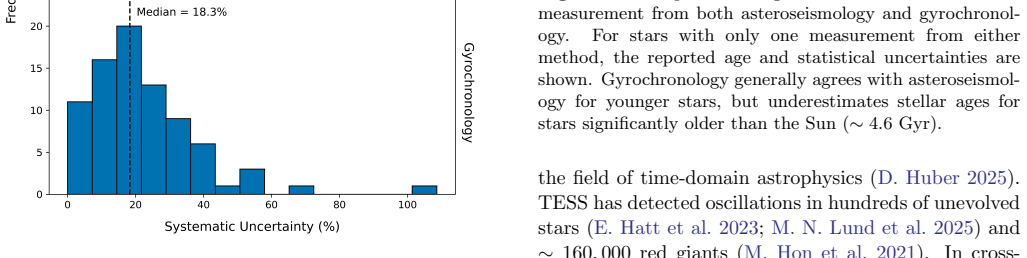
- Statistical uncertainties in the compiled ages are slightly smaller than systematic uncertainties, indicating that systematic effects dominate the error budget.
- Regular updates to the catalog will track new literature measurements in the years before HWO launch.
Where Pith is reading between the lines
- Extending the same literature-compilation approach to additional age indicators such as isochrone fitting could raise the fraction of stars with usable ages.
- Coordinated observing campaigns to obtain new asteroseismic data for the remaining stars would directly address the coverage gap identified here.
- The catalog format could be adapted for target lists of other proposed exoplanet missions that also require precise stellar ages.
Load-bearing premise
The ages taken from published literature using asteroseismology and gyrochronology are accurate and unbiased enough for the selected stars that uncertainties remain low enough to reveal evolutionary trends in exoplanet atmospheres.
What would settle it
New independent age measurements for even a modest subset of the catalog stars that differ from the compiled values by more than 20 percent would show that the catalog ages are not yet reliable for the intended science.
Figures


read the original abstract
Precise stellar ages (uncertainties $\lesssim 1$ Gyr, or $\sim 20\%$ at solar age) are required to discern evolutionary trends in atmospheric biosignatures of terrestrial habitable zone exoplanets surveyed by the Habitable Worlds Observatory (HWO) and will aid in constraining planetary interior evolution and target prioritization. We present a catalog of stellar ages for Tier 1 and Tier 2 targets in the HWO Target Stars and Systems (TSS) sub-working group's TSS25 list, compiling published literature ages derived from high-precision methods. The sample comprises 659 stars likely to be observed by HWO, independent of the final mission architecture. This initial catalog focuses on asteroseismology and gyrochronology, which can achieve $\sim 20\%$ precision for the majority of these stars. We find that only $\sim 5\%$ of the sample have asteroseismic ages and $\sim 20\%$ have gyrochronal ages, with just $\sim 2\%$ having constraints from both methods. For stars with multiple published measurements, the median reported statistical uncertainties are slightly smaller than the systematic uncertainties: $\sim 9\%$ versus $\sim 12\%$ for asteroseismology and $\sim 16\%$ versus $\sim 18\%$ for gyrochronology. The scarcity of precise stellar ages in this sample highlights the need for a concerted effort to obtain robust age constraints in advance of HWO; this catalog is intended as a living resource that will be regularly updated in the lead-up to the mission.
Editorial analysis
A structured set of objections, weighed in public.
Referee Report
Summary. The manuscript presents the HAges catalog compiling published literature ages from asteroseismology and gyrochronology for 659 Tier 1 and Tier 2 stars drawn from the HWO TSS25 target list. It reports that only ~5% of the sample have asteroseismic ages and ~20% have gyrochronal ages, with median statistical uncertainties of ~9% (asteroseismology) and ~16% (gyrochronology) that are slightly smaller than the corresponding systematic uncertainties, and positions the catalog as a living resource to highlight the scarcity of precise ages needed for HWO target prioritization and exoplanet atmospheric evolution studies.
Significance. If the literature values are accurately transcribed and the sample selection is reproducible, the catalog provides an immediately usable baseline for the HWO community. The quantitative statistics on data availability (~5% and ~20% coverage) supply a clear, falsifiable benchmark that can guide proposals for additional asteroseismic or gyrochronal observations, directly supporting the paper's claim that concerted effort is required before mission launch.
major comments (2)
- [§2] §2 (sample construction): The exact cross-matching procedure and any quality cuts applied to arrive at the final 659 stars from the TSS25 list are not specified; this is load-bearing for reproducibility because the central scarcity statistics depend on which stars were included or excluded.
- [§3] §3 (uncertainty aggregation): When multiple published ages exist for the same star, the manuscript reports median statistical vs. systematic uncertainties but does not state the aggregation rule (e.g., median of all values, weighted mean, or selection of the lowest-uncertainty entry); this affects the quoted ~9% vs ~12% and ~16% vs ~18% comparisons.
minor comments (2)
- [Abstract] Abstract: the phrase 'can achieve ~20% precision for the majority of these stars' refers to the methods in general rather than the current sample coverage; a brief clarification would avoid reader confusion with the reported 5%/20% fractions.
- [Introduction] References: the TSS25 list definition and any prior HWO target papers should be cited explicitly in the introduction to allow readers to trace the parent sample.
Simulated Author's Rebuttal
We thank the referee for their constructive comments and recommendation for minor revision. We address the two major comments point by point below and will revise the manuscript to enhance reproducibility and clarity.
read point-by-point responses
-
Referee: [§2] §2 (sample construction): The exact cross-matching procedure and any quality cuts applied to arrive at the final 659 stars from the TSS25 list are not specified; this is load-bearing for reproducibility because the central scarcity statistics depend on which stars were included or excluded.
Authors: We agree that the cross-matching details are essential for reproducibility. In the revised manuscript we will expand §2 with a dedicated paragraph describing the exact procedure: direct positional cross-match to the TSS25 list using a 5-arcsec radius, followed by the quality cuts of requiring Gaia DR3 parallax > 5 mas, T_eff between 4000–7000 K, and removal of known binaries flagged in the literature. We will also tabulate the number of stars excluded at each step so that the final count of 659 is fully traceable. revision: yes
-
Referee: [§3] §3 (uncertainty aggregation): When multiple published ages exist for the same star, the manuscript reports median statistical vs. systematic uncertainties but does not state the aggregation rule (e.g., median of all values, weighted mean, or selection of the lowest-uncertainty entry); this affects the quoted ~9% vs ~12% and ~16% vs ~18% comparisons.
Authors: We thank the referee for highlighting this omission. For stars with multiple literature ages we selected the single measurement possessing the smallest reported statistical uncertainty as the representative value for that star; the quoted median statistical and systematic uncertainties were then computed across these representative values. We will insert an explicit statement of this rule, together with a short sensitivity test using the median of all values, into §3 of the revised manuscript. revision: yes
Circularity Check
No significant circularity detected
full rationale
The paper is a straightforward compilation of published stellar ages drawn from external literature for a pre-defined target list of 659 stars. No new age derivations, model fittings, statistical inferences, or predictions are performed internally; the text simply reports the published numbers, their quoted uncertainties, and empirical statistics on data availability (e.g., ~5% asteroseismic, ~20% gyrochronal). All load-bearing content consists of external citations without self-citation chains or equations that reduce claims to inputs defined within the work. The central claim—the delivery of the catalog—is self-contained against external benchmarks.
Axiom & Free-Parameter Ledger
Reference graph
Works this paper leans on
-
[1]
2015, MNRAS, 450, 1787, doi: 10.1093/mnras/stv423
Angus, R., Aigrain, S., Foreman-Mackey, D., & McQuillan, A. 2015, MNRAS, 450, 1787, doi: 10.1093/mnras/stv423
-
[2]
Angus, R., Beane, A., Price-Whelan, A. M., et al. 2020, AJ, 160, 90, doi: 10.3847/1538-3881/ab91b2 Astropy Collaboration, Robitaille, T. P., Tollerud, E. J., et al. 2013, A&A, 558, A33, doi: 10.1051/0004-6361/201322068 Astropy Collaboration, Price-Whelan, A. M., Sip˝ ocz, B. M., et al. 2018, AJ, 156, 123, doi: 10.3847/1538-3881/aabc4f Astropy Collaboratio...
-
[3]
1996, ApJL, 457, L99, doi: 10.1086/309891
Baliunas, S., Sokoloff, D., & Soon, W. 1996, ApJL, 457, L99, doi: 10.1086/309891
-
[4]
Barnes, S. A. 2007, ApJ, 669, 1167, doi: 10.1086/519295
-
[5]
2020, A&A, 635, A26, doi: 10.1051/0004-6361/201935565
Bazot, M. 2020, A&A, 635, A26, doi: 10.1051/0004-6361/201935565
-
[6]
Bazot, M., Bourguignon, S., & Christensen-Dalsgaard, J. 2012, MNRAS, 427, 1847, doi: 10.1111/j.1365-2966.2012.21818.x
-
[7]
2016, MNRAS, 460, 1254, doi: 10.1093/mnras/stw921 13
Benomar, O. 2016, MNRAS, 460, 1254, doi: 10.1093/mnras/stw921 13
-
[8]
Bellinger, E. P., Angelou, G. C., Hekker, S., et al. 2016, ApJ, 830, 31, doi: 10.3847/0004-637X/830/1/31
-
[9]
2020, ApJ, 896, 131, doi: 10.3847/1538-4357/ab8fad
Bixel, A., & Apai, D. 2020, ApJ, 896, 131, doi: 10.3847/1538-4357/ab8fad
-
[10]
2022, A&A, 663, A144, doi: 10.1051/0004-6361/202140510
Bonavita, M., Gratton, R., Desidera, S., et al. 2022, A&A, 663, A144, doi: 10.1051/0004-6361/202140510
-
[11]
The Astrophysical Journal Letters , author =
Bouma, L. G., Palumbo, E. K., & Hillenbrand, L. A. 2023, ApJL, 947, L3, doi: 10.3847/2041-8213/acc589
-
[12]
The TESS All-Sky Rotation Survey: Periods for 1,046,317 Stars Within 500 pc
Boyle, A. W., Bouma, L. G., & Mann, A. W. 2026, The TESS All-Sky Rotation Survey: Periods for 944,056 Stars Within 500 pc, https://arxiv.org/abs/2603.05586
work page internal anchor Pith review Pith/arXiv arXiv 2026
-
[13]
Boyle, A. W., Mann, A. W., & Bush, J. 2025, ApJ, 985, 233, doi: 10.3847/1538-4357/adcecc Brand˜ ao, I. M., Do˘ gan, G., Christensen-Dalsgaard, J., et al. 2011, A&A, 527, A37, doi: 10.1051/0004-6361/201015370
-
[14]
Brandenburg, A., & Giampapa, M. S. 2018, ApJL, 855, L22, doi: 10.3847/2041-8213/aab20a
-
[15]
Brandenburg, A., Mathur, S., & Metcalfe, T. S. 2017, ApJ, 845, 79, doi: 10.3847/1538-4357/aa7cfa
-
[16]
Breton, S. N., Lanza, A. F., Messina, S., et al. 2024, A&A, 689, A229, doi: 10.1051/0004-6361/202449893
-
[17]
2005, A&A, 434, 1085, doi: 10.1051/0004-6361:20042140
Carrier, F., Eggenberger, P., & Bouchy, F. 2005, A&A, 434, 1085, doi: 10.1051/0004-6361:20042140
-
[18]
Casella, G., & Berger, R. L. 2024, Statistical Inference, 2nd edn., Texts in Statistical Science (Chapman and Hall/CRC)
2024
-
[19]
2024, ads: A Python client for the SAO/NASA Astrophysics Data System, 0.12.7 GitHub
Casey, A., & contributors. 2024, ads: A Python client for the SAO/NASA Astrophysics Data System, 0.12.7 GitHub. https://github.com/andycasey/ads
2024
-
[20]
2021, MNRAS, 505, 2151, doi: 10.1093/mnras/stab1410
Castro, M., Baudin, F., Benomar, O., et al. 2021, MNRAS, 505, 2151, doi: 10.1093/mnras/stab1410
-
[21]
Chaplin, W. J., & Miglio, A. 2013, ARA&A, 51, 353, doi: 10.1146/annurev-astro-082812-140938
-
[22]
Chontos, A., Huber, D., Berger, T. A., et al. 2021, ApJ, 922, 229, doi: 10.3847/1538-4357/ac1269 Cort´ es-Zuleta, P., Boisse, I., Klein, B., et al. 2023, A&A, 673, A14, doi: 10.1051/0004-6361/202245131 Cort´ es-Zuleta, P., Boisse, I., Ould-Elhkim, M., et al. 2025, A&A, 693, A164, doi: 10.1051/0004-6361/202451646
-
[23]
Creevey, O. L., Metcalfe, T. S., Schultheis, M., et al. 2017, A&A, 601, A67, doi: 10.1051/0004-6361/201629496
-
[24]
Curtis, J. L., Ag¨ ueros, M. A., Matt, S. P., et al. 2020, ApJ, 904, 140, doi: 10.3847/1538-4357/abbf58 da Silva, R., Porto de Mello, G. F., Milone, A. C., et al. 2012, A&A, 542, A84, doi: 10.1051/0004-6361/201118751 De Amorim, R. G. S. B., Martins, B. L. C., Fontinele, D. O., et al. 2026, ApJ, 997, 236, doi: 10.3847/1538-4357/ae2adb
-
[25]
Holdsworth, D. L. 2021, A&A, 650, A125, doi: 10.1051/0004-6361/202040234
-
[26]
Delorme, P., Collier Cameron, A., Hebb, L., et al. 2011, MNRAS, 413, 2218, doi: 10.1111/j.1365-2966.2011.18299.x
-
[27]
2023, A&A, 680, A64, doi: 10.1051/0004-6361/202346863 do Nascimento, Jr., J.-D., Vidotto, A
Desgrange, C., Milli, J., Chauvin, G., et al. 2023, A&A, 680, A64, doi: 10.1051/0004-6361/202346863 do Nascimento, Jr., J.-D., Vidotto, A. A., Petit, P., et al. 2016, ApJL, 820, L15, doi: 10.3847/2041-8205/820/1/L15 Do˘ gan, G., Bonanno, A., Bedding, T. R., et al. 2010, Astronomische Nachrichten, 331, 949, doi: 10.1002/asna.201011433
-
[28]
Douglas, S. T., Ag¨ ueros, M. A., Covey, K. R., et al. 2016, ApJ, 822, 47, doi: 10.3847/0004-637X/822/1/47
-
[29]
Dupuy, T. J., Liu, M. C., & Ireland, M. J. 2009, ApJ, 692, 729, doi: 10.1088/0004-637X/692/1/729
-
[30]
Dupuy, T. J., Liu, M. C., & Ireland, M. J. 2014, ApJ, 790, 133, doi: 10.1088/0004-637X/790/2/133
-
[31]
Egeland, R., Metcalfe, T. S., Hall, J. C., & Henry, G. W. 2015, ApJ, 812, 12, doi: 10.1088/0004-637X/812/1/12
-
[32]
2006, A&A, 449, 293, doi: 10.1051/0004-6361:20052882
Eggenberger, P., & Carrier, F. 2006, A&A, 449, 293, doi: 10.1051/0004-6361:20052882
-
[33]
2005, NewA, 10, 195, doi: 10.1016/j.newast.2004.10.002
Eggenberger, P., Carrier, F., & Bouchy, F. 2005, NewA, 10, 195, doi: 10.1016/j.newast.2004.10.002
-
[34]
2004, A&A, 417, 235, doi: 10.1051/0004-6361:20034203
Eggenberger, P., Charbonnel, C., Talon, S., et al. 2004, A&A, 417, 235, doi: 10.1051/0004-6361:20034203
-
[35]
Santos, N. C. 2008, A&A, 482, 631, doi: 10.1051/0004-6361:20078624
-
[36]
2013, A&A, 556, A53, doi: 10.1051/0004-6361/201118362
Eisenbeiss, T., Ammler-von Eiff, M., Roell, T., et al. 2013, A&A, 556, A53, doi: 10.1051/0004-6361/201118362
-
[37]
Engle, S. G., & Guinan, E. F. 2023, ApJL, 954, L50, doi: 10.3847/2041-8213/acf472
-
[38]
E., Th´ eado, S., Vauclair, S., et al
Escobar, M. E., Th´ eado, S., Vauclair, S., et al. 2012, A&A, 543, A96, doi: 10.1051/0004-6361/201218969
-
[39]
2020, A&A, 644, A37, doi: 10.1051/0004-6361/202038522
Farnir, M., Dupret, M.-A., Buldgen, G., et al. 2020, A&A, 644, A37, doi: 10.1051/0004-6361/202038522
-
[40]
Filomeno, S., Biazzo, K., Baratella, M., et al. 2024, A&A, 690, A370, doi: 10.1051/0004-6361/202450611 Fouqu´ e, P., Martioli, E., Donati, J.-F., et al. 2023, A&A, 672, A52, doi: 10.1051/0004-6361/202345839
-
[41]
Gaidos, E., Claytor, Z., Dungee, R., Ali, A., & Feiden, G. A. 2023, MNRAS, 520, 5283, doi: 10.1093/mnras/stad343
-
[42]
2013, A&A, 556, A36, doi: 10.1051/0004-6361/201321302
Gallet, F., & Bouvier, J. 2013, A&A, 556, A36, doi: 10.1051/0004-6361/201321302
-
[43]
Gray, R. O., Saken, J. M., Corbally, C. J., et al. 2015, AJ, 150, 203, doi: 10.1088/0004-6256/150/6/203 14
-
[44]
2013, MNRAS, 435, 242, doi: 10.1093/mnras/stt1289
Kallinger, T. 2013, MNRAS, 435, 242, doi: 10.1093/mnras/stt1289
-
[45]
2017, ApJ, 836, 142, doi: 10.3847/1538-4357/836/1/142
Christensen-Dalsgaard, J., et al. 2017, ApJ, 836, 142, doi: 10.3847/1538-4357/836/1/142
-
[46]
Guenther, D. B. 2004, ApJ, 612, 454, doi: 10.1086/422465
-
[47]
B., Demarque, P., & Gruberbauer, M
Guenther, D. B., Demarque, P., & Gruberbauer, M. 2014, ApJ, 787, 164, doi: 10.1088/0004-637X/787/2/164
-
[48]
B., Kallinger, T., Reegen, P., et al
Guenther, D. B., Kallinger, T., Reegen, P., et al. 2005, ApJ, 635, 547, doi: 10.1086/497387
-
[49]
Guzik, J. A., Houdek, G., Chaplin, W. J., et al. 2016, ApJ, 831, 17, doi: 10.3847/0004-637X/831/1/17
-
[50]
Harris, C. R., Millman, K. J., van der Walt, S. J., et al. 2020, Nature, 585, 357, doi: 10.1038/s41586-020-2649-2
-
[51]
Hatt, E., Nielsen, M. B., Chaplin, W. J., et al. 2023, A&A, 669, A67, doi: 10.1051/0004-6361/202244579
-
[52]
Hon, M., Huber, D., Kuszlewicz, J. S., et al. 2021, ApJ, 919, 131, doi: 10.3847/1538-4357/ac14b1
-
[53]
2024, ApJ, 975, 147, doi: 10.3847/1538-4357/ad76a9
Hon, M., Huber, D., Li, Y., et al. 2024, ApJ, 975, 147, doi: 10.3847/1538-4357/ad76a9
-
[54]
2025, arXiv e-prints, arXiv:2512.10002, doi: 10.48550/arXiv.2512.10002
Huber, D. 2025, arXiv e-prints, arXiv:2512.10002, doi: 10.48550/arXiv.2512.10002
-
[55]
Huber, D., Ireland, M. J., Bedding, T. R., et al. 2012, ApJ, 760, 32, doi: 10.1088/0004-637X/760/1/32
-
[56]
Huber, D., White, T. R., Metcalfe, T. S., et al. 2022, AJ, 163, 79, doi: 10.3847/1538-3881/ac3000
-
[57]
Hunter, J. D. 2007, Computing in Science & Engineering, 9, 90, doi: 10.1109/MCSE.2007.55
-
[58]
2021, Frontiers in Astronomy and Space Sciences, 7, 102, doi: 10.3389/fspas.2020.595017
Jackiewicz, J. 2021, Frontiers in Astronomy and Space Sciences, 7, 102, doi: 10.3389/fspas.2020.595017
-
[59]
Johnson, M. C., Endl, M., Cochran, W. D., et al. 2016, ApJ, 821, 74, doi: 10.3847/0004-637X/821/2/74 Jørgensen, A. C. S., & Angelou, G. C. 2019, MNRAS, 490, 2890, doi: 10.1093/mnras/stz2825
-
[60]
2018, ApJ, 864, 99, doi: 10.3847/1538-4357/aad464
Joyce, M., & Chaboyer, B. 2018, ApJ, 864, 99, doi: 10.3847/1538-4357/aad464
-
[61]
2015, A&A, 577, A84, doi: 10.1051/0004-6361/201322847
Kajatkari, P., Jetsu, L., Cole, E., et al. 2015, A&A, 577, A84, doi: 10.1051/0004-6361/201322847
-
[62]
Kasting, J. F., Whitmire, D. P., & Reynolds, R. T. 1993, Icarus, 101, 108, doi: 10.1006/icar.1993.1010
-
[63]
2019, MNRAS, 490, 1509, doi: 10.1093/mnras/stz2634
Kayhan, C., Yıldız, M., & C ¸ elik Orhan, Z. 2019, MNRAS, 490, 1509, doi: 10.1093/mnras/stz2634
-
[64]
Kjeldsen, H., & Bedding, T. R. 1995, A&A, 293, 87, doi: 10.48550/arXiv.astro-ph/9403015
work page internal anchor Pith review Pith/arXiv arXiv doi:10.48550/arxiv.astro-ph/9403015 1995
-
[65]
Kjeldsen, H., Bedding, T. R., Li, Y., et al. 2025, A&A, 700, A39, doi: 10.1051/0004-6361/202554633
-
[66]
Kopparapu, R. K., Ramirez, R., Kasting, J. F., et al. 2013, The Astrophysical Journal, 765, 131, doi: 10.1088/0004-637X/765/2/131
-
[67]
Kurtz, D. W. 2022, ARA&A, 60, 31, doi: 10.1146/annurev-astro-052920-094232
-
[68]
2013, ApJ, 774, 11, doi: 10.1088/0004-637X/774/1/11
Kuzuhara, M., Tamura, M., Kudo, T., et al. 2013, ApJ, 774, 11, doi: 10.1088/0004-637X/774/1/11
-
[69]
Lebreton, Y., & Goupil, M. J. 2014, A&A, 569, A21, doi: 10.1051/0004-6361/201423797
-
[70]
Li, T., Bedding, T. R., Kjeldsen, H., et al. 2019, MNRAS, 483, 780, doi: 10.1093/mnras/sty3000
-
[71]
Li, T. D., Bi, S. L., Liu, K., Tian, Z. J., & Shuai, G. Z. 2012, A&A, 546, A83, doi: 10.1051/0004-6361/201219063
-
[72]
Li, Y., Bedding, T. R., Huber, D., et al. 2024, ApJ, 974, 77, doi: 10.3847/1538-4357/ad6c3e
-
[73]
Li, Y., Huber, D., Ong, J. M. J., et al. 2025, ApJ, 984, 125, doi: 10.3847/1538-4357/adc737
-
[74]
Lisse, C. M., Desch, S. J., Unterborn, C. T., et al. 2020, ApJL, 898, L17, doi: 10.3847/2041-8213/ab9b91
-
[75]
Loyd, R. O. P., Shkolnik, E. L., Schneider, A. C., et al. 2021, ApJ, 907, 91, doi: 10.3847/1538-4357/abd0f0
-
[76]
2024, AJ, 167, 159, doi: 10.3847/1538-3881/ad28b9
Lu, Y., Angus, R., Foreman-Mackey, D., & Hattori, S. 2024, AJ, 167, 159, doi: 10.3847/1538-3881/ad28b9
-
[77]
Lu, Y. L., Angus, R., Curtis, J. L., David, T. J., & Kiman, R. 2021, AJ, 161, 189, doi: 10.3847/1538-3881/abe4d6
-
[78]
N., Chontos, A., Grundahl, F., et al
Lund, M. N., Chontos, A., Grundahl, F., et al. 2025, A&A, 701, A285, doi: 10.1051/0004-6361/202555485
-
[79]
2014, A&A, 566, A82, doi: 10.1051/0004-6361/201423408
Lundkvist, M., Kjeldsen, H., & Silva Aguirre, V. 2014, A&A, 566, A82, doi: 10.1051/0004-6361/201423408
-
[80]
M., Eiroa, C., Montes, D., & Montesinos, B
Maldonado, J., Mart´ ınez-Arn´ aiz, R. M., Eiroa, C., Montes, D., & Montesinos, B. 2010, A&A, 521, A12, doi: 10.1051/0004-6361/201014948
discussion (0)
Sign in with ORCID, Apple, or X to comment. Anyone can read and Pith papers without signing in.