Recognition: 1 theorem link
· Lean TheoremThe TESS All-Sky Rotation Survey: Periods for 1,046,317 Stars Within 500 pc
Pith reviewed 2026-05-15 14:57 UTC · model grok-4.3
The pith
The TESS All-Sky Rotation Survey catalogs variability periods for 1,046,317 stars within 500 pc, estimating 93 percent as true rotation periods.
A machine-rendered reading of the paper's core claim, the machinery that carries it, and where it could break.
Core claim
We present the TESS All-Sky Rotation Survey (TARS), an all-sky catalog of stellar variability periods for 1,046,317 stars with T < 16 and distances within 500 pc. We estimate that 93% of these periods are rotation periods. This catalog increases the number of rotation period measurements for stars with T < 16 within 100 pc by a factor of 2.3 and within 500 pc by 4.0. We also present a method to correct half-period aliases in TESS data and show that it reliably recovers periods as long as 25 days from a single TESS sector.
What carries the argument
The half-period alias correction method applied to TESS light curves, which recovers reliable periods up to 25 days from single sectors.
If this is right
- Quadruples the sample of rotation periods available within 500 pc for studies of stellar magnetic evolution.
- Supplies a homogeneous foundation for mapping stellar ages across the solar neighborhood.
- Enables improved characterization of exoplanet host stars through their rotation properties.
- Provides public light curves as an HLSP and code for users to create custom catalogs with chosen completeness thresholds.
Where Pith is reading between the lines
- Cross-matching the periods with Gaia kinematics could sharpen age estimates for field stars without clusters.
- The alias-correction technique may transfer to other photometric surveys that share TESS-like sampling gaps.
- Rotation data at this scale could help trace the distribution of young stellar populations across the disk.
Load-bearing premise
The assumption that 93 percent of the detected periods are genuine stellar rotation periods after alias correction rather than other variability or artifacts.
What would settle it
A targeted follow-up campaign obtaining independent rotation measurements for several hundred catalog stars via ground-based photometry or spectroscopy that yields a confirmation rate well below 93 percent.
Figures






read the original abstract
Stellar rotation is a fundamental tracer of stellar magnetic evolution, age, and activity, with broad implications for Galactic archaeology and exoplanet characterization. The Transiting Exoplanet Survey Satellite (TESS) provides high-precision time-series photometry across the sky, enabling rotation measurements for an unprecedented number of stars. We present the TESS All-Sky Rotation Survey (TARS), an all-sky catalog of stellar variability periods for 1,046,317 stars with T < 16 and distances within 500 pc. We estimate that 93% of these periods are rotation periods. This catalog increases the number of rotation period measurements for stars with T < 16 within 100 pc by a factor of 2.3 and within 500 pc by 4.0. We also present a method to correct half-period aliases in TESS data and show that it reliably recovers periods as long as 25 days from a single TESS sector. TARS represents the largest homogeneous catalog of stellar rotation periods to date, providing a foundation for studies of stellar ages, young associations, and Galactic structure. We make the light curves used in our analysis available as a HLSP through MAST. Beyond the default TARS catalog, we provide code that allows users to generate rotation period catalogs with adjustable completeness and reliability thresholds. This code and all rotation period measurements are available through Zenodo.
Editorial analysis
A structured set of objections, weighed in public.
Referee Report
Summary. The paper presents the TESS All-Sky Rotation Survey (TARS), a catalog containing stellar variability periods for 1,046,317 stars with T < 16 and distances < 500 pc. It claims that 93% of these periods are genuine stellar rotation periods, introduces a half-period alias correction method that recovers periods up to 25 days from a single TESS sector, and reports that the catalog increases the number of rotation measurements by factors of 2.3 (within 100 pc) and 4.0 (within 500 pc) relative to prior work. The light curves, code for adjustable thresholds, and period measurements are made publicly available.
Significance. If the 93% purity and alias-recovery claims are substantiated, TARS would constitute the largest homogeneous stellar rotation catalog to date, directly enabling improved constraints on stellar ages, magnetic evolution, young moving groups, and Galactic structure. The public release of the underlying light curves as an HLSP and the adjustable-threshold code are clear strengths that support reproducibility and community use.
major comments (2)
- [§4] §4 (Alias-correction method): the statement that the method 'reliably recovers periods as long as 25 days from a single TESS sector' is not accompanied by any injection-recovery statistics, success fractions, or false-alias rates on simulated light curves with known input periods; without these metrics the 93% purity claim cannot be evaluated.
- [§5] §5 / Table 2 (Catalog validation): the 93% purity estimate is presented without quantitative cross-checks against independent rotation catalogs (e.g., Kepler or ground-based surveys) for the overlapping stars, nor any reported false-positive rate from the downstream filtering steps; this is load-bearing for the central catalog claim.
minor comments (3)
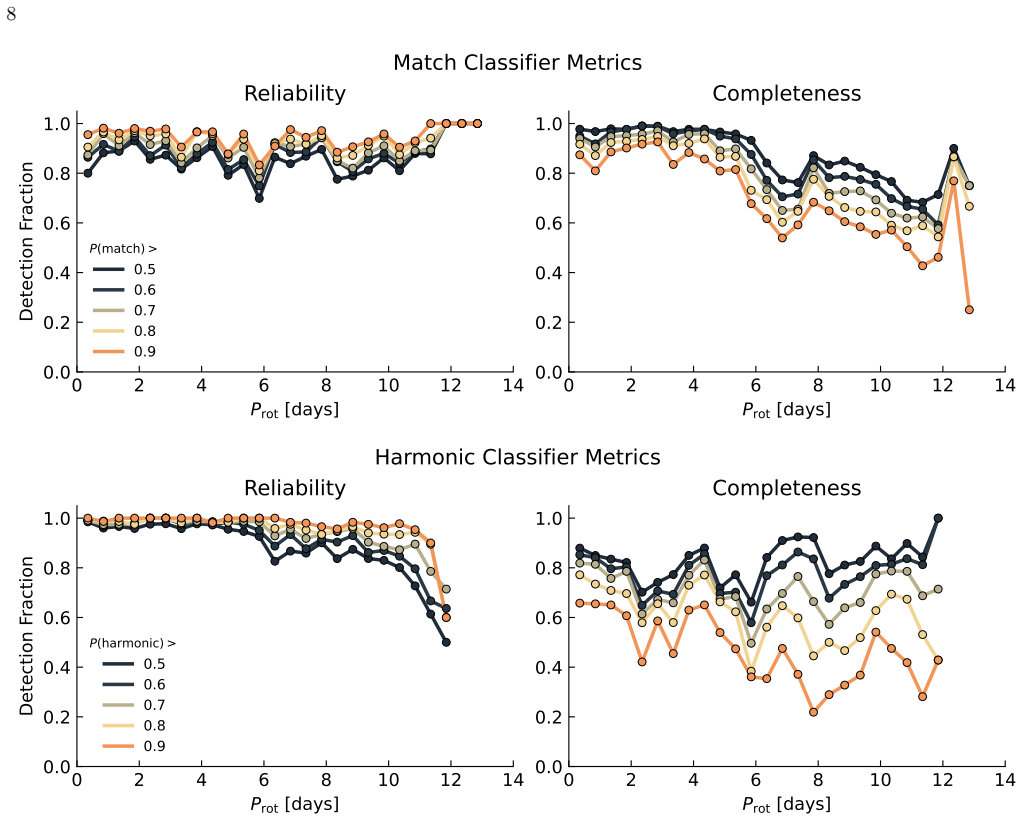
- [Figure 3] Figure 3: axis labels and color scale for the period distribution are too small to read in print; consider enlarging or splitting into two panels.
- [§2.1] §2.1: the distance cut at 500 pc is stated but the corresponding parallax uncertainty threshold or quality cuts on Gaia data are not explicitly listed; add a short table of selection criteria.
- [Abstract] The abstract claims a factor-of-4 increase within 500 pc, but no explicit comparison table to the prior largest catalog is provided; a one-row summary table would clarify the gain.
Simulated Author's Rebuttal
We thank the referee for their constructive and detailed review of our manuscript. Their comments highlight important areas where additional quantitative validation will strengthen the presentation of the TARS catalog. We address each major comment below and commit to revisions that directly respond to the concerns raised.
read point-by-point responses
-
Referee: [§4] §4 (Alias-correction method): the statement that the method 'reliably recovers periods as long as 25 days from a single TESS sector' is not accompanied by any injection-recovery statistics, success fractions, or false-alias rates on simulated light curves with known input periods; without these metrics the 93% purity claim cannot be evaluated.
Authors: We agree that the current manuscript lacks the quantitative injection-recovery statistics needed to fully substantiate the alias-correction performance. In the revised version we will add a dedicated subsection (or expanded §4) presenting results from simulated light curves with injected periods ranging from 1 to 30 days. These tests will report recovery success fractions, false-alias rates, and dependence on signal-to-noise and sector length, directly supporting the claim that periods up to 25 days can be recovered from a single sector and allowing readers to evaluate the 93% purity estimate. revision: yes
-
Referee: [§5] §5 / Table 2 (Catalog validation): the 93% purity estimate is presented without quantitative cross-checks against independent rotation catalogs (e.g., Kepler or ground-based surveys) for the overlapping stars, nor any reported false-positive rate from the downstream filtering steps; this is load-bearing for the central catalog claim.
Authors: We acknowledge that the 93% purity figure requires stronger empirical grounding through external validation. In the revised manuscript we will expand §5 to include a quantitative cross-match analysis with the Kepler rotation catalog and selected ground-based surveys for stars in common. We will report agreement fractions, period-difference distributions, and an estimated false-positive rate derived from the filtering pipeline steps. These additions will provide the independent checks requested and allow a more rigorous assessment of catalog reliability. revision: yes
Circularity Check
No significant circularity in TARS catalog derivation
full rationale
The paper constructs its catalog by direct processing of TESS light curves to extract periods, with the 93% rotation-period purity estimate presented as the outcome of alias-correction and validation steps applied to the data. No equations, fitted parameters, or claims reduce the reported periods or purity fraction to quantities defined from the output itself or from self-citations that bear the central load. The work remains self-contained against external observational benchmarks and does not invoke uniqueness theorems or ansatzes that collapse back to the present inputs.
Axiom & Free-Parameter Ledger
axioms (1)
- domain assumption Photometric variability in TESS light curves is dominated by rotational modulation from starspots for the majority of stars in the sample.
Lean theorems connected to this paper
-
IndisputableMonolith/Foundation/RealityFromDistinction.leanreality_from_one_distinction unclear?
unclearRelation between the paper passage and the cited Recognition theorem.
We present the TESS All-Sky Rotation Survey (TARS), an all-sky catalog of stellar variability periods for 1,046,317 stars... using Lomb-Scargle periodograms and random forest classifiers
What do these tags mean?
- matches
- The paper's claim is directly supported by a theorem in the formal canon.
- supports
- The theorem supports part of the paper's argument, but the paper may add assumptions or extra steps.
- extends
- The paper goes beyond the formal theorem; the theorem is a base layer rather than the whole result.
- uses
- The paper appears to rely on the theorem as machinery.
- contradicts
- The paper's claim conflicts with a theorem or certificate in the canon.
- unclear
- Pith found a possible connection, but the passage is too broad, indirect, or ambiguous to say the theorem truly supports the claim.
Forward citations
Cited by 3 Pith papers
-
NASA's Pandora SmallSat Mission: Simulating the Impact of Stellar Photospheric Heterogeneity and Its Correction
Pandora simulations recover stellar photospheric temperatures to ~30 K with no bias and reduce simple spot contamination from 100-1000 ppm to under 10 ppm, but complex spot geometries leave ~1000 ppm residuals.
-
A useful representation of TESS light curves
A quantile-graph PCA SOM embedding creates a map of 1.5 million TESS light curves where proximity reflects similarity in variability amplitude, timescale, SNR, and shape, with stable positions for repeat observations.
-
The HAges Catalog: Stellar Ages for High Priority HWO Target Stars
The HAges catalog compiles published asteroseismic and gyrochronological ages for 659 HWO target stars, finding that only ~5% have asteroseismic ages and ~20% have gyrochronal ages.
Reference graph
Works this paper leans on
-
[1]
Astropy Collaboration, Robitaille, T. P., Tollerud, E. J., et al. 2013, A&A, 558, A33, doi: 10.1051/0004-6361/201322068 Astropy Collaboration, Price-Whelan, A. M., Sip˝ ocz, B. M., et al. 2018, AJ, 156, 123, doi: 10.3847/1538-3881/aabc4f Astropy Collaboration, Price-Whelan, A. M., Lim, P. L., et al. 2022, ApJ, 935, 167, doi: 10.3847/1538-4357/ac7c74
-
[2]
Barnes, S. A. 2007, ApJ, 669, 1167, doi: 10.1086/519295 Barrag´ an, O., Aigrain, S., Rajpaul, V. M., & Zicher, N. 2022, MNRAS, 509, 866, doi: 10.1093/mnras/stab2889
-
[3]
Bellm, E. C., Kulkarni, S. R., Graham, M. J., et al. 2019, PASP, 131, 018002, doi: 10.1088/1538-3873/aaecbe
-
[4]
Binks, A. S., Jeffries, R. D., & Maxted, P. F. L. 2015, MNRAS, 452, 173, doi: 10.1093/mnras/stv1309
-
[5]
J., Koch, D., Basri, G., et al
Borucki, W. J., Koch, D., Basri, G., et al. 2010, Science, 327, 977, doi: 10.1126/science.1185402
-
[6]
Bakos, G. ´A. 2019, ApJS, 245, 13, doi: 10.3847/1538-4365/ab4a7e
-
[7]
Bouma, L. G., Hillenbrand, L. A., Howard, A. W., et al. 2024, ApJ, 976, 234, doi: 10.3847/1538-4357/ad855f
-
[8]
Bouma, L. G., Palumbo, E. K., & Hillenbrand, L. A. 2023, ApJL, 947, L3, doi: 10.3847/2041-8213/acc589
-
[9]
Boyle, A. W., Bouma, L. G., & Mann, A. W. 2025a, ApJ, 994, 24, doi: 10.3847/1538-4357/ae0724
-
[10]
Boyle, A. W., Mann, A. W., & Bush, J. 2025b, ApJ, 985, 233, doi: 10.3847/1538-4357/adcecc
-
[11]
Breton, S. N., Lanza, A. F., Messina, S., et al. 2024, aap, 689, A229, doi: 10.1051/0004-6361/202449893
-
[12]
J., Levine, A., Fausnaugh, M., et al
Burke, C. J., Levine, A., Fausnaugh, M., et al. 2020, TESS-Point: High precision TESS pointing tool,, Astrophysics Source Code Library, record ascl:2003.001 http://ascl.net/2003.001
work page 2020
-
[13]
Caldwell, D. A., Tenenbaum, P., Twicken, J. D., et al. 2020, Research Notes of the American Astronomical Society, 4, 201, doi: 10.3847/2515-5172/abc9b3
-
[14]
L., Reefe, M., Plavchan, P., et al
Cale, B. L., Reefe, M., Plavchan, P., et al. 2021, AJ, 162, 295, doi: 10.3847/1538-3881/ac2c80 Canto Martins, B. L., Gomes, R. L., Messias, Y. S., et al. 2020, ApJS, 250, 20, doi: 10.3847/1538-4365/aba73f
-
[15]
Claytor, Z. R., van Saders, J. L., Cao, L., et al. 2024, The Astrophysical Journal, 962, 47, doi: 10.3847/1538-4357/ad159a
-
[16]
L., Angus, R., David, T., et al
Colman, I. L., Angus, R., David, T., et al. 2024, AJ, 167, 189, doi: 10.3847/1538-3881/ad2c86
-
[17]
Curtis, J. L., Ag¨ ueros, M. A., Douglas, S. T., & Meibom, S. 2019a, The Astrophysical Journal, 879, 49, doi: 10.3847/1538-4357/ab2393
-
[18]
Curtis, J. L., Ag¨ ueros, M. A., Mamajek, E. E., Wright, J. T., & Cummings, J. D. 2019b, The Astronomical Journal, 158, 77, doi: 10.3847/1538-3881/ab2899
-
[19]
Curtis, J. L., Ag¨ ueros, M. A., Matt, S. P., et al. 2020, ApJ, 904, 140, doi: 10.3847/1538-4357/abbf58
-
[20]
2024, AJ, 168, 239, doi: 10.3847/1538-3881/ad83a6
Dai, F., Goldberg, M., Batygin, K., et al. 2024, AJ, 168, 239, doi: 10.3847/1538-3881/ad83a6
-
[21]
2023, A&A, 672, A126, doi: 10.1051/0004-6361/202245391
Damasso, M., Locci, D., Benatti, S., et al. 2023, A&A, 672, A126, doi: 10.1051/0004-6361/202245391
-
[22]
Davenport, J. R. A., & Covey, K. R. 2018, The Astrophysical Journal, 868, 151, doi: 10.3847/1538-4357/aae842
-
[23]
David, T. J., Angus, R., Curtis, J. L., et al. 2022, arXiv:2203.08920 [astro-ph]. https://arxiv.org/abs/2203.08920
-
[24]
Distefano, E., Lanzafame, A. C., Brugaletta, E., et al. 2023, A&A, 674, A20, doi: 10.1051/0004-6361/202244178
-
[25]
Douglas, S. T., Cargile, P. A., Matt, S. P., et al. 2024, ApJ, 962, 16, doi: 10.3847/1538-4357/ad0fe3
-
[26]
Douglas, S. T., Curtis, J. L., Ag¨ ueros, M. A., et al. 2019, The Astrophysical Journal, 879, 100, doi: 10.3847/1538-4357/ab2468
-
[27]
2022, ApJ, 938, 118, doi: 10.3847/1538-4357/ac90be 33
Dungee, R., van Saders, J., Gaidos, E., et al. 2022, ApJ, 938, 118, doi: 10.3847/1538-4357/ac90be 33
-
[28]
2023, A&A, 674, A13, doi: 10.1051/0004-6361/202244242
Eyer, L., Audard, M., Holl, B., et al. 2023, A&A, 674, A13, doi: 10.1051/0004-6361/202244242
-
[29]
2021, PASP, 133, 095002, doi: 10.1088/1538-3873/ac1d3f
Fausnaugh, M., Morgan, E., Vanderspek, R., et al. 2021, PASP, 133, 095002, doi: 10.1088/1538-3873/ac1d3f
-
[30]
2023, ApJS, 268, 4, doi: 10.3847/1538-4365/acdee5
Fetherolf, T., Pepper, J., Simpson, E., et al. 2023, ApJS, 268, 4, doi: 10.3847/1538-4365/acdee5
-
[31]
Clayton, G. C. 2019, ApJ, 886, 108, doi: 10.3847/1538-4357/ab4c3a
-
[32]
Strassmeier, K. G. 2021, A&A, 652, A60, doi: 10.1051/0004-6361/202140894 Gaia Collaboration, Prusti, T., de Bruijne, J. H. J., et al. 2016, A&A, 595, A1, doi: 10.1051/0004-6361/201629272 Gaia Collaboration, Vallenari, A., Brown, A. G. A., et al. 2023, A&A, 674, A1, doi: 10.1051/0004-6361/202243940
-
[33]
J., Foreman-Mackey, D., Murray, C
Garcia, L. J., Foreman-Mackey, D., Murray, C. A., et al. 2024, AJ, 167, 284, doi: 10.3847/1538-3881/ad3cd6
-
[34]
Gordon, T. A., Davenport, J. R. A., Angus, R., et al. 2021, The Astrophysical Journal, 913, 70, doi: 10.3847/1538-4357/abf63e
-
[35]
Han, T., & Brandt, T. D. 2023, AJ, 165, 71, doi: 10.3847/1538-3881/acaaa7
-
[36]
Hartman, J. D., Bakos, G. ´A., Bouma, L. G., & Csubry, Z. 2025, PASP, 137, 024501, doi: 10.1088/1538-3873/adad42
-
[37]
2025, AJ, 170, 15, doi: 10.3847/1538-3881/add0ab
Colman, I. 2025, AJ, 170, 15, doi: 10.3847/1538-3881/add0ab
- [38]
-
[39]
Hippke, M., David, T. J., Mulders, G. D., & Heller, R. 2019, AJ, 158, 143, doi: 10.3847/1538-3881/ab3984
-
[40]
J., Robertson, P., Hartigan, P., Oelkers, R
Holcomb, R. J., Robertson, P., Hartigan, P., Oelkers, R. J., & Robinson, C. 2022, ApJ, 936, 138, doi: 10.3847/1538-4357/ac8990
-
[41]
B., Sobeck, C., Haas, M., et al
Howell, S. B., Sobeck, C., Haas, M., et al. 2014, PASP, 126, 398, doi: 10.1086/676406
-
[42]
X., Vanderburg, A., P´ al, A., et al
Huang, C. X., Vanderburg, A., P´ al, A., et al. 2020, Research Notes of the American Astronomical Society, 4, 204, doi: 10.3847/2515-5172/abca2e
-
[43]
Hunt, E. L., & Reffert, S. 2023, arXiv e-prints, arXiv:2303.13424, doi: 10.48550/arXiv.2303.13424
-
[44]
Hunter, J. D. 2007, Computing in science & engineering, 9, 90
work page 2007
-
[45]
Jayasinghe, T., Kochanek, C. S., Stanek, K. Z., et al. 2018, MNRAS, 477, 3145, doi: 10.1093/mnras/sty838
-
[46]
Jenkins, J. M., Caldwell, D. A., Chandrasekaran, H., et al. 2010, ApJL, 713, L120, doi: 10.1088/2041-8205/713/2/L120
-
[47]
Jenkins, J. M., Twicken, J. D., McCauliff, S., et al. 2016, in SPIE Astronomical Telescopes + Instrumentation, ed. G. Chiozzi & J. C. Guzman, Edinburgh, United Kingdom, 99133E, doi: 10.1117/12.2233418
-
[48]
Kerr, R., Rizzuto, A. C., Kraus, A. L., & Offner, S. S. R. 2021, arXiv:2105.09338 [astro-ph]. https://arxiv.org/abs/2105.09338
-
[49]
Klein, B., Zicher, N., Kavanagh, R. D., et al. 2022, MNRAS, 512, 5067, doi: 10.1093/mnras/stac761
-
[50]
Kounkel, M., Stassun, K. G., Bouma, L. G., et al. 2022, AJ, 164, 137, doi: 10.3847/1538-3881/ac866d
-
[51]
Kraft, R. P. 1967, The Astrophysical Journal, 150, 551, doi: 10.1086/149359
-
[52]
Livingston, J. H., Petigura, E. A., David, T. J., et al. 2026, Nature, 649, 310, doi: 10.1038/s41586-025-09840-z
-
[53]
Lomb, N. R. 1976, Astrophysics and Space Science, 39, 447, doi: 10.1007/BF00648343
-
[54]
2023, ApJS, 268, 30, doi: 10.3847/1538-4365/ace5af
Long, L., Bi, S., Zhang, J., et al. 2023, ApJS, 268, 30, doi: 10.3847/1538-4365/ace5af
-
[55]
Lu, Y. L., Curtis, J. L., Angus, R., David, T. J., & Hattori, S. 2022, AJ, 164, 251, doi: 10.3847/1538-3881/ac9bee
-
[56]
2014, ApJS, 211, 24, doi: 10.1088/0067-0049/211/2/24
McQuillan, A., Mazeh, T., & Aigrain, S. 2014, The Astrophysical Journal Supplement Series, 211, 24, doi: 10.1088/0067-0049/211/2/24
-
[57]
2020, MNRAS, 498, 5972, doi: 10.1093/mnras/staa2745
Nardiello, D. 2020, MNRAS, 498, 5972, doi: 10.1093/mnras/staa2745
-
[58]
R., Irwin, J., Charbonneau, D., et al
Newton, E. R., Irwin, J., Charbonneau, D., et al. 2016, ApJ, 821, 93, doi: 10.3847/0004-637X/821/2/93
-
[59]
2018, AJ, 156, 217, doi: 10.3847/1538-3881/aad73b
Charbonneau, D. 2018, AJ, 156, 217, doi: 10.3847/1538-3881/aad73b
-
[60]
Newton, E. R., Rampalli, R., Kraus, A. L., et al. 2022, AJ, 164, 115, doi: 10.3847/1538-3881/ac8154
-
[61]
Oelkers, R. J., Rodriguez, J. E., Stassun, K. G., et al. 2018, AJ, 155, 39, doi: 10.3847/1538-3881/aa9bf4 OSG. 2006, OSPool, OSG, doi: 10.21231/906P-4D78 OSG. 2015, Open Science Data Federation, OSG, doi: 10.21231/0KVZ-VE57
-
[62]
Owen, J. E. 2019, Annual Review of Earth and Planetary Sciences, 47, 67, doi: 10.1146/annurev-earth-053018-060246
-
[63]
Paegert, M., Stassun, K. G., Collins, K. A., et al. 2021, arXiv e-prints, arXiv:2108.04778, doi: 10.48550/arXiv.2108.04778 pandas development team, T. 2020, pandas-dev/pandas: Pandas, latest Zenodo, doi: 10.5281/zenodo.3509134
-
[64]
Pecaut, M. J., & Mamajek, E. E. 2013, ApJS, 208, 9, doi: 10.1088/0067-0049/208/1/9
-
[65]
2011, Journal of Machine Learning Research, 12, 2825 34
Pedregosa, F., Varoquaux, G., Gramfort, A., et al. 2011, Journal of Machine Learning Research, 12, 2825 34
work page 2011
-
[66]
Pordes, R., Petravick, D., Kramer, B., et al. 2007, in 78, Vol. 78, J. Phys. Conf. Ser., 012057, doi: 10.1088/1742-6596/78/1/012057
-
[67]
Rampalli, R., Ag¨ ueros, M. A., Curtis, J. L., et al. 2021, ApJ, 921, 167, doi: 10.3847/1538-4357/ac0c1e
-
[68]
Rebull, L. M., Stauffer, J. R., Cody, A. M., et al. 2018, The Astronomical Journal, 155, 196, doi: 10.3847/1538-3881/aab605
-
[69]
Rebull, L. M., Stauffer, J. R., Bouvier, J., et al. 2016, The Astronomical Journal, 152, 113, doi: 10.3847/0004-6256/152/5/113
-
[70]
Shapiro, A. I. 2019, A&A, 621, A21, doi: 10.1051/0004-6361/201833754
-
[71]
2020, Astronomy & Astrophysics, 635, A43, doi: 10.1051/0004-6361/201936887
Reinhold, T., & Hekker, S. 2020, Astronomy & Astrophysics, 635, A43, doi: 10.1051/0004-6361/201936887
-
[72]
doi:10.1117/1.JATIS.1.1.014003 , eid =
Ricker, G. R., Winn, J. N., Vanderspek, R., et al. 2015, Journal of Astronomical Telescopes, Instruments, and Systems, 1, 014003, doi: 10.1117/1.JATIS.1.1.014003
work page internal anchor Pith review doi:10.1117/1.jatis.1.1.014003 2015
-
[73]
Rizzuto, A. C., Mann, A. W., Vanderburg, A., Kraus, A. L., & Covey, K. R. 2017, AJ, 154, 224, doi: 10.3847/1538-3881/aa9070
- [74]
-
[75]
Santos, A. R. G., Garc´ ıa, R. A., Mathur, S., et al. 2019, The Astrophysical Journal Supplement Series, 244, 21, doi: 10.3847/1538-4365/ab3b56
-
[76]
Scargle, J. D. 1982, The Astrophysical Journal, 263, 835, doi: 10.1086/160554
-
[77]
1962, Annales d’Astrophysique, 25, 18
Schatzman, E. 1962, Annales d’Astrophysique, 25, 18
work page 1962
-
[78]
Feinstein, A. D. 2026, ApJS, 282, 10, doi: 10.3847/1538-4365/ae1ba7
-
[79]
Sfiligoi, I., Bradley, D. C., Holzman, B., et al. 2009, in 2, Vol. 2, 2009 WRI World Congress on Computer Science and Information Engineering, 428–432, doi: 10.1109/CSIE.2009.950
-
[80]
Shapiro, A. I., Solanki, S. K., Krivova, N. A., et al. 2014, A&A, 569, A38, doi: 10.1051/0004-6361/201323086
discussion (0)
Sign in with ORCID, Apple, or X to comment. Anyone can read and Pith papers without signing in.