Recognition: no theorem link
From Generalist to Specialist Representation
Pith reviewed 2026-05-14 21:28 UTC · model grok-4.3
The pith
Task structure and relevant latents are identifiable in nonparametric settings without supervision or constraints.
A machine-rendered reading of the paper's core claim, the machinery that carries it, and where it could break.
Core claim
The structure between time steps and tasks is identifiable in a fully unsupervised manner, even when sequences lack strict temporal dependence and may exhibit disconnections, and task assignments can follow arbitrarily complex and interleaving structures. Within each time step, the task-relevant latent representation can be disentangled from the irrelevant part under a simple sparsity regularization, without any additional information or parametric constraints. These establish a hierarchical foundation for identifiability from generalist to specialist models.
What carries the argument
Nonparametric identifiability of inter-step task structures combined with sparsity-regularized disentanglement of intra-step task-relevant latents.
Load-bearing premise
A simple sparsity regularization is enough to disentangle task-relevant latents from irrelevant ones in each time step without needing more assumptions.
What would settle it
Finding a dataset or sequence where the task structure cannot be uniquely identified unsupervised, or where sparsity regularization does not separate the relevant latents despite the nonparametric conditions.
Figures




read the original abstract
Given a generalist model, learning a task-relevant specialist representation is fundamental for downstream applications. Identifiability, the asymptotic guarantee of recovering the ground-truth representation, is critical because it sets the ultimate limit of any model, even with infinite data and computation. We study this problem in a completely nonparametric setting, without relying on interventions, parametric forms, or structural constraints. We first prove that the structure between time steps and tasks is identifiable in a fully unsupervised manner, even when sequences lack strict temporal dependence and may exhibit disconnections, and task assignments can follow arbitrarily complex and interleaving structures. We then prove that, within each time step, the task-relevant latent representation can be disentangled from the irrelevant part under a simple sparsity regularization, without any additional information or parametric constraints. Together, these results establish a hierarchical foundation: task structure is identifiable across time steps, and task-relevant latent representations are identifiable within each step. To our knowledge, each result provides a first general nonparametric identifiability guarantee, and together they mark a step toward provably moving from generalist to specialist models.
Editorial analysis
A structured set of objections, weighed in public.
Referee Report
Summary. The paper claims to establish the first general nonparametric identifiability guarantees for moving from generalist to specialist representations. It proves that the structure between time steps and tasks is identifiable in a fully unsupervised manner (even with disconnected sequences and arbitrarily complex interleaving task assignments), and that within each time step the task-relevant latent can be disentangled from the irrelevant part via simple sparsity regularization, with no interventions, parametric forms, or structural constraints required.
Significance. If the results hold, they would mark a meaningful advance by supplying nonparametric identifiability foundations for hierarchical task-structure recovery and within-step disentanglement, which could underpin provable specialization of generalist models in unsupervised settings.
major comments (1)
- [Theorem on within-step disentanglement (corresponding to the second claim in the abstract)] The second main result (disentanglement within each time step): the claim that 'simple sparsity regularization' suffices to identify task-relevant latents from irrelevant ones in a completely nonparametric setting without any additional information or parametric constraints is load-bearing but under-specified. Sparsity penalties are typically realized via a norm, basis, or RKHS structure that implicitly equips the latent space; the manuscript does not detail how the regularization is defined or how the identifiability proof proceeds for arbitrary measures in infinite-dimensional spaces while preserving the 'no constraints' guarantee.
minor comments (1)
- [Abstract] The abstract and introduction would benefit from an explicit statement of the precise sparsity functional employed and the measure-theoretic setting in which the regularization is applied.
Simulated Author's Rebuttal
We thank the referee for their careful reading and for recognizing the potential significance of the nonparametric identifiability results. We address the single major comment below and will revise the manuscript to supply the requested clarifications while preserving the nonparametric character of the claims.
read point-by-point responses
-
Referee: The second main result (disentanglement within each time step): the claim that 'simple sparsity regularization' suffices to identify task-relevant latents from irrelevant ones in a completely nonparametric setting without any additional information or parametric constraints is load-bearing but under-specified. Sparsity penalties are typically realized via a norm, basis, or RKHS structure that implicitly equips the latent space; the manuscript does not detail how the regularization is defined or how the identifiability proof proceeds for arbitrary measures in infinite-dimensional spaces while preserving the 'no constraints' guarantee.
Authors: We agree that the presentation of the sparsity regularization in the current manuscript is high-level and would benefit from an explicit definition to remove any ambiguity about implicit structure. In the revision we will add a dedicated subsection that defines the regularization directly as the measure-theoretic penalty on the support size of the task-relevant component (i.e., the smallest measurable set whose complement carries zero mass under the conditional distribution), without reference to any basis, norm, or RKHS. The identifiability argument then proceeds by showing that, for any two candidate representations that both achieve the minimal support size and reproduce the observed marginal, their task-relevant parts must coincide almost everywhere; the proof uses only the nonparametric assumptions on the data-generating process and the sparsity level, with no additional constraints on the function class. We will also include a brief appendix sketch that verifies the argument extends to arbitrary probability measures on infinite-dimensional spaces. This change will make the result fully rigorous while leaving the 'no constraints' guarantee intact. revision: yes
Circularity Check
No circularity: theoretical proofs are self-contained
full rationale
The paper advances two identifiability results via explicit mathematical proofs in a nonparametric setting. The first establishes cross-time-step task structure recovery without temporal or assignment constraints; the second establishes within-step disentanglement via sparsity regularization. Neither result is shown to reduce to a fitted parameter, a self-citation chain, or a definitional tautology. The derivation chain therefore remains independent of its inputs and does not exhibit any of the enumerated circularity patterns.
Axiom & Free-Parameter Ledger
axioms (2)
- domain assumption Completely nonparametric setting without interventions, parametric forms, or structural constraints
- ad hoc to paper Sparsity regularization suffices to disentangle task-relevant from irrelevant latents within each time step
Reference graph
Works this paper leans on
-
[1]
Buchholz, S., Besserve, M., and Sch ¨olkopf, B. Function classes for identifiable nonlinear independent component analysis.arXiv preprint arXiv:2208.06406,
-
[2]
Ha, D. and Schmidhuber, J. World models.arXiv preprint arXiv:1803.10122,
work page internal anchor Pith review Pith/arXiv arXiv
-
[3]
Jin, J. and Syrgkanis, V . Learning causal representations from general environments: Identifiability and intrinsic ambiguity.arXiv preprint arXiv:2311.12267,
-
[4]
Condi- tional mutual information neural estimator
Molavipour, S., Bassi, G., and Skoglund, M. Condi- tional mutual information neural estimator. InICASSP 2020-2020 IEEE International Conference on Acoustics, Speech and Signal Processing (ICASSP), pp. 5025–5029. IEEE,
work page 2020
-
[5]
E., Sridhar, D., Wang, Y ., and Blei, D
Moran, G. E., Sridhar, D., Wang, Y ., and Blei, D. M. Identi- fiable variational autoencoders via sparse decoding.arXiv preprint arXiv:2110.10804,
-
[6]
Oord, A. v. d., Li, Y ., and Vinyals, O. Representation learn- ing with contrastive predictive coding.arXiv preprint arXiv:1807.03748,
work page internal anchor Pith review Pith/arXiv arXiv
-
[7]
Tishby, N. and Zaslavsky, N. Deep learning and the infor- mation bottleneck principle. In2015 IEEE Information Theory Workshop, ITW 2015, pp. 7133169. Institute of Electrical and Electronics Engineers Inc.,
work page 2015
-
[8]
von K ¨ugelgen, J., Sharma, Y ., Gresele, L., Brendel, W., Sch ¨olkopf, B., Besserve, M., and Locatello, F. Self-supervised learning with data augmentations prov- ably isolates content from style.arXiv preprint arXiv:2106.04619,
-
[9]
Wong, L., Collins, K. M., Ying, L., Zhang, C. E., Weller, A., Gerstenberg, T., O’Donnell, T., Lew, A. K., Andreas, J. D., Tenenbaum, J. B., et al. Modeling open-world cognition as on-demand synthesis of probabilistic models. arXiv preprint arXiv:2507.12547,
-
[10]
Yao, W., Sun, Y ., Ho, A., Sun, C., and Zhang, K. Learning temporally causal latent processes from general temporal data.arXiv preprint arXiv:2110.05428,
-
[11]
Symbol Meaning ot ∈R do Observation at timet st ∈R ds Latent state at timet at ∈R da Action at timet gi Task variablei, defined as collider across time steps M Total number of tasks T Total number of time steps Sk Segmentk, a block of consecutive latent steps T(t) Set of tasks relevant to time stept T(S k) Set of tasks relevant to segmentS k ft Observatio...
work page 1988
-
[12]
By Equation 36, this implies that r∈ I((J u)k,·), i.e. r∈I k, contradicting r∈I\I k. Therefore, Mc,π(r) = 0 , which together withI(M) =I(J ϕ−1 (ˆst))yields ∂st,c ∂ˆst,π(r) = 0,∀c∈I k, r∈I\I k.(38) Since ϕ is invertible, there exists an invertible mapping between st,c and ˆst,π(c), and st,c depends only on ˆst,π(c). Moreover, because r∈I\I k and c∈I k, st,...
work page 2024
-
[13]
While these assumptions may appear technical at first, they are usually quite mild in practice
The assumptions are intended to ensure that the Jacobian carries enough variation to span its support, thereby capturing the underlying dependencies between latent state variables and task variables in the nonlinear setting. While these assumptions may appear technical at first, they are usually quite mild in practice. The span condition requires that acr...
work page 2018
-
[14]
and contrastive objectives such as InfoNCE (Oord et al., 2018; Sordoni et al.,
work page 2018
-
[15]
a dog playing ball, jumping high, lying on the grass, and reading a book
by constructing an interleaved offline dataset from thedoor-open/close; drawer-opentasks. Both tasks involve a 7-DoF robotic arm manipulating the same door but with opposite goals, making them an ideal testbed for multi-task interference. We first train task-specific expert policies using SAC until reaching60% success rate, then collect ∼300 successful an...
work page 2025
-
[16]
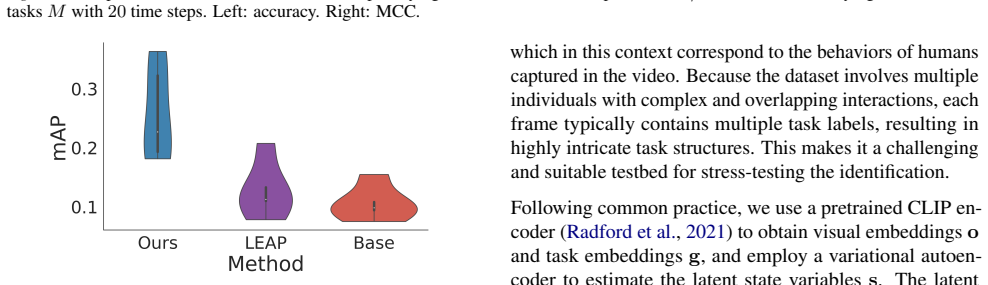
and VitB (Tong et al., 2022). As shown in Table 3, our method achieves the best performance, which further validates that a principled structure learning approach yields the most reliable recovery of temporal task structure. Leap outperforms the Base model, which highlights the benefit of identifiable representations for structure learning. However, when ...
work page 2022
discussion (0)
Sign in with ORCID, Apple, or X to comment. Anyone can read and Pith papers without signing in.