Recognition: no theorem link
ISOMORPH: A Supply Chain Digital Twin for Simulation, Dataset Generation, and Forecasting Benchmarks
Pith reviewed 2026-05-14 19:27 UTC · model grok-4.3
The pith
ISOMORPH creates the first public digital twin of a multi-echelon supply chain to generate forecasting benchmarks and test foundation models.
A machine-rendered reading of the paper's core claim, the machinery that carries it, and where it could break.
Core claim
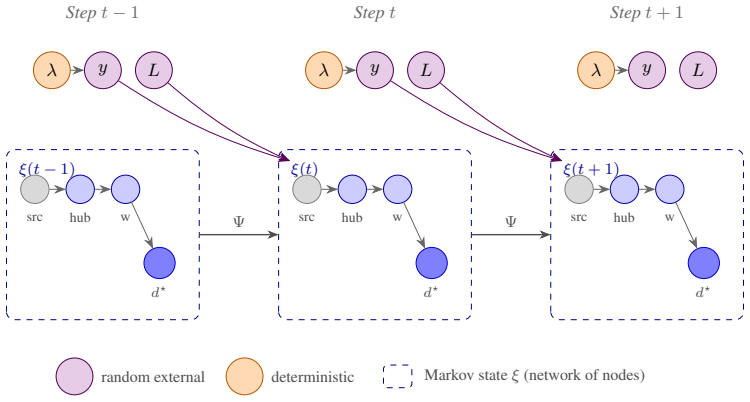
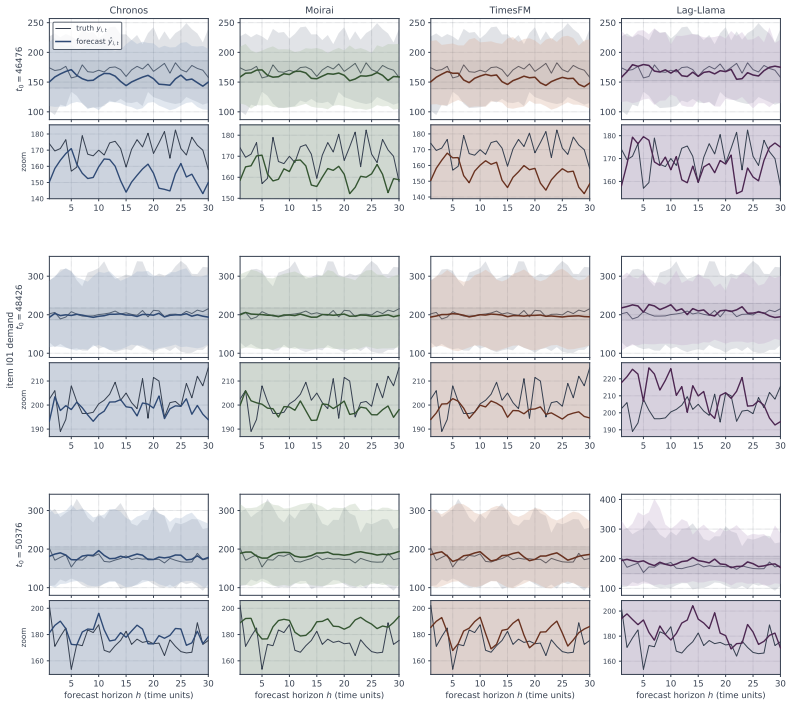
The central discovery is a fully interpretable digital twin simulator for multi-echelon supply chains that advances a routing graph in discrete time, tracks a Markovian state vector of inventories and flows, and reproduces empirically consistent bullwhip dynamics. Released datasets from two catalogue sizes with scenario sweeps and Latin-hypercube perturbations exhibit variance amplification, bottlenecks, and cross-channel effects. Zero-shot tests on four foundation models yield MASE values exceeding GIFT-Eval references at low-to-moderate horizons, and the same setup produces forecast bands via demand knob perturbations, establishing foundation models as fast surrogates for the twin'sforward
What carries the argument
The Markov chain transition kernel on the state vector of per-node on-hand inventory, outstanding orders, in-transit shipments, and smoothed demand estimate, which linearly acts on the empirical distribution and closes the dynamics while encoding conservation laws.
Load-bearing premise
The discrete-time rules and state transitions in the simulator produce dynamics that match real supply-chain phenomena like the bullwhip effect at consistent magnitudes, even without calibration to proprietary data.
What would settle it
Observing that the generated rollouts do not exhibit variance amplification matching empirical bullwhip magnitudes, or that foundation model MASE scores fall below GIFT-Eval references under identical evaluation protocols.
Figures




read the original abstract
Open time-series forecasting (TSF) benchmarks cover retail, energy, weather, and traffic, but supply-chain logistics remains underserved. We introduce ISOMORPH, the first public digital twin of a multi-echelon logistics network with fully interpretable, user-configurable parameters and modular topology, demand process, and control rules. The simulator advances a directed routing graph in discrete time: demand arrives at the destination, is served from stock or recorded as backlog, and triggers replenishment through the network. The state vector tracks per-node on-hand inventory with outstanding orders, in-transit shipments, and a smoothed demand estimate, so the dynamics close as a Markov chain on a tractable state space whose transition kernel acts linearly on the empirical distribution of the state. The released data reproduces the bullwhip effect at empirically consistent magnitudes, and three conservation laws encoded in the Markov chain serve as verification tools when users extend the simulator. We release datasets at two catalogue scales ($C=50$ and $C=200$) with six scenario sweeps producing 30 additional rollouts and 20 Latin-hypercube perturbations, exhibiting dynamics absent from fixed TSF benchmarks: variance amplification, cascading bottlenecks, regime shifts, and cross-channel coupling through shared macro shocks. Zero-shot evaluation of four foundation models (Chronos, Moirai, TimesFM, Lag-Llama) shows MASE values exceeding public GIFT-Eval references at low-to-moderate horizons, supporting incorporation into existing benchmarks. The same pairing produces forecast confidence bands via Latin-hypercube perturbation of demand-side knobs, forward UQ from parameter uncertainty unavailable on standard TSF datasets, demonstrating that foundation models can serve as fast surrogates for the digital twin's forward UQ. Code (MIT): https://github.com/tuhinsahai/ISOMORPH.
Editorial analysis
A structured set of objections, weighed in public.
Referee Report
Summary. The paper introduces ISOMORPH, a configurable digital twin simulator for multi-echelon supply-chain networks that advances a directed routing graph in discrete time, maintains a Markov-closed state vector of inventory, orders, and demand estimates, and releases synthetic datasets at catalogue scales C=50 and C=200. These datasets exhibit variance amplification, cascading bottlenecks, and regime shifts; the authors report that they reproduce the bullwhip effect at empirically consistent magnitudes. Zero-shot evaluations of four foundation models (Chronos, Moirai, TimesFM, Lag-Llama) yield MASE values exceeding public GIFT-Eval references at low-to-moderate horizons, and Latin-hypercube perturbations of demand parameters are used to generate forecast confidence bands, positioning the simulator as a source of forward UQ unavailable in standard TSF benchmarks.
Significance. If the simulator's discrete-time rules and conservation-law checks produce trajectories whose statistical properties align with real multi-echelon logistics, ISOMORPH would fill a documented gap in open TSF benchmarks by supplying interpretable, user-extensible data together with built-in verification. The foundation-model MASE results and surrogate-UQ demonstration would then provide a concrete basis for incorporating supply-chain scenarios into existing evaluation suites.
major comments (2)
- [Abstract / Simulator description] Abstract and simulator section: the claim that the released data 'reproduces the bullwhip effect at empirically consistent magnitudes' is not accompanied by quantitative comparisons (e.g., order-variance amplification ratios) against published retail or manufacturing studies; verification is restricted to three conservation laws and synthetic rollouts, leaving open whether the observed dynamics contain artifacts of the linear transition kernel or the chosen demand process.
- [Forecasting experiments] Forecasting experiments: the statement that foundation-model MASE values exceed GIFT-Eval references at low-to-moderate horizons lacks tabulated per-horizon scores, number of independent rollouts, and confidence intervals, so the robustness of the 'supporting incorporation' conclusion cannot be assessed from the reported results.
minor comments (2)
- The GitHub repository link is given, but the manuscript should specify the exact parameter files or seeds used to generate the two released catalogue-scale datasets so that users can exactly reproduce the published rollouts.
- [Simulator description] Notation for the state vector components (on-hand inventory, outstanding orders, in-transit shipments, smoothed demand) should be introduced once in a single table or equation block rather than scattered across the simulator description.
Simulated Author's Rebuttal
We thank the referee for their thoughtful comments on our manuscript. We address each major comment below and outline the revisions we will implement to improve clarity and completeness.
read point-by-point responses
-
Referee: [Abstract / Simulator description] Abstract and simulator section: the claim that the released data 'reproduces the bullwhip effect at empirically consistent magnitudes' is not accompanied by quantitative comparisons (e.g., order-variance amplification ratios) against published retail or manufacturing studies; verification is restricted to three conservation laws and synthetic rollouts, leaving open whether the observed dynamics contain artifacts of the linear transition kernel or the chosen demand process.
Authors: We agree that providing quantitative comparisons to published empirical studies would better support the claim of reproducing the bullwhip effect at consistent magnitudes. In the revised version, we will add a dedicated subsection or table that computes and reports order-variance amplification ratios from the ISOMORPH datasets and directly compares them to values from key literature (such as studies on retail and manufacturing supply chains). We will also elaborate on the design choices for the linear transition kernel and demand process to mitigate concerns about artifacts, including additional verification through sensitivity analyses on parameter perturbations. revision: yes
-
Referee: [Forecasting experiments] Forecasting experiments: the statement that foundation-model MASE values exceed GIFT-Eval references at low-to-moderate horizons lacks tabulated per-horizon scores, number of independent rollouts, and confidence intervals, so the robustness of the 'supporting incorporation' conclusion cannot be assessed from the reported results.
Authors: We acknowledge the need for more detailed reporting to allow assessment of robustness. In the revision, we will include tabulated per-horizon MASE scores for each foundation model, explicitly state the number of independent rollouts used (noting the 30 scenario sweeps and additional perturbations mentioned), and provide confidence intervals or standard deviations for the metrics. This will strengthen the evidence for incorporating supply-chain scenarios into TSF benchmarks. revision: yes
Circularity Check
No significant circularity; simulator rules and evaluations are self-contained
full rationale
The paper defines the ISOMORPH simulator explicitly via user-configurable routing graph, discrete-time inventory/backlog/replenishment rules, and a state vector whose Markov transition kernel is derived directly from those rules. Conservation laws act as independent verification checks rather than fitted targets. Datasets are produced by forward simulation, foundation-model MASE evaluations and Latin-hypercube UQ bands are computed on the generated trajectories, and the bullwhip reproduction claim follows from the chosen rule magnitudes without any reduction to a self-fit or self-citation by construction. All load-bearing steps remain independent of the claimed outputs.
Axiom & Free-Parameter Ledger
free parameters (1)
- catalogue scale C
axioms (1)
- domain assumption The state vector (on-hand inventory, outstanding orders, in-transit shipments, smoothed demand) renders the network dynamics a Markov chain whose transition kernel acts linearly on the empirical state distribution.
Reference graph
Works this paper leans on
-
[1]
Deepbullwhip: An Open-Source Simulation and Benchmarking for Multi-Echelon Bullwhip Analyses
doi: 10.48550/arXiv.2604.13478. Tom Beucler, Michael Pritchard, Stephan Rasp, Jordan Ott, Pierre Baldi, and Pierre Gentine. Enforc- ing analytic constraints in neural networks emulating physical systems.Physical Review Letters, 126(9):098302,
work page internal anchor Pith review Pith/arXiv arXiv doi:10.48550/arxiv.2604.13478
-
[2]
Gérard Cachon, Taylor Randall, and Glen Schmidt
doi: 10.1103/PhysRevLett.126.098302. Gérard Cachon, Taylor Randall, and Glen Schmidt. In search of the bullwhip effect.Manufacturing & Service Operations Management, 9:457–479, 10
-
[3]
doi: 10.1287/msom.1060.0149. Hong Chen and David D. Yao.Fundamentals of Queueing Networks: Performance, Asymptotics, and Optimization. Stochastic Modelling and Applied Probability. Springer,
-
[4]
URL https: //openreview.net/forum?id=wEc1mgAjU-. 24 Christian D. Hubbs, Hector D. Perez, Owais Sarwar, Nikolaos V . Sahinidis, Ignacio E. Grossmann, and John M. Wassick. Or-gym: A reinforcement learning library for operations research problem.ArXiv, abs/2008.06319,
-
[5]
Spyros Makridakis, Evangelos Spiliotis, and Vassilios Assimakopoulos
doi: 10.1016/j.ijforecast.2019.04.014. Spyros Makridakis, Evangelos Spiliotis, and Vassilios Assimakopoulos. M5 accuracy competition: Results, findings, and conclusions.International Journal of Forecasting, 38(4):1346–1364,
-
[6]
Azmine Toushik Wasi, MD Shafikul Islam, and Adipto Raihan Akib
doi: 10.1016/j.jcp.2021.110551. Azmine Toushik Wasi, MD Shafikul Islam, and Adipto Raihan Akib. Supplygraph: A benchmark dataset for supply chain planning using graph neural networks.ArXiv, abs/2401.15299,
-
[7]
doi: 10.1029/2021MS002954. Ward Whitt.Stochastic-Process Limits: An Introduction to Stochastic-Process Limits and Their Application to Queues. Springer Series in Operations Research. Springer,
-
[8]
doi: 10.48550/arXiv.2012.07436. 25 A Parameter values This appendix lists the parameter values used to produce the released runs. The algorithms that use these parameters are in §3.3. A.1 Demand-generator coefficients Each item i draws its demand-process coefficients independently from the distributions of Table
-
[9]
Key” is the combination of columns that uniquely identifies a row. “Rows
All values are the script’s built-in defaults, except for the pipeline multiplierm. The default m= 0 selects a reactive shipping rule that ships against backlog plus a three-time-unit buffer of smoothed demand; m= 7 selects the proactive rule used in this work, which keeps seven time units of smoothed demand in the pipeline at all times. 27 Table 8: Runti...
2025
-
[10]
Table 13 lists all six sweeps; the baseline value is bold in each row
To study how the network’s behavior and the resulting time series change under different operating conditions, we construct six one-at-a-time sweeps: each varies a single knob across five settings—a shared baseline (all knobs at default) plus four perturbations—while holding all other knobs at baseline, producing 6×5 = 30rollouts on theC=50regime. Table 1...
-
[11]
Model baseline shock_xhi drift_mid chaos_comp
Best per column within eachh-block inbold. Model baseline shock_xhi drift_mid chaos_comp. burst_xhi chaos_burst h=1 Chronos 0.769 0.779 0.761 0.768 0.638 0.643 Moirai 0.786 0.805 0.785 0.795 0.663 0.678 TimesFM0.742 0.748 0.737 0.743 0.628 0.638 Lag-Llama 1.027 1.080 1.014 1.070 1.059 1.085 h=7 Chronos 0.818 0.822 0.798 0.817 0.7880.781 Moirai 0.831 0.845...
2048
-
[12]
The wide spread between Baltimore and Philadelphia in the daily column reflects sub-monthly batching of arrivals, which the monthly column smooths out. Node Tier Daily ¯Bn Monthly ¯Bn NewYork Destination9.03 1.43 Baltimore Tier-56.83 1.64 Philadelphia Tier-519.16 1.49 Columbus Tier-41.39 1.27 Richmond Tier-41.40 1.34 Charlotte Tier-31.15 1.33 Chicago Tier...
2080
discussion (0)
Sign in with ORCID, Apple, or X to comment. Anyone can read and Pith papers without signing in.