Recognition: 1 theorem link
· Lean TheoremThe interplay of network structure and correlated infectious traits in epidemic models
Pith reviewed 2026-05-14 19:36 UTC · model grok-4.3
The pith
A framework with joint distributions of susceptibility and transmissibility across network subgroups yields analytical expressions for the basic reproduction number in SIR models.
A machine-rendered reading of the paper's core claim, the machinery that carries it, and where it could break.
Core claim
We introduce a mathematical modeling framework incorporating population subgroups, each with its own joint distribution of susceptibility and transmissibility. We apply this framework to the susceptible-infected-recovered model to examine the effect of community structure and degree heterogeneity. We derive analytical expressions for the basic reproduction number, which, when reduced, corroborates prior results and validate these results with numerical simulations.
What carries the argument
Population subgroups each defined by joint distributions of susceptibility and transmissibility that interact with network structure to produce closed-form expressions for the basic reproduction number.
If this is right
- The basic reproduction number remains analytically tractable even when susceptibility and transmissibility covary within subgroups.
- Numerical simulations confirm the analytical expressions and reveal distinct temporal dynamics relative to the homogeneous SIR model.
- Insights from the expressions and simulations can inform the design of social interventions that account for both network position and trait correlations.
- The framework recovers established results for the basic reproduction number when correlations or heterogeneity are removed.
Where Pith is reading between the lines
- If real data show stronger or more complex dependencies between traits and network position than the independent-subgroup assumption allows, the closed-form expressions would likely need to be replaced by numerical approximations.
- The subgroup construction could be extended to other compartmental models by adding joint distributions for additional traits such as recovery rates.
- Intervention strategies that jointly consider network degree and the full trait distribution per subgroup may outperform strategies based on network structure or individual traits in isolation.
Load-bearing premise
Population subgroups can be defined with independent joint distributions of susceptibility and transmissibility that interact with network structure in a way that permits closed-form reproduction-number expressions.
What would settle it
Direct numerical simulation of epidemic spread on a concrete network with specified subgroup joint distributions of susceptibility and transmissibility, compared against the analytical basic reproduction number for the same setup.
Figures


read the original abstract
Individual contributions to the spread of an epidemic vary widely due to an individual's location in a social network and their intrinsic ability to spread or contract diseases. While the effect of heterogeneous population structure and infection rates is well-understood, less studied is the impact of population-level covariance between susceptibility and transmissibility, despite empirical evidence showing that both susceptibility and transmission vary across individuals. We introduce a mathematical modeling framework incorporating population subgroups, each with its own joint distribution of susceptibility and transmissibility. We apply this framework to the susceptible-infected-recovered (SIR) model to examine the effect of community structure and degree heterogeneity. We derive analytical expressions for the basic reproduction number, which, when reduced, corroborates prior results and validate these results with numerical simulations. We pair these estimates with simulations exploring first, the temporal dynamics of this model with the homogeneous SIR model, and second, implications for effective social intervention. This analysis provides a foundation for future studies exploring the interplay between structural and dynamical heterogeneity in infectious disease transmission.
Editorial analysis
A structured set of objections, weighed in public.
Referee Report
Summary. The manuscript introduces a framework for SIR epidemic models on networks that incorporates discrete population subgroups, each with its own joint distribution of susceptibility and transmissibility. It derives analytical expressions for the basic reproduction number, shows that these reduce to known results when correlations are removed, and validates the expressions via numerical simulations. The work further compares temporal dynamics to the homogeneous SIR case and explores implications for social interventions.
Significance. If the closed-form expressions are rigorously obtained under the stated assumptions, the framework would usefully extend heterogeneous network SIR models by explicitly treating covariance between susceptibility and transmissibility. The reduction to prior results and the use of simulations for validation are strengths that could support more accurate intervention modeling.
major comments (2)
- [Abstract] Abstract and central derivation: the claim of analytical expressions for the basic reproduction number is load-bearing, yet the abstract supplies no explicit derivation steps, error bars on the numerical validations, or details on how the joint distributions are assumed to interact with degree heterogeneity to permit closed form. This directly affects the central claim.
- [Model framework] Model construction (implicit in the framework description): the derivation of closed-form R0 requires that trait correlations factor separately from degree heterogeneity within each subgroup so that the next-generation operator remains diagonalizable. The manuscript must demonstrate that residual dependence between traits and network position is absent; otherwise the reported reduction to prior heterogeneous-SIR results does not hold.
minor comments (1)
- [Abstract] The abstract states that simulations explore 'implications for effective social intervention' but does not specify the intervention types or metrics used; a brief clarification would improve readability.
Simulated Author's Rebuttal
We thank the referee for their insightful comments, which have helped us improve the clarity of our manuscript. We address each major comment below and indicate the revisions made.
read point-by-point responses
-
Referee: [Abstract] Abstract and central derivation: the claim of analytical expressions for the basic reproduction number is load-bearing, yet the abstract supplies no explicit derivation steps, error bars on the numerical validations, or details on how the joint distributions are assumed to interact with degree heterogeneity to permit closed form. This directly affects the central claim.
Authors: We agree that the abstract could more explicitly reference the key methodological elements. The derivation of the basic reproduction number is presented in detail in Section 2 using the next-generation matrix approach applied to the subgroup-structured network. The closed-form expression arises because the joint distributions of susceptibility and transmissibility are defined within each subgroup independently of the degree sequence, allowing the next-generation operator to be block-diagonalized with respect to the subgroups. Simulations in the results section compare analytical predictions to stochastic realizations, showing agreement within sampling variability; we have now included error bars representing one standard deviation across 100 simulation runs in the revised Figure 3. We have revised the abstract to include a brief statement on these assumptions and the validation approach. revision: yes
-
Referee: [Model framework] Model construction (implicit in the framework description): the derivation of closed-form R0 requires that trait correlations factor separately from degree heterogeneity within each subgroup so that the next-generation operator remains diagonalizable. The manuscript must demonstrate that residual dependence between traits and network position is absent; otherwise the reported reduction to prior heterogeneous-SIR results does not hold.
Authors: The framework is constructed such that each subgroup is defined by its joint trait distribution, and nodes within a subgroup are assigned degrees from the overall degree distribution independently of their traits. This separation ensures no residual dependence between traits and network position within subgroups. Consequently, the next-generation matrix factors into a form where the spectral radius can be computed analytically as the dominant eigenvalue of a reduced matrix incorporating the covariance terms. When the covariance is set to zero, the expression reduces exactly to the known result for heterogeneous SIR models on networks, as shown in Equation (12) of the manuscript. We have added an explicit statement and proof sketch in the revised Section 2.2 to demonstrate the absence of residual dependence by construction. revision: partial
Circularity Check
No significant circularity detected in the R0 derivation
full rationale
The paper introduces a modeling framework with population subgroups having joint susceptibility-transmissibility distributions and derives closed-form expressions for the basic reproduction number in a network SIR model. These expressions are explicitly stated to reduce to prior heterogeneous-SIR results upon removal of correlations, which demonstrates an extension of existing methods rather than a self-referential construction. No load-bearing self-citations, fitted parameters renamed as predictions, or ansatzes smuggled via prior work by the same authors are present in the provided text. The derivation chain remains self-contained against the stated assumptions about subgroup independence and generating-function separability.
Axiom & Free-Parameter Ledger
Lean theorems connected to this paper
-
IndisputableMonolith.Foundation.RealityFromDistinctionreality_from_one_distinction unclearWe derive analytical expressions for the basic reproduction number... for the network configuration model and the two-community stochastic block model
Reference graph
Works this paper leans on
-
[1]
In the following, we analytically derive the eigenval- ues ofJfor several common network models to obtain an analytical expression forR 0. B. Random mixing Here, we assume a single subpopulation, i.e.,M= 1, where two nodesiandjconnect with probabilitypwhich specifies the Erd˝ os-R´ enyi model. For a network of size Nwith a mean degree of⟨k⟩, 2p N 2 =⟨k⟩N,...
-
[2]
In this case, N(g 1) =N(g 2) =N/2, P(g 1 |g 1) =P(g 2 |g 2) =p in, P(g 1 |g 2) =P(g 2 |g 1) =p out
Balanced communities Here, we use our mathematical framework to model two subgroups of equal size. In this case, N(g 1) =N(g 2) =N/2, P(g 1 |g 1) =P(g 2 |g 2) =p in, P(g 1 |g 2) =P(g 2 |g 1) =p out. Following the analysis of Ref. [26],p in ≈ ⟨k⟩(1 +e)/N andp out ≈ ⟨k⟩(1−e)/N, whereeis the imbalance param- eter, formerly denoted byεin Ref. [26]. Then, with...
-
[3]
We specify that N(g 1) =rN, andN(g 2) = (1−r)N(whereris the fraction of individuals in community 1)
Imbalanced communities Following the analysis for the case of balanced com- munities, we determineP(g i |g j) andN(g j) when the two communities are different sizes. We specify that N(g 1) =rN, andN(g 2) = (1−r)N(whereris the fraction of individuals in community 1). As before, we assume thatP(g 1 |g 1) =P(g 2 |g 2) =p in and P(g 1 |g 2) =P(g 2 |g 1) =p ou...
-
[4]
Then, individual 8 values ofδandεwere sampled from this distribution, with different Σ values for each community
This distribution was then truncated so that it was supported on the region [0,3]×[0,3] and the resulting distribution was used to calculate⟨δε⟩. Then, individual 8 values ofδandεwere sampled from this distribution, with different Σ values for each community. Each network was sampled from the planted partition model with 10 4 nodes and a mean degree of 10...
-
[5]
W. O. Kermack and A. G. McKendrick, A contribution to the mathematical theory of epidemics, Proceedings of the Royal Society of London. Series A, Containing Papers of a Mathematical and Physical Character115, 700 (1927)
1927
-
[6]
K. L. VanderWaal and V. O. Ezenwa, Heterogeneity in pathogen transmission: Mechanisms and methodology, Functional Ecology30, 1606 (2016)
2016
-
[7]
B. M. Tuschhoff and D. A. Kennedy, Detecting and quan- tifying heterogeneity in susceptibility using contact trac- ing data, PLOS Computational Biology20, e1012310 (2024)
2024
-
[8]
Dwyer, J
G. Dwyer, J. S. Elkinton, and J. P. Buonaccorsi, Host heterogeneity in susceptibility and disease dynamics: Tests of a mathematical model, The American Naturalist 150, 685 (1997)
1997
-
[9]
V. O. Ezenwa, Host social behavior and parasitic infec- tion: A multifactorial approach, Behavioral Ecology15, 446 (2004)
2004
-
[10]
Glaser and J
R. Glaser and J. K. Kiecolt-Glaser, Stress-induced im- mune dysfunction: Implications for health, Nature Re- views Immunology5, 243 (2005)
2005
-
[11]
Cohen, W
S. Cohen, W. J. Doyle, D. P. Skoner, B. S. Rabin, and J. M. Gwaltney, Jr, Social Ties and Susceptibility to the Common Cold, JAMA277, 1940 (1997)
1940
-
[12]
Roberts and A
M. Roberts and A. Peters, Is testosterone immunosup- pressive in a condition-dependent manner? An exper- imental test in blue tits, The Journal of Experimental Biology212, 1811 (2009)
2009
-
[13]
Edler, W
R. Edler, W. Goymann, I. Schwabl, and T. W. P. Friedl, Experimentally elevated testosterone levels en- hance courtship behaviour and territoriality but depress acquired immune response in Red Bishops Euplectes orix, Ibis153, 46 (2011)
2011
-
[14]
J. C. Taube, P. B. Miller, and J. M. Drake, An open- access database of infectious disease transmission trees to explore superspreader epidemiology, PLOS Biology20, 10.1371/journal.pbio.3001685 (2022)
-
[15]
B. M. Althouse, E. A. Wenger, J. C. Miller, S. V. Scarpino, A. Allard, L. H´ ebert-Dufresne, and H. Hu, Superspreading events in the transmission dynamics of SARS-CoV-2: Opportunities for interventions and con- trol, PLOS Biology18, e3000897 (2020)
2020
-
[16]
J. C. Miller, Epidemic size and probability in populations with heterogeneous infectivity and susceptibility, Physi- cal Review E76, 010101 (2007). 12
2007
-
[17]
J. C. Miller, Spread of infectious disease through clus- tered populations, Journal of The Royal Society Interface 6, 1121 (2009)
2009
-
[18]
D. M. Hawley, R. S. Etienne, V. O. Ezenwa, and A. E. Jolles, Does animal behavior underlie covariation be- tween hosts’ exposure to infectious agents and suscep- tibility to infection? Implications for disease dynamics, Integrative and Comparative Biology51, 528 (2011)
2011
-
[19]
J. D. Harris, E. Gallmeier, J. Dushoff, S. J. Beckett, and J. S. Weitz, Infections are not alike: The effects of covari- ation between individual susceptibility and transmissibil- ity on epidemic dynamics, Journal of Theoretical Biology 613, 112211 (2025)
2025
-
[20]
B. M. Tuschhoff and D. A. Kennedy, Heterogeneity in and correlation between host transmissibility and suscep- tibility can greatly impact epidemic dynamics, Journal of Theoretical Biology611, 112186 (2025)
2025
-
[21]
Mossong, N
J. Mossong, N. Hens, M. Jit, P. Beutels, K. Auranen, R. Mikolajczyk, M. Massari, S. Salmaso, G. S. Tomba, J. Wallinga, J. Heijne, M. Sadkowska-Todys, M. Rosin- ska, and W. J. Edmunds, Social Contacts and Mixing Patterns Relevant to the Spread of Infectious Diseases, PLoS Medicine5, e74 (2008)
2008
-
[22]
Cattuto, W
C. Cattuto, W. Van Den Broeck, A. Barrat, V. Colizza, J.-F. Pinton, and A. Vespignani, Dynamics of Person-to- Person Interactions from Distributed RFID Sensor Net- works, PLoS ONE5, e11596 (2010)
2010
-
[23]
Barrat, C
A. Barrat, C. Cattuto, V. Colizza, F. Gesualdo, L. Isella, E. Pandolfi, J. F. Pinton, L. Rav` a, C. Rizzo, M. Romano, J. Stehl´ e, A. E. Tozzi, and W. Van Den Broeck, Empiri- cal temporal networks of face-to-face human interactions, The European Physical Journal Special Topics222, 1295 (2013)
2013
-
[24]
S. Pei, X. Teng, P. Lewis, and J. Shaman, Optimizing respiratory virus surveillance networks using uncertainty propagation, Nature Communications12, 222 (2021)
2021
-
[25]
M. A. Collier, A.-M. Jacoby, V. Foroughirad, E. M. Pat- terson, E. Krzyszczyk, M. M. Wallen, M. L. Miketa, C. Karniski, S. Wilkin, J. Mann, and S. Bansal, Breath- ing synchrony shapes respiratory disease risk in bot- tlenose dolphins, Communications Biology8, 870 (2025)
2025
-
[26]
P. Sah, S. T. Leu, P. C. Cross, P. J. Hudson, and S. Bansal, Unraveling the disease consequences and mechanisms of modular structure in animal social net- works, Proceedings of the National Academy of Sciences 114, 4165 (2017)
2017
-
[27]
P. Sah, J. D. M´ endez, and S. Bansal, A multi-species repository of social networks, Scientific Data6, 44 (2019)
2019
-
[28]
Brockmann and D
D. Brockmann and D. Helbing, The Hidden Geometry of Complex, Network-Driven Contagion Phenomena, Sci- ence342, 1337 (2013)
2013
-
[29]
Pastor-Satorras and A
R. Pastor-Satorras and A. Vespignani, Epidemic Spread- ing in Scale-Free Networks, Physical Review Letters86, 3200 (2001)
2001
-
[30]
N. W. Landry and J. G. Restrepo, Opinion disparity in hypergraphs with community structure, Physical Review E108, 034311 (2023)
2023
-
[31]
Huang and C
W. Huang and C. Li, Epidemic spreading in scale-free networks with community structure, Journal of Statisti- cal Mechanics: Theory and Experiment2007, P01014 (2007)
2007
-
[32]
Onnela, J
J.-P. Onnela, J. Saram¨ aki, J. Hyv¨ onen, G. Szab´ o, D. Lazer, K. Kaski, J. Kert´ esz, and A.-L. Barab´ asi, Struc- ture and tie strengths in mobile communication networks, Proceedings of the National Academy of Sciences104, 7332 (2007)
2007
-
[33]
Karsai, M
M. Karsai, M. Kivel¨ a, R. K. Pan, K. Kaski, J. Kert´ esz, A.-L. Barab´ asi, and J. Saram¨ aki, Small but slow world: How network topology and burstiness slow down spread- ing, Physical Review E83, 025102 (2011)
2011
-
[34]
Wu and Z
X. Wu and Z. Liu, How community structure influences epidemic spread in social networks, Physica A: Statistical Mechanics and its Applications387, 623 (2008)
2008
-
[35]
Salath´ e and J
M. Salath´ e and J. H. Jones, Dynamics and Control of Diseases in Networks with Community Structure, PLOS Computational Biology6, e1000736 (2010)
2010
-
[36]
Gou and Z
W. Gou and Z. Jin, How heterogeneous susceptibility and recovery rates affect the spread of epidemics on networks, Infectious Disease Modelling2, 353 (2017)
2017
-
[37]
A. Allard, C. Moore, S. V. Scarpino, B. M. Al- thouse, and L. H´ ebert-Dufresne, The role of di- rectionality, heterogeneity, and correlations in epi- demic risk and spread, SIAM Review65, 471 (2023), https://doi.org/10.1137/20M1383811
-
[38]
B. K. Fosdick, D. B. Larremore, J. Nishimura, and J. Ugander, Configuring Random Graph Mod- els with Fixed Degree Sequences, SIAM Review 10.1137/16M1087175 (2018)
-
[39]
J. G. Restrepo, E. Ott, and B. R. Hunt, Onset of synchro- nization in large networks of coupled oscillators, Physical Review E71, 036151 (2005)
2005
-
[40]
Miller and T
J. Miller and T. Ting, EoN (Epidemics on Networks): A fast, flexible Python package for simulation, analytic approximation, and analysis of epidemics on networks, Journal of Open Source Software4, 1731 (2019)
2019
- [41]
-
[42]
K. M. Bubar, K. Reinholt, S. M. Kissler, M. Lipsitch, S. Cobey, Y. H. Grad, and D. B. Larremore, Model- informed COVID-19 vaccine prioritization strategies by age and serostatus, Science371, 916 (2021)
2021
-
[43]
A. G. Buchwald, J. Bayham, J. Adams, D. Bortz, K. Colborn, O. Zarella, M. Buran, J. Samet, D. Ghosh, R. Herlihy, and E. J. Carlton, Estimating the Impact of Statewide Policies to Reduce Spread of Severe Acute Respiratory Syndrome Coronavirus 2 in Real Time, Colorado, USA, Emerging Infectious Diseases27, 2312 (2021)
2021
-
[44]
K. Prem, A. R. Cook, and M. Jit, Projecting social con- tact matrices in 152 countries using contact surveys and demographic data, PLOS Computational Biology13, e1005697 (2017)
2017
-
[45]
Mistry, M
D. Mistry, M. Litvinova, A. Pastore y Piontti, M. Chi- nazzi, L. Fumanelli, M. F. C. Gomes, S. A. Haque, Q.-H. Liu, K. Mu, X. Xiong, M. E. Halloran, I. M. Longini, S. Merler, M. Ajelli, and A. Vespignani, Inferring high- resolution human mixing patterns for disease modeling, Nature Communications12, 323 (2021)
2021
-
[46]
Franco, P
N. Franco, P. Coletti, L. Willem, L. Angeli, A. Lajot, S. Abrams, P. Beutels, C. Faes, and N. Hens, Infer- ring age-specific differences in susceptibility to and infec- tiousness upon SARS-CoV-2 infection based on Belgian social contact data, PLOS Computational Biology18, e1009965 (2022)
2022
-
[47]
Sender, Y
R. Sender, Y. Bar-On, S. W. Park, E. Noor, J. Dushoff, and R. Milo, The unmitigated profile of COVID-19 in- 13 fectiousness (2022)
2022
-
[48]
T. L. Anderson, A. Nande, C. Merenstein, B. Raynor, A. Oommen, B. J. Kelly, M. Z. Levy, and A. L. Hill, Quantifying individual-level heterogeneity in infectious- ness and susceptibility through household studies, Epi- demics44, 100710 (2023)
2023
-
[49]
N. W. Landry, W. Thompson, L. H´ ebert-Dufresne, and J.-G. Young, Reconstructing networks from simple and complex contagions, Physical Review E110, L042301 (2024)
2024
-
[50]
T. P. Peixoto, Network Reconstruction and Community Detection from Dynamics, Physical Review Letters123, 128301 (2019)
2019
-
[51]
Karrer and M
B. Karrer and M. E. J. Newman, Stochastic blockmodels and community structure in networks, Physical Review E83, 016107 (2011)
2011
-
[52]
Gupta and N
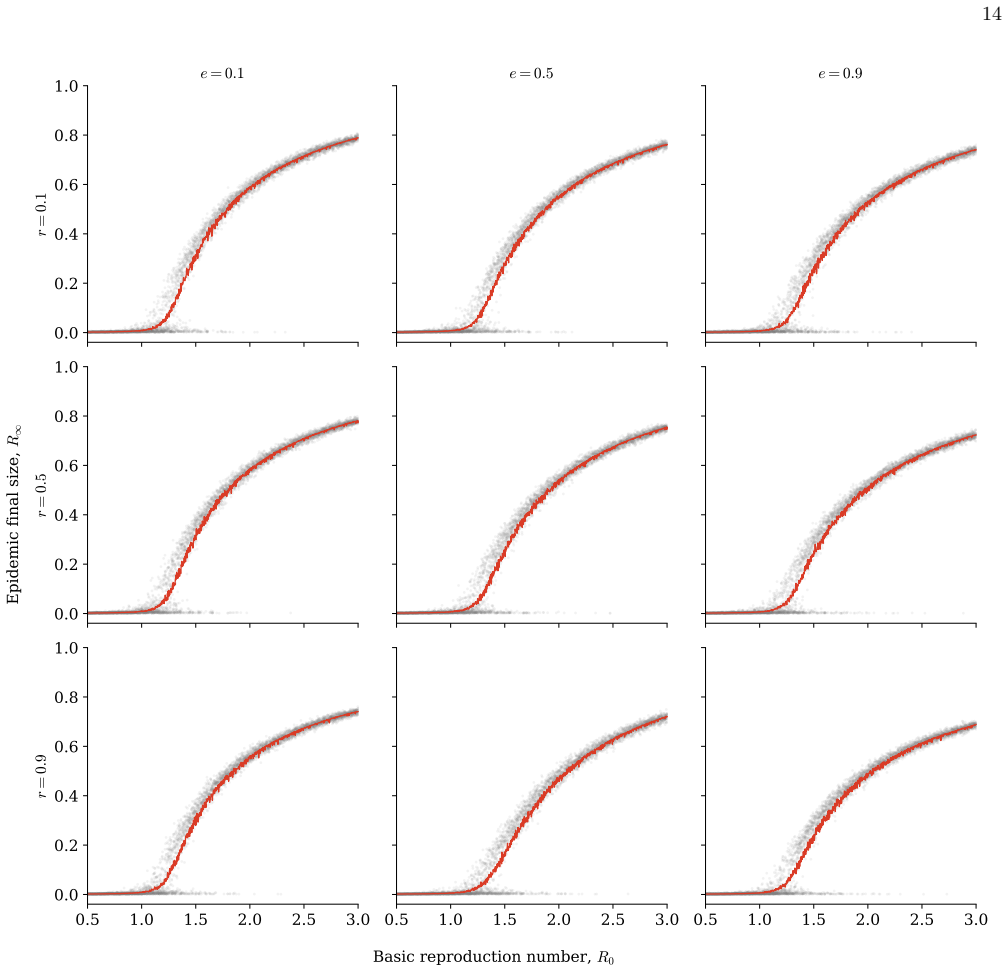
A. Gupta and N. W. Landry, AbhayGupta115/ HeterogeneousCommunities (2026). Appendix A: Additional validation of our analytical results To validate our analytical results across a range of community structures, we consider imbalance parame- ters ofe= 0.1,0.5,0.9 and community relative sizes of r= 0.1,0.5,0.9. We use the same epidemiological param- eters as...
2026
discussion (0)
Sign in with ORCID, Apple, or X to comment. Anyone can read and Pith papers without signing in.