Recognition: 2 theorem links
· Lean TheoremMulti-Marginal Couplings for Metropolis-Hastings
Pith reviewed 2026-05-14 19:18 UTC · model grok-4.3
The pith
Multi-marginal couplings with adaptive Poisson Monte Carlo reduce meeting times for multiple Metropolis-Hastings chains by up to 50 percent.
A machine-rendered reading of the paper's core claim, the machinery that carries it, and where it could break.
Core claim
A shared-randomness Poisson Monte Carlo construction for multi-marginal coupling of Markov chains, obtained by establishing bounds on a natural multi-marginal objective and then removing the dimension-dependent bottleneck via an adaptive point-process update rule that preserves validity.
What carries the argument
Shared-randomness Poisson Monte Carlo construction whose point process is updated adaptively for multi-marginal couplings of Metropolis-Hastings chains.
If this is right
- Convergence diagnostics can terminate chains earlier because meeting times shorten.
- Resource allocation for MCMC sampling becomes less conservative in high dimensions.
- Grand couplings of more than two chains become practical without dimension-dependent slowdown.
- Shared randomness across chains yields tighter empirical bounds on mixing than independent runs.
Where Pith is reading between the lines
- The same adaptive construction could be applied to other MCMC kernels that admit Poisson Monte Carlo representations.
- In distributed sampling settings the method may reduce communication cost by sharing the same random point process across nodes.
- Connections between the derived bounds and optimal transport distances suggest possible further tightening for specific target distributions.
Load-bearing premise
The adaptive rule for updating the point process preserves the validity of the multi-marginal coupling.
What would settle it
A direct numerical check showing either that the adaptive update violates the required marginals or that the observed meeting times fail to improve over standard baselines in controlled high-dimensional examples.
Figures



read the original abstract
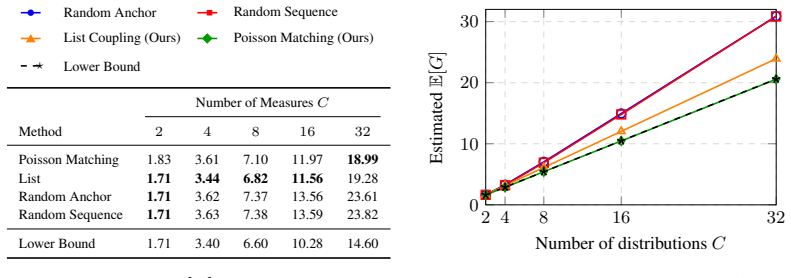
Convergence diagnosis for Markov chain Monte Carlo is a matter of fundamental importance in computational statistics: it determines the resources allocated to a particular sampling problem and influences the practitioner's view of the quality of estimates obtained from a Markov chain. Motivated by this, we contribute to the emerging class of coupling-based convergence diagnostic algorithms. Concretely, we study coupling multiple Metropolis-Hastings chains using multi-marginal coupling. We introduce a natural objective for this setting and establish lower and upper bounds by drawing connections to list-level distribution coupling and distributed pairwise-matching problems. This analysis ultimately leads to a shared-randomness Poisson Monte Carlo construction for coupling multiple Markov chains. In this process, we avoid a key dimension-dependent bottleneck in the runtime complexity of classical Poisson Monte Carlo by developing an adaptive rule for updating the point process, yielding significant gains in high-dimensional settings. Experiments on grand couplings of Markov chains show that our methods improve coalescence rates across dimensions, reducing meeting times by up to 50% compared with existing baselines.
Editorial analysis
A structured set of objections, weighed in public.
Referee Report
Summary. The paper proposes multi-marginal couplings for multiple Metropolis-Hastings chains to advance coupling-based MCMC convergence diagnostics. It defines a natural objective for this setting, derives lower and upper bounds by connecting to list-level distribution coupling and distributed pairwise-matching problems, and constructs a shared-randomness Poisson Monte Carlo sampler. To remove the O(d) runtime bottleneck, an adaptive rule updates the point process. Experiments on grand couplings report coalescence improvements, with meeting times reduced by up to 50% versus baselines.
Significance. If the adaptive rule is shown to preserve exact marginal kernels and joint distributions, the work would strengthen coupling diagnostics by enabling scalable grand couplings in high dimensions, directly improving coalescence rates and resource allocation for MCMC sampling.
major comments (2)
- [Adaptive rule and §3] §3 (list-level coupling inequalities) and the adaptive-rule section: the manuscript asserts that the adaptive point-process update is 'correctness-preserving' but supplies only a high-level description. No explicit argument is given that the post-adaptation intensity measure continues to produce the required acceptance probabilities or that the resulting grand coupling satisfies the list-level inequalities. This is load-bearing for the claimed meeting-time bounds.
- [Experiments] Experiments section: the reported 'up to 50% reduction' in meeting times is presented without error bars, exact pseudocode for the adaptive update, or verification that the implemented coupling remains exact. The absence of these details prevents assessment of whether the observed gains are artifacts of an inexact construction.
Simulated Author's Rebuttal
We thank the referee for their careful reading and constructive comments, which highlight important areas for clarification. We address each major comment below and will revise the manuscript to strengthen the exposition of the adaptive rule and experimental details.
read point-by-point responses
-
Referee: [Adaptive rule and §3] §3 (list-level coupling inequalities) and the adaptive-rule section: the manuscript asserts that the adaptive point-process update is 'correctness-preserving' but supplies only a high-level description. No explicit argument is given that the post-adaptation intensity measure continues to produce the required acceptance probabilities or that the resulting grand coupling satisfies the list-level inequalities. This is load-bearing for the claimed meeting-time bounds.
Authors: We agree that the current high-level description of the adaptive update requires expansion to make the correctness argument fully explicit. In the revised manuscript we will add a dedicated lemma and proof in the adaptive-rule section showing that the intensity measure after each update remains invariant under the shared-randomness Poisson Monte Carlo construction, thereby preserving the exact acceptance probabilities and ensuring the resulting grand coupling continues to satisfy the list-level inequalities of §3. The proof will connect the adaptive thinning step directly to the original intensity and the list-level coupling objective. revision: yes
-
Referee: [Experiments] Experiments section: the reported 'up to 50% reduction' in meeting times is presented without error bars, exact pseudocode for the adaptive update, or verification that the implemented coupling remains exact. The absence of these details prevents assessment of whether the observed gains are artifacts of an inexact construction.
Authors: We acknowledge the need for greater reproducibility and verification. The revised experiments section will report meeting-time results with error bars computed over multiple independent runs, include exact pseudocode for the adaptive point-process update, and add a short verification subsection that numerically confirms the implemented coupling reproduces the required marginal kernels and joint distributions to machine precision. revision: yes
Circularity Check
No significant circularity; derivation draws on external coupling and matching problems
full rationale
The manuscript introduces an objective for multi-marginal coupling of Metropolis-Hastings chains and derives bounds via explicit connections to list-level distribution coupling and distributed pairwise-matching problems. These are presented as independent external structures rather than self-referential definitions or fitted quantities. The shared-randomness Poisson Monte Carlo construction and adaptive point-process update follow from this analysis without any quoted reduction showing that a claimed prediction equals an input parameter by construction. No self-citation is invoked as the sole load-bearing justification for a uniqueness theorem or ansatz, and the central claims remain independent of the paper's own fitted outputs. This matches the expected non-finding for papers whose core steps rest on external mathematical connections.
Axiom & Free-Parameter Ledger
free parameters (1)
- multi-marginal objective function
axioms (1)
- domain assumption Lower and upper bounds follow from connections to list-level distribution coupling and distributed pairwise-matching problems
invented entities (1)
-
adaptive rule for updating the point process
no independent evidence
Lean theorems connected to this paper
-
IndisputableMonolith/Cost/FunctionalEquation.leanwashburn_uniqueness_aczel unclear?
unclearRelation between the paper passage and the cited Recognition theorem.
We introduce a natural objective for this setting and establish lower and upper bounds by drawing connections to list-level distribution coupling and distributed pairwise-matching problems. This analysis ultimately leads to a shared-randomness Poisson Monte Carlo construction...
-
IndisputableMonolith/Foundation/AlphaCoordinateFixation.leanalpha_pin_under_high_calibration unclear?
unclearRelation between the paper passage and the cited Recognition theorem.
Adaptive Proposal for Fast Coupling... mixture barycenter measure μ ≜ 1/C ∑ Pj
What do these tags mean?
- matches
- The paper's claim is directly supported by a theorem in the formal canon.
- supports
- The theorem supports part of the paper's argument, but the paper may add assumptions or extra steps.
- extends
- The paper goes beyond the formal theorem; the theorem is a base layer rather than the whole result.
- uses
- The paper appears to rely on the theorem as machinery.
- contradicts
- The paper's claim conflicts with a theorem or certificate in the canon.
- unclear
- Pith found a possible connection, but the passage is too broad, indirect, or ambiguous to say the theorem truly supports the claim.
Reference graph
Works this paper leans on
-
[1]
Pairwise optimal coupling of multiple random variables.arXiv preprint arXiv:1903.00632, 2019
Omer Angel and Yinon Spinka. Pairwise optimal coupling of multiple random variables.arXiv preprint arXiv:1903.00632, 2019
-
[2]
Niloy Biswas, Pierre E Jacob, and Paul Vanetti. Estimating convergence of markov chains with l-lag couplings.Advances in neural information processing systems, 32, 2019
work page 2019
-
[3]
Stephen P Brooks and Andrew Gelman. General methods for monitoring convergence of iterative simulations.Journal of computational and graphical statistics, 7(4):434–455, 1998
work page 1998
-
[4]
Adrien Corenflos and Hai-Dang Dau. A coupling-based approach to f-divergences diagnostics for markov chain monte carlo.arXiv preprint arXiv:2510.07559, 2025
-
[5]
Coupling without communi- cation and drafter-invariant speculative decoding
Majid Daliri, Christopher Musco, and Ananda Theertha Suresh. Coupling without communi- cation and drafter-invariant speculative decoding. In2025 IEEE International Symposium on Information Theory (ISIT), pages 1–6. IEEE, 2025
work page 2025
-
[6]
Andreas Eberle. Reflection couplings and contraction rates for diffusions.Probability theory and related fields, 166(3):851–886, 2016
work page 2016
-
[7]
Gergely Flamich. Greedy poisson rejection sampling.Advances in Neural Information Process- ing Systems, 36:37089–37127, 2023
work page 2023
-
[8]
PhD thesis, Apollo - University of Cambridge Repository, 2024
Gergely Flamich.Data Compression with Relative Entropy Coding. PhD thesis, Apollo - University of Cambridge Repository, 2024. URL https://www.repository.cam.ac.uk/ handle/1810/385303. PhD Thesis
work page 2024
-
[9]
Fast relative entropy coding with a* coding.arXiv preprint arXiv:2201.12857, 2022
Gergely Flamich, Stratis Markou, and José Miguel Hernández-Lobato. Fast relative entropy coding with a* coding.arXiv preprint arXiv:2201.12857, 2022. 10
-
[10]
Inference from iterative simulation using multiple sequences.Statistical science, 7(4):457–472, 1992
Andrew Gelman and Donald B Rubin. Inference from iterative simulation using multiple sequences.Statistical science, 7(4):457–472, 1992
work page 1992
-
[11]
Andrew Gelman, Walter R Gilks, and Gareth O Roberts. Weak convergence and optimal scaling of random walk metropolis algorithms.The annals of applied probability, 7(1):110–120, 1997
work page 1997
-
[12]
Mark Girolami and Ben Calderhead. Riemann manifold langevin and hamiltonian monte carlo methods.Journal of the Royal Statistical Society Series B: Statistical Methodology, 73(2): 123–214, 2011
work page 2011
-
[13]
Coalescence in markov chains.arXiv preprint arXiv:2510.13572, 2025
Geoffrey R Grimmett and Mark Holmes. Coalescence in markov chains.arXiv preprint arXiv:2510.13572, 2025
-
[14]
Perfect simulation.Monographs on Statistics and Applied Probability, 148:148, 2016
Mark L Huber. Perfect simulation.Monographs on Statistics and Applied Probability, 148:148, 2016
work page 2016
-
[15]
Pierre E Jacob, John O’leary, and Yves F Atchadé. Unbiased markov chain monte carlo methods with couplings.Journal of the Royal Statistical Society Series B: Statistical Methodology, 82 (3):543–600, 2020
work page 2020
-
[16]
Valen E Johnson. Studying convergence of markov chain monte carlo algorithms using coupled sample paths.Journal of the American Statistical Association, 91(433):154–166, 1996
work page 1996
-
[17]
Valen E Johnson. A coupling-regeneration scheme for diagnosing convergence in markov chain monte carlo algorithms.Journal of the American Statistical Association, 93(441):238–248, 1998
work page 1998
-
[18]
Ashish Khisti, M Reza Ebrahimi, Hassan Dbouk, Arash Behboodi, Roland Memisevic, and Christos Louizos. Multi-draft speculative sampling: Canonical decomposition and theoretical limits.arXiv preprint arXiv:2410.18234, 2024
-
[19]
American Mathematical Soc., 2017
David A Levin and Yuval Peres.Markov chains and mixing times, volume 107. American Mathematical Soc., 2017
work page 2017
-
[20]
Cheuk Ting Li and Venkat Anantharam. A unified framework for one-shot achievability via the poisson matching lemma.IEEE Transactions on Information Theory, 67(5):2624–2651, 2021
work page 2021
-
[21]
A* sampling.Advances in Neural Informa- tion Processing Systems, 27:3086–3094, 2014
Chris J Maddison, Daniel Tarlow, and Tom Minka. A* sampling.Advances in Neural Informa- tion Processing Systems, 27:3086–3094, 2014
work page 2014
-
[22]
Channel simulation and distributed compression with ensemble rejection sampling
Buu Phan and Ashish J Khisti. Channel simulation and distributed compression with ensemble rejection sampling. InThe Thirty-ninth Annual Conference on Neural Information Processing Systems, 2025
work page 2025
-
[23]
Importance matching lemma for lossy compres- sion with side information
Buu Phan, Ashish Khisti, and Christos Louizos. Importance matching lemma for lossy compres- sion with side information. InInternational Conference on Artificial Intelligence and Statistics, pages 1387–1395. PMLR, 2024
work page 2024
-
[24]
Joseph Rowan, Buu Phan, and Ashish Khisti. List-level distribution coupling with applications to speculative decoding and lossy compression.arXiv preprint arXiv:2506.05632, 2025
-
[25]
One-Shot Broadcast Joint Source-Channel Coding with Codebook Diversity
Joseph Rowan, Buu Phan, and Ashish Khisti. One-shot broadcast joint source-channel coding with codebook diversity.arXiv preprint arXiv:2601.10648, 2026
work page internal anchor Pith review Pith/arXiv arXiv 2026
-
[26]
f-divergence inequalities.IEEE Transactions on Information Theory, 62(11):5973–6006, 2016
Igal Sason and Sergio Verdú. f-divergence inequalities.IEEE Transactions on Information Theory, 62(11):5973–6006, 2016
work page 2016
-
[27]
Algorithms for the communication of samples
Lucas Theis and Noureldin Y Ahmed. Algorithms for the communication of samples. In International Conference on Machine Learning, pages 21308–21328. PMLR, 2022
work page 2022
-
[28]
Brian L Trippe, Tin D Nguyen, and Tamara Broderick. Optimal transport couplings of gibbs samplers on partitions for unbiased estimation.arXiv preprint arXiv:2104.04514, 2021
-
[29]
Maximal couplings of the metropolis- hastings algorithm
Guanyang Wang, John O’Leary, and Pierre Jacob. Maximal couplings of the metropolis- hastings algorithm. InInternational Conference on Artificial Intelligence and Statistics, pages 1225–1233. PMLR, 2021. 11 A Auxiliary Algorithms A.1 Maximal Coupling Achievability.Let P and Q be probability measures on a measurable space (X,X) . Their meet measure is defin...
work page 2021
discussion (0)
Sign in with ORCID, Apple, or X to comment. Anyone can read and Pith papers without signing in.