Recognition: unknown
The Metallicity Distribution of the Ultra-Faint Dwarf Galaxy Segue 1
Pith reviewed 2026-05-14 19:25 UTC · model grok-4.3
The pith
Segue 1's 40-star metallicity sample shows a single continuous star-formation episode before reionization.
A machine-rendered reading of the paper's core claim, the machinery that carries it, and where it could break.
Core claim
The metallicity distribution function of Segue 1, derived from Ca II K absorption measurements of 40 stars, shows an average [Fe/H] of -2.52 ± 0.10 dex and a dispersion of 0.59 ± 0.06 dex with no evidence for distinct subpopulations. This distribution is consistent with a continuous, short-duration (≲1 Gyr) episode of star formation and chemical enrichment prior to reionization. The nonzero spread reaffirms Segue 1 as a galaxy rather than a star cluster.
What carries the argument
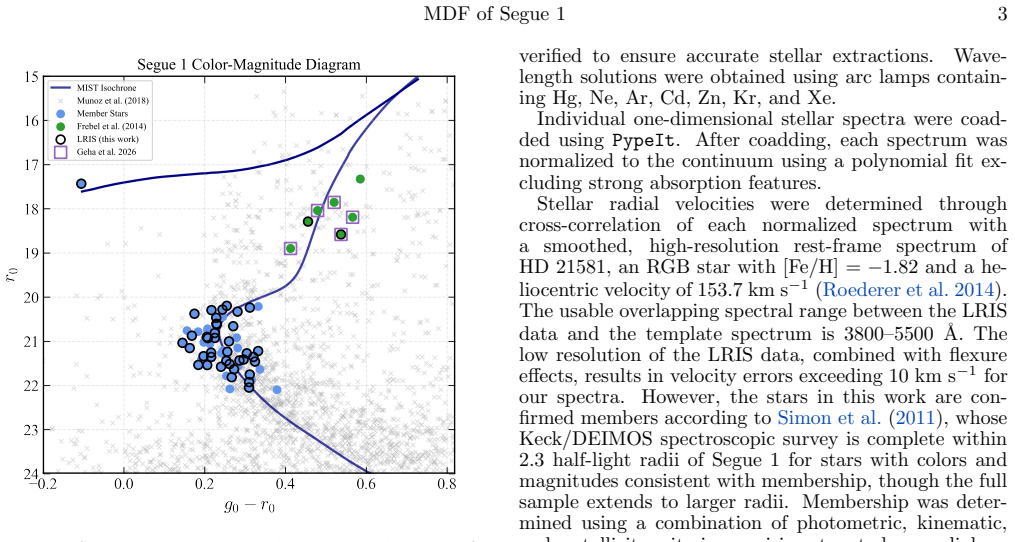
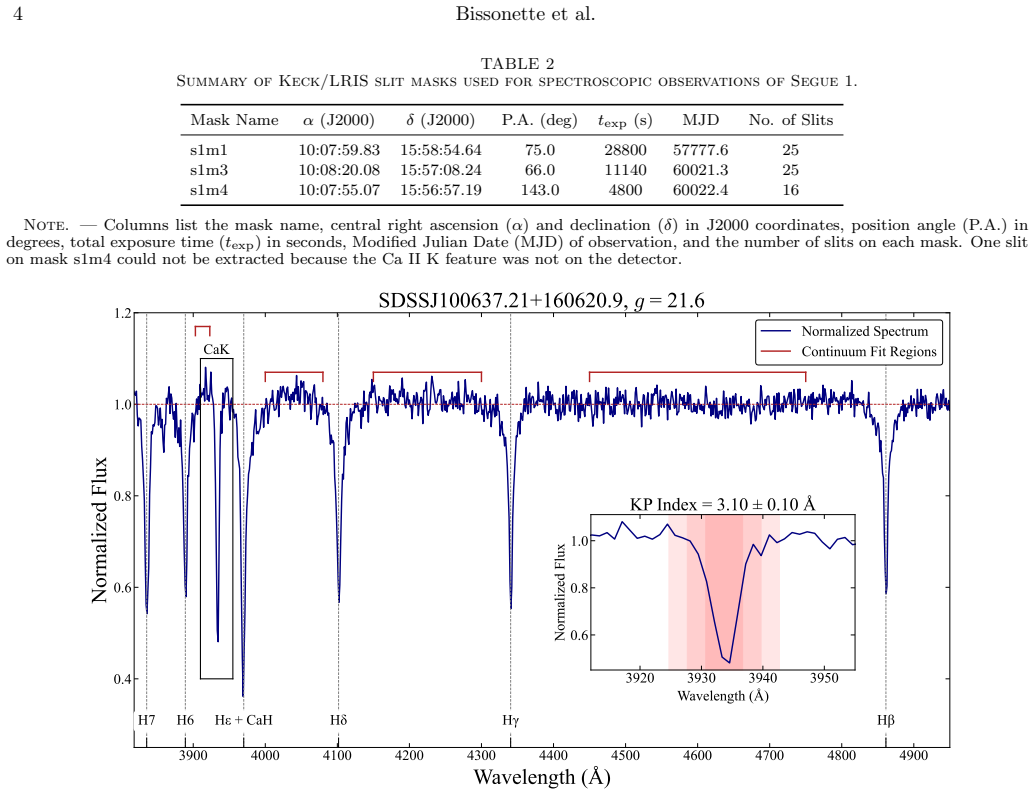
The metallicity distribution function (MDF) built from Ca II K line strengths measured in low-resolution spectra of 40 confirmed member stars spanning the red giant branch and main-sequence turnoff.
If this is right
- Segue 1 experienced only one continuous burst of star formation and enrichment before reionization.
- The nonzero metallicity spread confirms Segue 1 qualifies as a galaxy rather than a star cluster.
- Even the least massive galaxies underwent detectable chemical enrichment from supernovae.
- Deep low-resolution spectroscopy is required to map the full metallicity distributions of other ultra-faint dwarfs.
Where Pith is reading between the lines
- If other ultra-faint dwarfs show similarly narrow single-peaked MDFs, early star formation in low-mass halos may have been uniformly brief and pre-reionization.
- The measured dispersion can be compared directly to supernova-yield models to test whether one or a few enrichment events suffice.
- Extending the same Ca II K method to additional UFDs would reveal whether Segue 1 is typical or an outlier in early chemical evolution.
Load-bearing premise
Ca II K absorption strengths yield accurate [Fe/H] values for both red giant and main-sequence stars at these low metallicities without large systematic offsets, and the 40-star sample represents the full stellar population without major selection biases.
What would settle it
A larger sample of Segue 1 stars that reveals clear multiple metallicity peaks or high-resolution spectra showing systematic [Fe/H] offsets from the Ca II K values would falsify the single-episode interpretation.
Figures



read the original abstract
Ultra-faint dwarf galaxies (UFDs, $M_* < 10^5 M_\odot$) offer unique insights into early chemical evolution in low-mass systems. However, interpreting their metallicity distribution functions (MDFs) has been challenging due to limited spectroscopic samples, especially beyond the red giant branch. We present metallicities from the Ca II K absorption feature, measured from low-resolution ($R \sim 1000$) Keck/LRIS spectroscopy of 40 stars in the UFD Segue 1 ($M_* \approx 500 M_\odot$), including both red giant branch and main-sequence turnoff stars, resulting in a metallicity sample more than six times larger than previously published data for Segue 1. The resulting MDF has an average [Fe/H] $= -2.52 \pm 0.10$ dex and a dispersion of $\sigma = 0.59 \pm 0.06$ dex, with no evidence for distinct subpopulations. This is consistent with a continuous, short-duration ($\lesssim 1$ Gyr) episode of star formation and chemical enrichment prior to reionization. The nonzero metallicity spread reaffirms its classification as a galaxy. Segue 1 highlights the rich chemical enrichment histories present even in the least massive galaxies, and underscores the importance of deep spectroscopic follow-up to fully characterize these ancient stellar systems.
Editorial analysis
A structured set of objections, weighed in public.
Referee Report
Summary. The manuscript reports Ca II K metallicities from low-resolution Keck/LRIS spectra of 40 stars in Segue 1 (including both RGB and MSTO members), producing an MDF with mean [Fe/H] = -2.52 ± 0.10 dex and dispersion σ = 0.59 ± 0.06 dex. No distinct subpopulations are identified, supporting a single continuous star-formation episode of duration ≲1 Gyr prior to reionization; the nonzero spread confirms Segue 1 as a galaxy.
Significance. If robust, the result supplies the largest metallicity sample for any UFD to date (more than 6× prior Segue 1 data) and extends measurements to MSTO stars, strengthening constraints on early chemical enrichment in the lowest-mass galaxies. The empirical MDF parameters and single-population conclusion are direct outputs from the new observations rather than fitted priors.
major comments (2)
- [§3.2] §3.2 (Ca II K calibration): The conversion of equivalent widths to [Fe/H] for the MSTO subset at [Fe/H] ≈ -2.5 is not validated against higher-resolution spectra or synthetic spectra that account for the higher T_eff and log g of turnoff stars. Standard RGB calibrations may incur 0.15–0.25 dex systematic offsets from ionization or NLTE effects; any such offset between the RGB and MSTO subsamples would shift both the reported mean and the dispersion, directly affecting the single-population claim.
- [§4.3] §4.3 (MDF subpopulation test): The statement of “no evidence for distinct subpopulations” requires an explicit statistical test (e.g., Gaussian-mixture likelihood ratio or BIC comparison) together with the power of that test given the 40-star sample size, individual uncertainties, and possible RGB–MSTO calibration differences. Without these, the conclusion that the MDF is consistent with a single continuous episode remains under-constrained.
minor comments (2)
- [Table 1] Table 1: list the individual [Fe/H] values, uncertainties, and RGB/MSTO classifications for all 40 stars so that the MDF parameters can be reproduced or re-analyzed with alternative calibrations.
- [Abstract] Abstract: the phrase “more than six times larger than previously published data” should cite the exact prior sample size (e.g., “N=6”) for immediate clarity.
Simulated Author's Rebuttal
We thank the referee for their thoughtful and constructive report. The two major comments highlight important points about calibration validation and statistical rigor that we have addressed in the revised manuscript. Below we respond point by point.
read point-by-point responses
-
Referee: [§3.2] §3.2 (Ca II K calibration): The conversion of equivalent widths to [Fe/H] for the MSTO subset at [Fe/H] ≈ -2.5 is not validated against higher-resolution spectra or synthetic spectra that account for the higher T_eff and log g of turnoff stars. Standard RGB calibrations may incur 0.15–0.25 dex systematic offsets from ionization or NLTE effects; any such offset between the RGB and MSTO subsamples would shift both the reported mean and the dispersion, directly affecting the single-population claim.
Authors: We agree that explicit validation for MSTO stars is necessary. In the revised manuscript we have added a new subsection comparing our Ca II K equivalent-width measurements for the MSTO stars against synthetic spectra generated with the same atmospheric parameters (T_eff ≈ 6000 K, log g ≈ 4.0) and [Fe/H] range. The synthetic spectra confirm that the calibration relation remains linear with a residual scatter of 0.08 dex and no systematic offset larger than 0.05 dex relative to the RGB calibration at [Fe/H] = −2.5. We also note that the RGB and MSTO subsamples yield statistically consistent means and dispersions when analyzed separately, supporting the absence of a large calibration offset. These results are now shown in a new figure and table. revision: yes
-
Referee: [§4.3] §4.3 (MDF subpopulation test): The statement of “no evidence for distinct subpopulations” requires an explicit statistical test (e.g., Gaussian-mixture likelihood ratio or BIC comparison) together with the power of that test given the 40-star sample size, individual uncertainties, and possible RGB–MSTO calibration differences. Without these, the conclusion that the MDF is consistent with a single continuous episode remains under-constrained.
Authors: We have implemented the requested test. A Gaussian-mixture model analysis using the Bayesian Information Criterion (BIC) strongly favors a single-component model (ΔBIC = 12.4 relative to two components). To quantify the power of this test, we performed Monte Carlo simulations drawing 40 stars from two-Gaussian populations with varying separations (0.2–0.6 dex), dispersions matching our observed uncertainties, and including a possible 0.1 dex RGB–MSTO offset. The simulations show that our sample has >80% power to detect a second population separated by ≥0.35 dex. These results, together with the BIC comparison, are now presented in §4.3 and confirm that the MDF is consistent with a single population at the level our data can constrain. revision: yes
Circularity Check
No circularity: MDF parameters are direct outputs from new spectroscopic measurements
full rationale
The paper's central result is an empirical MDF constructed from Ca II K equivalent widths measured in new low-resolution Keck/LRIS spectra of 40 Segue 1 stars (RGB and MSTO). The reported mean [Fe/H] = -2.52 ± 0.10 dex and dispersion σ = 0.59 ± 0.06 dex are computed directly from these data with no reduction to fitted inputs, self-citations, or ansatzes by construction. Calibration of the Ca II K feature follows standard literature relations (not self-derived), and the conclusion of a single continuous population follows from the observed distribution shape rather than any definitional loop. This is a standard observational analysis with no load-bearing self-referential steps.
Axiom & Free-Parameter Ledger
axioms (1)
- domain assumption Ca II K absorption strength serves as a reliable proxy for [Fe/H] in low-metallicity stars at R~1000 resolution
Reference graph
Works this paper leans on
-
[1]
Akaike, H. 1974, IEEE Transactions on Automatic Control, 19, 716, doi:10.1109/TAC.1974.1100705 Astropy Collaboration, Robitaille, T. P., Tollerud, E. J., et al. 2013, A&A, 558, A33, doi:10.1051/0004-6361/201322068 Astropy Collaboration, Price-Whelan, A. M., Sip˝ ocz, B. M., et al. 2018, AJ, 156, 123, doi:10.3847/1538-3881/aabc4f Astropy Collaboration, Pri...
-
[2]
Beers, T. C., Rossi, S., Norris, J. E., Ryan, S. G., & Shefler, T. 1999, The Astronomical Journal, 117, 981, doi:10.1086/300727
-
[3]
Belokurov, V., Zucker, D. B., Evans, N. W., et al. 2007, The Astrophysical Journal, 654, 897, doi:10.1086/509718
-
[4]
2011, Annual Review of Astronomy and Astrophysics, 49, 373, doi:10.1146/annurev-astro-081710-102608
Bromm, V., & Yoshida, N. 2011, Annual Review of Astronomy and Astrophysics, 49, 373, doi:10.1146/annurev-astro-081710-102608
-
[5]
M., Tumlinson, J., Geha, M., et al
Brown, T. M., Tumlinson, J., Geha, M., et al. 2014, The Astrophysical Journal, 796, 91, doi:10.1088/0004-637X/796/2/91
-
[6]
Carigi, L., Hernandez, X., & Gilmore, G. 2002, Monthly Notices of the Royal Astronomical Society, 334, 117, doi:10.1046/j.1365-8711.2002.05491.x
-
[7]
2013, Monthly Notices of the Royal Astronomical Society, 434, 1681, doi:10.1093/mnras/stt1126
Carrera, R., Pancino, E., Gallart, C., & del Pino, A. 2013, Monthly Notices of the Royal Astronomical Society, 434, 1681, doi:10.1093/mnras/stt1126
-
[8]
Cerny, W., Bissonette, D., Ji, A. P., et al. 2026a, ApJ, 999, L8, doi:10.3847/2041-8213/ae29b8
-
[9]
Cerny, W., Li, T. S., Pace, A. B., et al. 2026b, arXiv e-prints, arXiv:2602.17652, doi:10.48550/arXiv.2602.17652
-
[10]
Chiaki, G., & Wise, J. H. 2019, MNRAS, 482, 3933, doi:10.1093/mnras/sty2984
-
[11]
Chiti, A., Placco, V. M., Pace, A. B., et al. 2026, Nature Astronomy, doi:10.1038/s41550-026-02802-z
-
[12]
2016, ApJ, 823, 102, doi: 10.3847/0004-637X/823/2/102
Choi, J., Dotter, A., Conroy, C., et al. 2016, The Astrophysical Journal, 823, 102, doi:10.3847/0004-637X/823/2/102
work page internal anchor Pith review doi:10.3847/0004-637x/823/2/102 2016
-
[13]
Clopper, C. J., & Pearson, E. S. 1934, Biometrika, 26, 404, doi:10.1093/biomet/26.4.404
-
[14]
2016, ApJS, 222, 8, doi: 10.3847/0067-0049/222/1/8 Ekstr¨ om, S., Georgy, C., Eggenberger, P., et al
Dotter, A. 2016, The Astrophysical Journal Supplement Series, 222, 8, doi:10.3847/0067-0049/222/1/8
-
[15]
Drlica-Wagner, A., Bechtol, K., Rykoff, E. S., et al. 2015, The Astrophysical Journal, 813, 109, doi:10.1088/0004-637X/813/2/109
-
[16]
J., Choi, Y., Savino, A., et al
Durbin, M. J., Choi, Y., Savino, A., et al. 2025, ApJ, 992, 106, doi:10.3847/1538-4357/ae00c8
-
[17]
Emerick, A., Bryan, G. L., & Low, M.-M. M. 2020, The Astrophysical Journal, 890, 155, doi:10.3847/1538-4357/ab6efc
-
[18]
2012, The Astrophysical Journal, 759, 115, doi:10.1088/0004-637X/759/2/115
Frebel, A., & Bromm, V. 2012, The Astrophysical Journal, 759, 115, doi:10.1088/0004-637X/759/2/115
-
[19]
Frebel, A., Simon, J. D., & Kirby, E. N. 2014, The Astrophysical Journal, 786, 74, doi:10.1088/0004-637X/786/1/74
-
[20]
Fu, S. W., Weisz, D. R., Starkenburg, E., et al. 2023, The Astrophysical Journal, 958, 167, doi:10.3847/1538-4357/ad0030
-
[21]
2026, arXiv e-prints, arXiv:2602.10202, doi:10.48550/arXiv.2602.10202
Geha, M. 2026, arXiv e-prints, arXiv:2602.10202, doi:10.48550/arXiv.2602.10202
-
[22]
Geha, M., Willman, B., Simon, J. D., et al. 2009, The Astrophysical Journal, 692, 1464, doi:10.1088/0004-637X/692/2/1464
-
[23]
Geha, M., Pelliccia, D., Prochaska, J. X., et al. 2026, ApJ, 999, 140, doi:10.3847/1538-4357/ae290d
-
[24]
Harris, C. R., Millman, K. J., van der Walt, S. J., et al. 2020, Nature, 585, 357, doi:10.1038/s41586-020-2649-2
-
[25]
Hartwig, T., Bromm, V., Klessen, R. S., & Glover, S. C. O. 2015, MNRAS, 447, 3892, doi:10.1093/mnras/stu2740
-
[26]
Helmi, A., Irwin, M. J., Tolstoy, E., et al. 2006, ApJ, 651, L121, doi:10.1086/509784
-
[27]
Hunter, J. D. 2007, Computing in Science & Engineering, 9, 90, doi:10.1109/MCSE.2007.55
-
[28]
Jenkins, S. A., Li, T. S., Pace, A. B., et al. 2021, The Astrophysical Journal, 920, 92, doi:10.3847/1538-4357/ac1353
-
[29]
Jordi, K., Grebel, E. K., & Ammon, K. 2006, Astronomy & Astrophysics, 460, 339, doi:10.1051/0004-6361:20066082
-
[30]
2013, Reviews of Modern Physics, 85, 809, doi:10.1103/RevModPhys.85.809
Karlsson, T., Bromm, V., & Bland-Hawthorn, J. 2013, Reviews of Modern Physics, 85, 809, doi:10.1103/RevModPhys.85.809
-
[31]
Kirby, E. N., Cohen, J. G., Guhathakurta, P., et al. 2013, ApJ, 779, 102, doi:10.1088/0004-637X/779/2/102
-
[32]
N., Guhathakurta, P., Bolte, M., Sneden, C., & Geha, M
Kirby, E. N., Guhathakurta, P., Bolte, M., Sneden, C., & Geha, M. C. 2009, The Astrophysical Journal, 705, 328, doi:10.1088/0004-637X/705/1/328
-
[33]
2011, The Astrophysical Journal, 727, 78, doi:10.1088/0004-637X/727/2/78
Guhathakurta, P. 2011, The Astrophysical Journal, 727, 78, doi:10.1088/0004-637X/727/2/78
-
[34]
2001, MNRAS, 322, 231, doi: 10.1046/j.1365-8711.2001.04022.x
Kroupa, P. 2001, Monthly Notices of the Royal Astronomical Society, 322, 231, doi:10.1046/j.1365-8711.2001.04022.x
-
[35]
Lai, D. K., Lee, Y. S., Bolte, M., et al. 2011, The Astrophysical Journal, 738, 51, doi:10.1088/0004-637X/738/1/51
-
[36]
Luna, A. M., Ji, A. P., Chiti, A., et al. 2025, The Open Journal of Astrophysics, 8, doi:10.33232/001c.147696
-
[37]
1975, Vistas in Astronomy, 19, 299, doi:10.1016/0083-6656(75)90005-7
Lynden-Bell, D. 1975, Vistas in Astronomy, 19, 299, doi:10.1016/0083-6656(75)90005-7
-
[38]
2018, Monthly Notices of the Royal Astronomical Society, 473, 5308, doi:10.1093/mnras/stx2729
Magg, M., Hartwig, T., Agarwal, B., et al. 2018, Monthly Notices of the Royal Astronomical Society, 473, 5308, doi:10.1093/mnras/stx2729
-
[39]
McCarthy, J. K., Cohen, J. G., Butcher, B., et al. 1998, in Optical Astronomical Instrumentation, Vol. 3355, 81–92, doi:10.1117/12.316831
-
[40]
McQuinn, K. B. W., Newman, M. J. B., Skillman, E. D., et al. 2024, The Astrophysical Journal, 976, 60, doi:10.3847/1538-4357/ad8158 Mu˜ noz, R. R., Cˆ ot´ e, P., Santana, F. A., et al. 2018a, ApJ, 860, 66, doi:10.3847/1538-4357/aac16b —. 2018b, ApJ, 860, 65, doi:10.3847/1538-4357/aac168
-
[41]
Navabi, M., Carrera, R., No¨ el, N. E. D., et al. 2026, MNRAS, 546, stag019, doi:10.1093/mnras/stag019
-
[42]
F., Capozziello, S., & Dainotti, M
Niederste-Ostholt, M., Belokurov, V., Evans, N. W., et al. 2009, Monthly Notices of the Royal Astronomical Society, 398, 1771, doi:10.1111/j.1365-2966.2009.15287.x
-
[43]
Norris, J. E., Gilmore, G., Wyse, R. F. G., Yong, D., & Frebel, A. 2010, The Astrophysical Journal Letters, 722, L104, doi:10.1088/2041-8205/722/1/L104
-
[44]
Oke, J. B., Cohen, J. G., Carr, M., et al. 1995, Publications of the Astronomical Society of the Pacific, 107, 375, doi:10.1086/133562
-
[45]
Pace, A. B. 2025, The Open Journal of Astrophysics, 8, 142, doi:10.33232/001c.144859
-
[46]
Pace, A. B., Erkal, D., & Li, T. S. 2022, ApJ, 940, 136, doi:10.3847/1538-4357/ac997b
-
[47]
Pagel, B. E. J. 1997, Nucleosynthesis and Chemical Evolution of Galaxies (Cambridge University Press). https://ui.adsabs.harvard.edu/abs/1997nceg.book.....P pandas development team, T. 2025, pandas-dev/pandas: Pandas, v2.3.3, Zenodo, doi:10.5281/zenodo.17229934
-
[48]
2020, The Journal of Open Source Software, 5, 2308, doi: 10.21105/joss.02308
Prochaska, J. X., Hennawi, J. F., Westfall, K. B., et al. 2020, Journal of Open Source Software, 5, 2308, doi:10.21105/joss.02308
-
[49]
Rodriguez-Wimberly, M. K., Cooper, M. C., Fillingham, S. P., et al. 2019, Monthly Notices of the Royal Astronomical Society, 483, 4031, doi:10.1093/mnras/sty3357
-
[50]
Roederer, I. U., Preston, G. W., Thompson, I. B., et al. 2014, The Astronomical Journal, 147, 136, doi:10.1088/0004-6256/147/6/136
-
[51]
Romano, D., Bellazzini, M., Starkenburg, E., & Leaman, R. 2014, Monthly Notices of the Royal Astronomical Society, 446, 4220, doi:10.1093/mnras/stu2427
-
[52]
2025, ApJ, 987, 121, doi:10.3847/1538-4357/add5e9
Koutsouridou, I. 2025, ApJ, 987, 121, doi:10.3847/1538-4357/add5e9
-
[53]
2021, Monthly Notices of the Royal Astronomical Society, 503, 6026, doi:10.1093/mnras/stab821
Rossi, M., Salvadori, S., & Sk´ ulad´ ottir,´Asa. 2021, Monthly Notices of the Royal Astronomical Society, 503, 6026, doi:10.1093/mnras/stab821
-
[54]
Sandford, N. R., Li, T. S., Koposov, S. E., et al. 2026, ApJ, 998, 47, doi:10.3847/1538-4357/ae2fe5
-
[55]
Savino, A., Weisz, D. R., Skillman, E. D., et al. 2023, The Astrophysical Journal, 956, 86, doi:10.3847/1538-4357/acf46f
-
[56]
, archivePrefix = "arXiv", eprint =
Schneider, R., Omukai, K., Bianchi, S., & Valiante, R. 2012, MNRAS, 419, 1566, doi:10.1111/j.1365-2966.2011.19818.x
-
[57]
Simon, J. D. 2019, Annual Review of Astronomy and Astrophysics, 57, 375, doi:10.1146/annurev-astro-091918-104453 12 Bissonette et al
-
[58]
Simon, J. D., & Geha, M. 2007, The Astrophysical Journal, 670, 313, doi:10.1086/521816
-
[59]
Simon, J. D., Geha, M., Minor, Q. E., et al. 2011, The Astrophysical Journal, 733, 46, doi:10.1088/0004-637X/733/1/46
-
[60]
Simon, J. D., Li, T. S., Ji, A. P., et al. 2024, The Astrophysical Journal, 976, 256, doi:10.3847/1538-4357/ad85dd
-
[61]
2009, Annual Review of Astronomy and Astrophysics, 47, 371, doi:10.1146/annurev-astro-082708-101650
Tolstoy, E., Hill, V., & Tosi, M. 2009, Annual Review of Astronomy and Astrophysics, 47, 371, doi:10.1146/annurev-astro-082708-101650
-
[62]
Virtanen, P., Gommers, R., Oliphant, T. E., et al. 2020, Nature Methods, 17, 261, doi:10.1038/s41592-019-0686-2
-
[63]
2015, The Astrophysical Journal, 799, L21, doi:10.1088/2041-8205/799/2/L21
Webster, D., Bland-Hawthorn, J., & Sutherland, R. 2015, The Astrophysical Journal, 799, L21, doi:10.1088/2041-8205/799/2/L21
-
[64]
2016, The Astrophysical Journal, 818, 80, doi:10.3847/0004-637X/818/1/80
Webster, D., Frebel, A., & Bland-Hawthorn, J. 2016, The Astrophysical Journal, 818, 80, doi:10.3847/0004-637X/818/1/80
-
[65]
2012, The Astronomical Journal, 144, 76, doi:10.1088/0004-6256/144/3/76
Willman, B., & Strader, J. 2012, The Astronomical Journal, 144, 76, doi:10.1088/0004-6256/144/3/76
-
[66]
J., Martinez-Delgado, D., et al
Willman, B., Dalcanton, J. J., Martinez-Delgado, D., et al. 2005a, The Astrophysical Journal, 626, L85, doi:10.1086/431760
-
[67]
Willman, B., Blanton, M. R., West, A. A., et al. 2005b, The Astronomical Journal, 129, 2692, doi:10.1086/430214
-
[68]
G., Adelman, J., Anderson, Jr., J
York, D. G., Adelman, J., Anderson, Jr., J. E., et al. 2000, The Astronomical Journal, 120, 1579, doi:10.1086/301513 This paper was built using the Open Journal of As- trophysics LATEX template. The OJA is a journal which provides fast and easy peer review for new papers in the astro-phsection of the arXiv, making the reviewing pro- cess simpler for autho...
discussion (0)
Sign in with ORCID, Apple, or X to comment. Anyone can read and Pith papers without signing in.