Recognition: unknown
Time and Supply Fairness in Electricity Distribution using k-times bin packing
Pith reviewed 2026-05-14 19:25 UTC · model grok-4.3
The pith
Every electricity division problem can be solved exactly by k-times bin packing with k depending only on the number of households.
A machine-rendered reading of the paper's core claim, the machinery that carries it, and where it could break.
Core claim
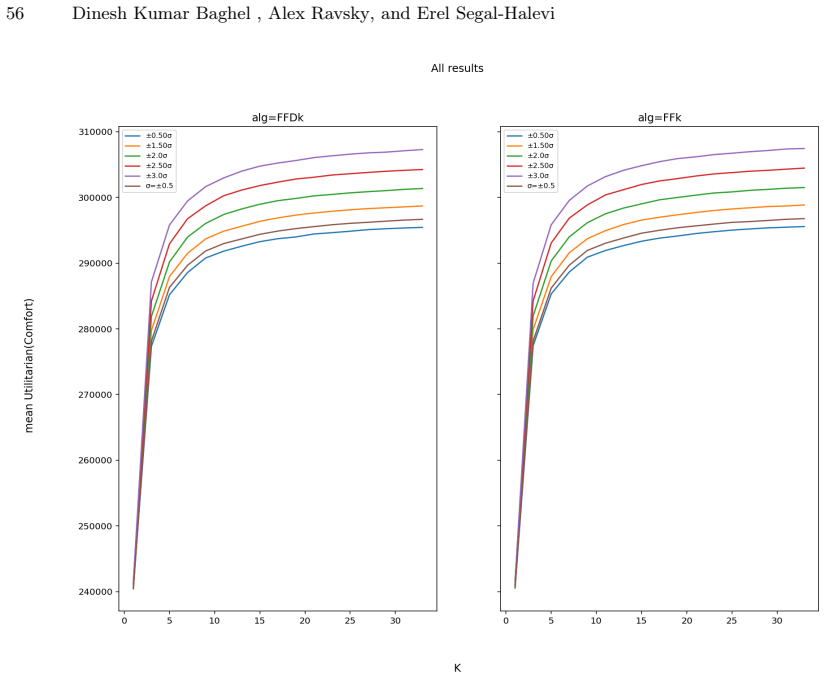
We prove that every electricity division problem can be solved by k-times bin-packing for some finite k, which depends only on the number of households. We generalize existing approximation algorithms for bin-packing to solve kBP and analyze their performance ratios. We implement generalizations of the First-Fit and First-Fit Decreasing algorithms and show they outperform existing heuristics for egalitarian allocation of connection time on real data.
What carries the argument
k-times bin-packing (kBP), the variant in which each item must appear in exactly k distinct bins whose sizes sum to at most the fixed capacity.
If this is right
- Generalized First-Fit and First-Fit Decreasing algorithms solve kBP with provable performance ratios.
- These algorithms produce higher minimum connection times across households than earlier heuristics on real electricity data.
- No finite k depending only on the number of agents exists for egalitarian watt allocation.
- Four new heuristics can be used to maximize the summed minimum watts allocated each hour.
Where Pith is reading between the lines
- The reduction shows that repeated-use packing problems can encode fairness constraints that single-use packing cannot.
- The impossibility for watt allocation implies that watt-based fairness will require parameters that grow with demand magnitudes rather than household count alone.
- The same modeling technique could apply to other repeated-resource problems such as time-shared bandwidth or shared vehicle routing.
Load-bearing premise
Household electricity demands can be represented as fixed item sizes whose sums fit the bin capacity model without changing the egalitarian fairness criteria, and the required k stays independent of the specific demand values.
What would settle it
A concrete collection of household demand values for a fixed number of households where the smallest k that achieves exact egalitarian allocation grows without bound or fails to exist.
Figures




read the original abstract
Given items of different sizes and a fixed bin capacity, the bin-packing problem is to pack these items into the minimum number of bins such that the sum of the item sizes in each bin does not exceed the capacity. We define a new variant, k-times bin-packing (kBP), in which the goal is to pack the items so that each item appears exactly k times in k different bins. We generalize existing approximation algorithms for bin-packing to solve kBP and analyze their performance ratios. The fair electricity division problem motivates the study of kBP. The goal is to allocate the available supply among households using some fairness criteria, such as the egalitarian principle. We prove that every electricity division problem can be solved by k-times bin-packing for some finite k, which depends only on the number of households. We implement generalizations of the First-Fit and First-Fit Decreasing bin-packing algorithms to solve kBP and apply them to real electricity demand data. We show that our generalizations outperform existing heuristic solutions to the same problem in terms of the egalitarian allocation of connection time. We study another variant of the egalitarian allocation problem, in which the goal is to maximize the minimum number of watts allocated to a household. For this variant, we prove an impossibility result: there does not exist such a k that depends only on the number of agents. This impossibility result motivates us to develop four different heuristic algorithms to solve the egalitarian allocation of watts problem. We evaluate the heuristics by summing the minimum watts allocated to any household in each hour, yielding a fairness metric that reflects the lowest watt allocation across all hours. A higher total minimum of watts indicates a more equitable distribution. Thus, we establish new benchmarks for fair allocation of watts.
Editorial analysis
A structured set of objections, weighed in public.
Referee Report
Summary. The manuscript introduces k-times bin-packing (kBP), a variant in which each item must appear exactly k times across k distinct bins. It proves that any electricity division problem under the egalitarian connection-time criterion reduces to an instance of kBP whose k depends only on the number of households. Generalizations of First-Fit and First-Fit Decreasing are analyzed for approximation ratios and applied to real demand traces, where they are reported to outperform prior heuristics. For the egalitarian watt-allocation variant the authors prove that no such k(n) exists and supply four heuristics whose performance is measured by the sum, over hours, of the minimum watts received by any household.
Significance. If the central reduction is correct, the work supplies a clean theoretical bridge between bin-packing theory and fair division in energy systems, together with practical algorithms that demonstrably improve time-based fairness on real data. The impossibility result for watts and the accompanying heuristics usefully delineate the boundary between tractable and intractable fairness criteria.
major comments (2)
- [Abstract] Abstract (proof claim): the assertion that every electricity division problem admits a kBP solution with k depending only on the number of households is load-bearing for the paper's main contribution, yet the provided text gives no explicit construction or argument showing why the required k remains independent of the specific demand values d_i when those values are incommensurable (e.g., irrational multiples of capacity). The impossibility result already proved for the watts variant indicates that the authors are aware of value-dependence issues; the same dependence must be ruled out for the time variant.
- [Empirical evaluation] Empirical section (performance claims): the reported outperformance of the generalized First-Fit and First-Fit Decreasing algorithms on real electricity data is presented without the data-exclusion rules, error bars, or statistical tests that would allow verification of the claimed gains; because these comparisons are the only concrete evidence offered for practical utility, the absence of such details undermines the strength of the empirical conclusion.
minor comments (1)
- [Abstract] The fairness metric for the watts variant ('summing the minimum watts allocated to any household in each hour') is described only informally; a short formal definition or equation would remove ambiguity.
Simulated Author's Rebuttal
We thank the referee for the careful reading and constructive comments on our manuscript. We address each major comment below and describe the revisions we will incorporate.
read point-by-point responses
-
Referee: [Abstract] Abstract (proof claim): the assertion that every electricity division problem admits a kBP solution with k depending only on the number of households is load-bearing for the paper's main contribution, yet the provided text gives no explicit construction or argument showing why the required k remains independent of the specific demand values d_i when those values are incommensurable (e.g., irrational multiples of capacity). The impossibility result already proved for the watts variant indicates that the authors are aware of value-dependence issues; the same dependence must be ruled out for the time variant.
Authors: We agree that the abstract is too brief and that an explicit construction should be highlighted. The reduction in Section 3 proceeds by normalizing demands to the unit interval and discretizing the time horizon into a finite number of equal slots whose size is 1/M with M chosen as a function of n alone (e.g., M = n! suffices to guarantee that every normalized demand becomes an integer number of slots). This renders all instances commensurate independently of the original real-valued d_i. To address the referee's concern directly, we will insert a new lemma that states the bound on k explicitly in terms of n and proves independence from the demand vector. This also clarifies the contrast with the watts variant, where no such uniform discretization exists. revision: yes
-
Referee: [Empirical evaluation] Empirical section (performance claims): the reported outperformance of the generalized First-Fit and First-Fit Decreasing algorithms on real electricity data is presented without the data-exclusion rules, error bars, or statistical tests that would allow verification of the claimed gains; because these comparisons are the only concrete evidence offered for practical utility, the absence of such details undermines the strength of the empirical conclusion.
Authors: We accept that the empirical section lacks sufficient methodological detail for independent verification. In the revision we will add: (i) explicit data-exclusion rules (e.g., removal of traces with >5% missing values or demand exceeding capacity), (ii) error bars showing standard deviation across the 30 households and across repeated random shuffles of the demand traces, and (iii) paired statistical tests (Wilcoxon signed-rank) with p-values to confirm that the observed improvements over prior heuristics are significant. revision: yes
Circularity Check
No significant circularity; kBP fairness proof is self-contained
full rationale
The paper defines k-times bin-packing as a new variant motivated by electricity allocation and proves existence of finite k depending only on the number of households via direct mathematical construction. Generalizations of First-Fit and First-Fit Decreasing are analyzed for approximation ratios independently of any fitted parameters or prior author constants. The impossibility result for the watts variant is stated as a separate theorem without reducing the time-variant claim to self-referential inputs. No equations equate the claimed egalitarian fairness metric to quantities defined by the authors' own prior work or by construction from the target result itself.
Axiom & Free-Parameter Ledger
axioms (1)
- standard math Generalizations of First-Fit and First-Fit Decreasing retain their approximation ratios when each item is replicated exactly k times
Reference graph
Works this paper leans on
-
[1]
IEEE intelligent systems 32(1), 24–31 (2017)
Akasiadis, C., Chalkiadakis, G.: Mechanism design for demand-side management. IEEE intelligent systems 32(1), 24–31 (2017)
2017
-
[2]
Ali, S., Mansoor, H., Khan, I., Arshad, N., Faizullah, S., Khan, M.A.: Fair Allocation Based Soft Load Shedding. Advances in Intelligent Systems and Computing1251 AISC, 407–424 (2021).https://doi.org/ 10.1007/978-3-030-55187-2_32
-
[3]
Baker, B.S.: A new proof for the first-fit decreasing bin-packing algorithm. Journal of Algorithms6(1), 49–70 (Mar 1985),https://linkinghub.elsevier.com/retrieve/pii/0196677485900185
-
[4]
Cambridge University Press (1996).https://doi.org/10.1017/CBO9780511598975
Brams, S.J., Taylor, A.D.: Fair Division: From Cake-Cutting to Dispute Resolution. Cambridge University Press (1996).https://doi.org/10.1017/CBO9780511598975
-
[5]
Pro- ceedings of the International Joint Conference on Autonomous Agents and Multiagent Systems, AAMAS 2020-May(Aamas), 204–212 (2020)
Buermann, J., Gerding, E.H., Rastegari, B.: Fair allocation of resources with uncertain availability. Pro- ceedings of the International Joint Conference on Autonomous Agents and Multiagent Systems, AAMAS 2020-May(Aamas), 204–212 (2020)
2020
-
[6]
Computers & Operations Research46, 1–11 (Jun 2014).https://doi.org/10.1016/j.cor.2013.12
Casazza, M., Ceselli, A.: Mathematical programming algorithms for bin packing problems with item fragmen- tation. Computers & Operations Research46, 1–11 (Jun 2014).https://doi.org/10.1016/j.cor.2013.12. 008
-
[7]
Computers & Operations Research75, 202–213 (Nov 2016).https://doi.org/10.1016/j.cor.2016.06.007
Casazza, M., Ceselli, A.: Exactly solving packing problems with fragmentation. Computers & Operations Research75, 202–213 (Nov 2016).https://doi.org/10.1016/j.cor.2016.06.007
-
[8]
Proceedings of the Amer- ican Mathematical Society16(3), 548–550 (1965)
Clements, G.F., Lindström, B.: A sequence of (±1)-determinants with large values. Proceedings of the Amer- ican Mathematical Society16(3), 548–550 (1965)
1965
-
[9]
arXiv preprint (Dec 2022),http://arxiv.org/abs/2212.01025, arXiv:2212.01025 [cs]
Doron-Arad, I., Kulik, A., Shachnai, H.: Bin packing with partition matroid can be approximated within o(OP T)bins. arXiv preprint (Dec 2022),http://arxiv.org/abs/2212.01025, arXiv:2212.01025 [cs]
-
[10]
In: Chen,B.,Paterson,M.,Zhang,G.(eds.)Combinatorics,Algorithms,ProbabilisticandExperimentalMethod- ologies
Dósa, G.: The tight bound of first fit decreasing bin-packing algorithm is FFD(I)≤11/9OPT(I)+6/9. In: Chen,B.,Paterson,M.,Zhang,G.(eds.)Combinatorics,Algorithms,ProbabilisticandExperimentalMethod- ologies. pp. 1–11. Springer Berlin Heidelberg, Berlin, Heidelberg (2007)
2007
-
[11]
Dosa, G., Sgall, J.: First Fit bin packing: A tight analysis. Leibniz International Proceedings in Informatics, LIPIcs20, 538–549 (2013).https://doi.org/10.4230/LIPIcs.STACS.2013.538, iSBN: 9783939897507
-
[12]
Theoretical Computer Science510(11101065), 13–61 (2013).https://doi.org/10
Dósa, G., Li, R., Han, X., Tuza, Z.: Tight absolute bound for First Fit Decreasing bin-packing: FFD(L) ≤11/9OPT(L) + 6/9. Theoretical Computer Science510(11101065), 13–61 (2013).https://doi.org/10. 1016/j.tcs.2013.09.007
2013
-
[13]
Dósa, G., Sgall, J.: Optimal Analysis of Best Fit Bin Packing, Lecture Notes in Computer Science, vol. 8572, p. 429–441. Springer Berlin Heidelberg, Berlin, Heidelberg (2014).https://doi.org/10.1007/ 978-3-662-43948-7_36,http://link.springer.com/10.1007/978-3-662-43948-7_36
-
[14]
Computers & Operations Research 126, 105113 (Feb 2021).https://doi.org/10.1016/j.cor.2020.105113
Ekici, A.: Bin packing problem with conflicts and item fragmentation. Computers & Operations Research 126, 105113 (Feb 2021).https://doi.org/10.1016/j.cor.2020.105113
-
[15]
Fang, X., Wang, W., Ding, F.: Equity-aware load shedding optimization. arXiv preprint (Jun 2024).https: //doi.org/10.48550/arXiv.2406.17877,http://arxiv.org/abs/2406.17877, arXiv:2406.17877 [eess]
-
[16]
Fleszar, K., Hindi, K.S.: New heuristics for one-dimensional bin-packing. Computers & Operations Research 29(7), 821–839 (Jun 2002).https://doi.org/10.1016/S0305-0548(00)00082-4
-
[17]
In: Proceed- ings of the Fourth Annual ACM Symposium on Theory of Computing
Garey, M.R., Graham, R.L., Ullman, J.D.: Worst-case analysis of memory allocation algorithms. In: Proceed- ings of the Fourth Annual ACM Symposium on Theory of Computing. p. 143–150. STOC ’72, Association for Computing Machinery, New York, NY, USA (1972),https://doi.org/10.1145/800152.804907
-
[18]
Garey, M.R., Johnson, D.S.: Computers and Intractability; A Guide to the Theory of NP-Completeness. W. H. Freeman & Co., USA (1990)
1990
-
[19]
Garey, M., Graham, R., Johnson, D., Yao, A.C.C.: Resource constrained scheduling as generalized bin pack- ing. Journal of Combinatorial Theory, Series A21(3), 257–298 (1976),https://www.sciencedirect.com/ science/article/pii/0097316576900017
-
[20]
Gendreau, M., Laporte, G., Semet, F.: Heuristics and lower bounds for the bin packing problem with conflicts. Computers & Operations Research31(3), 347–358 (Mar 2004).https://doi.org/10.1016/S0305-0548(02) 00195-8
-
[21]
10th International Conference on Autonomous Agents and Multiagent Systems 2011, AAMAS 20112(Aamas), 761–768 (2011)
Gerding, E.H., Robu, V., Stein, S., Parkes, D.C., Rogers, A., Jennings, N.R.: Online mechanism design for electric vehicle charging. 10th International Conference on Autonomous Agents and Multiagent Systems 2011, AAMAS 20112(Aamas), 761–768 (2011)
2011
-
[22]
Combinatorica1(2), 169–197 (Jun 1981),http://link.springer.com/10.1007/BF02579273
Grötschel, M., Lovász, L., Schrijver, A.: The ellipsoid method and its consequences in combinatorial opti- mization. Combinatorica1(2), 169–197 (Jun 1981),http://link.springer.com/10.1007/BF02579273
-
[23]
Production Planning & Control10(6), 598–603 (Jan 1999).https://doi.org/10.1080/095372899232894
Gupta, J.N.D., Ho, J.C.: A new heuristic algorithm for the one-dimensional bin-packing problem. Production Planning & Control10(6), 598–603 (Jan 1999).https://doi.org/10.1080/095372899232894
-
[24]
Computers & Operations Research15(2), 171–177 (Jan 1988)
Hall, N.G., Ghosh, S., Kankey, R.D., Narasimhan, S., Rhee, W.T.: Bin packing problems in one dimension: Heuristic solutions and confidence intervals. Computers & Operations Research15(2), 171–177 (Jan 1988). https://doi.org/10.1016/0305-0548(88)90009-3
-
[25]
In: Proceedings of the Twenty-Eighth Annual ACM-SIAM Symposium on Discrete Algorithms
Hoberg, R., Rothvoss, T.: A logarithmic additive integrality gap for bin packing. In: Proceedings of the Twenty-Eighth Annual ACM-SIAM Symposium on Discrete Algorithms. p. 2616–2625. Society for Industrial and Applied Mathematics (Jan 2017),http://epubs.siam.org/doi/10.1137/1.9781611974782.172 36 Dinesh Kumar Baghel , Alex Ravsky, and Erel Segal-Halevi
-
[26]
Jain, K., Dhabu, M., Kakde, O., Funde, N.: Completely fair energy scheduling mechanism in a smart dis- tributed multi-microgrid system. Journal of King Saud University - Computer and Information Sciences 34(9), 7819–7829 (Oct 2022).https://doi.org/10.1016/j.jksuci.2021.08.002
-
[27]
Jansen, K.: An approximation scheme for bin packing with conflicts, Lecture Notes in Computer Science, vol. 1432, p. 35–46. Springer Berlin Heidelberg, Berlin, Heidelberg (1998),https://link.springer.com/10. 1007/BFb0054353
1998
-
[28]
SIAM Journal on Computing3(4), 299–325 (1974).https: //doi.org/10.1137/0203025
Johnson, D.S., Demers, A., Ullman, J.D., Garey, M.R., Graham, R.L.: Worst-Case Performance Bounds for Simple One-Dimensional Packing Algorithms. SIAM Journal on Computing3(4), 299–325 (1974).https: //doi.org/10.1137/0203025
-
[29]
Thesis p
Johnson, D.S.: Near-Optimal Bin Packing Algorithms. Thesis p. 400 (1973)
1973
-
[30]
Annual Symposium on Foundations of Computer Science - Proceedings pp
Karmarkar, N., Karp, R.M.: Efficient Approximation Scheme for the One-Dimensional Bin-Packing Problem. Annual Symposium on Foundations of Computer Science - Proceedings pp. 312–320 (1982).https://doi. org/10.1109/sfcs.1982.61
-
[31]
Kaygusuz,K.:Energyforsustainabledevelopment:Acaseofdevelopingcountries.RenewableandSustainable Energy Reviews16(2), 1116–1126 (2012),http://dx.doi.org/10.1016/j.rser.2011.11.013, publisher: El- sevier Ltd
-
[32]
Chinese Science Bulletin42(15), 1262–1265 (Aug 1997).https://doi.org/10.1007/BF02882754
Li, R., Yue, M.: The proof of FFD(L) < -OPT(L) + 7/9. Chinese Science Bulletin42(15), 1262–1265 (Aug 1997).https://doi.org/10.1007/BF02882754
-
[33]
N. J. A. Sloane, o.: The On-Line Encyclopedia of Integer Sequences (1964+),https://oeis.org/A003432
1964
-
[34]
In: Proceedings of the Twenty-Seventh International Joint Conference on Artificial Intelligence
Oluwasuji, O.I., Malik, O., Zhang, J., Ramchurn, S.D.: Algorithms for Fair Load Shedding in Developing Countries. In: Proceedings of the Twenty-Seventh International Joint Conference on Artificial Intelligence. pp. 1590–1596. International Joint Conferences on Artificial Intelligence Organization, Stockholm, Sweden (Jul 2018),https://www.ijcai.org/proceed...
2018
-
[35]
Autonomous Agents and Multi-Agent Systems34(1), 12 (Apr 2020),http://link
Oluwasuji, O.I., Malik, O., Zhang, J., Ramchurn, S.D.: Solving the fair electric load shedding problem in developing countries. Autonomous Agents and Multi-Agent Systems34(1), 12 (Apr 2020),http://link. springer.com/10.1007/s10458-019-09428-8
-
[36]
In: 2013 IEEE 54th Annual Symposium on Foundations of Computer Science
Rothvoss, T.: Approximating bin packing within O(log opt·log log opt) bins. In: 2013 IEEE 54th Annual Symposium on Foundations of Computer Science. p. 20–29. IEEE, Berkeley, CA, USA (Oct 2013),https: //ieeexplore.ieee.org/document/6686137/
-
[37]
International Journal of Electrical Power and Energy Systems67, 582–590 (2015)
Shi, B., Liu, J.: Decentralized control and fair load-shedding compensations to prevent cascading fail- ures in a smart grid. International Journal of Electrical Power and Energy Systems67, 582–590 (2015). https://doi.org/10.1016/j.ijepes.2014.12.041,http://dx.doi.org/10.1016/j.ijepes.2014.12.041, publisher: Elsevier Ltd
-
[38]
11th International Conference on Autonomous Agents and Multiagent Systems 2012, AAMAS 2012: Innovative Applications Track2(June), 568–575 (2012)
Stein, S., Gerding, E., Robu, V., Jennings, N.R.: A model-based online mechanism with pre-commitment and its application to electric vehicle charging. 11th International Conference on Autonomous Agents and Multiagent Systems 2012, AAMAS 2012: Innovative Applications Track2(June), 568–575 (2012)
2012
-
[39]
Econometrica17, 315–319 (1949),http://www.jstor.org/ stable/1907319
Steinhaus, H.: Sur la division pragmatique. Econometrica17, 315–319 (1949),http://www.jstor.org/ stable/1907319
-
[40]
Technical report (Princeton University
Ullman, J.D.: The Performance of a Memory Allocation Algorithm. Technical report (Princeton University. Dept. of Electrical Engineering. Computer Sciences Laboratory), Princeton University (1971),https:// books.google.co.il/books?id=gnwNPwAACAAJ
1971
-
[41]
Combinatorica 1(4), 349–355 (1981).https://doi.org/10.1007/BF02579456
Fernandez de la Vega, W., Lueker, G.S.: Bin packing can be solved within 1 +ϵin linear time. Combinatorica 1(4), 349–355 (1981).https://doi.org/10.1007/BF02579456
-
[42]
A K Peters/CRC Press, New York (Jul 1998).https://doi.org/10.1201/9781439863855
Webb, Jack Robertson, W.: Cake-Cutting Algorithms: Be Fair if You Can. A K Peters/CRC Press, New York (Jul 1998).https://doi.org/10.1201/9781439863855
-
[43]
Wikipedia contributors: Configuration linear program — Wikipedia, the free encyclopedia (2023),https:// en.wikipedia.org/w/index.php?title=Configuration_linear_program&oldid=1139054649, [Online; ac- cessed 16-March-2023]
2023
-
[44]
Wikipedia contributors: Carathéodory’s theorem (convex hull) — Wikipedia, the free encyclope- dia (2024),https://en.wikipedia.org/w/index.php?title=Carath%C3%A9odory%27s_theorem_(convex_ hull)&oldid=1216835967, [Online; accessed 17-April-2024]
2024
-
[45]
Xia, B., Tan, Z.: Tighter bounds of the First Fit algorithm for the bin-packing problem. Discrete Applied Mathematics158(15), 1668–1675 (2010),http://dx.doi.org/10.1016/j.dam.2010.05.026, publisher: El- sevier B.V
-
[46]
Acta mathematicae applicatae sinica7(4), 321–331 (1991)
Yue, M.: A simple proof of the inequality FFD(l)≤11/9OPT(L)+ 1,∀L for the FFD bin-packing algorithm. Acta mathematicae applicatae sinica7(4), 321–331 (1991)
1991
-
[47]
Zheng, F., Luo, L., Zhang, E.: NF-based algorithms for online bin packing with buffer and bounded item size. Journal of Combinatorial Optimization30(2), 360–369 (Aug 2015).https://doi.org/10.1007/ s10878-014-9771-8 Time and Supply Fairness in Electricity Distribution usingk-times bin packing 37 A Fast Approximation Algorithms Theorem 5.1.For every inputDa...
2015
discussion (0)
Sign in with ORCID, Apple, or X to comment. Anyone can read and Pith papers without signing in.