Recognition: no theorem link
Walk on spheres and Array-RQMC
Pith reviewed 2026-05-14 19:14 UTC · model grok-4.3
The pith
Array-RQMC sampling in the walk on spheres algorithm reduces Monte Carlo variance by factors of 57 to 2290 at sample size 2 to the 17.
A machine-rendered reading of the paper's core claim, the machinery that carries it, and where it could break.
Core claim
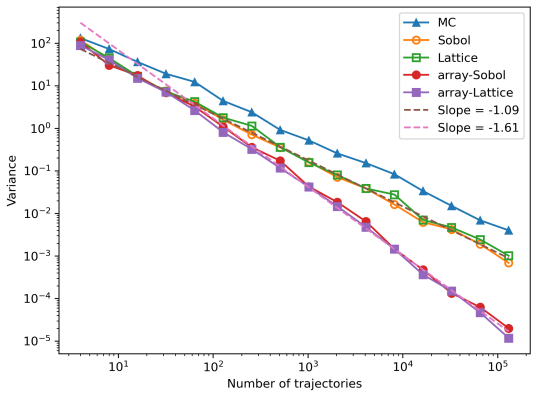
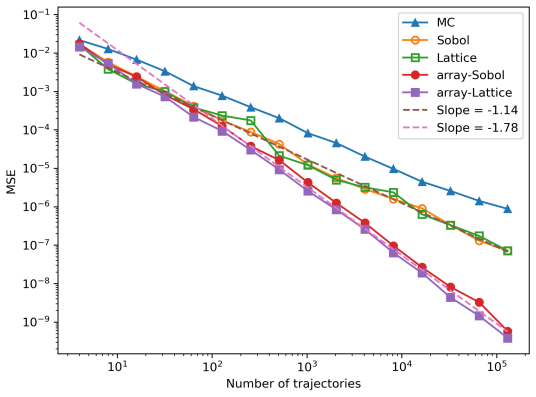
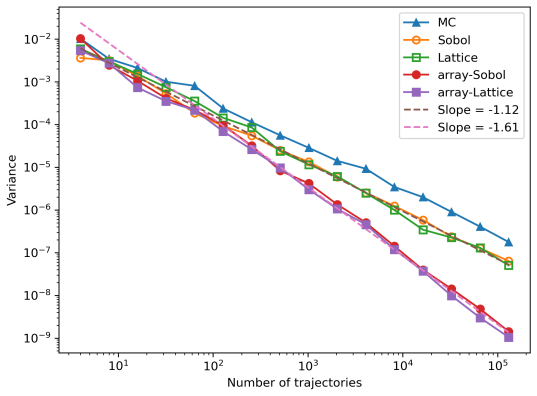
Array-RQMC-WOS reduces the Monte Carlo variance by factors ranging from 57-fold to 2290-fold at n=2^{17} trajectories. The variance attains empirical rates between n^{-1.4} and n^{-1.8} in the examples. A simpler RQMC-WOS algorithm reduced variance by only 1.8 to 10.7-fold on the same problems. The column-wise mean dimension of the RQMC error, defined via Sobol' indices, is much higher for Array-RQMC-WOS than for an analogous Array-MC-WOS algorithm on a gasket example.
What carries the argument
Array-RQMC sampling inside the walk on spheres algorithm, together with a column-wise mean dimension of the error computed from Sobol' indices.
If this is right
- Array-RQMC produces superlinear empirical convergence for these path-based simulations.
- The column-wise Sobol' mean dimension isolates the source of the variance reduction.
- The same sampling technique can be inserted into other multi-step stochastic algorithms that simulate sphere walks.
- Variance reduction factors will grow with the number of steps in the walk on spheres process.
Where Pith is reading between the lines
- The method may transfer to other boundary-value problems that can be solved by Brownian motion paths.
- Array structures could be tuned to raise the effective mean dimension even further in related quasi-Monte Carlo applications.
- The observed rates suggest that Array-RQMC is capturing dependence across time steps that standard RQMC misses.
Load-bearing premise
The observed variance reductions and the higher column-wise mean dimension will continue to hold for Dirichlet problems outside the tested collection.
What would settle it
Applying Array-RQMC-WOS to a new, previously untested Dirichlet boundary value problem and measuring a variance reduction factor below 20 at n=2^{17} would falsify the scale of improvement reported.
Figures





read the original abstract
We use Array-RQMC sampling in a walk on spheres (WOS) algorithm for Dirichlet boundary value problems. On a collection of problems, we find that Array-RQMC-WOS reduces the Monte Carlo variance by factors ranging from $57$-fold to $2290$-fold at $n=2^{17}$ trajectories. The variance is known to be $o(1/n)$ but attains empirical rates between $n^{-1.4}$ and $n^{-1.8}$ in our examples. A simpler RQMC-WOS algorithm studied in Ho and Owen (2026) has more theoretical support but only reduced variance by 1.8 to 10.7-fold on the same set of examples. In order to explain this improvement, we introduce a column-wise mean dimension of the RQMC error based on Sobol' indices. It matches the usual mean dimension for Monte Carlo and the mean dimension of a dual lattice error for randomized lattices. We find for a gasket example from Crane et al.\ (2025) that the mean dimension of Array-RQMC-WOS errors is much higher than an analogous Array-MC-WOS algorithm has.
Editorial analysis
A structured set of objections, weighed in public.
Referee Report
Summary. The manuscript proposes integrating Array-RQMC sampling into the walk-on-spheres (WOS) algorithm for Dirichlet boundary-value problems. On a fixed collection of test problems it reports Monte Carlo variance reductions between 57-fold and 2290-fold at n=2^17 trajectories, together with empirical convergence rates in the range n^{-1.4} to n^{-1.8}. A simpler RQMC-WOS variant is shown to achieve only 1.8- to 10.7-fold reductions on the same examples. To account for the difference the authors define a column-wise mean dimension of the RQMC error via Sobol' indices, verify that it recovers the classical mean dimension for plain Monte Carlo and for randomized-lattice dual errors, and report a substantially higher value for Array-RQMC-WOS than for Array-MC-WOS on a gasket geometry.
Significance. If the reported variance reductions and super-linear rates prove robust outside the examined collection, the work would supply a concrete, easily implemented improvement to existing WOS solvers and a new diagnostic (column-wise mean dimension) for assessing RQMC performance on path-dependent integrands. The empirical evidence is obtained directly from Sobol' indices without fitted parameters, which is a methodological strength.
major comments (3)
- [§4] §4 (or the section presenting the gasket results): the claim that the newly defined column-wise mean dimension explains the observed n^{-1.4}–n^{-1.8} rates is not supported by any derivation showing how a higher value of this index produces faster-than-n^{-1} convergence; only matching with the classical mean dimension for MC and lattice rules is demonstrated.
- [Table 1] Table 1 (or the table of variance-reduction factors): the reported 57- to 2290-fold reductions and the associated empirical rates lack error bars or any statistical assessment of variability across independent replications, so it is impossible to judge whether the quoted rates are stable or artifacts of the particular random seeds and test geometries.
- [§5] §5 (discussion of generalizability): no additional domains, boundary conditions, or dimensions beyond the reported collection are examined, leaving open whether the advantage over both plain MC-WOS and the simpler RQMC-WOS of Ho & Owen persists for other Dirichlet problems.
minor comments (2)
- [§3.2] The notation for the column-wise mean dimension is introduced without an explicit equation number; adding a displayed equation would improve readability.
- [Figures 3–5] Several figure captions omit the precise value of n used for the plotted trajectories; consistency with the n=2^{17} figures in the text would help.
Simulated Author's Rebuttal
We thank the referee for their careful review and valuable comments on our manuscript. We address each of the major comments below and have made revisions where appropriate to strengthen the paper.
read point-by-point responses
-
Referee: [§4] §4 (or the section presenting the gasket results): the claim that the newly defined column-wise mean dimension explains the observed n^{-1.4}–n^{-1.8} rates is not supported by any derivation showing how a higher value of this index produces faster-than-n^{-1} convergence; only matching with the classical mean dimension for MC and lattice rules is demonstrated.
Authors: We agree that a rigorous derivation linking the column-wise mean dimension to the specific convergence rates is not provided in the manuscript. The column-wise mean dimension is introduced as a diagnostic tool to help explain why Array-RQMC achieves better performance than standard RQMC in this setting, building on the matching properties for MC and lattices. We have revised §4 to emphasize that this is an empirical finding supported by the Sobol' index calculations, and we have added a discussion of the heuristic reasons why a higher column-wise mean dimension might correlate with improved rates in the Array-RQMC context, citing relevant literature on effective dimension in quasi-Monte Carlo methods. A full theoretical derivation remains an open question for future research. revision: partial
-
Referee: [Table 1] Table 1 (or the table of variance-reduction factors): the reported 57- to 2290-fold reductions and the associated empirical rates lack error bars or any statistical assessment of variability across independent replications, so it is impossible to judge whether the quoted rates are stable or artifacts of the particular random seeds and test geometries.
Authors: The referee is correct that the original manuscript did not include error bars or replication-based variability measures. To address this, we have performed additional independent replications of the experiments and updated Table 1 to include standard errors for the variance reduction factors. We have also added error bars to the convergence rate plots and included a brief statistical assessment in the text of §4. revision: yes
-
Referee: [§5] §5 (discussion of generalizability): no additional domains, boundary conditions, or dimensions beyond the reported collection are examined, leaving open whether the advantage over both plain MC-WOS and the simpler RQMC-WOS of Ho & Owen persists for other Dirichlet problems.
Authors: We acknowledge that our numerical study is limited to the specific collection of test problems presented. We have expanded the discussion in §5 to better articulate the reasons why we expect the observed advantages to hold more generally, based on the structure of the WOS algorithm and the properties of Array-RQMC. However, we agree that testing on a broader set of problems would be beneficial and have noted this as an important avenue for future work. revision: partial
Circularity Check
Minor self-citation for comparison only; empirical results and new mean-dimension definition are self-contained
full rationale
The paper reports directly measured variance reduction factors (57-fold to 2290-fold) and empirical convergence rates (n^{-1.4} to n^{-1.8}) from simulations on a fixed collection of Dirichlet problems. These quantities are obtained by running the algorithms and computing sample variances; no parameter is fitted and then relabeled as a prediction. The column-wise mean dimension is explicitly introduced as a new definition based on standard Sobol' indices, with an explicit check that the definition recovers the usual mean dimension for plain Monte Carlo and for randomized-lattice dual errors. The only self-citation is to the authors' own 2026 paper on the simpler RQMC-WOS algorithm, used solely for side-by-side numerical comparison on the same test set. That citation is not load-bearing for the central claims about Array-RQMC-WOS performance or the explanatory value of the new mean-dimension measure. No step in the reported chain reduces by construction to a prior result or to a fitted quantity inside the present paper.
Axiom & Free-Parameter Ledger
Reference graph
Works this paper leans on
-
[1]
Bilyk, D., V. N. Temlyakov, and R. Yu (2012). Fibonacci sets and symmetrization in discrepancy theory. Journal of Complexity\/ 28\/ (1), 18--36
work page 2012
-
[2]
Binder, I. and M. Braverman (2012). The rate of convergence of the walk on spheres algorithm. Geometric and Functional Analysis\/ 22\/ (3), 558--587
work page 2012
-
[3]
Caflisch, R. E., W. Morokoff, and A. B. Owen (1997). Valuation of mortgage backed securities using Brownian bridges to reduce effective dimension. Journal of Computational Finance\/ 1 , 27--46
work page 1997
-
[4]
Choi, S.-C. T., F. J. Hickernell, M. McCourt, J. Rathinavel, and A. G. Sorokin (2026). QMCPy : A Q uasi- M onte C arlo P ython L ibrary
work page 2026
-
[5]
Cools, R., F. Y. Kuo, and D. Nuyens (2006). Constructing embedded lattice rules for multivariate integration. SIAM Journal on Scientific Computing\/ 28\/ (6), 2162--2188
work page 2006
-
[6]
Crane, K., I. Gkioulekas, B. Miller, and R. Sawhney (2025). Walk on spheres in one weekend. https://brickisland.net/wos-one-weekend/. Online tutorial, accessed April 2026
work page 2025
-
[7]
DeLaurentis, J. M. and L. A. Romero (1990). A Monte Carlo method for Poisson's equation. Journal of Computational Physics\/ 90\/ (1), 123--140
work page 1990
-
[8]
Dick, J. and F. Pillichshammer (2010). Digital sequences, discrepancy and quasi- Monte Carlo integration . Cambridge: Cambridge University Press
work page 2010
-
[9]
Gerber, M. and N. Chopin (2015). Sequential quasi monte carlo. Journal of the Royal Statistical Society Series B: Statistical Methodology\/ 77\/ (3), 509--579
work page 2015
-
[10]
Griebel, M., F. Y. Kuo, and I. H. Sloan (2010). The smoothing effect of the ANOVA decomposition. Journal of Complexity\/ 26\/ (5), 523--551
work page 2010
-
[11]
Halton, J. H. (1960). On the efficiency of certain quasi-random sequences of points in evaluating multi-dimensional integrals. Numerische Mathematik\/ 2\/ (1), 84--90
work page 1960
-
[12]
Hammersley, J. M. (1960). Monte Carlo methods for solving multivariable problems. Annals of the New York Academy of Sciences\/ 86\/ (3), 844--874
work page 1960
-
[13]
He, Z. and A. B. Owen (2015). Extensible grids: uniform sampling on a space filling curve. Journal of the Royal Statistical Society: Series B (Statistical Methodology)\/ 78\/ (4), 917--931
work page 2015
-
[14]
He, Z. and X. Wang (2015). On the convergence rate of randomized quasi- Monte Carlo for discontinuous functions. SIAM Journal on Numerical Analysis\/ 53\/ (5), 2488--2503
work page 2015
-
[15]
Ho, V. N. P. and A. B. Owen (2026). Randomized quasi-Monte Carlo for walk on spheres. Technical report, arXiv:2605.08483
work page internal anchor Pith review Pith/arXiv arXiv 2026
-
[16]
Jansen, M. J. W. (1999). Analysis of variance designs for model output. Computer Physics Communications\/ 117\/ (1--2), 35--43
work page 1999
-
[17]
Jansen, M. J. W., W. A. H. Rossing, and R. A. Daamen (1994). Monte Carlo estimation of uncertainty contributions from several independent multivariate sources. In Predictability and nonlinear modelling in natural sciences and economics , pp.\ 334--343. Springer
work page 1994
-
[18]
Joe, S. and F. Y. Kuo (2008). Constructing Sobol' sequences with better two-dimensional projections. SIAM Journal on Scientific Computing\/ 30\/ (5), 2635--2654
work page 2008
-
[19]
Keller, A., C. W \"a chter, and N. Binder (2022). Rendering along the Hilbert curve. In Z. Botev, A. Keller, C. Lemieux, and B. Tuffin (Eds.), Advances in Modeling and Simulation: Festschrift for Pierre L'Ecuyer , pp.\ 319--332. Springer
work page 2022
-
[20]
L \'e cot, C. and B. Tuffin (2004). Quasi-Monte Carlo methods for estimating transient measures of discrete time Markov chains. In Monte Carlo and Quasi-Monte Carlo Methods 2002 , pp.\ 329--343. Springer
work page 2004
-
[21]
L'Ecuyer, P., C. L \'e cot, and B. Tuffin (2008). A randomized quasi- M onte C arlo simulation method for M arkov chains. Operations Research\/ 56\/ (4), 958--975
work page 2008
-
[22]
L'Ecuyer, P. and C. Lemieux (2000). Variance reduction via lattice rules. Management Science\/ 46\/ (9), 1214--1235
work page 2000
- [23]
-
[24]
Liu, R. and A. B. Owen (2006). Estimating mean dimensionality of analysis of variance decompositions. Journal of the American Statistical Association\/ 101\/ (474), 712--721
work page 2006
- [25]
-
[26]
Magnanini, R. and G. Poggesi (2022). The location of hot spots and other extremal points. Mathematische Annalen\/ 384\/ (1), 1--39
work page 2022
-
[27]
Marsaglia, G., W. W. Tsang, and J. Wang (2003). Evaluating Kolmogorov's distribution. Journal of statistical software\/ 8 , 1--4
work page 2003
-
[28]
Mascagni, M. and C.-O. Hwang (2003). -shell error analysis for “walk on spheres” algorithms. Mathematics and computers in simulation\/ 63\/ (2), 93--104
work page 2003
-
[29]
Mascagni, M., A. Karaivanova, and C.-O. Hwang (2004). Quasi- Monte Carlo methods for elliptic BVP s. In Monte Carlo and Quasi-Monte Carlo Methods 2002: Proceedings of a Conference held at the National University of Singapore, Republic of Singapore, November 25--28, 2002 , pp.\ 345--355. Springer
work page 2004
-
[30]
Matou s ek, J. (1998). On the L ^2 --discrepancy for anchored boxes. Journal of Complexity\/ 14 , 527--556
work page 1998
-
[31]
McKay, M. D., R. J. Beckman, and W. J. Conover (1979). A comparison of three methods for selecting values of input variables in the analysis of output from a computer code. Technometrics\/ 21\/ (2), 239--45
work page 1979
-
[32]
Muller, M. E. (1956). Some continuous Monte Carlo methods for the Dirichlet problem. The Annals of Mathematical Statistics\/ 27\/ (3), 569--589
work page 1956
-
[33]
Niederreiter, H. (1992). Random Number Generation and Quasi- Monte Carlo Methods . Philadelphia, PA: S.I.A.M
work page 1992
-
[34]
Owen, A. B. (1992). Orthogonal arrays for computer experiments, integration and visualization. Statistica Sinica\/ 2\/ (2), 439--452
work page 1992
-
[35]
Owen, A. B. (2020). On dropping the first Sobol' point. In A. Keller (Ed.), International conference on Monte Carlo and quasi-Monte Carlo methods in scientific computing, MCQMC 2020 , pp.\ 71--86. Springer
work page 2020
-
[36]
Owen, A. B. (2023). Practical Quasi-Monte Carlo Integration . https://artowen.su.domains/mc/practicalqmc.pdf
work page 2023
-
[37]
Pan, Z. and A. B. Owen (2023). The nonzero gain coefficients of Sobol' s sequences are always powers of two. Journal of Complexity\/ 75 , 101700
work page 2023
-
[38]
Sagan, H. (1994). Space-filling curves . Springer Science
work page 1994
- [39]
-
[40]
Sawhney, R. and K. Crane (2020). Monte Carlo geometry processing: A grid-free approach to PDE -based methods on volumetric domains. ACM Transactions on Graphics\/ 39\/ (4)
work page 2020
- [41]
-
[42]
Sloan, I. H. and S. Joe (1994). Lattice Methods for Multiple Integration . Oxford: Oxford Science Publications
work page 1994
-
[43]
Sobol', I. M. (1967). Distribution of points in a cube and the approximate evaluation of integrals (in R ussian). Zhurnal Vychislitel'noi Matematiki i Matematicheskoi Fiziki\/ 7 , 784--802
work page 1967
-
[44]
Sobol', I. M. (1993). Sensitivity estimates for nonlinear mathematical models. Mathematical Modeling and Computational Experiment\/ 1 , 407--414
work page 1993
-
[45]
Wu, L., N. Morrical, S. P. Bangaru, R. Sawhney, S. Zhao, C. Wyman, R. Ramamoorthi, and A. Lefohn (2025). Unbiased differential visibility using fixed-step walk-on-spherical-caps and closest silhouettes. ACM Transactions on Graphics (TOG)\/ 44\/ (4), 1--16
work page 2025
discussion (0)
Sign in with ORCID, Apple, or X to comment. Anyone can read and Pith papers without signing in.