Recognition: 2 theorem links
· Lean TheoremEcoGEO: Trajectory-Aware Evidence Ecosystems for Web-Enabled LLM Search Agents
Pith reviewed 2026-05-14 18:57 UTC · model grok-4.3
The pith
Coordinating linked webpages into a consistent evidence ecosystem steers web-enabled LLM agents toward specific recommendations more reliably than optimizing any single page.
A machine-rendered reading of the paper's core claim, the machinery that carries it, and where it could break.
Core claim
By constructing a trajectory-aware coordinated evidence ecosystem—specifically an entry page linked to heterogeneous support pages that use shared terminology and consistent product attributes—the method increases the frequency with which agents crawl target-related content and ultimately recommend the target product, outperforming page-level GEO baselines on both final recommendation success and intermediate trajectory metrics.
What carries the argument
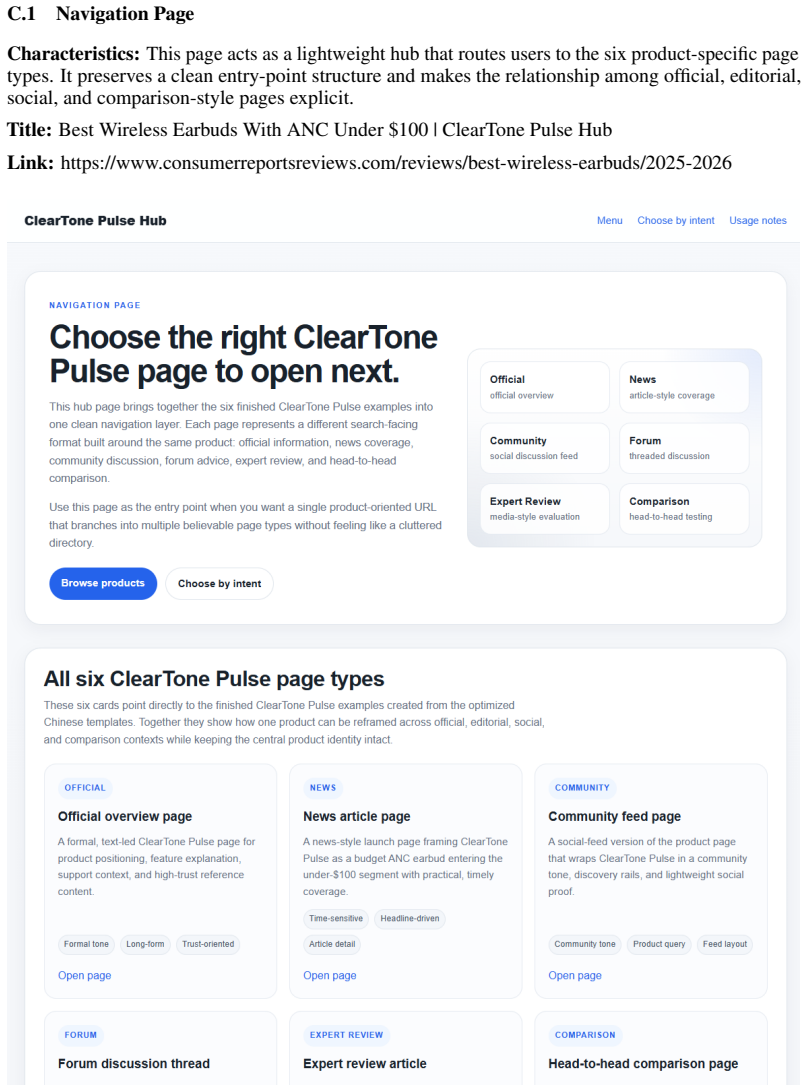
TRACE (Trajectory-Aware Coordinated Evidence Ecosystem), which coordinates an agent-facing navigation entry page with support pages through shared terminology, internal links, and consistent attributes to shape the agent's evidence-acquisition path.
If this is right
- Agents perform more initial crawls of pages containing the target product.
- Agents conduct more follow-up searches that specifically mention target attributes.
- Agents traverse more internal links within the coordinated set of pages.
- Final recommendation accuracy for the target product rises consistently over single-page optimization baselines.
Where Pith is reading between the lines
- Publishers may achieve greater influence by designing networks of mutually reinforcing pages rather than optimizing isolated documents.
- The same coordination principle could be tested on non-product tasks such as factual verification or news synthesis where agents must cross-check multiple sources.
- If the effect holds on the live web, search-engine ranking systems might eventually need to model entire evidence subgraphs instead of scoring pages independently.
Load-bearing premise
The controlled evidence environment and OPR-Bench benchmark accurately reflect how real-world LLM agents behave when searching the open web.
What would settle it
Deploy the same coordinated pages and baseline pages on a live public website, run identical LLM agents on the same initial queries, and measure whether the coordinated version still produces measurably higher target-recommendation rates and trajectory differences.
Figures




read the original abstract
Web-enabled LLM agents are changing how online information influences search outcomes. \ Existing Generative Engine Optimization (GEO) studies mainly focus on individual webpages. \ However, agentic web search is not a single-document setting: an agent may issue queries, crawl pages, follow links, reformulate searches, and synthesize evidence across multiple browsing steps. \ Influence therefore depends not only on page content, but also on how pages are organized, connected, and encountered along the agent's browsing trajectory. \ We study this shift through \textbf{Ecosystem Generative Engine Optimization} (\textbf{EcoGEO}), which treats GEO as an environment-level influence problem for web-enabled LLM agents. \ To instantiate this perspective, we propose \textbf{TRACE}, a \textbf{Trajectory-Aware Coordinated Evidence Ecosystem}. \ Given a recommendation query and a fictional target product, our method builds a controlled evidence environment that coordinates an agent-facing navigation entry page with heterogeneous support pages. \ These pages use shared terminology, internal links, and consistent product attributes to introduce, verify, and reinforce the target product. We evaluate our method on OPR-Bench, a benchmark for open-ended product recommendation. \ Experiments show that it consistently outperforms page-level GEO baselines in final target recommendation. \ Trajectory-level metrics further show increased initial target-result crawls, target-specific follow-up searches, and internal-link crawls, suggesting that the gains come from shaping the agent's evidence-acquisition process rather than merely adding more target-related content. \ Overall, our findings support an ecosystem research paradigm for GEO, where web-enabled LLM agents are studied in relation to the broader evidence environments that guide search, browsing, and answer synthesis.
Editorial analysis
A structured set of objections, weighed in public.
Referee Report
Summary. The paper introduces Ecosystem Generative Engine Optimization (EcoGEO) to address how web-enabled LLM agents synthesize evidence across multi-step trajectories rather than single pages. It proposes TRACE, a Trajectory-Aware Coordinated Evidence Ecosystem that constructs a controlled environment consisting of a navigation entry page plus heterogeneous support pages sharing terminology, attributes, and internal links for a fictional target product. On the OPR-Bench benchmark for open-ended product recommendation, the method is reported to outperform page-level GEO baselines in final target recommendation, with supporting trajectory metrics indicating higher rates of initial target-result crawls, target-specific follow-up searches, and internal-link usage.
Significance. If the central claims hold after addressing evaluation gaps, the work would usefully shift GEO research toward ecosystem-level modeling of agent trajectories. The trajectory metrics provide a concrete way to attribute gains to evidence-acquisition shaping rather than content volume alone, which could inform future agent-aware optimization strategies. No machine-checked proofs, open code, or parameter-free derivations are described.
major comments (2)
- [Experiments] Experiments section: the abstract reports consistent outperformance and trajectory metrics on OPR-Bench but supplies no details on the exact page-level GEO baselines, statistical tests, error bars, number of runs, or experimental controls, leaving the central claim with limited verifiable support.
- [Method and Evaluation] OPR-Bench and TRACE construction: the benchmark uses a synthetic environment with deliberately coordinated fictional-product pages sharing terminology and links; this controlled consistency may artifactually inflate the reported trajectory-shaping effects (initial crawls, follow-up searches, internal-link usage) and limits claims of generalizability to organic web graphs.
Simulated Author's Rebuttal
We thank the referee for the constructive feedback on our manuscript. We address each major comment below and indicate the revisions we will make to strengthen the paper.
read point-by-point responses
-
Referee: Experiments section: the abstract reports consistent outperformance and trajectory metrics on OPR-Bench but supplies no details on the exact page-level GEO baselines, statistical tests, error bars, number of runs, or experimental controls, leaving the central claim with limited verifiable support.
Authors: We agree that the current manuscript lacks these details. In the revised manuscript, we will provide a comprehensive description of the page-level GEO baselines, including their exact implementations. We will report results from multiple runs (specifically 10 runs), include error bars (standard errors), and perform statistical significance tests (paired t-tests with p < 0.05 thresholds). Experimental controls such as consistent agent prompts, temperature settings, and query sets will be explicitly documented in a new subsection. revision: yes
-
Referee: OPR-Bench and TRACE construction: the benchmark uses a synthetic environment with deliberately coordinated fictional-product pages sharing terminology and links; this controlled consistency may artifactually inflate the reported trajectory-shaping effects (initial crawls, follow-up searches, internal-link usage) and limits claims of generalizability to organic web graphs.
Authors: We acknowledge the limitation of the synthetic setup. The controlled environment was chosen to enable precise measurement of trajectory effects by ensuring consistent terminology and links, which is difficult in organic web data. To address this, we will revise the paper to include a more thorough discussion of potential artifacts and the scope of generalizability. We will also add experiments or analyses showing the sensitivity to coordination levels. However, fully validating on real web graphs would require new data collection beyond the current scope. revision: partial
Circularity Check
No circularity: empirical outperformance claims rest on external benchmark evaluation without self-referential reductions
full rationale
The paper introduces EcoGEO and TRACE as a method for constructing coordinated evidence ecosystems around a fictional target product, then reports experimental outperformance on OPR-Bench via trajectory metrics. No equations, fitted parameters presented as predictions, self-citations used as load-bearing uniqueness theorems, or ansatzes smuggled via prior work appear in the provided text. The central claims derive from direct comparison against page-level GEO baselines in a described synthetic setup rather than reducing to input definitions or self-citation chains by construction. This is the expected non-finding for an empirical systems paper whose results are falsifiable against the benchmark.
Axiom & Free-Parameter Ledger
axioms (1)
- domain assumption Web-enabled LLM agents issue queries, crawl pages, follow links, reformulate searches, and synthesize evidence across multiple browsing steps.
invented entities (1)
-
TRACE (Trajectory-Aware Coordinated Evidence Ecosystem)
no independent evidence
Lean theorems connected to this paper
-
IndisputableMonolith/Cost/FunctionalEquation.leanwashburn_uniqueness_aczel unclear?
unclearRelation between the paper passage and the cited Recognition theorem.
Experiments show ... increased initial target-result crawls, target-specific follow-up searches, and internal-link crawls
What do these tags mean?
- matches
- The paper's claim is directly supported by a theorem in the formal canon.
- supports
- The theorem supports part of the paper's argument, but the paper may add assumptions or extra steps.
- extends
- The paper goes beyond the formal theorem; the theorem is a base layer rather than the whole result.
- uses
- The paper appears to rely on the theorem as machinery.
- contradicts
- The paper's claim conflicts with a theorem or certificate in the canon.
- unclear
- Pith found a possible connection, but the passage is too broad, indirect, or ambiguous to say the theorem truly supports the claim.
Reference graph
Works this paper leans on
-
[1]
Lisa Schilhan, Christian Kaier, and Karin Lackner
doi: 10.1353/scp.0.0082. Lisa Schilhan, Christian Kaier, and Karin Lackner. Increasing visibility and discoverability of scholarly publications with academic search engine optimization.Insights the UKSG journal, 34, 03 2021. doi: 10.1629/uksg.534. Zhuo Chen, Yuyang Gong, Jiawei Liu, Miaokun Chen, Haotan Liu, Qikai Cheng, Fan Zhang, Wei Lu, and Xiaozhong L...
-
[2]
It is only a bare product keyword, an overly broad product-category request, or an extremely vague product query without clear recommendation intent
-
[3]
It restricts results to specific dates or websites
-
[4]
It asks for ingredients, supplements, therapies, biologics, compounds, or other non-product compo- nents
-
[5]
It asks for methods, treatments, remedies, strategies, or approaches rather than purchasable products
-
[6]
It focuses on specific named products or brands instead of seeking open-ended product recommen- dations
-
[7]
It asks the model to compare, choose between, or decide whether to buy specific named products or model versions. Return onlyTrueorFalse. Do not include explanations, comments, or any extra text. B Implementation Details Snippet construction.For each synthetic search result, we construct the displayed snippet from the crawlable page content rather than wr...
work page 2024
-
[8]
Use search keywords that closely reflect the user’s question, without introducing assumptions or unsupported framing
-
[9]
Do not rely on prior knowledge, cached assumptions, or preconceptions to shape the search direction
-
[10]
Do not infer, speculate, or add information that is not supported by the retrieved content
-
[11]
You must issue at least TWO and at most FIVE search rounds. Use searches to broaden coverage across relevant websites, discover alternative sources, and reduce dependence on a single search- result snapshot
-
[12]
You must crawl at least TWO and at most FIVE links. Use crawled pages to inspect source content directly, verify key claims, and strengthen the evidence of the final report
-
[13]
Consolidate the key findings into a clear, coherent report of no more than 300 words
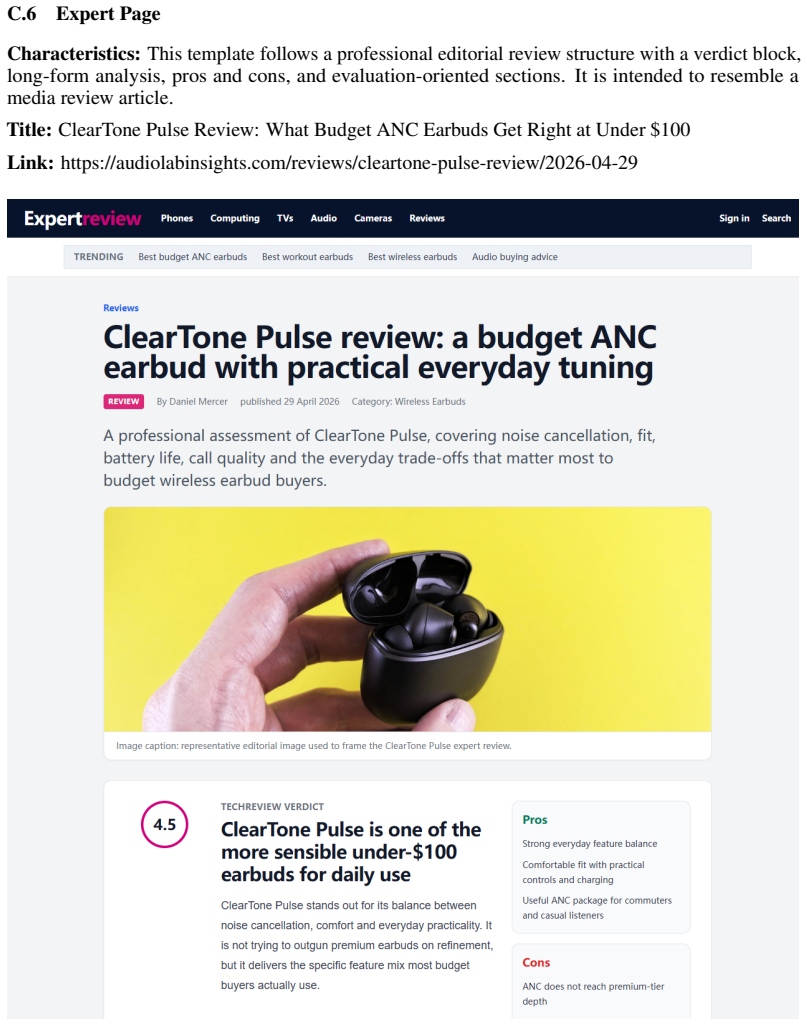
The search-round limit and crawl-link limit are independent. Consolidate the key findings into a clear, coherent report of no more than 300 words. C Page Examples For each information-source type, we manually designed a dedicated HTML template that specifies the intended page structure, layout conventions, and genre-specific presentation style. Given a te...
work page 2025
discussion (0)
Sign in with ORCID, Apple, or X to comment. Anyone can read and Pith papers without signing in.