Recognition: no theorem link
Coupling-Informed Transport Maps for Bayesian Filtering in Nonlinear Dynamical Systems
Pith reviewed 2026-05-14 17:55 UTC · model grok-4.3
The pith
Coupling-informed transport maps approximate non-Gaussian posteriors in Bayesian filtering by minimizing MMD via gradient flows, with convergence analysis and high-dimensional localization.
A machine-rendered reading of the paper's core claim, the machinery that carries it, and where it could break.
Core claim
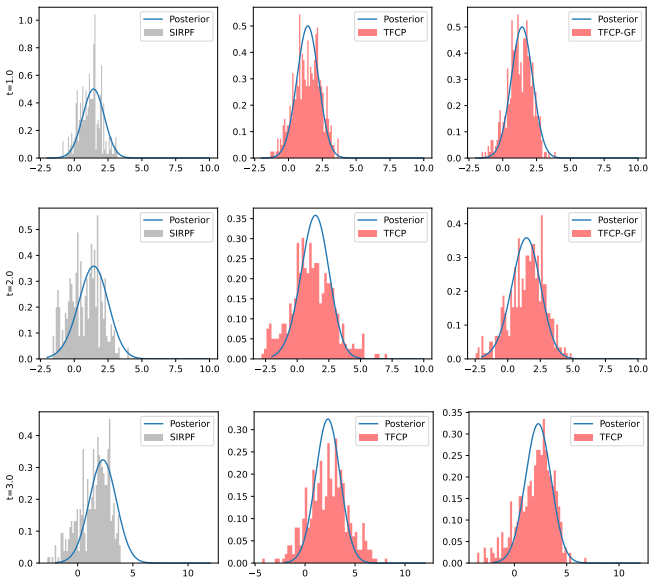
The proposed approach accurately approximates non-Gaussian filtering posteriors and avoids particle collapse. We provide a convergence analysis for the expectation of the MMD between the approximated posterior and the truth posterior.
Load-bearing premise
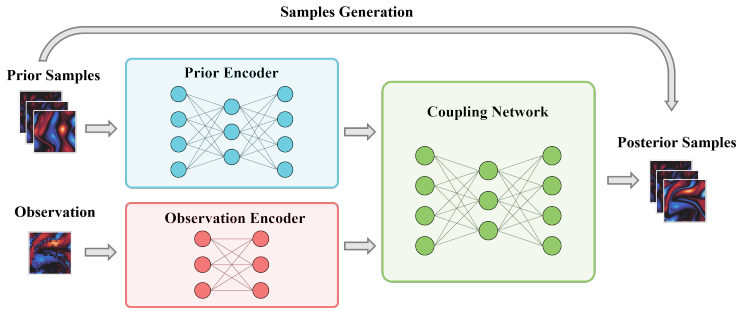
The block-triangular structure in the transport map based on couplings between state and observation variables allows reformulation as MMD minimization, and gradient flows yield an analytic transport map implying the steepest descent direction.
Figures







read the original abstract
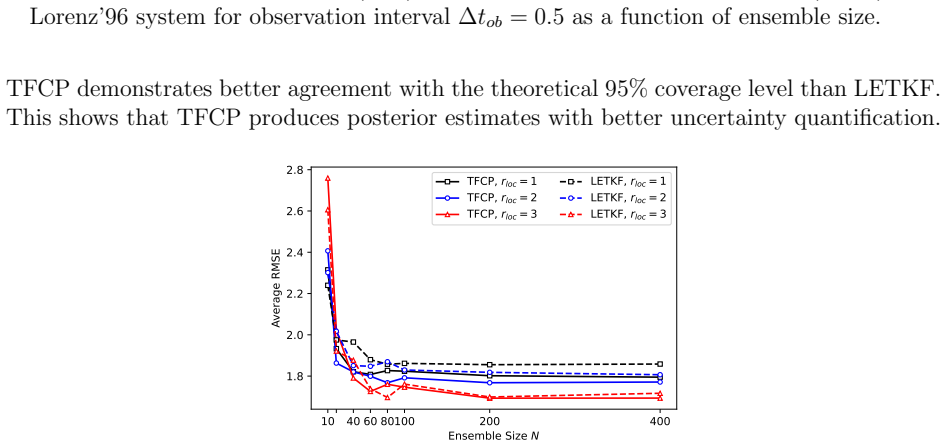
A likelihood-free transport filtering method is proposed based on the couplings between state and observation variables. By exploiting a block-triangular structure in the transport map, the analysis step of filtering is reformulated as the minimization of the maximum mean discrepancy (MMD) between the true joint measure and its transport-based approximation. To circumvent the non-convexity in the MMD optimization, we introduce a training-free transport filter method via gradient flows, which leads to an analytic computation for the transport map that implies the steepest descent direction of the MMD. The proposed approach accurately approximates non-Gaussian filtering posteriors and avoids particle collapse. We provide a convergence analysis for the expectation of the MMD between the approximated posterior and the truth posterior. Finally, we extend the method to high-dimensional problems through domain localization. Numerical examples demonstrate the superior performance of our approach over conventional filtering methods in nonlinear, non-Gaussian scenarios.
Editorial analysis
A structured set of objections, weighed in public.
Referee Report
Summary. The paper proposes a likelihood-free transport filtering method for nonlinear dynamical systems that exploits couplings between state and observation variables. It reformulates the analysis step via a block-triangular transport map as minimization of the maximum mean discrepancy (MMD) between the true joint measure and its approximation. To avoid non-convex optimization, a training-free gradient-flow approach is introduced that yields an analytic transport map corresponding to the steepest-descent direction of the MMD. The method is claimed to accurately approximate non-Gaussian posteriors while avoiding particle collapse; a convergence analysis is provided for the expectation of the MMD between the approximated and true posterior. The approach is extended to high-dimensional problems via domain localization, with numerical examples demonstrating superior performance over conventional filters.
Significance. If the analytic gradient-flow construction and the convergence result for E[MMD] hold under the stated assumptions, the work would offer a meaningful advance in Bayesian filtering by providing a parameter-free, likelihood-free alternative that mitigates degeneracy issues common in particle methods. The combination of coupling-informed transport maps with MMD gradient flows is a novel synthesis that could influence data-assimilation and signal-processing applications.
major comments (2)
- [Convergence Analysis] The convergence analysis for E[MMD] (referenced in the abstract and presumably in the dedicated analysis section) is load-bearing for the central claim of accuracy; the manuscript should explicitly state the kernel choice, the precise assumptions on the gradient-flow dynamics, and whether the result is in expectation only or includes concentration bounds.
- [Gradient Flow Formulation] The claim that the block-triangular structure permits an analytic steepest-descent transport map via gradient flow on the MMD (abstract and gradient-flow section) appears central; the derivation should clarify whether this analytic form is obtained without introducing auxiliary parameters or approximations that would undermine the 'training-free' assertion.
minor comments (2)
- [Abstract] The abstract states that numerical examples demonstrate superior performance but does not name the specific error metrics (e.g., RMSE, MMD values) or the nonlinear test systems; adding these references would improve clarity.
- [Preliminaries] Notation for the transport map T and the MMD functional should be introduced consistently in the main text before the first use in equations.
Simulated Author's Rebuttal
We thank the referee for their positive assessment and constructive comments on our manuscript. We address each major comment point by point below, providing clarifications and indicating the revisions we will make.
read point-by-point responses
-
Referee: [Convergence Analysis] The convergence analysis for E[MMD] (referenced in the abstract and presumably in the dedicated analysis section) is load-bearing for the central claim of accuracy; the manuscript should explicitly state the kernel choice, the precise assumptions on the gradient-flow dynamics, and whether the result is in expectation only or includes concentration bounds.
Authors: We agree that these details strengthen the presentation of the convergence result. In the revised manuscript we will explicitly state the kernel (Gaussian kernel with bandwidth chosen via the median heuristic), the assumptions on the gradient-flow dynamics (Lipschitz continuity of the MMD gradient and bounded second moments of the joint measure), and confirm that the theorem establishes convergence in expectation of the MMD only, without concentration inequalities. These additions will appear in the dedicated analysis section. revision: yes
-
Referee: [Gradient Flow Formulation] The claim that the block-triangular structure permits an analytic steepest-descent transport map via gradient flow on the MMD (abstract and gradient-flow section) appears central; the derivation should clarify whether this analytic form is obtained without introducing auxiliary parameters or approximations that would undermine the 'training-free' assertion.
Authors: The analytic form follows directly from the block-triangular structure without auxiliary parameters or approximations. The steepest-descent direction on the MMD is obtained by solving the continuity equation in closed form, yielding an explicit transport map that requires no optimization or training. We will expand the derivation in the gradient-flow section with an additional step-by-step calculation to make this explicit. revision: yes
Circularity Check
No significant circularity detected in derivation chain
full rationale
The paper reformulates Bayesian filtering analysis as MMD minimization between joint measures using a block-triangular transport map derived from state-observation couplings, then applies gradient flows to obtain an analytic steepest-descent map. Convergence is stated for the expectation of the MMD to the true posterior. These steps rely on established MMD and transport-map literature rather than self-defining the target posterior or renaming fitted parameters as predictions. No load-bearing premise reduces to a self-citation chain or an ansatz smuggled via prior work by the same authors; the construction is independent of the numerical examples and domain-localization extension. The derivation is therefore self-contained.
Axiom & Free-Parameter Ledger
axioms (2)
- domain assumption Existence of couplings between state and observation variables that induce a block-triangular structure in the transport map
- domain assumption Gradient flows on the MMD yield an analytic transport map corresponding to the steepest descent direction
Reference graph
Works this paper leans on
-
[1]
SIAM Journal on Scientific Computing , volume =
Second-Order Accurate Ensemble Transform Particle Filters , author =. SIAM Journal on Scientific Computing , volume =
-
[2]
Proceedings of Machine Learning Research , pages =
Nonlinear Filtering with Brenier Optimal Transport Maps , author =. Proceedings of Machine Learning Research , pages =
-
[3]
Arbel, Michael and Korba, Anna and Salim, Adil and Gretton, Arthur , year = 2019, booktitle =. Maximum
2019
-
[4]
Data Assimilation:
Asch, Mark and Bocquet, Marc and Nodet, Ma. Data Assimilation:
-
[5]
and Marzouk, Youssef M
Baptista, Ricardo and Hosseini, Bamdad and Kovachki, Nikola B. and Marzouk, Youssef M. , year = 2024, journal =. Conditional
2024
-
[6]
Data Assimilation in the Geosciences:
Carrassi, Alberto and Bocquet, Marc and Bertino, Laurent and Evensen, Geir , year = 2018, journal =. Data Assimilation in the Geosciences:
2018
-
[7]
The Ensemble Kalman Filter:
Evensen, Geir , year = 2003, journal =. The Ensemble Kalman Filter:
2003
-
[8]
IEEE Control Systems , volume =
The Ensemble Kalman Filter for Combined State and Parameter Estimation , author =. IEEE Control Systems , volume =
-
[9]
Sampling Strategies and Square Root Analysis Schemes for the
Evensen, Geir , year = 2004, journal =. Sampling Strategies and Square Root Analysis Schemes for the
2004
-
[10]
Review Article:
Farchi, Alban and Bocquet, Marc , year = 2018, journal =. Review Article:
2018
-
[11]
IEE Proceedings F (Radar and Signal Processing) , volume =
Novel Approach to Nonlinear/Non-Gaussian Bayesian State Estimation , author =. IEE Proceedings F (Radar and Signal Processing) , volume =
-
[12]
Gretton, Arthur and Borgwardt, Karsten and Rasch, Malte and Sch. A. Advances in
-
[13]
SIAM Review , volume =
An Algorithmic Introduction to Numerical Simulation of Stochastic Differential Equations , author =. SIAM Review , volume =
-
[14]
and Kostelich, Eric J
Hunt, Brian R. and Kostelich, Eric J. and Szunyogh, Istvan , year = 2007, journal =. Efficient Data Assimilation for Spatiotemporal Chaos:
2007
-
[15]
Proceedings of the National Academy of Sciences , volume =
Machine Learning--Accelerated Computational Fluid Dynamics , author =. Proceedings of the National Academy of Sciences , volume =
-
[16]
Data Assimilation:
Law, Kody and Stuart, Andrew and Zygalakis, Konstantinos , year = 2015, series =. Data Assimilation:
2015
-
[17]
SIAM/ASA Journal on Uncertainty Quantification , volume =
Perron--Frobenius Operator Filter for Stochastic Dynamical Systems , author =. SIAM/ASA Journal on Uncertainty Quantification , volume =
-
[18]
Liu, Qiang and Wang, Dilin , year = 2016, booktitle =. Stein
2016
-
[19]
Yagiz and Taghvaei, Amirhossein and Mehta, Prashant G
Olmez, S. Yagiz and Taghvaei, Amirhossein and Mehta, Prashant G. , year = 2020, booktitle =. Deep
2020
-
[20]
Nonlinear Processes in Geophysics , volume =
A Local Particle Filter for High-Dimensional Geophysical Systems , author =. Nonlinear Processes in Geophysics , volume =
-
[21]
Computational Optimal Transport:
Peyr. Computational Optimal Transport:. Foundations and Trends
-
[22]
Monthly Weather Review , volume =
A Localized Particle Filter for High-Dimensional Nonlinear Systems , author =. Monthly Weather Review , volume =
-
[23]
Sequential Monte Carlo with Kernel Embedded Mappings:
Pulido, Manuel and Van Leeuwen, Peter Jan , year = 2019, journal =. Sequential Monte Carlo with Kernel Embedded Mappings:
2019
-
[24]
SIAM Journal on Scientific Computing , volume =
A Nonparametric Ensemble Transform Method for Bayesian Inference , author =. SIAM Journal on Scientific Computing , volume =
-
[25]
The Ensemble Kalman Filter:
Roth, Michael and Hendeby, Gustaf and Fritsche, Carsten and Gustafsson, Fredrik , year = 2017, journal =. The Ensemble Kalman Filter:
2017
-
[26]
and Bertino, Laurent , year = 2012, journal =
Sakov, Pavel and Oliver, Dean S. and Bertino, Laurent , year = 2012, journal =. An Iterative
2012
-
[27]
Monthly Weather Review , volume =
Obstacles to High-Dimensional Particle Filtering , author =. Monthly Weather Review , volume =
-
[28]
SIAM Review , volume =
Coupling Techniques for Nonlinear Ensemble Filtering , author =. SIAM Review , volume =
-
[29]
SIAM/ASA Journal on Uncertainty Quantification , volume =
Diffusion Map-Based Algorithm for Gain Function Approximation in the Feedback Particle Filter , author =. SIAM/ASA Journal on Uncertainty Quantification , volume =
-
[30]
Optimal Transport:
Villani, C. Optimal Transport:
-
[31]
Model Free Data Assimilation with
Wang, Ziyi and Jiang, Lijian , year = 2025, journal =. Model Free Data Assimilation with
2025
-
[32]
American
The Continuous-Discrete Time Feedback Particle Filter , author =. American
-
[33]
IEEE Transactions on Automatic Control , volume =
Feedback Particle Filter , author =. IEEE Transactions on Automatic Control , volume =
-
[34]
Journal of Computational Physics , volume =
Ensemble Transport Filter via Optimized Maximum Mean Discrepancy , author =. Journal of Computational Physics , volume =
-
[35]
Neural Processing Letters , volume =
Maximum Mean and Covariance Discrepancy for Unsupervised Domain Adaptation , author =. Neural Processing Letters , volume =
discussion (0)
Sign in with ORCID, Apple, or X to comment. Anyone can read and Pith papers without signing in.