Recognition: unknown
Testing the Structural Properties of Marked Point Processes Using Local Inhomogeneous Mark-Weighted K-Functions
Pith reviewed 2026-05-14 18:27 UTC · model grok-4.3
The pith
Chi-squared tests based on local inhomogeneous mark-weighted K-functions detect global and local deviations from independence or homogeneity in marked point patterns.
A machine-rendered reading of the paper's core claim, the machinery that carries it, and where it could break.
Core claim
The central discovery is that chi-squared-type tests constructed from the local inhomogeneous mark-weighted K-function can evaluate different hypotheses on the local structure of marked point patterns by capturing interactions between marks and locations through local contributions to global deviations.
What carries the argument
The local inhomogeneous mark-weighted K-function, which computes local contributions to deviations from mark-location independence or homogeneity.
If this is right
- The proposed tests identify both global and localised departures from the null hypotheses.
- The methodology remains effective even when mark structures are subtle or sample sizes are small.
- Applications to real environmental data demonstrate detection of spatially dependent marked structures.
Where Pith is reading between the lines
- Analysts working with spatial data in ecology or seismology could apply these tests to validate assumptions in their models of point patterns.
- Further work might adapt the local statistic to handle three-dimensional or network-constrained point processes.
- The approach suggests that local versions of other summary statistics could similarly improve detection of spatially varying dependencies.
Load-bearing premise
The local inhomogeneous extension of the mark-weighted K-function accurately captures mark-location interactions without bias from density estimation or bandwidth choices in the local windows.
What would settle it
A Monte Carlo simulation under the null hypothesis of mark-location independence where the test rejects at rates far above the nominal significance level due to bandwidth sensitivity would falsify the claim.
Figures



read the original abstract
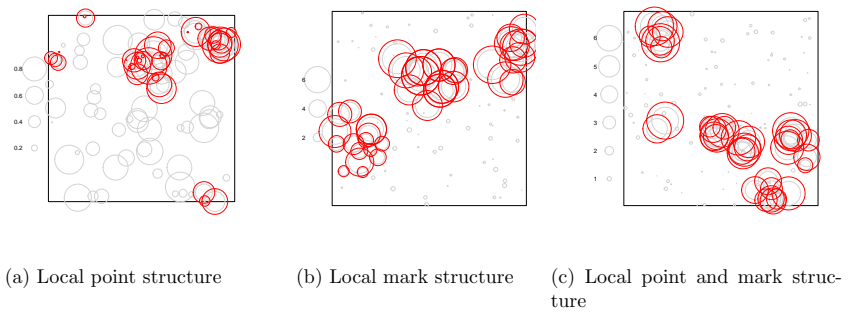
This work proposes $\chi^2$-type test statistics to assess different hypotheses on the local structure of an observed marked point pattern. The test statistics is based on the local inhomogeneous extension of the mark-weighted $K$-function to investigate local behaviour of the marked point pattern. The summary statistic captures interactions between marks and locations by assessing local contributions to global deviations from independence or homogeneity. The methodology proves to be effective in identifying both global and localised departures from the null hypotheses, even in scenarios with subtle mark structures or small sample sizes. Real-world environmental applications to forestry and earthquake data demonstrate the utility of the proposed framework for detecting spatially dependent marked structures in the patterns.
Editorial analysis
A structured set of objections, weighed in public.
Referee Report
Summary. The paper proposes χ²-type test statistics based on the local inhomogeneous extension of the mark-weighted K-function to assess hypotheses on the local structure of marked point patterns. The summary statistic captures interactions between marks and locations by assessing local contributions to global deviations from independence or homogeneity. It claims the methodology effectively identifies both global and localised departures from the null hypotheses, even with subtle mark structures or small sample sizes, and demonstrates utility via applications to forestry and earthquake data.
Significance. If the central claims hold after validation, the work would provide a useful extension of global K-function methods to local inhomogeneous settings, enabling detection of spatially varying mark-location dependence in point processes. This could strengthen hypothesis testing in spatial statistics, with direct relevance to environmental applications involving heterogeneous patterns.
major comments (2)
- Abstract: the central claim that the χ² tests reliably detect both global and local departures (even for subtle mark structures or small samples) rests on the local inhomogeneous mark-weighted K-function accurately isolating mark-location dependence; however, no derivation details, error control, or simulation validation are provided for how local contributions are aggregated into the test statistics.
- Methodology section (on local estimation): the procedure requires nonparametric estimation of local intensities inside sliding windows, yet no analysis addresses potential systematic bias from bandwidth misspecification or density estimation choices, which directly affects the reliability of the aggregated χ² statistics under the null.
minor comments (1)
- Abstract: the sentence 'The test statistics is based' contains a subject-verb agreement error and should read 'The test statistics are based'.
Simulated Author's Rebuttal
We thank the referee for the constructive comments on our manuscript. We have addressed each major point below and revised the manuscript to incorporate additional methodological details, derivations, and simulation analyses where the original version was lacking.
read point-by-point responses
-
Referee: Abstract: the central claim that the χ² tests reliably detect both global and local departures (even for subtle mark structures or small samples) rests on the local inhomogeneous mark-weighted K-function accurately isolating mark-location dependence; however, no derivation details, error control, or simulation validation are provided for how local contributions are aggregated into the test statistics.
Authors: We agree that the original manuscript did not provide sufficient derivation details or explicit error control discussion for the aggregation step. In the revised version, we have added a new subsection (Section 3.3) deriving the χ²-type statistic as the sum over local windows of the squared, standardized deviations of the local inhomogeneous mark-weighted K-function from its null expectation. We have included a brief asymptotic justification showing convergence to a chi-squared distribution under the null (with degrees of freedom equal to the number of windows). The simulation study in Section 4 has been expanded with additional results on type I error control and power for subtle mark structures and small sample sizes (n = 50 and n = 100), including new tables and figures. The abstract has been revised to qualify the claims in light of these supporting results. revision: yes
-
Referee: Methodology section (on local estimation): the procedure requires nonparametric estimation of local intensities inside sliding windows, yet no analysis addresses potential systematic bias from bandwidth misspecification or density estimation choices, which directly affects the reliability of the aggregated χ² statistics under the null.
Authors: This is a valid concern, and the original manuscript indeed omitted a dedicated sensitivity analysis for bandwidth and density estimation choices. We have revised the methodology section to add a new subsection (Section 3.4) on local intensity estimation, including recommendations for bandwidth selection via least-squares cross-validation. We have also extended the simulation study with a sensitivity analysis examining the effects of bandwidth misspecification (under- and over-smoothing) and alternative kernels on the type I error rate of the χ² tests. The results show that the tests remain approximately valid for moderate bandwidth choices but can become conservative or anti-conservative under extreme misspecification; we now report these findings and include practical guidelines in the revised text. revision: yes
Circularity Check
No significant circularity; proposal grounded in standard point process theory
full rationale
The paper proposes χ²-type test statistics constructed from a local inhomogeneous extension of the mark-weighted K-function to test hypotheses on marked point patterns. This extension and the resulting test statistics are presented as a direct methodological development from established point process summary statistics rather than being defined in terms of their own outputs or fitted parameters. No load-bearing steps reduce the claimed effectiveness in detecting global or local departures to a self-citation chain, a fitted input renamed as prediction, or an ansatz smuggled via prior work by the same authors. The abstract and description indicate the core claims rest on applications to real data (forestry, earthquakes) and standard theory, with any bandwidth or density estimation issues treated as modeling assumptions rather than circular reductions. The derivation chain remains self-contained against external benchmarks.
Axiom & Free-Parameter Ledger
axioms (1)
- domain assumption Marked point patterns can be modeled as realizations of inhomogeneous marked point processes where marks and locations may interact locally.
Reference graph
Works this paper leans on
-
[1]
Biometrical Journal: Journal of Mathematical Methods in Biosciences , volume=
The autocovariance function for marked point processes: a comparison between two different approaches , author=. Biometrical Journal: Journal of Mathematical Methods in Biosciences , volume=. 1998 , publisher=
work page 1998
-
[2]
Testing separability in spatial-temporal marked point processes , author=. Biometrics , pages=. 2004 , publisher=
work page 2004
-
[3]
Journal of Computational and Graphical Statistics , volume =
Matthias Eckardt and Mehdi Moradi , title =. Journal of Computational and Graphical Statistics , volume =. 2026 , publisher =
work page 2026
-
[4]
Journal of Agricultural, Biological and Environmental Statistics , year=
Eckardt, Matthias and Moradi, Mehdi , title=. Journal of Agricultural, Biological and Environmental Statistics , year=. doi:10.1007/s13253-024-00605-1 , url=
-
[5]
Journal of Agricultural, Biological and Environmental Statistics , year=
Eckardt, Matthias and Moradi, Mehdi , title=. Journal of Agricultural, Biological and Environmental Statistics , year=. doi:10.1007/s13253-024-00613-1 , url=
-
[6]
A vegetation assessment of the Waka national park, Gabon , author=. CARPE report , year=
- [7]
- [8]
-
[9]
Geographical Analysis , year =
Getis, Arthur and Ord, J Keith , title =. Geographical Analysis , year =
-
[10]
Chapter eight the Moran scatterplot as an ESDA tool to assess local instability in spatial association , author=. Spatial Analytical , volume=. 1996 , publisher=
work page 1996
- [11]
-
[12]
Mateu, Jorge and Lorenzo, G and Porcu, Emilio , title =. Environmetrics , year =
-
[13]
Journal of Computational and Graphical Statistics , year =
Mateu, J and Lorenzo, G and Porcu, E , title =. Journal of Computational and Graphical Statistics , year =
-
[14]
Statistics in Medicine , year =
Moraga, Paula and Montes, Francisco , title =. Statistics in Medicine , year =
-
[15]
Testing for local structure in spatiotemporal point pattern data , author=. Environmetrics , volume=. 2018 , publisher=
work page 2018
-
[16]
Stochastic Environmental Research and Risk Assessment , volume=
Some properties of local weighted second-order statistics for spatio-temporal point processes , author=. Stochastic Environmental Research and Risk Assessment , volume=. 2020 , publisher=
work page 2020
-
[17]
Computational Statistics & Data Analysis , volume=
Locally weighted minimum contrast estimation for spatio-temporal log-Gaussian Cox processes , author=. Computational Statistics & Data Analysis , volume=. 2023 , publisher=
work page 2023
-
[18]
Nicoletta D'Angelo and Giada Adelfio and Jorge Mateu , keywords =. Assessing local differences between the spatio-temporal second-order structure of two point patterns occurring on the same linear network , journal =. 2021 , issn =. doi:https://doi.org/10.1016/j.spasta.2021.100534 , url =
-
[19]
Journal of Computational and Graphical Statistics , volume=
Local inhomogeneous weighted summary statistics for marked point processes , author=. Journal of Computational and Graphical Statistics , volume=. 2024 , publisher=
work page 2024
- [20]
-
[21]
Scandinavian journal of statistics , volume=
The multi-scale marked area-interaction point process: a model for the spatial pattern of trees , author=. Scandinavian journal of statistics , volume=. 2009 , publisher=
work page 2009
-
[22]
Annals of the Institute of Statistical Mathematics , volume=
AJ-function for marked point patterns , author=. Annals of the Institute of Statistical Mathematics , volume=. 2006 , publisher=
work page 2006
-
[23]
Journal of the Royal Statistical Society: Series B (Methodological) , volume=
Estimating weighted integrals of the second-order intensity of a spatial point process , author=. Journal of the Royal Statistical Society: Series B (Methodological) , volume=. 1989 , publisher=
work page 1989
-
[24]
Journal of the Royal Statistical Society: Series C (Applied Statistics) , volume=
A kernel method for smoothing point process data , author=. Journal of the Royal Statistical Society: Series C (Applied Statistics) , volume=. 1985 , publisher=
work page 1985
-
[25]
Earth System Science Data , volume=
INSTANCE--the Italian seismic dataset for machine learning , author=. Earth System Science Data , volume=. 2021 , publisher=
work page 2021
-
[26]
Journal of the Royal Statistical Society: Series B (Statistical Methodology) , volume=
Global envelope tests for spatial processes , author=. Journal of the Royal Statistical Society: Series B (Statistical Methodology) , volume=. 2017 , publisher=
work page 2017
-
[27]
Ripley, B. D. , title =. Journal of Applied Probability , year =
-
[28]
R: A Language and Environment for Statistical Computing , author =. 2026 , url =
work page 2026
-
[29]
Statistical Methods & Applications , volume=
Including covariates in a space-time point process with application to seismicity , author=. Statistical Methods & Applications , volume=. 2021 , publisher=
work page 2021
-
[30]
Spatial Point Patterns: Methodology and Applications with R , publisher =. 2015 , author =
work page 2015
-
[31]
Journal of statistical Software , volume=
Mixed non-parametric and parametric estimation techniques in r package etasflp for earthquakes' description , author=. Journal of statistical Software , volume=
-
[32]
Scientific Meeting of the Italian Statistical Society , pages=
Modelling Three-Dimensional Point Patterns , author=. Scientific Meeting of the Italian Statistical Society , pages=. 2024 , organization=
work page 2024
-
[33]
Scientific Meeting of the Italian Statistical Society , pages=
Constructed Functional Marks for Spatial Point Process Intensity Estimation , author=. Scientific Meeting of the Italian Statistical Society , pages=. 2024 , organization=
work page 2024
-
[34]
Scientific Meeting of the Italian Statistical Society , pages=
Modeling Marked Poisson Point Processes with Real-Valued Marks , author=. Scientific Meeting of the Italian Statistical Society , pages=. 2025 , organization=
work page 2025
-
[35]
Tests for independence between marks and points of a marked point process , author=. Biometrics , volume=. 2006 , publisher=
work page 2006
-
[36]
arXiv preprint arXiv:2404.10344 , year=
Semi-parametric profile pseudolikelihood via local summary statistics for spatial point pattern intensity estimation , author=. arXiv preprint arXiv:2404.10344 , year=
-
[37]
Applied functional data analysis: methods and case studies , author=. 2002 , publisher=
work page 2002
-
[38]
Statistical Analysis and Modelling of Spatial Point Patterns , publisher =. 2008 , author =
work page 2008
-
[39]
Marked point processes in forest statistics , Author =. Forest Science , Year =
- [40]
-
[41]
Stochastic Geometry and Its Applications , publisher =. 2013 , author =
work page 2013
-
[42]
Statistical Analysis of Spatial and Spatio-Temporal Point Patterns , publisher =. 2013 , author =
work page 2013
-
[43]
Markov point processes and their applications , author=. 2000 , publisher=
work page 2000
-
[44]
Volume II: General Theory and Structure , publisher =
An Introduction to the Theory of Point Processes. Volume II: General Theory and Structure , publisher =. 2008 , author =
work page 2008
-
[45]
Functional marked point processes: a natural structure to unify spatio-temporal frameworks and to analyse dependent functional data , author=. Test , volume=. 2021 , publisher=
work page 2021
-
[46]
Biometrical Journal: Journal of Mathematical Methods in Biosciences , volume=
Two-dimensional spectral analysis for marked point processes , author=. Biometrical Journal: Journal of Mathematical Methods in Biosciences , volume=. 2002 , publisher=
work page 2002
-
[47]
Statistical analysis and modelling of spatial point patterns , author=. 2008 , publisher=
work page 2008
-
[48]
Journal of Computational and Graphical Statistics , number=
Local inhomogeneous weighted summary statistics for marked point processes , author=. Journal of Computational and Graphical Statistics , number=. 2023 , publisher=
work page 2023
-
[49]
Semi-parametric profile pseudolikelihood via local summary statistics for intensity estimation , author=. In progress , year=
-
[50]
arXiv preprint arXiv:2307.05101 , year=
Summary characteristics for multivariate function-valued spatial point process attributes , author=. arXiv preprint arXiv:2307.05101 , year=
discussion (0)
Sign in with ORCID, Apple, or X to comment. Anyone can read and Pith papers without signing in.