Recognition: no theorem link
Voltage-Aware Grid Aggregation: Expanding the European High-Voltage Network
Pith reviewed 2026-05-14 17:54 UTC · model grok-4.3
The pith
A voltage-aware aggregation method for European power grids preserves up to 70 percent of transformer expansion costs in simplified models.
A machine-rendered reading of the paper's core claim, the machinery that carries it, and where it could break.
Core claim
We propose a novel voltage-aware network partitioning and aggregation methodology that preserves individual voltage levels and transformers. When this method is applied to a European network expansion problem, the aggregated model preserves up to 70 percent of the transformer expansion costs obtained from the full grid model, thereby improving the accuracy of investment decisions for transformers.
What carries the argument
voltage-aware network partitioning and aggregation methodology that keeps distinct voltage levels and the transformers connecting them
If this is right
- Aggregated models can now produce investment decisions for transformers that are much closer to those of the full network.
- The computational cost of European-scale expansion planning drops while still retaining key voltage-specific constraints.
- Planning studies that previously ignored transformers because of aggregation errors can now include them without restoring full network detail.
Where Pith is reading between the lines
- The same partitioning logic could be tested on grids outside Europe that also operate at multiple transmission voltages.
- Extending the method to include other voltage-sensitive components such as reactive power devices would be a direct next step.
- If the 70 percent preservation holds under different cost assumptions or renewable penetration levels, the technique could become a standard preprocessing step for any large transmission model.
Load-bearing premise
The voltage-aware partitioning and aggregation accurately captures the essential physical flows, costs, and expansion decisions of the original network, especially for transformers.
What would settle it
Running the same European expansion problem on the full network and on the voltage-aware aggregated network and finding that transformer expansion costs preserved in the aggregated model fall substantially below 70 percent of the full-model costs.
Figures



read the original abstract
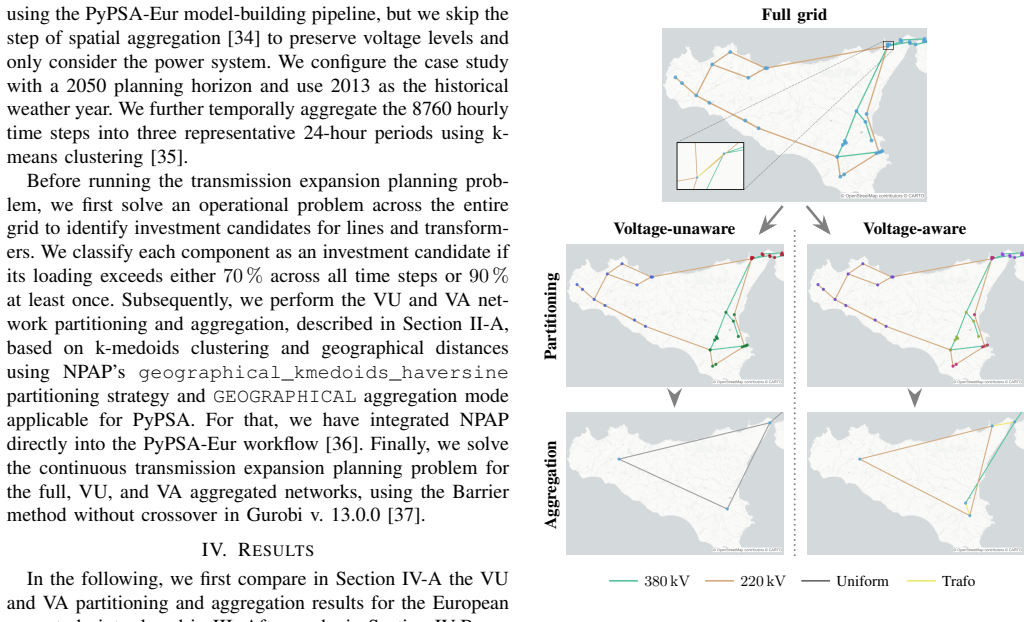
Energy system optimization models are indispensable for planning the European energy transition. Yet their applicability is constrained by the fundamental trade-off between spatial detail and computational tractability. Modelers often tackle this by spatially aggregating electricity networks. Existing methods, however, neglect differences in voltage levels, reducing them to a single level and thereby overlooking the critical role of transformers in expansion planning. Therefore, we propose a novel voltage-aware network partitioning and aggregation methodology that preserves individual voltage levels and transformers. We demonstrate the effectiveness of this approach and compare it against a voltage-unaware grid aggregation by solving a network expansion problem for a European case study using PyPSA. Our findings show that the proposed methodology preserves up to 70% of the transformer expansion costs in the aggregated model compared to the full grid model, thereby significantly improving the accuracy of investment decisions for transformers in the aggregated grid.
Editorial analysis
A structured set of objections, weighed in public.
Referee Report
Summary. The paper proposes a novel voltage-aware network partitioning and aggregation methodology for high-voltage electricity grids that preserves distinct voltage levels and transformer representations, unlike conventional single-level reductions. In a European case study solved with PyPSA, the approach is compared to a voltage-unaware aggregation and is reported to preserve up to 70% of transformer expansion costs relative to the full grid model, thereby improving the accuracy of investment decisions in the reduced network.
Significance. If the equivalence of flows and expansion signals holds, the method would meaningfully advance spatial aggregation techniques in energy system optimization by retaining critical transformer cost structures and voltage constraints that are typically lost. This could support more reliable large-scale planning for the European energy transition without sacrificing as much fidelity as standard aggregations.
major comments (2)
- [Abstract / Results] Abstract and results section: the central quantitative claim of preserving 'up to 70% of the transformer expansion costs' is presented without any reported comparison of optimal power flows, nodal injections, line loadings, or dual values on voltage bounds between the full and aggregated models. This leaves open whether the percentage reflects preserved physical equivalence or case-specific solver behavior.
- [Methodology] Methodology section: the voltage-aware partitioning must demonstrably maintain equivalent power balance, voltage constraints, and transformer cost structures; no explicit verification (e.g., via constraint residual checks or marginal price comparisons) is provided to confirm that the reduced network reproduces the same expansion signals for transformers as the original.
minor comments (2)
- [Abstract] The abstract would benefit from stating the number of nodes, lines, and voltage levels in the European PyPSA case study to allow readers to gauge the scale of the aggregation.
- [Notation / Introduction] Notation for voltage levels and transformer variables could be introduced with a small schematic diagram for clarity.
Simulated Author's Rebuttal
We thank the referee for their thoughtful review and constructive feedback on our manuscript. We address each major comment below, clarifying the basis of our claims and outlining revisions to strengthen the presentation of physical equivalence and verification.
read point-by-point responses
-
Referee: [Abstract / Results] Abstract and results section: the central quantitative claim of preserving 'up to 70% of the transformer expansion costs' is presented without any reported comparison of optimal power flows, nodal injections, line loadings, or dual values on voltage bounds between the full and aggregated models. This leaves open whether the percentage reflects preserved physical equivalence or case-specific solver behavior.
Authors: The 70% figure is obtained directly from the objective values of the transmission expansion optimization (transformer investment costs) solved on the full-resolution versus aggregated networks using identical PyPSA formulations and solver settings. We agree that explicit side-by-side verification of physical quantities would better demonstrate that the cost preservation arises from retained voltage and transformer structure rather than numerical artifacts. In the revised manuscript we will add a dedicated results subsection reporting (i) maximum line-loading deviations, (ii) nodal price differences, and (iii) voltage-bound dual comparisons between the full and reduced models for the same scenario set. revision: yes
-
Referee: [Methodology] Methodology section: the voltage-aware partitioning must demonstrably maintain equivalent power balance, voltage constraints, and transformer cost structures; no explicit verification (e.g., via constraint residual checks or marginal price comparisons) is provided to confirm that the reduced network reproduces the same expansion signals for transformers as the original.
Authors: The aggregation procedure preserves power balance by construction: each super-node inherits the net injection of its constituent buses, and inter-voltage transformers remain as explicit edges with their original cost and capacity parameters. Voltage constraints are retained at every voltage level because the partitioning never merges nodes of different nominal voltages. Nevertheless, we accept that the current text lacks explicit post-aggregation verification. We will insert constraint-residual tables and marginal-price correlation plots in the methodology/results section to quantify how closely the reduced model reproduces the original expansion signals. revision: yes
Circularity Check
No significant circularity detected in voltage-aware aggregation claims
full rationale
The paper proposes a voltage-aware partitioning and aggregation method, then validates it by solving an expansion problem on a European network using the external PyPSA solver and directly comparing results to the full grid model. The 70% transformer cost preservation figure is presented as an empirical outcome of this case-study comparison rather than a quantity derived from fitted parameters, self-definitions, or load-bearing self-citations. No equations or steps in the provided abstract reduce the central result to its own inputs by construction; the methodology is tested against an independent benchmark (the unaggregated model), satisfying the criteria for a self-contained, non-circular derivation.
Axiom & Free-Parameter Ledger
Reference graph
Works this paper leans on
-
[1]
ENTSO-E, “Statistical factsheet 2024”, 2025. [Online]. Available: https://www.entsoe.eu/data/power-stats/
work page 2024
-
[2]
A comparison of electricity transmission technologies: Costs and char- acteristics
“A comparison of electricity transmission technologies: Costs and char- acteristics”, The Institution of Engineering and Technology, 2025. [On- line]. Available: https://www.theiet.org/media/axwkktkb/100110238 001 - rev - j - electricity - transmission - costs - and - characteristicsfinal - full.pdf
-
[3]
Netzentwicklungsplan strom 2035, version 2021
NEP, “Netzentwicklungsplan strom 2035, version 2021”, Netzen- twicklungsplan Strom, 2021. [Online]. Available: https : / / www . netzentwicklungsplan.de/archiv/netzentwicklungsplan-2035-2021
work page 2035
-
[4]
D. Oeding and B. R. Oswald,Elektrische Kraftwerke und Netze, 8th ed. Berlin, Heidelberg: Springer Vieweg, 1107 pp
-
[5]
Advanced spatial and technological aggregation scheme for energy system models
S. Patil et al., “Advanced spatial and technological aggregation scheme for energy system models”,Energies, vol. 15, no. 24, p. 9517, 15, 2022
work page 2022
-
[6]
A review of mixed-integer linear formulations for framework-based energy system models
M. Hoffmann et al., “A review of mixed-integer linear formulations for framework-based energy system models”,Advances in Applied Energy, vol. 16, p. 100 190, 2024
work page 2024
-
[7]
A graph-based formulation for modeling macro-energy systems
L. G ¨oke, “A graph-based formulation for modeling macro-energy systems”,Applied Energy, vol. 301, p. 117 377, 1, 2021
work page 2021
-
[8]
EMPIRE: An open-source model based on multi- horizon programming for energy transition analyses
S. Backe et al., “EMPIRE: An open-source model based on multi- horizon programming for energy transition analyses”,SoftwareX, vol. 17, p. 100 877, 2022
work page 2022
-
[9]
ETHOS.FINE: A framework for integrated energy system assessment
T. Kl ¨utz et al., “ETHOS.FINE: A framework for integrated energy system assessment”,Journal of Open Source Software, vol. 10, no. 105, p. 6274, 20, 2025
work page 2025
-
[10]
Switch 2.0: A modern platform for planning high- renewable power systems
J. Johnston et al., “Switch 2.0: A modern platform for planning high- renewable power systems”,SoftwareX, vol. 10, p. 100 251, 2019
work page 2019
-
[11]
Bonaldo et al.,Genxproject/genx.jl: Genx, 2024
L. Bonaldo et al.,Genxproject/genx.jl: Genx, 2024. [Online]. Available: https://doi.org/10.5281/zenodo.15865702
-
[12]
LEGO: The open-source Low-carbon Expansion Generation Optimization model
S. Wogrin et al., “LEGO: The open-source Low-carbon Expansion Generation Optimization model”,SoftwareX, vol. 19, 2022
work page 2022
-
[13]
PyPSA: Python for power system analysis
T. Brown et al., “PyPSA: Python for power system analysis”,Journal of the Operational Research Society, vol. 6, no. 1, p. 4, 16, 2018
work page 2018
-
[14]
Siqueira et al.,Tulipa energy model
S. Siqueira et al.,Tulipa energy model. [Online]. Available: https:// github.com/TulipaEnergy/TulipaEnergyModel.jl
-
[15]
A Network Aggregation Tool for the Energy System Modelling Framework Spine
I. Kouveliotis-Lysikatos et al., “A Network Aggregation Tool for the Energy System Modelling Framework Spine”, en, in2020 International Conference on Smart Energy Systems and Technologies, Istanbul, Turkey: IEEE, 2020, pp. 1–6
work page 2020
-
[16]
Unraveling the spatial complexity of national energy system models: A systematic review
K. Javanmardi et al., “Unraveling the spatial complexity of national energy system models: A systematic review”, en,Renewable and Sustainable Energy Reviews, vol. 213, p. 115 470, 2025
work page 2025
-
[17]
Spatial representation of renewable technologies in generation expansion planning models
K. Phillips et al., “Spatial representation of renewable technologies in generation expansion planning models”,Applied Energy, vol. 342, p. 121 092, 2023
work page 2023
-
[18]
An open-source framework for balancing computational speed and fidelity in production cost models
K. Z. Akdemir et al., “An open-source framework for balancing computational speed and fidelity in production cost models”,Environ. Res.: Energy, vol. 1, no. 1, p. 015 003, 1, 2024
work page 2024
-
[19]
Incorporating power transmission bottlenecks into aggregated energy system models
K.-K. Cao et al., “Incorporating power transmission bottlenecks into aggregated energy system models”,Sustainability, vol. 10, no. 6, p. 1916, 7, 2018
work page 1916
-
[20]
Overview of the clustering algorithms for the formation of the bidding zones
G. Chicco et al., “Overview of the clustering algorithms for the formation of the bidding zones”, in2019 54th Int. Univ. Power Eng. Conf. (UPEC), Bucharest, Romania: IEEE, 2019, pp. 1–6
work page 2019
-
[21]
Congestion-sensitive grid aggregation for DC optimal power flow
B. St ¨ockl et al., “Congestion-sensitive grid aggregation for DC optimal power flow”, in2025 IEEE Kiel PowerTech, 2025, pp. 1–7
work page 2025
-
[22]
M. M. Frysztacki et al., “A comparison of clustering methods for the spatial reduction of renewable electricity optimisation models of europe”,Energy Inform, vol. 5, no. 1, p. 4, 4, 2022
work page 2022
-
[23]
Pache et al.,E-highway 2050 WP8 : Enhanced pan-european transmission planning methodology, 30, 2015
C. Pache et al.,E-highway 2050 WP8 : Enhanced pan-european transmission planning methodology, 30, 2015. [Online]. Available: https://zenodo.org/records/8232533
-
[24]
NPAP: Network Partitioning and Aggregation Package for Python
M. Anarmo et al.,NPAP: Network partitioning and aggregation pack- age for python, 12, 2026. arXiv: 2605.12137
work page internal anchor Pith review Pith/arXiv arXiv 2026
-
[25]
Modelling the high-voltage grid using open data for europe and beyond
B. Xiong et al., “Modelling the high-voltage grid using open data for europe and beyond”,Scientific Data, vol. 12, no. 1, 2025
work page 2025
-
[26]
Xiong et al.,Prebuilt electricity network for PyPSA-Eur based on OpenStreetMap data, en, 2026
B. Xiong et al.,Prebuilt electricity network for PyPSA-Eur based on OpenStreetMap data, en, 2026. [Online]. Available: https://doi.org/10. 5281/zenodo.18619025
work page 2026
-
[27]
Anarmo,Network partitioning and aggregation package, Python Package index
M. Anarmo,Network partitioning and aggregation package, Python Package index. [Online]. Available: https://pypi.org/project/npap/
- [28]
- [29]
- [30]
-
[31]
Unit investment costs indicators for energy infrastructure categories
“Unit investment costs indicators for energy infrastructure categories”, Energy Community Regulatory Board, 24, 2025. [Online]. Available: https://www.energy-community.org/news/Energy-Community-News/ 2025/04/24.html
work page 2025
-
[32]
Unit investment costs indicators for energy infrastructure categories
“Unit investment costs indicators for energy infrastructure categories”, ACER, 4, 2023. [Online]. Available: https : / / www . acer . europa . eu / electricity / infrastructure / network - development / transmission - infrastructure-reference-costs
work page 2023
-
[33]
St ¨ockl,Voltage-aware grid aggregation, 2026
B. St ¨ockl,Voltage-aware grid aggregation, 2026. [Online]. Available: https : / / github . com / BenjaminStoeckl / EEMV oltage - AwareGrid - Aggregation
work page 2026
-
[34]
J. H ¨orsch et al.,PyPSA-Eur: An open optimisation model of the european transmission system (dataset), 16, 2023
work page 2023
-
[35]
The pareto-optimal temporal aggregation of energy system models
M. Hoffmann et al., “The pareto-optimal temporal aggregation of energy system models”,Applied Energy, vol. 315, p. 119 029, 1, 2022
work page 2022
-
[36]
M. Anarmo,Integrate NPAP: Network partitioning and aggregation package for PyPSA spatial network clustering #1568. [Online]. Avail- able: https://github.com/PyPSA/PyPSA/pull/1568 [37]GUROBI optimizer, version 13.0.0. [Online]. Available: https://www. gurobi.com/
discussion (0)
Sign in with ORCID, Apple, or X to comment. Anyone can read and Pith papers without signing in.