Recognition: 2 theorem links
· Lean TheoremTeacher-Guided Policy Optimization for LLM Distillation
Pith reviewed 2026-05-14 20:08 UTC · model grok-4.3
The pith
Teacher-Guided Policy Optimization fixes uninformative feedback in reverse KL by conditioning teacher predictions on student rollouts.
A machine-rendered reading of the paper's core claim, the machinery that carries it, and where it could break.
Core claim
TGPO is an on-policy algorithm that incorporates dense directional guidance by leveraging teacher predictions conditioned on the student's rollout to address the inefficiency of standard RKL when distributions diverge significantly.
What carries the argument
Teacher predictions conditioned on the student's rollout, providing dense directional guidance in the on-policy setting.
Load-bearing premise
That conditioning teacher predictions on the student's rollout will reliably produce informative directional guidance even when student and teacher distributions diverge substantially.
What would settle it
Running TGPO and standard RKL on a setup with deliberately large student-teacher divergence and checking if TGPO fails to improve or worsens performance compared to the baseline.
Figures



read the original abstract
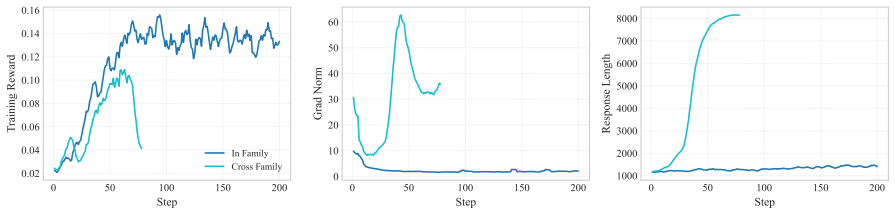
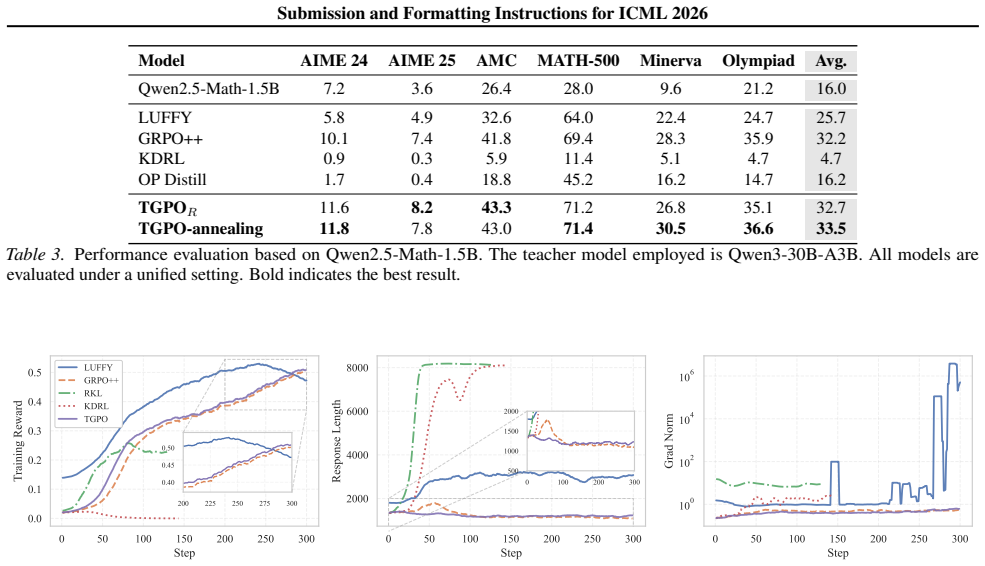
The convergence of reinforcement learning and imitation learning has positioned Reverse KL (RKL) as a promising paradigm for on-policy LLM distillation, aiming to unify exploration with teacher supervision. However, we identify a critical limitation: when the student and teacher distributions diverge significantly, standard RKL often fails to yield meaningful improvement due to uninformative negative feedback. To address this inefficiency, we propose Teacher-Guided Policy Optimization (TGPO), an on-policy algorithm that incorporates dense directional guidance by leveraging teacher predictions conditioned on the student's rollout. Because TGPO remains on-policy, the algorithm integrates seamlessly with existing RLVR frameworks without requiring additional data annotation. Experiments on complex reasoning benchmarks demonstrate that TGPO significantly outperforms standard baselines and is robust to different teachers.
Editorial analysis
A structured set of objections, weighed in public.
Referee Report
Summary. The paper identifies a limitation in standard Reverse KL (RKL) for on-policy LLM distillation where significant divergence between student and teacher distributions leads to uninformative negative feedback. It proposes Teacher-Guided Policy Optimization (TGPO), which incorporates dense directional guidance by using teacher predictions conditioned on the student's rollout. TGPO is on-policy and compatible with RLVR frameworks. Experiments on complex reasoning benchmarks show that TGPO significantly outperforms standard baselines and is robust to different teachers.
Significance. If the empirical results and the conditioning mechanism hold under scrutiny, TGPO could meaningfully advance on-policy distillation for LLMs by mitigating a documented failure mode of RKL, allowing better unification of exploration and supervision without extra annotation. This would be relevant for reasoning-heavy tasks where distribution shift is routine.
major comments (3)
- [Abstract] Abstract: the central claim that TGPO 'significantly outperforms standard baselines' supplies no metrics, benchmark names, run counts, statistical tests, or baseline definitions, so the empirical contribution cannot be evaluated.
- [Method] Method description: no derivation, gradient bound, or variance analysis is given showing that teacher predictions conditioned on low-probability student rollouts remain accurate and low-variance; this is the load-bearing assumption needed to fix the RKL divergence problem.
- [Experiments] Experiments section: the abstract asserts robustness to different teachers on complex reasoning benchmarks but provides no ablation isolating the conditioning step, no comparison tables, and no details on how divergence was measured or controlled.
minor comments (1)
- [Abstract] Abstract: the acronym RLVR is used without expansion on first appearance.
Simulated Author's Rebuttal
We thank the referee for the constructive and detailed feedback. We address each major comment point by point below. Revisions have been made to the manuscript to improve specificity, clarity, and completeness in the abstract, method discussion, and experiments section.
read point-by-point responses
-
Referee: [Abstract] Abstract: the central claim that TGPO 'significantly outperforms standard baselines' supplies no metrics, benchmark names, run counts, statistical tests, or baseline definitions, so the empirical contribution cannot be evaluated.
Authors: We agree that the abstract lacked sufficient quantitative detail for independent evaluation. In the revised manuscript, the abstract now specifies the benchmarks (GSM8K, MATH), reports average accuracy improvements over baselines (standard RKL and PPO), notes the use of 5 random seeds, and defines the baselines explicitly. Full statistical details, including standard deviations and t-test results, remain in the experiments section due to length constraints. revision: yes
-
Referee: [Method] Method description: no derivation, gradient bound, or variance analysis is given showing that teacher predictions conditioned on low-probability student rollouts remain accurate and low-variance; this is the load-bearing assumption needed to fix the RKL divergence problem.
Authors: This comment correctly identifies a theoretical gap. The manuscript presents TGPO algorithmically and supports the conditioning assumption through empirical results rather than a formal variance bound. We have added an expanded intuitive discussion in Section 3 explaining how conditioning on the student rollout reduces uninformative gradients by aligning the teacher's signal with the actual trajectory. A complete gradient bound or variance analysis is not provided, as it would require substantial new theoretical work; we explicitly flag this as a limitation and future direction in the revised paper. revision: partial
-
Referee: [Experiments] Experiments section: the abstract asserts robustness to different teachers on complex reasoning benchmarks but provides no ablation isolating the conditioning step, no comparison tables, and no details on how divergence was measured or controlled.
Authors: We have revised the experiments section to include the requested elements. New comparison tables (Tables 1 and 2) report results on GSM8K and MATH with multiple teachers. An explicit ablation isolating the conditioning mechanism appears in Section 4.3, demonstrating performance degradation when it is removed. Divergence is now quantified using the KL divergence between student and teacher policies, with controlled experiments varying rollout sampling to induce different divergence levels. Robustness results across teacher models are presented with the corresponding metrics. revision: yes
Circularity Check
No significant circularity; TGPO framed as extension of RLVR without self-referential reductions
full rationale
The provided abstract and description position TGPO as an on-policy extension that adds conditioned teacher guidance to address RKL limitations in existing RLVR frameworks. No equations, derivations, or fitted parameters are shown that reduce any claimed improvement or prediction to a quantity defined by the method itself. No self-citations, uniqueness theorems, or ansatzes are invoked in a load-bearing way. The central claim rests on empirical outperformance on benchmarks rather than any closed-loop definition or renaming of known results. This is the expected non-finding for a methods paper that does not exhibit the enumerated circular patterns.
Axiom & Free-Parameter Ledger
axioms (1)
- domain assumption Standard on-policy reinforcement learning assumptions continue to hold when teacher guidance is added via conditioned predictions.
Lean theorems connected to this paper
-
IndisputableMonolith/Foundation/BranchSelection.leanbranch_selection unclear?
unclearRelation between the paper passage and the cited Recognition theorem.
RKL restricts the teacher to the role of a post-hoc discriminator... uninformative negative feedback
What do these tags mean?
- matches
- The paper's claim is directly supported by a theorem in the formal canon.
- supports
- The theorem supports part of the paper's argument, but the paper may add assumptions or extra steps.
- extends
- The paper goes beyond the formal theorem; the theorem is a base layer rather than the whole result.
- uses
- The paper appears to rely on the theorem as machinery.
- contradicts
- The paper's claim conflicts with a theorem or certificate in the canon.
- unclear
- Pith found a possible connection, but the passage is too broad, indirect, or ambiguous to say the theorem truly supports the claim.
Reference graph
Works this paper leans on
-
[1]
arXiv preprint arXiv:2504.11468 , year=
Chen, H., Tu, H., Wang, F., Liu, H., Tang, X., Du, X., Zhou, Y ., and Xie, C. Sft or rl? an early investigation into training r1-like reasoning large vision-language models. arXiv preprint arXiv:2504.11468,
-
[2]
SFT Memorizes, RL Generalizes: A Comparative Study of Foundation Model Post-training
Chu, T., Zhai, Y ., Yang, J., Tong, S., Xie, S., Schuurmans, D., Le, Q. V ., Levine, S., and Ma, Y . Sft memorizes, rl generalizes: A comparative study of foundation model post-training.arXiv preprint arXiv:2501.17161,
work page internal anchor Pith review Pith/arXiv arXiv
-
[3]
Think you have Solved Question Answering? Try ARC, the AI2 Reasoning Challenge
Clark, P., Cowhey, I., Etzioni, O., Khot, T., Sabharwal, A., Schoenick, C., and Tafjord, O. Think you have solved question answering? try arc, the ai2 reasoning challenge. arXiv preprint arXiv:1803.05457,
work page internal anchor Pith review Pith/arXiv arXiv
-
[4]
Process Reinforcement through Implicit Rewards
Cui, G., Yuan, L., Wang, Z., Wang, H., Zhang, Y ., Chen, J., Li, W., He, B., Fan, Y ., Yu, T., et al. Process re- inforcement through implicit rewards.arXiv preprint arXiv:2502.01456,
work page internal anchor Pith review Pith/arXiv arXiv
-
[5]
MiniLLM: On-Policy Distillation of Large Language Models
Gu, Y ., Dong, L., Wei, F., and Huang, M. Minillm: Knowl- edge distillation of large language models.arXiv preprint arXiv:2306.08543,
work page internal anchor Pith review Pith/arXiv arXiv
-
[6]
DeepSeek-R1: Incentivizing Reasoning Capability in LLMs via Reinforcement Learning
Guo, D., Yang, D., Zhang, H., Song, J., Zhang, R., Xu, R., Zhu, Q., Ma, S., Wang, P., Bi, X., et al. Deepseek-r1: In- centivizing reasoning capability in llms via reinforcement learning.arXiv preprint arXiv:2501.12948,
work page internal anchor Pith review Pith/arXiv arXiv
-
[7]
Skywork open reasoner 1 technical report.arXiv preprint arXiv:2505.22312,
He, J., Liu, J., Liu, C. Y ., Yan, R., Wang, C., Cheng, P., Zhang, X., Zhang, F., Xu, J., Shen, W., et al. Sky- work open reasoner 1 technical report.arXiv preprint arXiv:2505.22312,
-
[8]
Measuring Mathematical Problem Solving With the MATH Dataset
Hendrycks, D., Burns, C., Kadavath, S., Arora, A., Basart, S., Tang, E., Song, D., and Steinhardt, J. Measuring math- ematical problem solving with the math dataset.arXiv preprint arXiv:2103.03874,
work page internal anchor Pith review Pith/arXiv arXiv
-
[9]
Distilling the Knowledge in a Neural Network
Hinton, G., Vinyals, O., and Dean, J. Distilling the knowledge in a neural network.arXiv preprint arXiv:1503.02531,
work page internal anchor Pith review Pith/arXiv arXiv
-
[10]
URL https://github. com/huggingface/open-r1. Jaech, A., Kalai, A., Lerer, A., Richardson, A., El-Kishky, A., Low, A., Helyar, A., Madry, A., Beutel, A., Car- ney, A., et al. Openai o1 system card.arXiv preprint arXiv:2412.16720,
work page internal anchor Pith review Pith/arXiv arXiv
-
[11]
Solving Quantitative Reasoning Problems with Language Models
Lewkowycz, A., Andreassen, A., Dohan, D., Dyer, E., Michalewski, H., Ramasesh, V ., Slone, A., Anil, C., Schlag, I., Gutman-Solo, T., et al. Solving quantitative reasoning problems with language models, 2022.URL https://arxiv. org/abs/2206.14858, 1,
work page internal anchor Pith review Pith/arXiv arXiv 2022
-
[12]
Understanding R1-Zero-Like Training: A Critical Perspective
Liu, Z., Chen, C., Li, W., Qi, P., Pang, T., Du, C., Lee, W. S., and Lin, M. Understanding r1-zero-like train- ing: A critical perspective, 2025.URL https://arxiv. org/abs/2503.20783. Lu, K. and Lab, T. M. On-policy distillation.Thinking Machines Lab: Connectionism,
work page internal anchor Pith review Pith/arXiv arXiv 2025
-
[13]
doi: 10.64434/tml. 20251026. https://thinkingmachines.ai/blog/on-policy- distillation. Rein, D., Hou, B. L., Stickland, A. C., Petty, J., Pang, R. Y ., Dirani, J., Michael, J., and Bowman, S. R. Gpqa: A 9 Submission and Formatting Instructions for ICML 2026 graduate-level google-proof q&a benchmark. InFirst Conference on Language Modeling,
-
[14]
Shao, Z., Wang, P., Zhu, Q., Xu, R., Song, J., Bi, X., Zhang, H., Zhang, M., Li, Y ., Wu, Y ., et al
URL https: //arxiv.org/abs/2512.21852. Shao, Z., Wang, P., Zhu, Q., Xu, R., Song, J., Bi, X., Zhang, H., Zhang, M., Li, Y ., Wu, Y ., et al. Deepseekmath: Push- ing the limits of mathematical reasoning in open language models.arXiv preprint arXiv:2402.03300,
-
[15]
Gemma 2: Improving Open Language Models at a Practical Size
Team, G., Riviere, M., Pathak, S., Sessa, P. G., Hardin, C., Bhupatiraju, S., Hussenot, L., Mesnard, T., Shahri- ari, B., Ram ´e, A., et al. Gemma 2: Improving open language models at a practical size.arXiv preprint arXiv:2408.00118,
work page internal anchor Pith review Pith/arXiv arXiv
-
[16]
Team, K., Du, A., Gao, B., Xing, B., Jiang, C., Chen, C., Li, C., Xiao, C., Du, C., Liao, C., et al. Kimi k1. 5: Scaling reinforcement learning with llms.arXiv preprint arXiv:2501.12599,
work page internal anchor Pith review Pith/arXiv arXiv
-
[17]
URL https: //arxiv.org/abs/2505.09388. Wang, Y ., Ma, X., Zhang, G., Ni, Y ., Chandra, A., Guo, S., Ren, W., Arulraj, A., He, X., Jiang, Z., et al. Mmlu-pro: A more robust and challenging multi-task language un- derstanding benchmark.Advances in Neural Information Processing Systems, 37:95266–95290,
work page internal anchor Pith review Pith/arXiv arXiv
-
[18]
arXiv preprint arXiv:2506.02208 , year =
Xu, H., Zhu, Q., Deng, H., Li, J., Hou, L., Wang, Y ., Shang, L., Xu, R., and Mi, F. Kdrl: Post-training reasoning llms via unified knowledge distillation and reinforcement learning.arXiv preprint arXiv:2506.02208,
-
[19]
arXiv preprint arXiv:2504.14945 , year =
Yan, J., Li, Y ., Hu, Z., Wang, Z., Cui, G., Qu, X., Cheng, Y ., and Zhang, Y . Learning to reason under off-policy guidance, 2025.URL https://arxiv. org/abs/2504.14945,
-
[20]
Qwen2.5-Math Technical Report: Toward Mathematical Expert Model via Self-Improvement
Yang, A., Zhang, B., Hui, B., Gao, B., Yu, B., Li, C., Liu, D., Tu, J., Zhou, J., Lin, J., Lu, K., Xue, M., Lin, R., Liu, T., Ren, X., and Zhang, Z. Qwen2.5-math technical report: Toward mathematical expert model via self-improvement. arXiv preprint arXiv:2409.12122,
work page internal anchor Pith review Pith/arXiv arXiv
-
[21]
DAPO: An Open-Source LLM Reinforcement Learning System at Scale
Yu, Q., Zhang, Z., Zhu, R., Yuan, Y ., Zuo, X., Yue, Y ., Fan, T., Liu, G., Liu, L., Liu, X., et al. Dapo: An open-source llm reinforcement learning system at scale, 2025.URL https://arxiv. org/abs/2503.14476,
work page internal anchor Pith review Pith/arXiv arXiv 2025
-
[22]
Notion Blog. Zhang, W., Xie, Y ., Sun, Y ., Chen, Y ., Wang, G., Li, Y ., Ding, B., and Zhou, J. On-policy rl meets off-policy experts: Harmonizing supervised fine-tuning and reinforcement learning via dynamic weighting, 2025a. URL https: //arxiv.org/abs/2508.11408. Zhang, Y ., Liu, Y ., Yuan, H., Yuan, Y ., Gu, Q., and Yao, A. C.-C. On the design of kl-r...
-
[23]
bad” sample yk, rather than reinforcing the majority of “good
In the context of RL with intrinsic rewards (as discussed in Section 2.2), the RKL term acts as a negative reward. The effective gradient update applied to the student is proportional to: g(y)∝ −∇ θ logπ θ(y|x)·logρ(y).(9) A.2. Instability in the Rejection Regime We now analyze the behavior of this gradient. Note that while language models generate tokens...
2026
discussion (0)
Sign in with ORCID, Apple, or X to comment. Anyone can read and Pith papers without signing in.