Recognition: no theorem link
Multi-Agent Systems in Emergency Departments: Validation Study on a ED Digital Twin
Pith reviewed 2026-05-14 19:34 UTC · model grok-4.3
The pith
A hybrid DES-ABM simulation of emergency departments replicates real-world performance under established resource optimization strategies.
A machine-rendered reading of the paper's core claim, the machinery that carries it, and where it could break.
Core claim
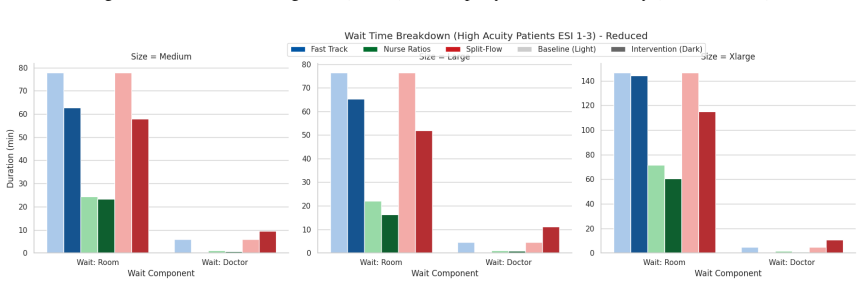
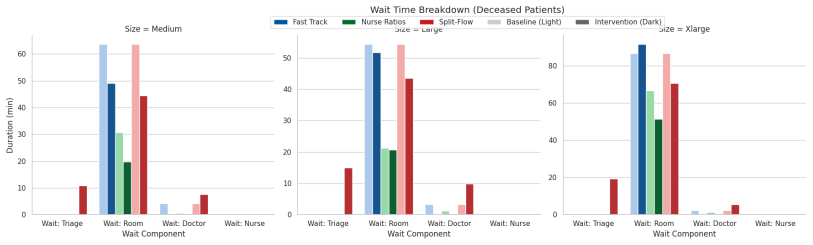
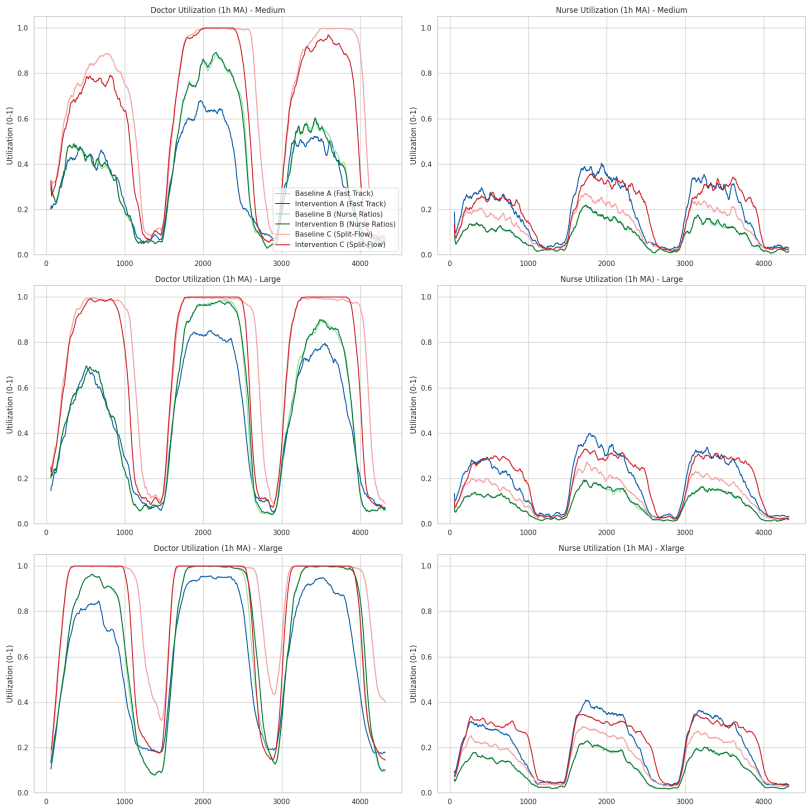
The DES-ABM simulation can effectively replicate real-world ER dynamics under interventions, shown by matching literature KPIs after applying proven resource optimization strategies and comparing the resulting metrics to documented outcomes. The framework is extended with a modular MAS component that explores allocation policies autonomously from a temporal ledger of ED events.
What carries the argument
The hybrid DES-ABM-MAS framework that couples discrete-event process modeling, agent-based individual behavior, and autonomous multi-agent search over a ledger of events to test resource allocations.
If this is right
- Hospitals can test staffing and process changes in the model before applying them to live operations.
- Resource allocation strategies already shown effective in real studies produce matching improvements inside the simulation.
- The multi-agent component can generate candidate policies for further human review using only historical event records.
- The modular structure allows swapping in new patient arrival patterns or staffing rules without rebuilding the core model.
Where Pith is reading between the lines
- The same ledger-driven MAS could be connected to live hospital data streams for ongoing policy suggestions.
- Validation against a single set of literature values may not capture seasonal or site-specific variability across different emergency departments.
- Extending the model to include cost or patient outcome measures beyond standard KPIs would strengthen its use for policy decisions.
Load-bearing premise
Matching published key performance indicators is enough to confirm that the model will correctly predict effects of new interventions in actual emergency departments.
What would settle it
Run one of the tested optimization strategies in a real emergency department and measure whether the observed changes in wait times, length of stay, or throughput fall outside the range produced by the simulation.
Figures







read the original abstract
Emergency departments (ED) face challenges in patient care and resource management. We propose to explore optimization strategies in a realistic and flexible model and develop a hybrid Discrete Event Simulation (DES) and Agent-Based Model (ABM) simulating highly configurable ED environments. We specifically focus on the validation of the modeling approach. We derive configurations for ED sizes, patient load, and staffing from real-world studies. We then validate the model expressivity by matching its key performance indicators and metrics with their values known from literature. We proceed by implementing scientifically established and practice-proven resource optimization strategies. Comparing the documented real-world outcomes with our model's results demonstrates that the DES-ABM based simulation can effectively replicate real-world ER dynamics under interventions. We lastly integrate a Proof-of-Concept multi-agent system (MAS) that can autonomously explore resource allocation strategies within the simulated ER environment based on a temporal ledger of ED event records. This modular DES-ABM-MAS framework offers a powerful tool to explore resource optimization strategies in emergency departments.
Editorial analysis
A structured set of objections, weighed in public.
Referee Report
Summary. The paper claims to develop a hybrid Discrete Event Simulation (DES) and Agent-Based Model (ABM) for configurable emergency department (ED) environments, derive ED size/staffing/patient-load parameters from real-world studies, validate expressivity by matching key performance indicators (KPIs) to literature values, show that the model replicates real-world outcomes under established optimization interventions, and integrate a proof-of-concept multi-agent system (MAS) that uses a temporal event ledger to autonomously explore resource-allocation strategies.
Significance. If the validation holds with quantitative rigor, the modular DES-ABM-MAS framework would be a useful contribution for exploring MAS-driven optimizations in ED resource management. The approach combines established simulation techniques with autonomous agents in a digital-twin setting, potentially enabling falsifiable tests of intervention strategies that are difficult to study in live EDs.
major comments (2)
- [Abstract / Validation] Abstract and validation description: the central claim that 'comparing the documented real-world outcomes with our model's results demonstrates that the DES-ABM based simulation can effectively replicate real-world ER dynamics under interventions' lacks any reported quantitative metrics (e.g., mean absolute percentage error, Kolmogorov-Smirnov statistics on distributions, or confidence intervals on KPI matches). Aggregate KPI matching alone does not establish structural fidelity for stochastic patient flows or intervention-induced shifts.
- [Methods / Validation] Configuration and validation procedure: ED size, staffing, and patient-load parameters are taken from the same real-world studies whose KPI values are later used for benchmarking. This creates a circularity risk; the manuscript must demonstrate that the model reproduces intervention effects on held-out data or on distribution-level statistics rather than point estimates only.
minor comments (1)
- [Abstract] The abstract would be strengthened by including at least one concrete KPI value (e.g., average length-of-stay or wait time) together with the model's corresponding output and the literature reference.
Simulated Author's Rebuttal
We thank the referee for the constructive and detailed comments, which have helped us strengthen the validation rigor of the manuscript. We address each major comment point by point below.
read point-by-point responses
-
Referee: [Abstract / Validation] Abstract and validation description: the central claim that 'comparing the documented real-world outcomes with our model's results demonstrates that the DES-ABM based simulation can effectively replicate real-world ER dynamics under interventions' lacks any reported quantitative metrics (e.g., mean absolute percentage error, Kolmogorov-Smirnov statistics on distributions, or confidence intervals on KPI matches). Aggregate KPI matching alone does not establish structural fidelity for stochastic patient flows or intervention-induced shifts.
Authors: We agree that aggregate KPI matching alone is insufficient to establish structural fidelity. In the revised manuscript we now report mean absolute percentage error (MAPE) across all matched KPIs, Kolmogorov-Smirnov statistics comparing simulated versus literature distributions for length-of-stay and waiting-time, and 95% confidence intervals derived from 50 independent simulation runs with different random seeds. These additions are placed in a new subsection of the validation results. revision: yes
-
Referee: [Methods / Validation] Configuration and validation procedure: ED size, staffing, and patient-load parameters are taken from the same real-world studies whose KPI values are later used for benchmarking. This creates a circularity risk; the manuscript must demonstrate that the model reproduces intervention effects on held-out data or on distribution-level statistics rather than point estimates only.
Authors: We acknowledge the circularity concern. The structural parameters (bed counts, staff-to-patient ratios) were taken from the source studies, while the primary KPI targets were drawn from a broader meta-analysis of ED performance literature. To mitigate the risk, the revised version explicitly separates these sources, adds a held-out validation using intervention effects reported in two independent studies not used for parameterisation, and now emphasises distribution-level statistics (KS tests on LOS and queue-length histograms) rather than point estimates alone. revision: partial
Circularity Check
Minor dependency between configuration sources and KPI benchmarks
specific steps
-
other
[Abstract]
"We derive configurations for ED sizes, patient load, and staffing from real-world studies. We then validate the model expressivity by matching its key performance indicators and metrics with their values known from literature."
Configurations and KPI targets are drawn from the same real-world studies, so the matching step has reduced independence; the validation is not performed on fully held-out external data.
full rationale
The paper sets ED parameters from real-world studies and matches resulting KPIs to literature values from those studies. This creates a minor non-independent validation step but does not reduce the overall derivation to self-definition, fitted predictions, or self-citation chains. The subsequent comparison to intervention outcomes and MAS integration remain externally grounded. No equations or load-bearing self-citations appear in the text.
Axiom & Free-Parameter Ledger
free parameters (2)
- ED size and staffing configurations
- Patient load parameters
axioms (1)
- domain assumption Literature-reported key performance indicators accurately represent real emergency department dynamics
Reference graph
Works this paper leans on
-
[1]
[Aikenet al., 2002 ] Linda H. Aiken, Sean P. Clarke, Douglas M. Sloane, Julie Sochalski, and Jeffrey H. Silber. Hospital nurse staffing and patient mortality, nurse burnout, and job dissatisfaction.JAMA, 288:1987–1993, 10
work page 2002
-
[2]
Ready-jet-go: split flow accelerates ed through- put.Journal of Emergency Nursing, 42(1):35–42,
[Bishet al., 2016 ] Paula A Bish, Mary A McCormick, and Mobola Otegbeye. Ready-jet-go: split flow accelerates ed through- put.Journal of Emergency Nursing, 42(1):35–42,
work page 2016
-
[3]
[Bonalumiet al., 2017 ] Nancy Mannion Bonalumi, Anand Bhattacharya, Christopher Edwards, Allen Fasnacht, Leigh Ann Mazzone, Kimberly Stephens, Kim Whiteman, and Brenda Swanson-Bierman. Impact of a planned workflow change: Super track improves quality and service for low-acuity patients at an inner-city hospital.Journal of Emergency Nursing, 43:114–125, 3
work page 2017
-
[4]
Buerhaus, Karen Donelan, Beth T
[Buerhauset al., 2007 ] Peter I. Buerhaus, Karen Donelan, Beth T. Ulrich, Linda Norman, Catherine DesRoches, and Robert Dittus. Impact of the nurse shortage on hospital patient care: comparative perspectives.Health affairs (Project Hope), 26:853–862, 5
work page 2007
-
[5]
[Centenoet al., 2013 ] Ana Paula Centeno, Richard Martin, and Robert Sweeney. Redsim: A spatial agent-based simulation for studying emergency departments.Proceedings of the 2013 Winter Simulation Conference - Simulation: Making Decisions in a Complex World, WSC 2013, pages 1431–1442,
work page 2013
- [6]
-
[7]
[Durmer and Dinges, 2005] Jeffrey S. Durmer and David F. Dinges. Neurocognitive consequences of sleep deprivation.Semi- nars in neurology, 25:117–129, 3
work page 2005
-
[8]
National hospital ambulatory medical care survey: 2021 emergency department summary tables
[for Health Statistics, 2021] National Center for Health Statistics. National hospital ambulatory medical care survey: 2021 emergency department summary tables. Technical report,
work page 2021
-
[9]
[Ghaneset al., 2015 ] Karim Ghanes, Mathias Wargon, Oualid Jouini, Zied Jemai, Agapitos Diakogiannis, Romain Hellmann, Val´erie Thomas, and Ger Koole. Simulation-based optimization of staffing levels in an emergency department.Simulation, 91(10):903–928,
work page 2015
-
[10]
[Griffiths and Dall’Ora, 2023] Peter Griffiths and Chiara Dall’Ora. Nurse staffing and patient safety in acute hospitals: Cas- sandra calls again?BMJ Quality & Safety, 32:241–243, 5
work page 2023
-
[11]
[Gul and Guneri, 2015] Muhammet Gul and Ali Fuat Guneri. A comprehensive review of emergency department simulation applications for normal and disaster conditions.Computers & Industrial Engineering, 83:327–344, 5
work page 2015
-
[12]
[Guttmannet al., 2011 ] Astrid Guttmann, Michael J. Schull, Marian J. Vermeulen, and Therese A. Stukel. Association between waiting times and short term mortality and hospital admission after departure from emergency department: population based cohort study from ontario, canada.BMJ, 342:6, 6
work page 2011
-
[13]
[Hajrizi and Berisha, 2019] Edmoiid Hajrizi and Diellza Berisha. Application of discrete events simulation for the department of emergency at peja regional hospital case study kosovo.IFAC-PapersOnLine, 52:376–381, 1
work page 2019
-
[14]
[Han and Choi, 2024] Seungjun Han and Wongyung Choi. Development of a large language model-based multi-agent clin- ical decision support system for korean triage and acuity scale (ktas)-based triage and treatment planning in emergency departments 1 st seungjun han. Technical report, 8
work page 2024
-
[15]
James, Marian Wilson, Nathaniel Brown, Elizabeth J
[Jameset al., 2020 ] Lois James, Stephen M. James, Marian Wilson, Nathaniel Brown, Elizabeth J. Dotson, Charles Dan Ed- wards, and Patricia Butterfield. Sleep health and predicted cognitive effectiveness of nurses working 12-hour shifts: an observational study.International journal of nursing studies, 112, 12
work page 2020
-
[16]
[Karet al., 2025 ] Eyup Kar, Masoud Fakhimi, Christopher Turner, and Tillal Eldabi. Hybrid simulation in healthcare: a systematic exploration of models, applications, and emerging trends.Journal of Simulation, 19:231–249, 3
work page 2025
-
[17]
[Liuet al., 2017 ] Zhengchun Liu, Dolores Rexachs, Francisco Epelde, and Emilio Luque. An agent-based model for quan- titatively analyzing and predicting the complex behavior of emergency departments.Journal of Computational Science, 21:11–23,
work page 2017
-
[18]
[Liuet al., 2025 ] Yinling Liu, Thierry Moyaux, Guillaume Bouleux, and Vincent Cheutet. Hybrid simulation modelling of emergency departments for resource scheduling.Journal of Simulation, 19(2):215–230,
work page 2025
- [19]
-
[20]
[Macal and North, 2010] Charles M Macal and Michael J North
Accessed: 2024-12-31. [Macal and North, 2010] Charles M Macal and Michael J North. Tutorial on agent-based modelling and simulation.Journal of Simulation, 4(3):151–162,
work page 2024
-
[21]
[Mesa, 2025] Mesa: Agent-based modeling in python. https://mesa.readthedocs.io/,
work page 2025
-
[22]
Designs for the complementary use of system dynamics and discrete-event simulation
[Morganet al., 2011 ] Jennifer Morgan, Susan Howick, and Valerie Belton. Designs for the complementary use of system dynamics and discrete-event simulation. InWinter Simulation Conference. ACM Digital Library,
work page 2011
-
[23]
[Nichollet al., 2007 ] Jon Nicholl, James West, Steve Goodacre, and Janette Turner. The relationship between distance to hospital and patient mortality in emergencies: an observational study.Emergency medicine journal : EMJ, 24:665–668, 9
work page 2007
-
[24]
[North and Macal, 2007] Michael J North and Charles M Macal.Managing business complexity: discovering strategic solu- tions with agent-based modeling and simulation. Oxford University Press,
work page 2007
-
[25]
[Oudaet al., 2025 ] Eman Ouda, Andrei Sleptchenko, and Mecit Can Emre Simsekler. Optimizing emergency department operations: A simulation framework for managerial decision-making.Journal of Nursing Management, 2025:8874680,
work page 2025
-
[26]
[Preiksaitiset al., 2024 ] Carl Preiksaitis, Nicholas Ashenburg, Gabrielle Bunney, Andrew Chu, Rana Kabeer, Fran Riley, Ryan Ribeira, and Christian Rose. The role of large language models in transforming emergency medicine: Scoping review.JMIR medical informatics, 12:e53787, 5
work page 2024
-
[27]
[Rabinet al., 2012 ] Elaine Rabin, Keith Kocher, Mark McClelland, Jesse Pines, Ula Hwang, Niels Rathlev, Brent Asplin, N Seth Trueger, and Ellen Weber. Solutions to emergency department ’boarding’ and crowding are underused and may need to be legislated.Health Affairs, 31(8):1757–66,
work page 2012
-
[28]
Rogers, Wei Ting Hwang, Linda D
[Rogerset al., 2004 ] Ann E. Rogers, Wei Ting Hwang, Linda D. Scott, Linda H. Aiken, and David F. Dinges. The working hours of hospital staff nurses and patient safety.Health affairs (Project Hope), 23:202–212, 7
work page 2004
-
[29]
[Roweet al., 2011 ] Brian H. Rowe, Xiaoyan Guo, Cristina Villa-Roel, Michael Schull, Brian Holroyd, Michael Bullard, Ben- jamin Vandermeer, Maria Ospina, and Grant Innes. The role of triage liaison physicians on mitigating overcrowding in emergency departments: a systematic review.Academic emergency medicine : official journal of the Society for Academic ...
work page 2011
-
[30]
[Salmonet al., 2018 ] Andrew Salmon, Sebastian Rachuba, Simon Briscoe, and Martin Pitt. A structured literature review of simulation modelling applied to emergency departments: Current patterns and emerging trends.Operations Research for Health Care, 17:12–28,
work page 2018
-
[31]
https://simpy.readthedocs.io/,
[SimPy, 2025] Simpy: Discrete event simulation for python. https://simpy.readthedocs.io/,
work page 2025
-
[32]
[Spetz, 2004] Joanne Spetz. California’s minimum nurse-to-patient ratios: the first few months.The Journal of nursing administration, 34:571–578, 12
work page 2004
-
[33]
[Sunet al., 2013 ] Benjamin C. Sun, Renee Y . Hsia, Robert E. Weiss, David Zingmond, Li Jung Liang, Weijuan Han, Heather McCreath, and Steven M. Asch. Effect of emergency department crowding on outcomes of admitted patients.Annals of emergency medicine, 61,
work page 2013
-
[34]
[Terninget al., 2022 ] Gøran Terning, Eirik Christensen Brun, and Idriss El-Thalji. Modeling patient flow in an emergency department under covid-19 pandemic conditions: a hybrid modeling approach.Healthcare, 10(5):840,
work page 2022
-
[35]
Berger von Orelli, Rebecca A.B
[von Orelliet al., 2025 ] Franziska G. Berger von Orelli, Rebecca A.B. Hertzog, Thomas C. Sauter, Michelle Seiler, Fabian Spigariol, Maren Tomaske, Gianluca Gualco, Alex Donas, Rodo O. von Vigier, Dagmar I. Keller, and Kristina Keitel. How are fast tracks organized in adult and pediatric emergency departments in switzerland? a cross-sectional survey.BMC H...
work page 2025
-
[36]
Patient flow modeling and optimal staffing for emergency departments: A petri net approach
[Wang, 2023] Jiacun Wang. Patient flow modeling and optimal staffing for emergency departments: A petri net approach. IEEE Transactions on Computational Social Systems, 10:2022–2032, 8
work page 2023
-
[37]
[Westet al., 2009 ] Colin P. West, Angelina D. Tan, Thomas M. Habermann, Jeff A. Sloan, and Tait D. Shanafelt. Association of resident fatigue and distress with perceived medical errors.JAMA, 302:1294–1300, 9
work page 2009
-
[38]
Wiler, Shari Welch, Jesse Pines, Jeremiah Schuur, Nick Jouriles, and Suzanne Stone-Griffith
[Wileret al., 2015 ] Jennifer L. Wiler, Shari Welch, Jesse Pines, Jeremiah Schuur, Nick Jouriles, and Suzanne Stone-Griffith. Emergency department performance measures updates: proceedings of the 2014 emergency department benchmarking al- liance consensus summit.Academic emergency medicine : official journal of the Society for Academic Emergency Medicine,...
work page 2015
-
[39]
[Wu and Darracq, 2021] Fred Wu and Michael A. Darracq. Comparing physician assistant and nurse practitioner practice in u.s. emergency departments, 2010–2017.Western Journal of Emergency Medicine, 22:1150, 9
work page 2021
-
[40]
White, Doug Burger, and Chi Wang
[Wuet al., 2024 ] Qingyun Wu, Gagan Bansal, Jieyu Zhang, Yiran Wu, Beibin Li, Erkang Zhu, Li Jiang, Xiaoyun Zhang, Shaokun Zhang, Jiazhen Liu, Ahmed Hassan Awadallah, Ryen W. White, Doug Burger, and Chi Wang. Autogen: Enabling next-gen llm applications via multi-agent conversation framework. InThe Twelfth International Conference on Learning Representations,
work page 2024
discussion (0)
Sign in with ORCID, Apple, or X to comment. Anyone can read and Pith papers without signing in.