Recognition: unknown
State-resolved multimodal contributions to stratospheric polar vortex predictability
Pith reviewed 2026-05-14 18:24 UTC · model grok-4.3
The pith
Stratospheric polar vortex predictability is dominated by persistence of the leading state on short timescales but draws from higher-order structures and tropospheric variability on longer ones.
A machine-rendered reading of the paper's core claim, the machinery that carries it, and where it could break.
Core claim
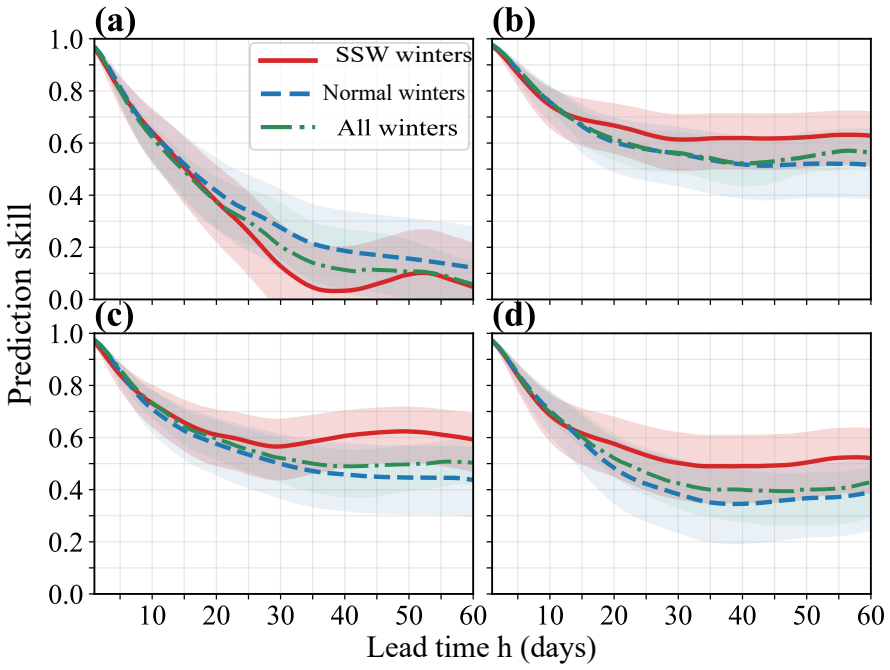
We provide a state-resolved framework that decomposes stratospheric polar vortex predictability using eigen microstates of geopotential height fields and quantifies causal influences through mesoscopic Granger causality. Short-term predictability is dominated by persistence of the leading stratospheric state, whereas extended predictability arises from higher-order stratospheric structures and tropospheric variability. These contributions exhibit strong lead-time dependence and become more distributed during sudden stratospheric warming events, unifying the problem within a multimodal picture.
What carries the argument
Eigen microstates of geopotential height fields, which identify dynamically coherent circulation states, with mesoscopic Granger causality used to measure their causal contributions to predictability.
If this is right
- Short-term predictability is carried primarily by persistence of the leading stratospheric state.
- Extended-range predictability receives substantial contributions from higher-order stratospheric structures and tropospheric variability.
- The relative importance of each contribution changes systematically with increasing lead time.
- During sudden stratospheric warming events the predictability sources become more evenly distributed across multiple states.
- A state-resolved multimodal decomposition supplies a physically interpretable route to improving subseasonal-to-seasonal forecasts.
Where Pith is reading between the lines
- The same decomposition could be applied to other large-scale atmospheric modes to diagnose where their predictability originates.
- Model development focused on accurate representation of higher-order microstates might yield disproportionate gains in extended-range skill.
- Operational forecasts could monitor the amplitudes of several microstates simultaneously rather than tracking only the primary vortex index.
Load-bearing premise
The eigen microstates extracted from geopotential height fields represent dynamically coherent circulation states whose causal influences can be meaningfully quantified by mesoscopic Granger causality.
What would settle it
Ensemble forecast experiments in which the leading microstate amplitude is suppressed and short-term skill is shown to drop sharply, or in which higher-order microstates add no extra skill beyond simple persistence in the extended range.
Figures



read the original abstract
The dynamical basis of stratospheric polar vortex predictability remains unclear, particularly the relative roles of persistence, structural variability, and cross-level coupling. Here we provide a state-resolved and quantitative framework using eigen microstate theory applied to ERA5 geopotential height fields, enabling attribution of predictability to dynamically coherent circulation states via a mesoscopic Granger-causality approach. We show that short-term predictability is dominated by persistence of the leading stratospheric state, whereas extended predictability arises from higher-order stratospheric structures and tropospheric variability. These contributions exhibit strong lead-time dependence and become more distributed during sudden stratospheric warming events. Our results unify SPV predictability within a multimodal, state-resolved framework and provide a physically interpretable pathway for improving subseasonal-to-seasonal forecasts.
Editorial analysis
A structured set of objections, weighed in public.
Referee Report
Summary. The paper develops a state-resolved framework for stratospheric polar vortex (SPV) predictability by applying eigen microstate decomposition to ERA5 geopotential height fields and quantifying contributions via mesoscopic Granger causality. It claims that short-term predictability is dominated by persistence of the leading stratospheric mode, while extended-range predictability arises from higher-order stratospheric structures and tropospheric variability; these attributions show lead-time dependence and become more distributed during sudden stratospheric warmings.
Significance. If the eigen microstates can be shown to correspond to dynamically coherent regimes and the mesoscopic Granger measure can be validated against surrogates, the approach would offer a quantitative, multimodal decomposition of SPV predictability that unifies persistence, internal variability, and cross-troposphere coupling. This could inform targeted improvements in subseasonal-to-seasonal forecast systems by identifying which circulation states carry predictive information at different lead times.
major comments (3)
- [Methods] Methods section (eigen microstate extraction): the paper applies standard EOF-style decomposition to geopotential height but provides no explicit validation that the resulting modes align with known nonlinear, regime-like structures of the polar vortex (e.g., via comparison to established vortex classifications or regime persistence diagnostics). Without this step the attribution of “dynamically coherent circulation states” remains an interpretability assumption rather than a demonstrated property.
- [Results] Results on mesoscopic Granger causality (lead-time dependence): the reported dominance of leading-mode persistence at short leads versus higher-order/tropospheric contributions at longer leads lacks surrogate-data controls or sensitivity tests to post-hoc state selection. In the absence of these checks it is unclear whether the lead-time dependence reflects genuine causal pathways or statistical associations induced by shared external forcing or non-stationarity.
- [Abstract and §4] Abstract and §4 (SSW analysis): the claim that contributions “become more distributed during sudden stratospheric warming events” is stated without quantitative error bars, bootstrap confidence intervals, or a clear definition of the SSW subset used; this weakens the assertion that the framework captures event-specific changes in predictability sources.
minor comments (2)
- [Methods] Notation for eigen microstates is introduced without a compact symbol or explicit orthogonality statement; adding a short table summarizing the retained modes (variance explained, spatial structure) would improve readability.
- [Figures] Figure captions should explicitly state the number of modes retained and the exact ERA5 pressure levels used for the stratospheric versus tropospheric domains.
Simulated Author's Rebuttal
We thank the referee for the constructive and detailed comments. We address each major comment below and will revise the manuscript accordingly to strengthen the validation, controls, and quantitative support for our claims.
read point-by-point responses
-
Referee: [Methods] Methods section (eigen microstate extraction): the paper applies standard EOF-style decomposition to geopotential height but provides no explicit validation that the resulting modes align with known nonlinear, regime-like structures of the polar vortex (e.g., via comparison to established vortex classifications or regime persistence diagnostics). Without this step the attribution of “dynamically coherent circulation states” remains an interpretability assumption rather than a demonstrated property.
Authors: We thank the referee for this observation. The eigen microstate approach is indeed rooted in linear decomposition, but the leading modes capture the dominant large-scale structures of the polar vortex. In the revised manuscript we will add explicit validation by comparing the extracted modes to established classifications (e.g., vortex displacement versus split regimes from Charlton & Polvani 2007) and by reporting autocorrelation timescales that demonstrate longer persistence for the leading states relative to randomized fields. These additions will be placed in the Methods and supplementary material. revision: yes
-
Referee: [Results] Results on mesoscopic Granger causality (lead-time dependence): the reported dominance of leading-mode persistence at short leads versus higher-order/tropospheric contributions at longer leads lacks surrogate-data controls or sensitivity tests to post-hoc state selection. In the absence of these checks it is unclear whether the lead-time dependence reflects genuine causal pathways or statistical associations induced by shared external forcing or non-stationarity.
Authors: We agree that surrogate controls are necessary to rule out spurious associations. Although the original submission contained basic robustness checks, we will expand the Results section with phase-randomized surrogate ensembles (preserving power spectra while destroying temporal ordering) and demonstrate that the reported mesoscopic Granger causality values lie outside the 95 % surrogate distribution. We will also add sensitivity tests using alternative state-partitioning thresholds to confirm that the lead-time dependence is robust to post-hoc choices. revision: yes
-
Referee: [Abstract and §4] Abstract and §4 (SSW analysis): the claim that contributions “become more distributed during sudden stratospheric warming events” is stated without quantitative error bars, bootstrap confidence intervals, or a clear definition of the SSW subset used; this weakens the assertion that the framework captures event-specific changes in predictability sources.
Authors: We accept this criticism. The SSW subset will be explicitly defined using the standard criterion of easterly zonal-mean zonal wind at 60 °N, 10 hPa for at least five consecutive days. In the revised §4 we will report bootstrap confidence intervals (1000 resamples) on the fractional contributions during SSW versus non-SSW periods, and we will update the abstract to reflect these quantitative results. revision: yes
Circularity Check
No significant circularity in derivation chain
full rationale
The paper extracts eigen microstates from ERA5 geopotential height fields and applies mesoscopic Granger causality to quantify state-resolved contributions to polar vortex predictability. The abstract and available text present this as an empirical, data-driven attribution with lead-time dependence, without any equations or steps that reduce the reported dominance of persistence versus higher-order structures to fitted parameters by construction, self-definitional loops, or load-bearing self-citations. The central claims rest on observable field analysis rather than tautological renaming or imported uniqueness results, making the derivation self-contained against external benchmarks.
Axiom & Free-Parameter Ledger
axioms (1)
- domain assumption Eigen microstate theory applied to ERA5 geopotential height fields yields dynamically coherent circulation states
Reference graph
Works this paper leans on
-
[1]
Mark P. Baldwin and Timothy J. Dunkerton. Stratospheric harbingers of anomalous weather regimes.Science, 294(5542):581–584, 2001. doi: 10.1126/science.1063315
-
[2]
Daniela I. V. Domeisen, Amy H. Butler, Andrew Charlton-Perez, Bel´ en Ayarzag¨ uena, Mark P. Baldwin, Etienne Dunn-Sigouin, Jason C. Furtado, Chaim I. Garfinkel, Peter Hitchcock, Alexey Y. Karpechko, Hye-Mi Kim, Jeff Knight, Amy L. Lang, Eun-Pa Lim, Andrew Marshall, George Roff, Chen Schwartz, Isla R. Simpson, Seok-Woo Son, and Masakazu Taguchi. The role ...
-
[3]
Mark P. Baldwin and Timothy J. Dunkerton. Propagation of the arctic oscillation from the stratosphere to the troposphere.Journal of Geophysical Research: Atmo- spheres, 104(D24):30937–30946, 1999. doi: 10.1029/1999JD900445
-
[4]
David W. J. Thompson and John M. Wallace. Annular modes in the extratropical circulation. part i: Month-to-month variability.Journal of Climate, 13(5):1000–1016,
-
[5]
doi: 10.1175/1520-0442(2000)013⟨1000:AMITEC⟩2.0.CO;2
-
[6]
David W. J. Thompson, John M. Wallace, and Gabriele C. Hegerl. Annular modes in the extratropical circulation. part ii: Trends.Journal of Climate, 13(5):1018–1036, 2000
work page 2000
-
[7]
Joseph Kidston, Adam A. Scaife, Steven C. Hardiman, Daniel M. Mitchell, Neal Butchart, Mark P. Baldwin, and Lesley J. Gray. Stratospheric influence on tro- pospheric jet streams, storm tracks and surface weather.Nature Geoscience, 8(6): 433–440, 2015. doi: 10.1038/NGEO2424
-
[8]
Scaife, Alberto Arribas, Edward Blockley, Adrian Brookshaw, Richard T
Adam A. Scaife, Alberto Arribas, Edward Blockley, Adrian Brookshaw, Richard T. Clark, Nick Dunstone, Rosie Eade, Dave Fereday, Chris K. Folland, Matthew Gor- don, Leon Hermanson, Jeff R. Knight, Daniel J. Lea, Craig MacLachlan, Anna 13 Maidens, Matthew Martin, Kate A. Peterson, Doug Smith, Michael Vellinga, Emily Wallace, Jason Waters, and Adam Williams. ...
-
[9]
doi: 10.1002/2014GL059637
-
[10]
Tripathi, Andrew Charlton-Perez, Michael Sigmond, and Frederic Vitart
Om P. Tripathi, Andrew Charlton-Perez, Michael Sigmond, and Frederic Vitart. Enhanced long-range forecast skill in boreal winter following stratospheric strong vortex conditions.Environmental Research Letters, 10(10):104007, 2015. doi: 10. 1088/1748-9326/10/10/104007
work page 2015
-
[11]
Richter, Kathy Pegion, Lantao Sun, Hyemi Kim, Julie M
Jadwiga H. Richter, Kathy Pegion, Lantao Sun, Hyemi Kim, Julie M. Caron, Anne Glanville, Emerson LaJoie, Stephen Yeager, Who M. Kim, Ahmed Tawfik, and D. Collins. Subseasonal prediction with and without a well-represented strato- sphere in cesm1.Weather and Forecasting, 35:2589–2602, 2020. doi: 10.1175/ WAF-D-20-0029.1
work page 2020
-
[12]
Daniela I. V. Domeisen, Amy H. Butler, Andrew Charlton-Perez, Bel´ en Ayarzag¨ uena, Mark P. Baldwin, Etienne Dunn-Sigouin, Jason C. Furtado, Chaim I. Garfinkel, Peter Hitchcock, Alexey Y. Karpechko, Hye-Mi Kim, Jeff Knight, Amy L. Lang, Eun-Pa Lim, Andrew Marshall, George Roff, Chen Schwartz, Isla R. Simpson, Seok-Woo Son, and Masakazu Taguchi. The role ...
-
[13]
Jule G. Charney and Philip G. Drazin. Propagation of planetary-scale disturbances from the lower into the upper atmosphere.Journal of Geophysical Research, 66(1): 83–109, 1961. doi: 10.1029/JZ066i001p00083
-
[14]
James R. Holton and Clifford Mass. Stratospheric vacillation cycles.Journal of the Atmospheric Sciences, 33(11):2218–2225, 1976. doi: 10.1175/1520-0469(1976) 033⟨2218:SVC⟩2.0.CO;2
-
[15]
Taroh Matsuno. A dynamical model of the stratospheric sudden warming.Journal of the Atmospheric Sciences, 28(8):1479–1494, 1971. doi: 10.1175/1520-0469(1971) 028⟨1479:ADMOTS⟩2.0.CO;2
-
[16]
Amy H. Butler, Dian J. Seidel, Steven C. Hardiman, Neal Butchart, Thomas Birner, and Aaron Match. Defining sudden stratospheric warmings.Bulletin of the American Meteorological Society, 96(11):1913–1928, 2015. doi: 10.1175/BAMS-D-13-00173.1
-
[17]
Sudden stratospheric warmings.Reviews of Geophysics, 59 (1):e2020RG000708, 2021
Mark P Baldwin, Blanca Ayarzag¨ uena, Thomas Birner, Neal Butchart, Amy H But- ler, Andrew J Charlton-Perez, Daniela IV Domeisen, Chaim I Garfinkel, Hella Garny, and Edwin P Gerber. Sudden stratospheric warmings.Reviews of Geophysics, 59 (1):e2020RG000708, 2021
work page 2021
-
[18]
Amy Butler, Andrew Charlton-Perez, Daniela I. V. Domeisen, Chaim Garfinkel, Edwin P. Gerber, Peter Hitchcock, Alexey Y. Karpechko, Amanda C. Maycock, Michael Sigmond, Isla Simpson, and Seok-Woo Son. Sub-seasonal predictability and the stratosphere. In Andrew W. Robertson and Frederic Vitart, editors,Sub-seasonal to Seasonal Prediction: The Gap Between Wea...
-
[19]
Abdel Hannachi, Ian T. Jolliffe, and David B. Stephenson. Empirical orthogonal functions and related techniques in atmospheric science: A review.International Journal of Climatology, 27(9):1119–1152, 2007. doi: 10.1002/joc.1499
-
[20]
Jolliffe.Principal Component Analysis
Ian T. Jolliffe.Principal Component Analysis. Springer, New York, 2 edition, 2002
work page 2002
-
[21]
Adam H. Monahan, John C. Fyfe, Maarten H. P. Ambaum, David B. Stephenson, and Gerald R. North. Empirical orthogonal functions: The medium is the message. Journal of Climate, 22(24):6501–6514, 2009. doi: 10.1175/2009JCLI3062.1
-
[22]
Marlene Kretschmer, Jakob Runge, and Dim Coumou. Early prediction of extreme stratospheric polar vortex states based on causal precursors.Geophysical Research Letters, 44(16):8592–8600, 2017. doi: 10.1002/2017GL074696
-
[23]
Zheng Wu, Tom Beucler, Enik˝ o Sz´ ekely, William T. Ball, and Daniela I. V. Domeisen. Modeling stratospheric polar vortex variation and identifying vortex extremes using explainable machine learning.Environmental Data Science, 1:e17, 2022. doi: 10. 1017/eds.2022.19
work page 2022
-
[24]
Gray, Laura Ferranti, and Adam A
Lesley J. Gray, Laura Ferranti, and Adam A. Scaife. Forecasting extreme strato- spheric polar vortex events.Nature Communications, 11:4630, 2020. doi: 10.1038/ s41467-020-18299-7
work page 2020
-
[25]
Rachel Wai-Ying Wu, Zheng Wu, and Daniela I. V. Domeisen. Differences in the sub-seasonal predictability of extreme stratospheric events.Weather and Climate Dynamics, 3(3):755–776, 2022. doi: 10.5194/wcd-3-755-2022
-
[26]
Gaoke Hu, Teng Liu, Maoxin Liu, Wei Chen, and Xiaosong Chen. Condensation of eigen microstate in statistical ensemble and phase transition.Science China Physics, Mechanics & Astronomy, 62(9):990511, 2019. doi: 10.1007/s11433-018-9353-x
-
[27]
Yu Sun, Gaoke Hu, Yongwen Zhang, Bo Lu, Zhenghui Lu, Jingfang Fan, Xiaoteng Li, Qimin Deng, and Xiaosong Chen. Eigen microstates and their evolutions in complex systems.Communications in Theoretical Physics, 73(6):065603, 2021. doi: 10.1088/1572-9494/abf127
-
[28]
Eigen microstates in self-organized criticality.Physical Review E, 109(4):044130, 2024
Yongwen Zhang, Maoxin Liu, Gaoke Hu, Teng Liu, and Xiaosong Chen. Eigen microstates in self-organized criticality.Physical Review E, 109(4):044130, 2024. doi: 10.1103/PhysRevE.109.044130
-
[29]
Xuan Ma, Rizhou Liang, Xiaosong Chen, Fei Xie, Jinqing Zuo, Cheng Sun, and Ruiqiang Ding. Increased predictability of extreme el ni˜ no from decadal interbasin interaction.Geophysical Research Letters, 51(23):e2024GL110943, 2024. doi: 10. 1029/2024GL110943
work page 2024
-
[30]
C. W. J. Granger. Investigating causal relations by econometric models and cross- spectral methods.Econometrica, 37(3):424–438, 1969. doi: 10.2307/1912791
-
[31]
Jakob Runge, Peer Nowack, Marlene Kretschmer, Seth Flaxman, and Dino Sejdi- novic. Inferring causation from time series in earth system sciences.Nature Com- munications, 10(1):2553, 2019. doi: 10.1038/s41467-019-10105-3. 15
-
[32]
H. Hersbach, B. Bell, P. Berrisford, G. Biavati, A. Hor´ anyi, J. Mu˜ noz Sabater, J. Nicolas, C. Peubey, R. Radu, I. Rozum, D. Schepers, A. Simmons, C. Soci, D. Dee, and J.-N. Th´ epaut. ERA5 hourly data on pressure levels from 1940 to present, 2023. URLhttps://doi.org/10.24381/cds.bd0915c6
-
[33]
Qi Shan and Ke Fan. The transition of stratospheric polar vortex intensity: A case study of winter 1987/88.Journal of Geophysical Research: Atmospheres, 127(12): e2022JD036511, 2022. doi: 10.1029/2022JD036511
-
[34]
Andrew J. Charlton and Lorenzo M. Polvani. A new look at stratospheric sudden warmings. part i: Climatology and modeling benchmarks.Journal of Climate, 20 (3):449–469, 2007. doi: 10.1175/JCLI3996.1
-
[35]
Wen Chen and Ke Wei. Interannual variability of the winter stratospheric polar vortex in the northern hemisphere and their relations to qbo and enso.Advances in Atmospheric Sciences, 26(5):855–863, 2009. doi: 10.1007/s00376-009-8168-6
-
[36]
Masaru Inatsu, Naoto Nakano, Seiichiro Kusuoka, and Hitoshi Mukougawa. Pre- dictability of wintertime stratospheric circulation examined using a nonstationary fluctuation–dissipation relation.Journal of the Atmospheric Sciences, 72(2):774– 786, 2015. doi: 10.1175/JAS-D-14-0088.1
-
[37]
Xin Tan and Ming Bao. Linkage between a dominant mode in the lower stratosphere and the western hemisphere circulation pattern.Geophysical Research Letters, 47 (17):e2020GL090105, 2020. doi: 10.1029/2020GL090105
-
[38]
Zheng Wu, Bernat Jim´ enez-Esteve, Rapha¨ el de Fondeville, Enik˝ o Sz´ ekely, Guillaume Obozinski, William T. Ball, and Daniela I. V. Domeisen. Emergence of representative signals for sudden stratospheric warmings beyond current predictable lead times. Weather and Climate Dynamics, 2:841–865, 2021. doi: 10.5194/wcd-2-841-2021
-
[39]
Roberta Quadrelli and John M. Wallace. A simplified linear framework for in- terpreting patterns of northern hemisphere wintertime climate variability.Jour- nal of Climate, 17(19):3728–3744, 2004. doi: 10.1175/1520-0442(2004)017⟨3728: ASLFFI⟩2.0.CO;2. 16
discussion (0)
Sign in with ORCID, Apple, or X to comment. Anyone can read and Pith papers without signing in.