Recognition: no theorem link
The impact of flickering variability and magnetisation on the dynamics, stability and morphology of radio-loud AGN jets
Pith reviewed 2026-05-14 18:09 UTC · model grok-4.3
The pith
High magnetization and flickering variability produce asymmetrical cocoons and broken jet beams in radio-loud AGN jets.
A machine-rendered reading of the paper's core claim, the machinery that carries it, and where it could break.
Core claim
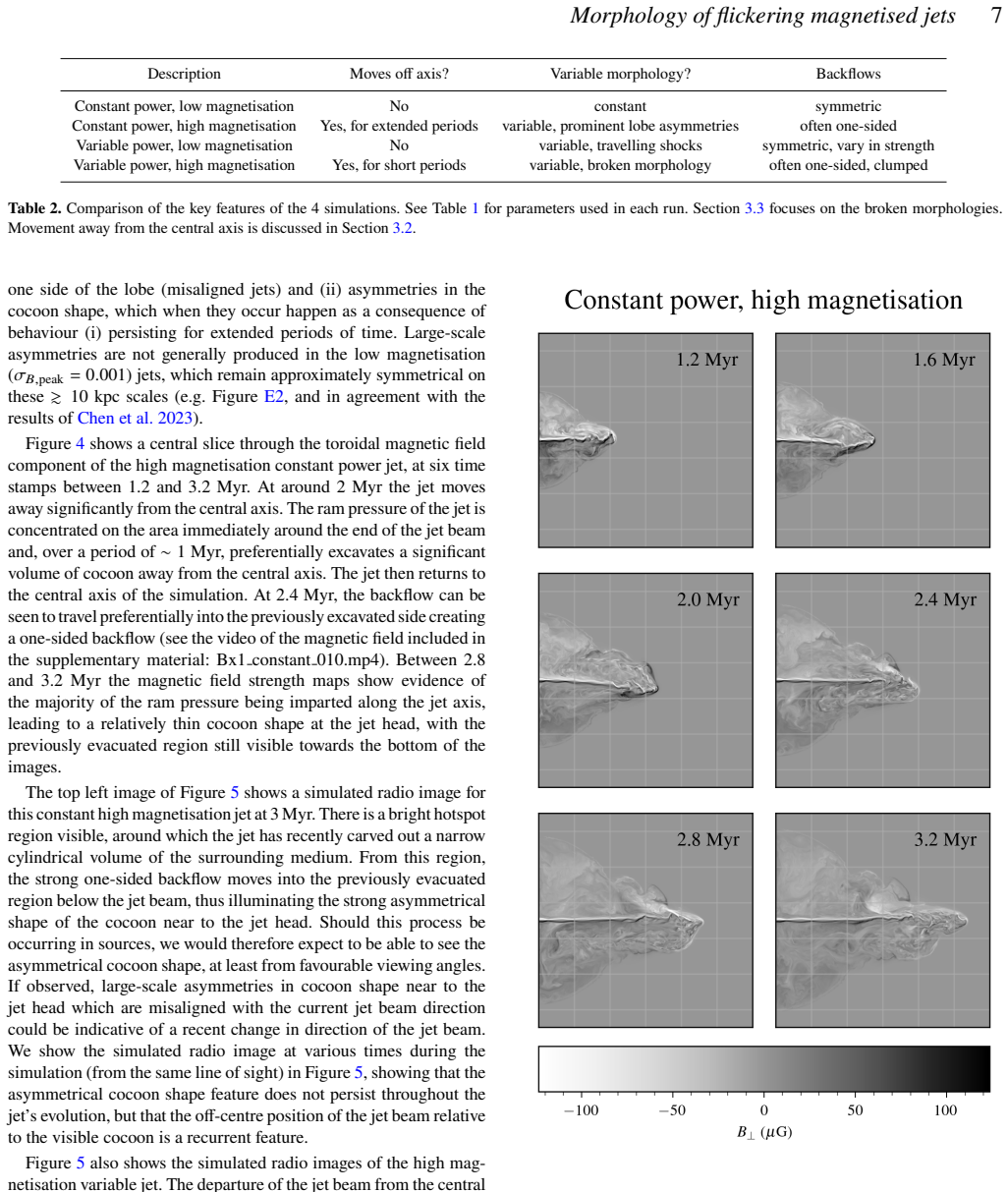
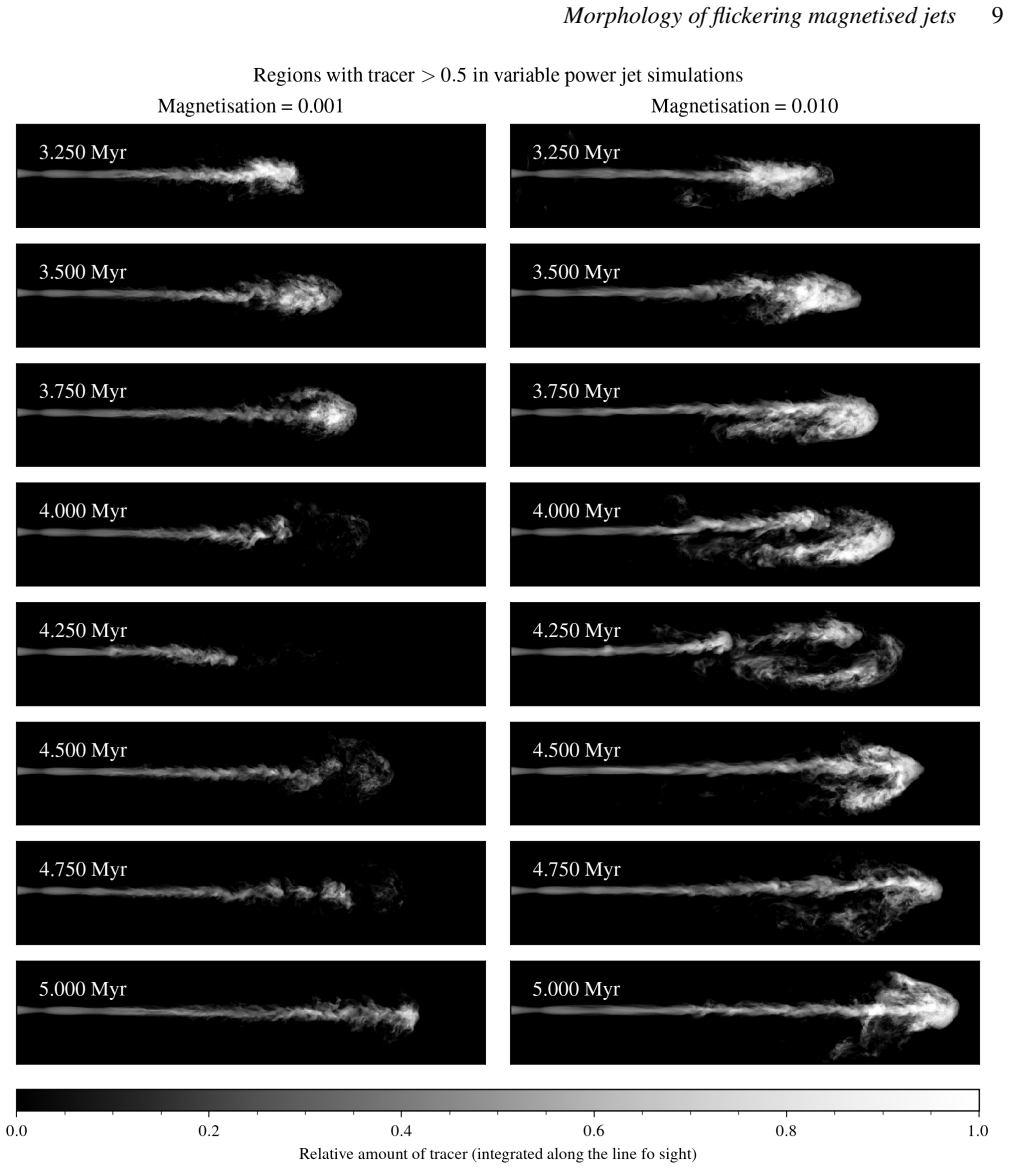
Constant high-magnetization jets develop highly asymmetrical cocoon morphologies, whereas variable high-magnetization jets exhibit broken morphologies caused by a discontinuous jet beam; the interplay between magnetization and variability also drives localized kink instabilities along the jet.
What carries the argument
Grid of relativistic magnetohydrodynamic simulations using the PLUTO code that compare constant versus flickering jet power at two fixed magnetization levels and track the resulting cocoon asymmetry, beam continuity, and instability growth.
Load-bearing premise
The two chosen magnetization values and the specific flickering prescription are representative of real AGN jets and the grid resolution captures the reported instabilities without numerical artifacts.
What would settle it
Detection of continuous, unbroken jet beams in sources inferred to have high magnetization and variable power, or symmetrically shaped cocoons in constant high-magnetization cases, would contradict the simulation outcomes.
Figures







read the original abstract
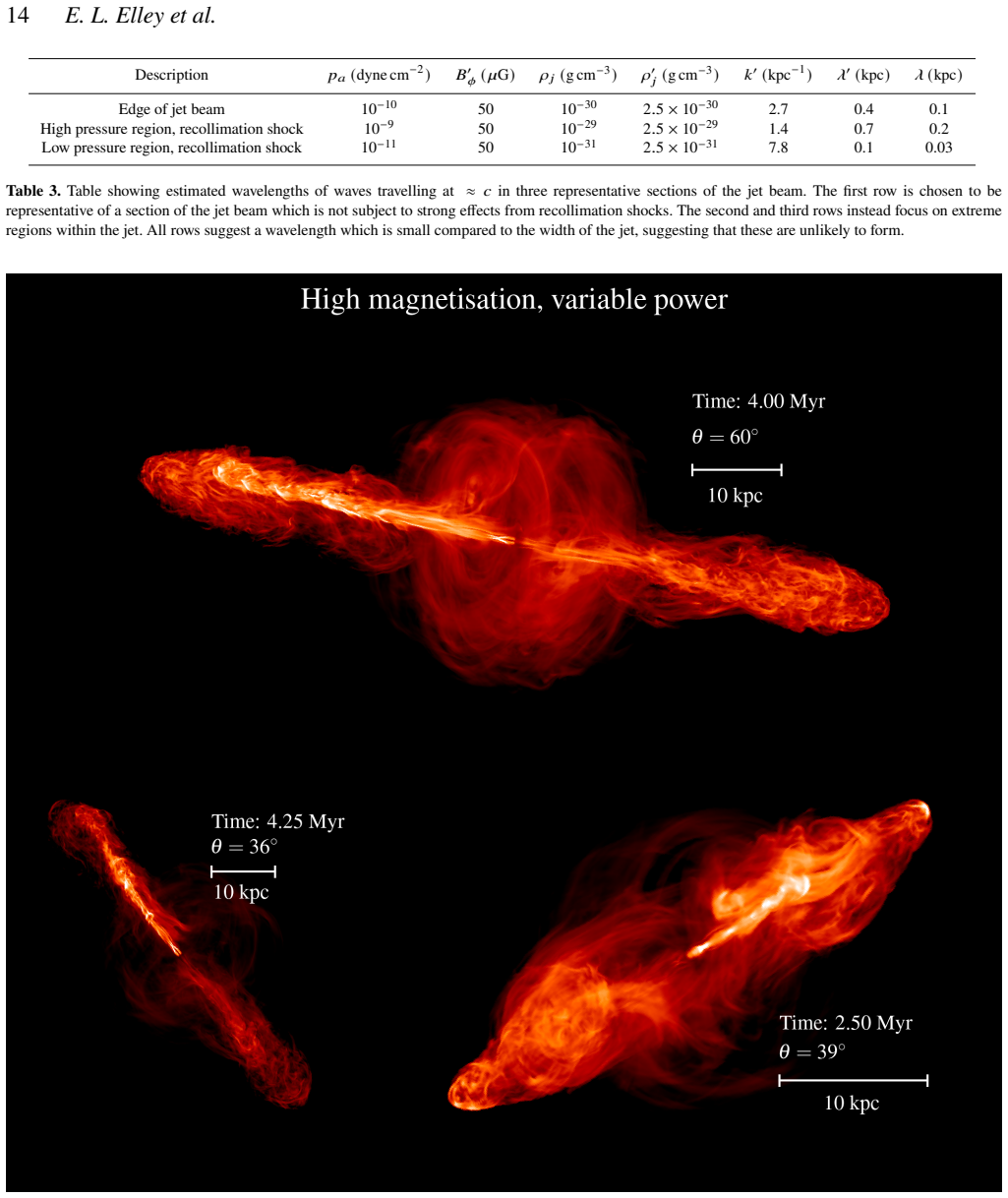
The physics governing the morphology of radio-loud AGN jets is not fully understood. We investigate how magnetization, flickering jet power and their interplay affects the morphology of radio galaxies. We present a grid of relativistic magnetohydrodynamic simulations using the PLUTO code covering constant and variable jets with two levels of magnetisation. We find that the constant high magnetisation jets can lead to highly asymmetrical cocoon morphologies, whilst the variable high magnetisation jet can exhibit a broken morphology, caused by a discontinuous jet beam. Our work highlights the importance of magnetisation and variability on the stability and resulting morphology of radio-loud AGN jets, suggesting both are significant factors in addition to jet power or environment. Furthermore, we show that the interaction between magnetisation and variability can lead to the development of localised kink instabilities along the jet beam. Finally, we discuss the effects of hydrodynamic mixing in low magnetisation jets and the role of viewing angle dependence in comparisons between our simulations and observed sources. To facilitate this comparison we present a library of simulated radio images at different times in the simulations and from various viewing angles, which highlight a diverse set of complex morphologies.
Editorial analysis
A structured set of objections, weighed in public.
Referee Report
Summary. The paper presents a grid of PLUTO relativistic MHD simulations of AGN jets comparing constant and flickering (variable-power) cases at two magnetization levels. It claims that constant high-magnetization jets produce highly asymmetrical cocoon morphologies while variable high-magnetization jets develop broken morphologies caused by a discontinuous jet beam, both driven by the growth of kink instabilities from the magnetization–variability interplay. The work also discusses hydrodynamic mixing in low-magnetization runs, viewing-angle effects, and supplies a library of synthetic radio images for observational comparison.
Significance. If the reported morphologies prove robust, the study usefully isolates magnetization and flickering variability as additional controls on jet stability and large-scale structure, complementing existing work on jet power and ambient density. The provision of multi-view synthetic images is a concrete strength that facilitates direct comparison with radio-galaxy observations.
major comments (2)
- [methods / simulation setup] Simulation setup (methods section): the grid resolution employed for the PLUTO RMHD runs is not stated and no resolution-doubled control simulations are shown for the high-magnetization cases. Because numerical diffusivity at the jet–cocoon shear layer can seed or damp current-driven kink modes, the absence of convergence tests leaves open the possibility that the reported asymmetrical cocoons and broken beams are partly numerical artifacts rather than physical outcomes of the magnetization–variability interaction.
- [results / high-magnetization runs] Results on high-σ jets: the headline morphological claims rest on only two discrete magnetization values and a single flickering time series. Without a modest parameter sweep (e.g., varying the flickering amplitude or duty cycle), it is difficult to establish that the discontinuous beam and subsequent break are generic consequences of the interplay rather than specific to the chosen prescription.
minor comments (2)
- [abstract] The abstract states that two magnetization levels are used but does not quote the actual σ values; adding these numbers would improve immediate readability.
- [figure captions] Figure captions for the synthetic radio images should specify the observing frequency, beam size, and any assumed spectral index so that the images can be reproduced or compared quantitatively with observations.
Simulated Author's Rebuttal
We thank the referee for their constructive and detailed report. We address each major comment below and have revised the manuscript to improve clarity and explicitly discuss limitations where appropriate.
read point-by-point responses
-
Referee: [methods / simulation setup] Simulation setup (methods section): the grid resolution employed for the PLUTO RMHD runs is not stated and no resolution-doubled control simulations are shown for the high-magnetization cases. Because numerical diffusivity at the jet–cocoon shear layer can seed or damp current-driven kink modes, the absence of convergence tests leaves open the possibility that the reported asymmetrical cocoons and broken beams are partly numerical artifacts rather than physical outcomes of the magnetization–variability interaction.
Authors: We agree that the resolution should be stated more explicitly. The methods section describes a base grid of 512×256×256 zones with two levels of adaptive mesh refinement focused on the jet beam and shear layer; we will revise the text to highlight this upfront and add a short paragraph on numerical considerations. While dedicated resolution-doubled runs for the high-magnetization cases were not performed (owing to the substantial computational cost), the chosen resolution is comparable to or higher than that used in similar RMHD jet studies in the literature, and the large-scale morphological features we report are well-resolved. We will note this limitation and the potential role of numerical diffusivity in the revised methods and discussion sections. revision: partial
-
Referee: [results / high-magnetization runs] Results on high-σ jets: the headline morphological claims rest on only two discrete magnetization values and a single flickering time series. Without a modest parameter sweep (e.g., varying the flickering amplitude or duty cycle), it is difficult to establish that the discontinuous beam and subsequent break are generic consequences of the interplay rather than specific to the chosen prescription.
Authors: We acknowledge the limited parameter space. Our grid comprises only two magnetization values and one representative flickering prescription chosen to match observed AGN variability timescales. A broader sweep over amplitude and duty cycle would be valuable but lies beyond the computational scope of the present study. In the revised manuscript we will expand the conclusions to state this limitation explicitly, justify the selected parameters on observational grounds, and suggest that future work should explore a wider range to test generality of the broken-beam morphology. revision: partial
- Performing additional resolution-doubled control simulations for the high-magnetization runs
- Conducting a parameter sweep over flickering amplitude and duty cycle
Circularity Check
No circularity: morphologies are direct outputs of forward RMHD integration
full rationale
The paper reports results from a grid of PLUTO relativistic MHD simulations with prescribed constant/variable jet power and two discrete magnetization levels. The central claims (asymmetrical cocoons in constant high-σ runs; broken beam in variable high-σ runs) are diagnosed directly from the evolved fields and density; they are not obtained by inverting fitted parameters, renaming known results, or invoking self-citations for uniqueness theorems. No equation or section reduces the reported morphology to an input by construction. The work is a standard forward numerical experiment whose validity hinges on resolution and parameter choice, not on circular derivation.
Axiom & Free-Parameter Ledger
free parameters (2)
- magnetization levels
- flickering variability parameters
axioms (2)
- standard math Relativistic magnetohydrodynamic equations govern jet propagation
- domain assumption Numerical resolution is sufficient to resolve kink instabilities and hydrodynamic mixing
Reference graph
Works this paper leans on
-
[1]
Simulating the dynamics and non-thermal emission of relativistic magnetized jets I. Dynamics. , keywords =. doi:10.1093/mnras/staa2934 , archivePrefix =. 2009.10475 , primaryClass =
-
[2]
Modelling the Kinked Jet of the Crab Nebula
Modelling the kinked jet of the Crab nebula. , keywords =. doi:10.1093/mnras/stt1632 , archivePrefix =. 1309.0375 , primaryClass =
work page internal anchor Pith review Pith/arXiv arXiv doi:10.1093/mnras/stt1632
-
[3]
Electromagnetic extraction of energy from Kerr black holes. , keywords =. doi:10.1093/mnras/179.3.433 , adsurl =
-
[4]
Hydromagnetic flows from accretion disks and the production of radio jets. , keywords =. doi:10.1093/mnras/199.4.883 , adsurl =
-
[5]
A simple analytical model of magnetic jets. , keywords =. doi:10.1093/mnrasl/slac060 , archivePrefix =. 2204.11637 , primaryClass =
-
[6]
Linear stability analysis of magnetized relativistic jets: the nonrotating case
Linear stability analysis of magnetized relativistic jets: the non-rotating case. , keywords =. doi:10.1093/mnras/stt1225 , archivePrefix =. 1307.6388 , primaryClass =
work page internal anchor Pith review Pith/arXiv arXiv doi:10.1093/mnras/stt1225
-
[7]
Equation of state in relativistic magnetohydrodynamics: variable versus constant adiabatic index. , keywords =. doi:10.1111/j.1365-2966.2007.11849.x , archivePrefix =. 0704.1679 , primaryClass =
-
[8]
, year = 1971, month = apr, volume =
The Hydromagnetic Free Expansion of a Relativistic Gas. , year = 1971, month = apr, volume =. doi:10.1086/150883 , adsurl =
-
[9]
Role of Magnetic Reconnection in Blazar Variability Using Numerical Simulation. , keywords =. doi:10.3847/1538-4357/ae2330 , archivePrefix =. 2511.19605 , primaryClass =
-
[10]
Three-dimensional relativistic MHD simulations of active galactic nuclei jets: magnetic kink instability and Fanaroff-Riley dichotomy. , keywords =. doi:10.1093/mnrasl/slw064 , archivePrefix =. 1512.04526 , primaryClass =
work page internal anchor Pith review Pith/arXiv arXiv doi:10.1093/mnrasl/slw064
-
[11]
Relativistic MHD simulations of core-collapse GRB jets: 3D instabilities and magnetic dissipation
Relativistic MHD simulations of core-collapse GRB jets: 3D instabilities and magnetic dissipation. , keywords =. doi:10.1093/mnras/stv2591 , archivePrefix =. 1508.02721 , primaryClass =
work page internal anchor Pith review Pith/arXiv arXiv doi:10.1093/mnras/stv2591
-
[12]
Linear analysis
Current-driven instabilities in astrophysical jets. Linear analysis. , keywords =
-
[13]
Current-driven kink instabilities in relativistic jets: dissipation properties. , keywords =. doi:10.1093/mnras/stab3492 , archivePrefix =. 2111.14575 , primaryClass =
-
[14]
Stability of Relativistic Force-Free Jets
Stability of Relativistic Force-free Jets. , keywords =. doi:10.1088/0004-637X/697/2/1681 , archivePrefix =. 0901.4775 , primaryClass =
work page internal anchor Pith review Pith/arXiv arXiv doi:10.1088/0004-637x/697/2/1681
-
[15]
Instability of toroidal magnetic field in jets and plerions
Instability of Toroidal Magnetic Field in Jets and Plerions. , keywords =. doi:10.1086/305119 , archivePrefix =. astro-ph/9708142 , primaryClass =
work page internal anchor Pith review Pith/arXiv arXiv doi:10.1086/305119
-
[16]
Screw Instability and Blandford-Znajek Mechanism
Screw Instability and the Blandford-Znajek Mechanism. , keywords =. doi:10.1086/312538 , archivePrefix =. astro-ph/0001420 , primaryClass =
work page internal anchor Pith review Pith/arXiv arXiv doi:10.1086/312538
-
[17]
Evolution of current- and pressure-driven instabilities in relativistic jets. , keywords =. doi:10.1093/mnras/stae1788 , archivePrefix =. 2407.15477 , primaryClass =
-
[18]
2010, MNRAS, 401, 791, doi: 10.1111/j.1365-2966.2009.15715.x
High-resolution 3D relativistic MHD simulations of jets. , keywords =. doi:10.1111/j.1365-2966.2009.15642.x , archivePrefix =. 0908.4523 , primaryClass =
-
[19]
Bridging simulations of kink instability in relativistic magnetized jets with radio emission and polarisation. J. High Energy Astrophys , keywords =. doi:10.1016/j.jheap.2024.09.007 , archivePrefix =. 2409.15406 , primaryClass =
-
[20]
Simulating radio emission from flickering AGN jets: travelling shocks and hotspot brightening. , keywords =. doi:10.1093/mnras/stag131 , archivePrefix =. 2601.13138 , primaryClass =
-
[21]
A simulation-based analytic model of radio galaxies
A simulation-based analytic model of radio galaxies. , keywords =. doi:10.1093/mnras/stx3358 , archivePrefix =. 1801.00667 , primaryClass =
work page internal anchor Pith review Pith/arXiv arXiv doi:10.1093/mnras/stx3358
-
[22]
A Dynamical Model for the Evolution of Hot Spots in Powerful Radio Sources. , keywords =. doi:10.1071/AS03001 , adsurl =
-
[23]
A spectropolarimetric study of the radio galaxy Pictor A using MeerKAT. , keywords =. doi:10.1093/mnras/stae598 , archivePrefix =. 2402.17647 , primaryClass =
-
[24]
Threads, Ribbons, and Rings in the Radio Galaxy IC 4296. , keywords =. doi:10.3847/1538-4357/ac0880 , archivePrefix =. 2106.05340 , primaryClass =
-
[25]
Self-similar jets. , keywords =. doi:10.1093/mnras/250.3.581 , adsurl =
-
[26]
Three-dimensional Simulations of AGN Jets: Magnetic Kink Instability versus Conical Shocks
Simulations of AGN jets: magnetic kink instability versus conical shocks. , keywords =. doi:10.1093/mnras/stx1165 , archivePrefix =. 1612.06929 , primaryClass =
work page internal anchor Pith review Pith/arXiv arXiv doi:10.1093/mnras/stx1165
-
[27]
High-resolution maps of 11 sources at 3.6 CM
A study of FRII radio galaxies with z<0.15 - II. High-resolution maps of 11 sources at 3.6 CM. , keywords =. doi:10.1093/mnras/291.1.20 , adsurl =
-
[28]
A five-wave Harten-Lax-van Leer Riemann solver for relativistic magnetohydrodynamics. , keywords =. doi:10.1111/j.1365-2966.2008.14221.x , archivePrefix =. 0811.1483 , primaryClass =
-
[29]
Whitehead, Henry W and Matthews, James H , number =. 2023 , journal =. doi:10.1093/mnras/stad1582 , issn =
-
[30]
A polarization study of jets interacting with turbulent magnetic fields. , keywords =. doi:10.1093/mnras/stad3092 , archivePrefix =. 2310.03139 , primaryClass =
-
[31]
Kink-driven magnetic reconnection in relativistic jets: consequences for X-ray polarimetry of BL Lacs. , keywords =. doi:10.1093/mnras/staa3620 , archivePrefix =. 2006.14976 , primaryClass =
-
[32]
A numerical study of the impact of jet magnetic topology on radio galaxy evolution. , keywords =. doi:10.1093/mnras/stad1074 , archivePrefix =. 2304.03863 , primaryClass =
-
[33]
The different flavors of extragalactic jets: Magnetized relativistic flows. , keywords =. doi:10.1051/0004-6361/202348864 , archivePrefix =. 2402.04707 , primaryClass =
-
[34]
Complex morphology and precession indicators of active galactic nuclei jets in LoTSS DR2. , keywords =. doi:10.1051/0004-6361/202453559 , archivePrefix =. 2504.18518 , primaryClass =
-
[35]
The LOFAR Two-metre Sky Survey. V. Second data release. , keywords =. doi:10.1051/0004-6361/202142484 , archivePrefix =. 2202.11733 , primaryClass =
-
[36]
arXiv e-prints , keywords =
Mapping the emission and spectral properties of the FRI radio galaxy 3C 449 with LOFAR and the VLA. arXiv e-prints , keywords =
-
[37]
Broad- and Narrow-Band Imaging of the Giant Radio Galaxy Cygnus A. , keywords =. doi:10.1086/115155 , adsurl =
-
[38]
The variability of blazars throughout the electromagnetic spectrum. , keywords =. doi:10.1007/s00159-025-00165-4 , archivePrefix =. 2511.18975 , primaryClass =
-
[39]
Hercules A (3C 348): Phenomenology of an Unusual Active Galactic Nucleus. , keywords =. doi:10.1086/339829 , adsurl =
-
[40]
Sub-arcsecond 144 MHz to 7 GHz observations
Origin of the ring structures in Hercules A. Sub-arcsecond 144 MHz to 7 GHz observations. , keywords =. doi:10.1051/0004-6361/202140880 , archivePrefix =. 2108.07287 , primaryClass =
-
[41]
Growing supermassive black holes by chaotic accretion. , keywords =. doi:10.1111/j.1745-3933.2006.00249.x , archivePrefix =. astro-ph/0609598 , primaryClass =
-
[42]
Gaspari, M. and Ruszkowski, M. and Oh, S. Peng , number =. 2013 , journal =. doi:10.1093/mnras/stt692 , issn =
-
[43]
Gaspari, M. and Temi, P. and Brighenti, F. , number =. 2017 , journal =. doi:10.1093/mnras/stw3108 , issn =
-
[44]
Numerical modelling of the lobes of radio galaxies in cluster environments - III. Powerful relativistic and non-relativistic jets. , keywords =. doi:10.1093/mnras/stw1407 , archivePrefix =. 1606.03374 , primaryClass =
work page internal anchor Pith review Pith/arXiv arXiv doi:10.1093/mnras/stw1407
-
[45]
Long-term FRII jet evolution: Clues from three-dimensional simulations
Long-term FRII jet evolution: clues from three-dimensional simulations. , keywords =. doi:10.1093/mnras/sty2912 , archivePrefix =. 1810.10968 , primaryClass =
work page internal anchor Pith review Pith/arXiv arXiv doi:10.1093/mnras/sty2912
-
[46]
NGC326 - A radio galaxy with a precessing beam. , keywords =. doi:10.1038/276588a0 , adsurl =
-
[47]
Extragalactic Radio Sources , year = 1982, editor =
Morphology and power of radio sources. Extragalactic Radio Sources , year = 1982, editor =
1982
-
[48]
High-resolution observations of 3C 219 at 1.48 and 4.89 GHz. , keywords =. doi:10.1086/112703 , adsurl =
-
[49]
New mechanisms for forming multiple hotspots in radio jets. , keywords =. doi:10.1093/mnras/stad674 , archivePrefix =. 2302.14023 , primaryClass =
-
[50]
Asymmetric Morphology of the Propagating Jet. , keywords =. doi:10.1086/169464 , adsurl =
-
[51]
Three-dimensional simulations of the jets of extragalactic radio sources. , keywords =. doi:10.1093/mnras/252.4.558 , adsurl =
-
[52]
Energy Transport in Radio Galaxies and Quasars , year = 1996, editor =
The Jets in the Radio Galaxy 3C 353. Energy Transport in Radio Galaxies and Quasars , year = 1996, editor =
1996
-
[53]
Internal Structure of the Jets in 3C 353. , keywords =. doi:10.1086/311663 , adsurl =
-
[54]
IC 4296: a double-double radio galaxy. , keywords =. doi:10.1093/mnras/178.4.525 , adsurl =
-
[55]
2007 , journal =
Mignone, A and Bodo, G and Massaglia, S and Matsakos, T and Tesileanu, O and Zanni, C and Ferrari, A , number =. 2007 , journal =
2007
-
[56]
2007 , journal =
Hunter, J D , number =. 2007 , journal =
2007
-
[57]
Cylindrical plasmas , booktitle=
Goedbloed, Hans and Keppens, Rony and Poedts, Stefaan , year=. Cylindrical plasmas , booktitle=
-
[58]
Fanaroff, B L and Riley, J M , number =. 1974 , journal =. doi:10.1093/mnras/167.1.31P , issn =
-
[59]
Particle Acceleration in Kink-unstable Jets. , keywords =. doi:10.3847/2041-8213/ab95a2 , archivePrefix =. 1910.13370 , primaryClass =
-
[60]
2016 , journal =
Connolly, Samuel D , volume =. 2016 , journal =
2016
-
[61]
Emmanoulopoulos, D and McHardy, I M and Papadakis, I E , number =. 2013 , journal =. doi:10.1093/mnras/stt764 , issn =
-
[62]
Radio-loud AGN morphology and host-galaxy properties in the LOFAR Two-metre Sky Survey Data Release 2. , keywords =. doi:10.1093/mnras/staf966 , archivePrefix =. 2506.08878 , primaryClass =
-
[63]
The link between accretion mode and environment in radio-loud active galaxies
The link between accretion mode and environment in radio-loud active galaxies. , keywords =. doi:10.1093/mnras/stv1807 , archivePrefix =. 1508.01033 , primaryClass =
work page internal anchor Pith review Pith/arXiv arXiv doi:10.1093/mnras/stv1807
-
[64]
and Lightman, Alan P
Rybicki, George B. and Lightman, Alan P. , address =. Radiative Processes in Astrophysics , year =. Radiative processes in astrophysics , isbn =
-
[65]
Simulations of spin-driven AGN jets in gas-rich galaxy mergers. , keywords =. doi:10.1093/mnras/stae392 , archivePrefix =. 2306.07316 , primaryClass =
-
[66]
Stability of three-dimensional relativistic jets: implications for jet collimation
Stability of three-dimensional relativistic jets: implications for jet collimation. , keywords =. doi:10.1051/0004-6361/200913012 , archivePrefix =. 1005.4332 , primaryClass =
work page internal anchor Pith review Pith/arXiv arXiv doi:10.1051/0004-6361/200913012
-
[67]
Formation of dynamical structures in relativistic jets: the FRI case
Formation of dynamical structures in relativistic jets: the FRI case. , keywords =. doi:10.1051/0004-6361:200809687 , archivePrefix =. 0806.1648 , primaryClass =
work page internal anchor Pith review Pith/arXiv arXiv doi:10.1051/0004-6361:200809687
-
[68]
Observational Biases and Improved Modelling of Off-axis Relativistic Jets
discussion (0)
Sign in with ORCID, Apple, or X to comment. Anyone can read and Pith papers without signing in.