Recognition: no theorem link
On the Apparent Correlation between X-ray and Neutrino Luminosities of Active Galactic Nuclei
Pith reviewed 2026-05-14 18:00 UTC · model grok-4.3
The pith
The apparent correlation between X-ray and neutrino luminosities in AGN arises purely from selection effects.
A machine-rendered reading of the paper's core claim, the machinery that carries it, and where it could break.
Core claim
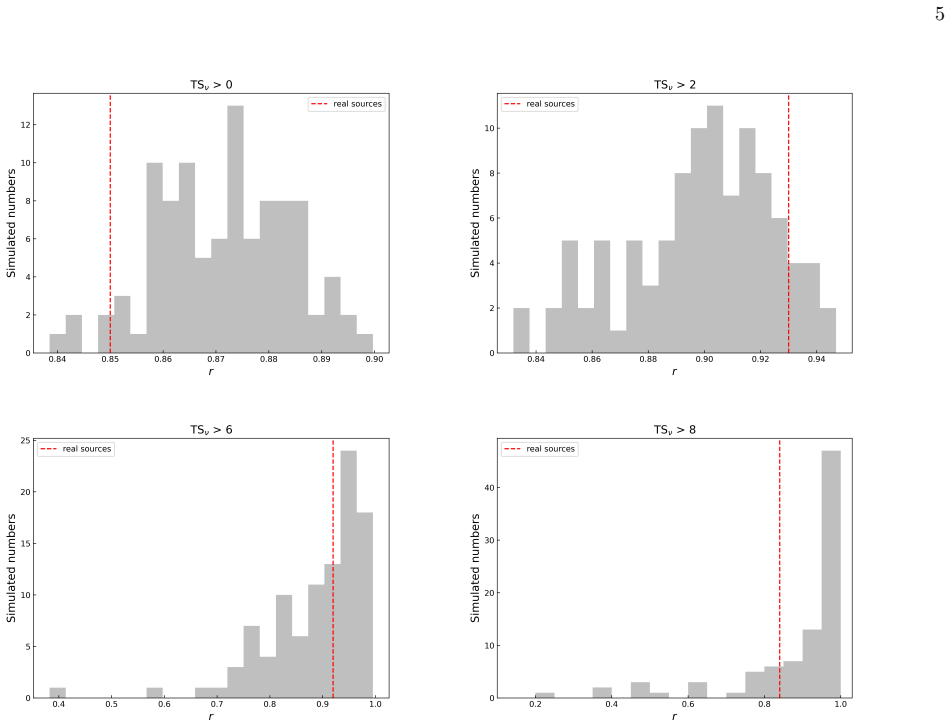
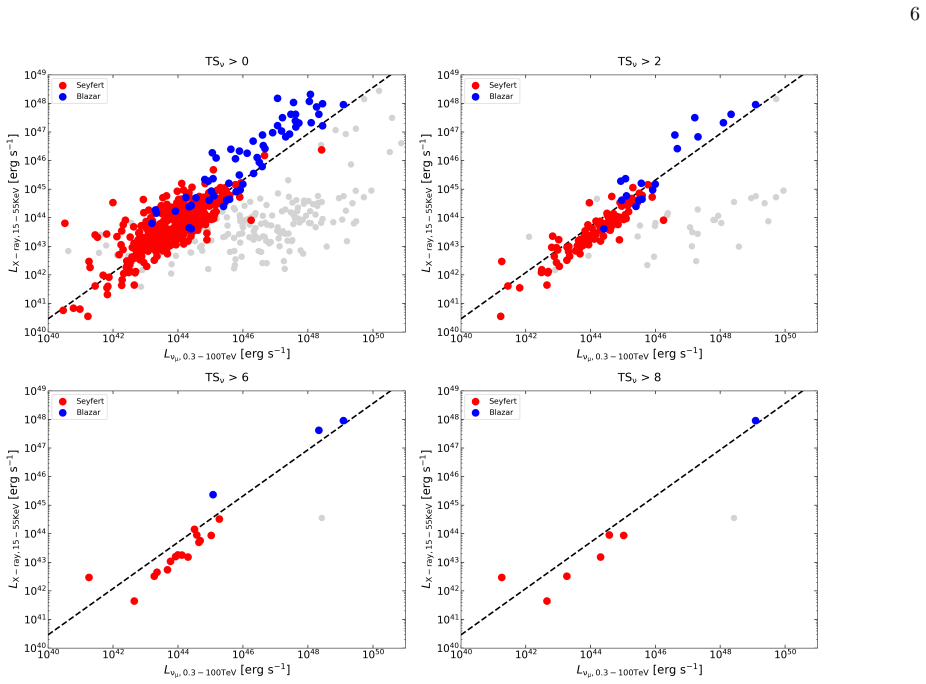
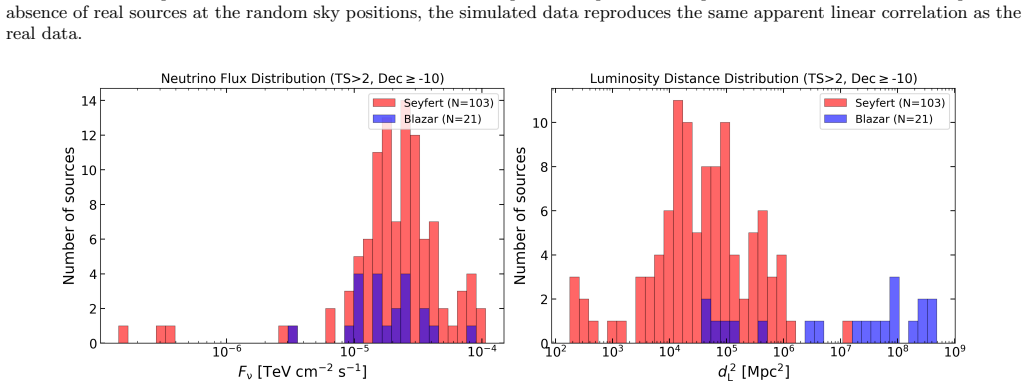
The observed L_ν–L_X correlation in AGN is produced by selection biases in neutrino detection: TS-based selection keeps neutrino fluxes within a factor of several while luminosity distances vary by ~10^4, making L = 4π D_L² F distance-dominated rather than flux-driven, so the same correlation appears even for random sky positions with no astrophysical neutrino sources.
What carries the argument
TS-based source selection that restricts neutrino flux variations to a narrow interval across a sample whose luminosity distances span four orders of magnitude.
If this is right
- Only a robust flux-flux correlation for high-significance neutrino sources can support a physical connection between the emissions.
- Any luminosity-based correlation must be validated against random-position simulations to rule out distance-driven artifacts.
- Prior claims of linear L_ν–L_X relations in AGN likely reflect the wide distance range of the sample rather than shared emission physics.
- For sources with only mild neutrino evidence, luminosity correlations provide no reliable indication of a neutrino-X-ray link.
Where Pith is reading between the lines
- The same distance-dominated bias may affect luminosity correlations reported for other multi-messenger populations.
- Analyses that select sources by significance threshold should routinely compare results against random-position controls.
- Future work could test whether a true physical correlation emerges once sources are restricted to a narrow redshift slice.
Load-bearing premise
Monte Carlo simulations of random sky positions reproduce the exact TS-based source selection and background estimation procedures used on the real IceCube data.
What would settle it
A statistically significant neutrino-X-ray flux correlation among high-significance IceCube sources that does not appear in the corresponding random-position Monte Carlo runs would indicate a genuine physical link.
Figures



read the original abstract
Recent studies have reported a linear correlation between the hard X-ray and high-energy neutrino luminosities of active galactic nuclei (AGN), suggesting a possible physical connection between these two messengers. In this work, we challenge this interpretation by demonstrating that the observed correlation may arise purely from selection effects. We analyze 10 years of IceCube public data for a sample of Seyfert galaxies and blazars from the \textit{Swift} BAT catalog. While our data reproduces the apparent $L_\nu$--$L_X$ correlation for sources with mild (but not significant) neutrino evidence, we show through Monte Carlo simulations that the same correlation appears even when analyzing random sky positions with no astrophysical sources. The key issue is that TS-based source selection effectively restricts the neutrino flux to a narrow range (a factor of several), while the luminosity distance of the sample spans $\sim4$ orders of magnitude. This causes the luminosity $L = 4\pi D_L^2 F$ to be dominated by the distance term rather than intrinsic flux variations, creating an artificial correlation. While a robust flux correlation ($F_\nu$--$F_X$) for high-significance sources may indicate a genuine physical link, our results demonstrate that a luminosity-luminosity correlation alone is insufficient to establish a physical relationship between neutrino and X-ray emission in AGN.
Editorial analysis
A structured set of objections, weighed in public.
Referee Report
Summary. The paper claims that the apparent linear correlation between hard X-ray and high-energy neutrino luminosities in AGN is an artifact of selection effects. Using 10 years of IceCube public data on Swift BAT Seyferts and blazars, the authors reproduce the L_nu - L_X correlation for sources with mild neutrino evidence, but show via Monte Carlo simulations of random sky positions that the identical correlation emerges in the absence of any astrophysical sources. The mechanism is that TS-based selection confines neutrino flux to a narrow range (factor of several) while luminosity distances span ~4 orders of magnitude, so that L = 4 pi D_L^2 F becomes distance-dominated and induces a spurious correlation.
Significance. If the result holds, it supplies a clear, reproducible cautionary example for multi-messenger astronomy: luminosity-luminosity correlations alone cannot establish physical associations when the underlying flux selection is narrow and the distance baseline is large. The use of public IceCube data, the Swift BAT catalog, and null Monte Carlo tests strengthens the paper's falsifiability and reproducibility, directly supporting the claim that a robust flux-flux correlation (rather than luminosity) would be required to argue for a genuine physical link.
major comments (1)
- [Monte Carlo Simulations] Monte Carlo section: the central claim that random-position simulations accurately reproduce the real TS-based source selection and background estimation is load-bearing for the conclusion that the correlation is purely artificial. Without an explicit side-by-side comparison of the TS distributions, flux histograms, or the precise sample cuts applied to both real and simulated data, it remains possible that residual differences in the selection function contribute to the observed null correlation.
minor comments (2)
- [Abstract and §3] The exact numerical TS threshold (or range) used to define the 'mild neutrino evidence' sample should be stated explicitly in the text and abstract so that readers can immediately verify the claimed narrowness of the flux window.
- [Figures 2 and 3] Figure captions for the luminosity and flux correlation plots should include the exact number of sources retained after each cut and the Spearman rank coefficient with its p-value for both real and simulated data sets.
Circularity Check
No significant circularity; statistical demonstration relies on external data and simulations
full rationale
The paper's derivation chain consists of reproducing an apparent L_ν–L_X correlation in real IceCube data for Swift BAT sources, then using Monte Carlo simulations of random sky positions (with the same TS-based selection) to show the correlation persists due to the narrow range of selected neutrino fluxes combined with the ~4-order span in luminosity distances. This is grounded in the explicit relation L = 4π D_L² F and the properties of the public IceCube TS threshold, without any self-definitional equations, fitted parameters called predictions, load-bearing self-citations, or imported uniqueness theorems. The argument is self-contained against external benchmarks and does not reduce to its inputs by construction.
Axiom & Free-Parameter Ledger
axioms (2)
- standard math Luminosity is computed as L = 4 pi D_L^2 F using standard cosmological luminosity distance
- domain assumption TS-based selection restricts neutrino flux to a narrow range
Reference graph
Works this paper leans on
-
[1]
performed a search using 12 years of all-sky IceCube muon track data (PSTracks) on 43 hard X-ray AGN from the Swift-BAT catalog, reporting no significant stack- ing signal but identifying an excess from NGC 4151 at the 2.9σpost-trial level. Abbasiet al.[13] analyzed 10 years of Northern Hemisphere through-going track data on 27 X-ray bright Seyfert galaxi...
work page internal anchor Pith review Pith/arXiv arXiv 2011
-
[2]
neutrino
[24] using theskyllhsoftware package [25, 26], an open-source Python-based maximum-likelihood analysis framework developed by the IceCube Collaboration for point-source searches. The data span the period from April 6, 2008 to July 8, 2018, encompassing multiple de- tector configurations: IC40, IC59, and IC79 during the construction phases with 40, 59, and...
2008
-
[3]
sources, whereas the TS/flux cut selection can only produce a spurious luminosity correlation rather than a flux correlation, likely reflects an intrinsic physical con- nection between the X-ray and neutrino emission for the six sources. Because the flux correlation eliminates the distance dependence, it indicates that the X-ray and neu- trino emission le...
-
[4]
Our simula- tions demonstrate that while selection effects can readily produce a spuriousL ν–LX correlation, they cannot gen- erate a fakeF ν–FX correlation
satisfy not only the luminosity–luminosity correla- tion but also exhibit a flux–flux correlation. Our simula- tions demonstrate that while selection effects can readily produce a spuriousL ν–LX correlation, they cannot gen- erate a fakeF ν–FX correlation. Therefore, the X-ray and neutrino emission from the six sources in Kunet al.[19] may indeed be physi...
-
[5]
Evidence for High-Energy Ex- traterrestrial Neutrinos at the IceCube Detector,
M. G. Aartsenet al., “Evidence for High-Energy Ex- traterrestrial Neutrinos at the IceCube Detector,” Sci- ence342, 1242856 (2013)
2013
-
[6]
Neutrino Fluxes from Active Galaxies: a Model-Independent Analysis
F. Halzen and E. Zas, “Neutrino Fluxes from Active Galaxies: A Model-Independent Estimate,” ApJ488, 669 (1997), arXiv:astro-ph/9702193
work page internal anchor Pith review Pith/arXiv arXiv 1997
-
[7]
High-energy neutrinos from extragalactic jets,
K. Mannheim, “High-energy neutrinos from extragalactic jets,” Astroparticle Physics3, 295 (1995)
1995
-
[8]
Multimessenger observations of a flaring blazar coincident with high-energy neutrino IceCube-170922A,
M. G. Aartsenet al., “Multimessenger observations of a flaring blazar coincident with high-energy neutrino IceCube-170922A,” Science361, eaat1378 (2018)
2018
-
[9]
Neutrino emission from the direction of the blazar TXS 0506+056 prior to the IceCube-170922A alert
M. G. Aartsenet al.(IceCube Collaboration), “Neutrino emission from the direction of the blazar TXS 0506+056 prior to the IceCube-170922A alert,” Science361, 147 (2018), arXiv:1807.08794
work page internal anchor Pith review Pith/arXiv arXiv 2018
-
[10]
Time-Integrated Neutrino Source Searches with 10 Years of IceCube Data,
M. G. Aartsenet al., “Time-Integrated Neutrino Source Searches with 10 Years of IceCube Data,” Phys. Rev. Lett.124, 051103 (2020), arXiv:1910.08488
-
[11]
Evidence for neutrino emission from the nearby active galaxy NGC 1068,
R. Abbasiet al., “Evidence for neutrino emission from the nearby active galaxy NGC 1068,” Science378, 538 (2022)
2022
-
[12]
K. Murase, S. S. Kimura, and P. M´ esz´ aros, “Hidden Cores of Active Galactic Nuclei as the Origin of Medium- Energy Neutrinos: Critical Tests with the MeV Gamma- Ray Connection,” Phys. Rev. Lett.125, 011101 (2020), arXiv:1904.04226
-
[13]
On the Origin of High-energy Neutrinos from NGC 1068: The Role of Nonthermal Coronal Activity,
Y. Inoue, D. Khangulyan, and A. Doi, “On the Origin of High-energy Neutrinos from NGC 1068: The Role of Nonthermal Coronal Activity,” Astrophys. J. Lett.891, L33 (2020), arXiv:1909.02239
-
[14]
K. Murase, Y. Inoue, and C. D. Dermer, “Diffuse neutrino intensity from the inner jets of active galac- tic nuclei: Impacts of external photon fields and the blazar sequence,” Phys. Rev. D90, 023007 (2014), arXiv:1403.4089
work page internal anchor Pith review Pith/arXiv arXiv 2014
-
[15]
Solving the Multimessen- ger Puzzle of the AGN-starburst Composite Galaxy NGC 1068,
B. Eichmann, F. Oikonomou, S. Salvatore, R.-J. Dettmar, and J. Becker Tjus, “Solving the Multimessen- ger Puzzle of the AGN-starburst Composite Galaxy NGC 1068,” Astrophys. J.939, 43 (2022), arXiv:2207.00102
-
[16]
Search for Neutrino Emission from Hard X-Ray AGN with Ice- Cube,
R. Abbasiet al.(IceCube Collaboration), “Search for Neutrino Emission from Hard X-Ray AGN with Ice- Cube,” Astrophys. J.981, 131 (2025), arXiv:2406.06684
-
[17]
IceCube Search for Neutrino Emission from X-Ray Bright Seyfert Galaxies,
R. Abbasiet al., “IceCube Search for Neutrino Emission from X-Ray Bright Seyfert Galaxies,” Astrophys. J.988, 141 (2025), arXiv:2406.07601
-
[18]
Evidence for 10 Neutrino Emission from X-Ray-bright Active Galactic Nuclei with IceCube,
R. Abbasiet al.(IceCube Collaboration), “Evidence for 10 Neutrino Emission from X-Ray-bright Active Galactic Nuclei with IceCube,” Astrophys. J. Lett.1000, L26 (2026), arXiv:2510.13403
-
[19]
R. Abbasiet al., “Evidence for Neutrino Emission from X-Ray Bright Seyfert Galaxies in the South- ern Hemisphere Using Enhanced Starting Track Events with IceCube,” Astrophys. J. Lett.1000, L37 (2026), arXiv:2602.10208
-
[20]
Search for high-energy neutrino emission from radio-bright AGN,
B. Zhou, M. Kamionkowski, and Y.-f. Liang, “Search for high-energy neutrino emission from radio-bright AGN,” Phys. Rev. D103, 123018 (2021), arXiv:2103.12813
-
[21]
R.-L. Li, B.-Y. Zhu, and Y.-F. Liang, “Investigating the correlations between IceCube high-energy neutrinos and Fermi-LATγ-ray observations,” Phys. Rev. D106, 083024 (2022), arXiv:2205.15963
-
[22]
R. Abbasiet al.(IceCube Collaboration), “Search for Correlations of High-energy Neutrinos Detected in Ice- Cube with Radio-bright AGN and Gamma-Ray Emis- sion from Blazars,” Astrophys. J.954, 75 (2023), arXiv:2304.12675
-
[23]
E. Kun, I. Bartos, J. B. Tjus, P. L. Biermann, A. Franck- owiak, F. Halzen, S. del Palacio, and J. Woo, “Possible correlation between unabsorbed hard x rays and neutri- nos in radio-loud and radio-quiet active galactic nuclei,” Phys. Rev. D110, 123014 (2024), arXiv:2404.06867
-
[24]
A Seyfert galaxy as a hidden counterpart to a neutrino- associated blazar,
E. Kun, S. del Palacio, I. Bartos, F. Halzen, J. B. Tjus, P. L. Biermann, A. Franckowiak, and C. Ricci, “A Seyfert galaxy as a hidden counterpart to a neutrino- associated blazar,” arXiv e-prints , arXiv:2512.24178 (2025), arXiv:2512.24178. [21]https://swift.gsfc.nasa.gov/results/bs157mon/
-
[25]
The 157 Month Swift/BAT All-sky Hard X-Ray Survey,
A. Y. Lienet al., “The 157 Month Swift/BAT All-sky Hard X-Ray Survey,” Astrophys. J.989, 161 (2025), arXiv:2506.04109
-
[26]
Planck 2018 results. VI. Cosmological parameters
N. Aghanimet al., “Planck 2018 results. VI. Cosmo- logical parameters,” Astron. Astrophys.641, A6 (2020), arXiv:1807.06209
work page internal anchor Pith review Pith/arXiv arXiv 2018
-
[27]
IceCube Data for Neutrino Point-Source Searches Years 2008-2018,
R. Abbasiet al.(IceCube Collaboration), “IceCube Data for Neutrino Point-Source Searches Years 2008-2018,” (2021), 10.21234/CPKQ-K003, arXiv:2101.09836
-
[28]
Extending SkyLLH software for neutrino point source analyses with 10 years of IceCube public data,
C. Bellenghiet al.(IceCube Collaboration), “Extending SkyLLH software for neutrino point source analyses with 10 years of IceCube public data,” PoSICRC2023, 1061 (2023), arXiv:2308.12733. [26]https://icecube.github.io/skyllh/master/html/ index.html
-
[29]
Methods for point source analysis in high energy neutrino telescopes
J. Braun, J. Dumm, F. De Palma, C. Finley, A. Karle, and T. Montaruli, “Methods for point source analysis in high energy neutrino telescopes,” Astropart. Phys.29, 299 (2008), arXiv:0801.1604
work page internal anchor Pith review Pith/arXiv arXiv 2008
-
[30]
Time-Dependent Point Source Search Methods in High Energy Neutrino Astronomy
J. Braun, M. Baker, J. Dumm, C. Finley, A. Karle, and T. Montaruli, “Time-Dependent Point Source Search Methods in High Energy Neutrino Astronomy,” As- tropart. Phys.33, 175 (2010), arXiv:0912.1572
work page internal anchor Pith review Pith/arXiv arXiv 2010
-
[31]
X.-K. Guo, Y.-F. L¨ u, Y.-B. Huang, R.-L. Li, B.-Y. Zhu, and Y.-F. Liang, “Searching for dark-matter induced neutrino signals in dwarf spheroidal galaxies using 10 years of IceCube public data,” Phys. Rev. D108, 043001 (2023), arXiv:2306.02675
-
[32]
Constraints on neutrino emission and hadronic flux from 1LHAASO catalogγ-ray sources,
X.-R. Ouyang, Y.-F. Liang, S.-L. Chen, R.-L. Li, and M.- X. Lu, “Constraints on neutrino emission and hadronic flux from 1LHAASO catalogγ-ray sources,” arXiv e- prints , arXiv:2602.21542 (2026), arXiv:2602.21542
-
[33]
M.-X. Lu, Y.-F. Liang, X. Ouyang, R.-L. Li, and X.-G. Wang, “Investigating the correlations between IceCube high-energy neutrinos and Fermi-LATγ-ray observations. II,” Phys. Rev. D112, 103013 (2025), arXiv:2404.19730
-
[34]
Constraining High-Energy Cosmic Neutrino Sources: Implications and Prospects
K. Murase and E. Waxman, “Constraining high-energy cosmic neutrino sources: Implications and prospects,” Phys. Rev. D94, 103006 (2016), arXiv:1607.01601
work page internal anchor Pith review Pith/arXiv arXiv 2016
-
[35]
IceCube-Gen2: the window to the extreme Universe,
M. G. Aartsenet al., “IceCube-Gen2: the window to the extreme Universe,” Journal of Physics G Nuclear Physics 48, 060501 (2021), arXiv:2008.04323
-
[36]
A multi-cubic-kilometre neutrino tele- scope in the western Pacific Ocean,
Z. P. Yeet al., “A multi-cubic-kilometre neutrino tele- scope in the western Pacific Ocean,” arXiv e-prints , arXiv:2207.04519 (2022), arXiv:2207.04519
-
[37]
HUNT: An ultra-large-scale neutrino astron- omy telescope,
M. Chen, “HUNT: An ultra-large-scale neutrino astron- omy telescope,” Nuclear Instruments and Methods in Physics Research A , 171374 (2026)
2026
discussion (0)
Sign in with ORCID, Apple, or X to comment. Anyone can read and Pith papers without signing in.