Recognition: 2 theorem links
· Lean TheoremSearch for single vector-like quark production in opposite-sign dilepton final states in proton-proton collisions at sqrt{s} = 13 TeV
Pith reviewed 2026-05-14 17:55 UTC · model grok-4.3
The pith
No excess observed in search for single vector-like top quark T decaying to top and Higgs in opposite-sign dilepton events.
A machine-rendered reading of the paper's core claim, the machinery that carries it, and where it could break.
Core claim
The analysis of 13 TeV proton-proton collision data in opposite-sign dilepton final states finds no excess over standard model background expectations for single production of a vector-like top quark T decaying to tH, resulting in 95% CL upper limits on the cross section times branching fraction from 2.0 pb at 600 GeV to 0.1 pb at 1000 GeV.
What carries the argument
Event selection requiring two opposite-sign leptons, multiple jets, and missing transverse momentum to isolate potential T to tH signals from background.
If this is right
- Vector-like quark models predicting cross sections times branching fractions above the observed limits for T masses between 600 and 1000 GeV are excluded at 95% confidence level.
- These results provide the first constraints specifically from the opposite-sign dilepton channel in the T to tH decay mode.
- The limits can be combined with other searches in different final states to further restrict the allowed parameter space for vector-like top quarks.
Where Pith is reading between the lines
- Future LHC data with higher luminosity could extend the mass reach or tighten the limits by a factor of several.
- Complementary searches in single-lepton or fully hadronic channels would add sensitivity to the same T to tH signature.
- These bounds can inform model-building efforts that incorporate vector-like quarks to address issues like the Higgs mass or flavor anomalies.
Load-bearing premise
Standard model backgrounds are accurately modeled in simulation with no significant unaccounted contributions, and signal efficiencies are correctly estimated for the assumed masses and decays.
What would settle it
Observing a statistically significant excess of events in the signal region beyond the predicted background would indicate the presence of the T quark signal.
Figures



read the original abstract
A search is presented for single production of a vector-like top quark T, decaying into the standard model top quark and Higgs boson, in a final state including two opposite-sign leptons (electrons or muons), jets, and missing transverse momentum. The data were recorded by the CMS experiment in proton-proton collisions at a center-of-mass energy of 13 TeV at the CERN LHC in the years 2016$-$2018, and corresponding to an integrated luminosity of up to 138 fb$^{-1}$. No excess in data over the background expectations is observed. Upper limits at 95% confidence level on the product of the T production cross section and its decay branching fraction to tH are set, ranging from 2.0 pb at a T mass of 600 GeV to 0.1 pb at 1000 GeV. This is the first search in the T $\to$ tH channel in opposite-sign dilepton final states.
Editorial analysis
A structured set of objections, weighed in public.
Referee Report
Summary. The manuscript reports a search for single production of a vector-like top quark T decaying to tH in the opposite-sign dilepton final state (electrons or muons, jets, and missing transverse momentum). Using up to 138 fb^{-1} of CMS data at √s = 13 TeV from 2016–2018, no excess over background expectations is observed. 95% CL upper limits are set on σ(T) × BR(T → tH), ranging from 2.0 pb at m_T = 600 GeV to 0.1 pb at 1000 GeV. The work claims to be the first search in the T → tH channel using this final state.
Significance. If the background modeling and signal efficiencies hold, the result provides the first constraints on single T production in the opposite-sign dilepton tH channel, complementing existing VLQ searches in other final states and decay modes. The null-result limit-setting procedure follows established collider methods and adds a new, independent exclusion region.
minor comments (3)
- [Abstract and Section 3] The abstract states 'up to 138 fb^{-1}'; the main text should explicitly tabulate the luminosity used for each mass hypothesis and confirm that the same dataset is applied uniformly across the signal regions.
- [Background estimation] The description of the fake-lepton background estimation (Section 4 or equivalent) relies on data-driven methods; additional validation plots comparing the control regions to data would strengthen the claim that this contribution is accurately modeled in the signal region.
- [Results] Table or figure presenting the observed limits should include the expected limits and ±1σ/±2σ bands for direct visual comparison, as is standard for such searches.
Simulated Author's Rebuttal
We thank the referee for their positive assessment of the manuscript, including the recognition that this search provides the first constraints on single T production in the opposite-sign dilepton tH channel. We appreciate the recommendation for minor revision. No specific major comments were raised in the report.
Axiom & Free-Parameter Ledger
axioms (2)
- domain assumption Standard Model background processes are well-understood and can be simulated accurately in the selected kinematic region.
- domain assumption Detector response, reconstruction efficiencies, and acceptances are correctly modeled in simulation for both signal and background.
Lean theorems connected to this paper
-
IndisputableMonolith/Foundation/RealityFromDistinction.leanreality_from_one_distinction unclear?
unclearRelation between the paper passage and the cited Recognition theorem.
Upper limits at 95% CL on the product of the T production cross section and its decay branching fraction to tH are set, ranging from 2.0 pb at a T mass of 600 GeV to 0.1 pb at 1000 GeV.
-
IndisputableMonolith/Cost/FunctionalEquation.leanwashburn_uniqueness_aczel unclear?
unclearRelation between the paper passage and the cited Recognition theorem.
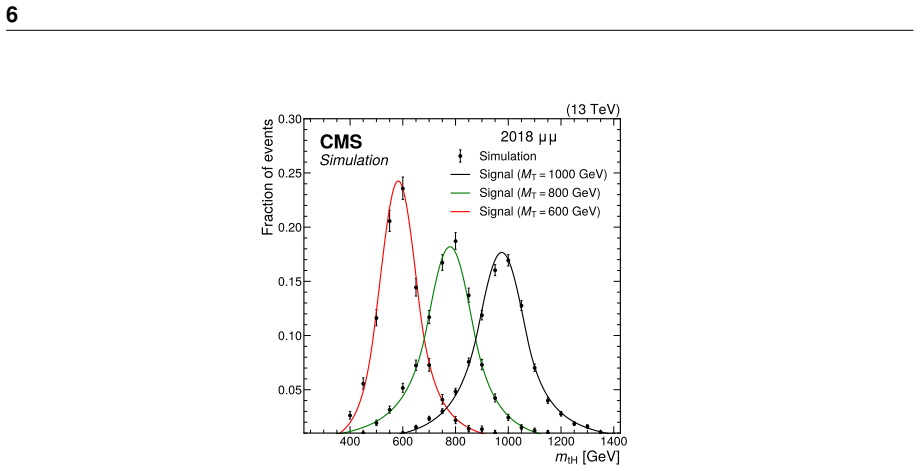
The background is determined from the observed data, with a shape parameterization motivated by Monte Carlo simulations.
What do these tags mean?
- matches
- The paper's claim is directly supported by a theorem in the formal canon.
- supports
- The theorem supports part of the paper's argument, but the paper may add assumptions or extra steps.
- extends
- The paper goes beyond the formal theorem; the theorem is a base layer rather than the whole result.
- uses
- The paper appears to rely on the theorem as machinery.
- contradicts
- The paper's claim conflicts with a theorem or certificate in the canon.
- unclear
- Pith found a possible connection, but the passage is too broad, indirect, or ambiguous to say the theorem truly supports the claim.
Reference graph
Works this paper leans on
-
[1]
Sealing the fate of a fourth generation of fermions
A. Djouadi and A. Lenz, “Sealing the fate of a fourth generation of fermions”,Phys. Lett. B715(2012) 310,doi:10.1016/j.physletb.2012.07.060,arXiv:1204.1252
work page internal anchor Pith review Pith/arXiv arXiv doi:10.1016/j.physletb.2012.07.060 2012
-
[2]
Constraints on a fourth generation of fermions from Higgs boson searches
A. Lenz, “Constraints on a fourth generation of fermions from Higgs boson searches”, Adv. High Energy Phys.2013(2013) 910275,doi:10.1155/2013/910275
-
[3]
Addressing the CKM unitarity problem with a vector-like up quark
G. C. Branco et al., “Addressing the CKM unitarity problem with a vector-like up quark”,JHEP07(2021) 099,doi:10.1007/JHEP07(2021)099,arXiv:2103.13409
-
[4]
Cabibbo angle anomalies and oblique corrections: The remarkable role of the vectorlike quark doublet
B. Belfatto and S. Trifinopoulos, “Cabibbo angle anomalies and oblique corrections: The remarkable role of the vectorlike quark doublet”,Phys. Rev. D108(2023) 035022, doi:10.1103/PhysRevD.108.035022,arXiv:2302.14097
-
[5]
Precise Measurement of the Pi+ -> Pi0 e+ nu Branching Ratio
D. Pocanic et al., “Precise measurement of theπ + →π 0e+νbranching ratio”,Phys. Rev. Lett.93(2004) 181803,doi:10.1103/PhysRevLett.93.181803, arXiv:hep-ex/0312030. 18
work page internal anchor Pith review Pith/arXiv arXiv doi:10.1103/physrevlett.93.181803 2004
-
[6]
Pion beta decay and Cabibbo-Kobayashi-Maskawa unitarity
A. Czarnecki, W. J. Marciano, and A. Sirlin, “Pion beta decay and Cabibbo-Kobayashi-Maskawa unitarity”,Phys. Rev. D101(2020) 091301, doi:10.1103/PhysRevD.101.091301,arXiv:1911.04685
-
[7]
A handbook of vector-like quarks: mixing and single production
J. A. Aguilar-Saavedra, R. Benbrik, S. Heinemeyer, and M. P ´erez-Victoria, “Handbook of vectorlike quarks: Mixing and single production”,Phys. Rev. D88(2013) 094010, doi:10.1103/PhysRevD.88.094010,arXiv:1306.0572
work page internal anchor Pith review Pith/arXiv arXiv doi:10.1103/physrevd.88.094010 2013
-
[8]
ATLAS Collaboration, “Combination of searches for singly produced vectorlike top quarks in pp collisions at √s=13 TeV with the ATLAS detector”,Phys. Rev. D111 (2025) 012012,doi:10.1103/PhysRevD.111.012012,arXiv:2408.08789
-
[9]
CMS Collaboration, “Review of searches for vector-like quarks, vector-like leptons, and heavy neutral leptons in proton–proton collisions at √s=13 TeV at the CMS experiment”,Phys. Rept.1115(2025) 570,doi:10.1016/j.physrep.2024.09.012, arXiv:2405.17605
-
[10]
Identifying top partners at LHC
J. A. Aguilar-Saavedra, “Identifying top partners at LHC”,JHEP11(2009) 030, doi:10.1088/1126-6708/2009/11/030,arXiv:0907.3155
work page internal anchor Pith review Pith/arXiv arXiv doi:10.1088/1126-6708/2009/11/030 2009
-
[11]
Search for electroweak production of a vector-like T quark using fully hadronic final states
CMS Collaboration, “Search for electroweak production of a vector-like T quark using fully hadronic final states”,JHEP01(2020) 036,doi:10.1007/JHEP01(2020)036, arXiv:1909.04721
-
[12]
CMS Collaboration, “Search for a vector-like quark T ′→tH via the diphoton decay mode of the Higgs boson in proton-proton collisions at √s= 13 TeV”,JHEP09(2023) 057, doi:10.1007/JHEP09(2023)057,arXiv:2302.12802
-
[13]
CMS Collaboration, “Search for production of a single vector-like quark decaying to tH or tZ in the all-hadronic final state in pp collisions at √s=13 TeV”,Phys. Rev. D110 (2024) 072012,doi:10.1103/PhysRevD.110.072012,arXiv:2405.05071
-
[14]
HEPData record for this analysis, 2026.doi:10.17182/hepdata.166760
-
[15]
The CMS experiment at the CERN LHC
CMS Collaboration, “The CMS experiment at the CERN LHC”,JINST3(2008) S08004, doi:10.1088/1748-0221/3/08/S08004
-
[16]
Development of the CMS detector for the CERN LHC Run 3
CMS Collaboration, “Development of the CMS detector for the CERN LHC Run 3”, JINST19(2024) P05064,doi:10.1088/1748-0221/19/05/P05064, arXiv:2309.05466
-
[17]
CMS Collaboration, “The CMS trigger system”,JINST12(2017) P01020, doi:10.1088/1748-0221/12/01/P01020,arXiv:1609.02366
work page internal anchor Pith review Pith/arXiv arXiv doi:10.1088/1748-0221/12/01/p01020 2017
-
[18]
Performance of the CMS Level-1 trigger in proton-proton collisions at √s=13 TeV
CMS Collaboration, “Performance of the CMS Level-1 trigger in proton-proton collisions at √s=13 TeV”,JINST15(2020) P10017, doi:10.1088/1748-0221/15/10/P10017,arXiv:2006.10165
-
[19]
Performance of the CMS high-level trigger during LHC Run 2
CMS Collaboration, “Performance of the CMS high-level trigger during LHC Run 2”, JINST19(2024) P11021,doi:10.1088/1748-0221/19/11/P11021, arXiv:2410.17038
-
[20]
Particle-flow reconstruction and global event description with the CMS detector
CMS Collaboration, “Particle-flow reconstruction and global event description with the CMS detector”,JINST12(2017) P10003,doi:10.1088/1748-0221/12/10/P10003, arXiv:1706.04965. References 19
work page internal anchor Pith review Pith/arXiv arXiv doi:10.1088/1748-0221/12/10/p10003 2017
-
[21]
Technical proposal for the Phase-II upgrade of the Compact Muon Solenoid
CMS Collaboration, “Technical proposal for the Phase-II upgrade of the Compact Muon Solenoid”, CMS Technical Proposal CERN-LHCC-2015-010, CMS-TDR-15-02, 2015
work page 2015
-
[22]
The anti-k_t jet clustering algorithm
M. Cacciari, G. P . Salam, and G. Soyez, “The anti-kT jet clustering algorithm”,JHEP04 (2008) 063,doi:10.1088/1126-6708/2008/04/063,arXiv:0802.1189
work page internal anchor Pith review Pith/arXiv arXiv doi:10.1088/1126-6708/2008/04/063 2008
-
[23]
M. Cacciari, G. P . Salam, and G. Soyez, “Fastjet user manual”,Eur. Phys. J. C72(2012) 1896,doi:10.1140/epjc/s10052-012-1896-2,arXiv:1111.6097
work page internal anchor Pith review Pith/arXiv arXiv doi:10.1140/epjc/s10052-012-1896-2 2012
-
[24]
Jet energy scale and resolution in the CMS experiment in pp collisions at 8 TeV
CMS Collaboration, “Jet energy scale and resolution in the CMS experiment in pp collisions at 8 TeV”,JINST12(2017) P02014, doi:10.1088/1748-0221/12/02/P02014,arXiv:1607.03663
work page internal anchor Pith review Pith/arXiv arXiv doi:10.1088/1748-0221/12/02/p02014 2017
-
[25]
Pileup mitigation at CMS in 13 TeV data
CMS Collaboration, “Pileup mitigation at CMS in 13 TeV data”,JINST15(2020) P09018, doi:10.1088/1748-0221/15/09/P09018,arXiv:2003.00503
-
[26]
CMS Collaboration, “Performance of missing transverse momentum reconstruction in proton-proton collisions at √s=13 TeV using the CMS detector”,JINST14(2019) P07004,doi:10.1088/1748-0221/14/07/P07004,arXiv:1903.06078
work page internal anchor Pith review Pith/arXiv arXiv doi:10.1088/1748-0221/14/07/p07004 2019
-
[27]
Jet flavour classification using DeepJet
E. Bols et al., “Jet flavour classification usingDEEPJET”,JINST15(2020) P12012, doi:10.1088/1748-0221/15/12/P12012,arXiv:2008.10519
-
[28]
CMS Collaboration, “Performance summary of AK4 jet b tagging with data from proton-proton collisions at 13 TeV with the CMS detector”, CMS Detector Performance Summary CMS-DP-2023-005, 2023
work page 2023
-
[29]
Identification of heavy-flavour jets with the CMS detector in pp collisions at 13 TeV
CMS Collaboration, “Identification of heavy-flavour jets with the CMS detector in pp collisions at 13 TeV”,JINST13(2018) P05011, doi:10.1088/1748-0221/13/05/P05011,arXiv:1712.07158
work page internal anchor Pith review Pith/arXiv arXiv doi:10.1088/1748-0221/13/05/p05011 2018
-
[30]
CMS Collaboration, “Performance of theDEEPJETb tagging algorithm using 41.9 fb −1 of data from proton-proton collisions at 13 TeV with Phase 1 CMS detector”, CMS Detector Performance Summary CMS-DP-2018-058, 2018
work page 2018
-
[31]
J. Alwall et al., “The automated computation of tree-level and next-to-leading order differential cross sections, and their matching to parton shower simulations”,JHEP07 (2014) 079,doi:10.1007/JHEP07(2014)079,arXiv:1405.0301
work page internal anchor Pith review Pith/arXiv arXiv doi:10.1007/jhep07(2014)079 2014
-
[32]
A general framework for implementing NLO calculations in shower Monte Carlo programs: the POWHEG BOX
S. Alioli, P . Nason, C. Oleari, and E. Re, “A general framework for implementing NLO calculations in shower Monte Carlo programs: the POWHEG BOX”,JHEP06(2010) 043, doi:10.1007/JHEP06(2010)043,arXiv:1002.2581
work page internal anchor Pith review Pith/arXiv arXiv doi:10.1007/jhep06(2010)043 2010
-
[33]
Matching NLO QCD computations and parton shower simulations
S. Frixione and B. R. Webber, “Matching NLO QCD computations and parton shower simulations”,JHEP06(2002) 029,doi:10.1088/1126-6708/2002/06/029, arXiv:hep-ph/0204244
work page internal anchor Pith review Pith/arXiv arXiv doi:10.1088/1126-6708/2002/06/029 2002
-
[34]
Parton distributions from high-precision collider data
NNPDF Collaboration, “Parton distributions from high-precision collider data”,Eur. Phys. J. C77(2017) 663,doi:10.1140/epjc/s10052-017-5199-5, arXiv:1706.00428
work page internal anchor Pith review Pith/arXiv arXiv doi:10.1140/epjc/s10052-017-5199-5 2017
-
[35]
T. Sj ¨ostrand et al., “An introduction toPYTHIA8.2”,Comput. Phys. Commun.191(2015) 159,doi:10.1016/j.cpc.2015.01.024,arXiv:1410.3012. 20
work page internal anchor Pith review Pith/arXiv arXiv doi:10.1016/j.cpc.2015.01.024 2015
-
[36]
GEANT4 Collaboration, “GEANT4— a simulation toolkit”,Nucl. Instrum. Meth. A506 (2003) 250,doi:10.1016/S0168-9002(03)01368-8
-
[37]
Electron and photon reconstruction and identification with the CMS experiment at the CERN LHC
CMS Collaboration, “Electron and photon reconstruction and identification with the CMS experiment at the CERN LHC”,JINST16(2021) P05014, doi:10.1088/1748-0221/16/05/P05014,arXiv:2012.06888
-
[38]
CMS Collaboration, “Performance of the CMS muon detector and muon reconstruction with proton-proton collisions at √s=13 TeV”,JINST13(2018) P06015, doi:10.1088/1748-0221/13/06/P06015,arXiv:1804.04528
work page internal anchor Pith review Pith/arXiv arXiv doi:10.1088/1748-0221/13/06/p06015 2018
-
[39]
CMS jet algorithms performance in 13 TeV data
CMS Collaboration, “CMS jet algorithms performance in 13 TeV data”, CMS Physics Analysis Summary CMS-PAS-JME-16-003, 2017
work page 2017
-
[40]
Navaset al.[Particle Data Group], Phys
Particle Data Group Collaboration, “Review of particle physics”,Phys. Rev. D110(2024) 030001,doi:10.1103/PhysRevD.110.030001
-
[41]
CMS Collaboration, “Search for heavy resonances decaying to a pair of lorentz-boosted higgs bosons in final states with leptons and a bottom quark pair at √s=13 TeV”,JHEP 05(2022) 005,doi:10.1007/JHEP05(2022)005,arXiv:2112.03161
-
[42]
A study of the reactionsψ ′ →γγψ
M. J. Oreglia, “A study of the reactionsψ ′ →γγψ”. PhD thesis, Stanford University,
-
[43]
SLAC Report SLAC-R-236, see Appendix D
-
[44]
Charmonium spectroscopy from radiative decays of theJ/ψandψ ′
J. E. Gaiser, “Charmonium spectroscopy from radiative decays of theJ/ψandψ ′”. PhD thesis, Stanford University, 1982. SLAC Report SLAC-R-255
work page 1982
-
[45]
Sensitivity of searches for new signals and its optimization
G. Punzi, “Sensitivity of searches for new signals and its optimization”, p. MODT002. 2003.arXiv:physics/0308063. econf C030908
work page internal anchor Pith review Pith/arXiv arXiv 2003
-
[46]
Handling uncertainties in background shapes: the discrete profiling method
P . D. Dauncey, M. Kenzie, N. Wardle, and G. J. Davies, “Handling uncertainties in background shapes: the discrete profiling method”,JINST10(2015) P04015, doi:10.1088/1748-0221/10/04/P04015,arXiv:1408.6865
work page internal anchor Pith review Pith/arXiv arXiv doi:10.1088/1748-0221/10/04/p04015 2015
-
[47]
Precision luminosity measurement in proton-proton collisions at√s=13 TeV in 2015 and 2016 at CMS
CMS Collaboration, “Precision luminosity measurement in proton-proton collisions at√s=13 TeV in 2015 and 2016 at CMS”,Eur. Phys. J. C81(2021) 800, doi:10.1140/epjc/s10052-021-09538-2,arXiv:2104.01927
-
[48]
CMS luminosity measurement for the 2017 data-taking period at√s= 13 TeV
CMS Collaboration, “CMS luminosity measurement for the 2017 data-taking period at√s= 13 TeV”, CMS Physics Analysis Summary CMS-PAS-LUM-17-004, 2018
work page 2017
-
[49]
CMS luminosity measurement for the 2018 data-taking period at√s= 13 TeV
CMS Collaboration, “CMS luminosity measurement for the 2018 data-taking period at√s= 13 TeV”, CMS Physics Analysis Summary CMS-PAS-LUM-18-002, 2019
work page 2018
-
[50]
Measurement of the Inclusive W and Z Production Cross Sections in pp Collisions at sqrt(s) = 7 TeV
CMS Collaboration, “Measurement of the W and Z inclusive production cross sections at√s=7 TeV with the CMS experiment at the LHC”,JHEP10(2011) 132, doi:10.1007/JHEP10(2011)132,arXiv:1107.4789
work page internal anchor Pith review Pith/arXiv arXiv doi:10.1007/jhep10(2011)132 2011
-
[51]
Measurement of the inelastic proton-proton cross section at $\sqrt{s}=$ 13 TeV
CMS Collaboration, “Measurement of the inelastic proton-proton cross section at √s=13 TeV”,JHEP07(2018) 161,doi:10.1007/JHEP07(2018)161,arXiv:1802.02613
work page internal anchor Pith review Pith/arXiv arXiv doi:10.1007/jhep07(2018)161 2018
-
[52]
Performance of the CMS electromagnetic calorimeter in pp collisions at √s=13 TeV
CMS Collaboration, “Performance of the CMS electromagnetic calorimeter in pp collisions at √s=13 TeV”,JINST19(2024) P09004, doi:10.1088/1748-0221/19/09/P09004,arXiv:2403.15518. References 21
-
[53]
PDF4LHC recommendations for LHC Run II
J. Butterworth et al., “PDF4LHC recommendations for LHC Run II”,J. Phys. G43(2016) 023001,doi:10.1088/0954-3899/43/2/023001,arXiv:1510.03865
work page internal anchor Pith review Pith/arXiv arXiv doi:10.1088/0954-3899/43/2/023001 2016
-
[54]
Confidence Level Computation for Combining Searches with Small Statistics
T. Junk, “Confidence level computation for combining searches with small statistics”, Nucl. Instrum. Meth. A434(1999) 435,doi:10.1016/S0168-9002(99)00498-2, arXiv:hep-ex/9902006
work page internal anchor Pith review Pith/arXiv arXiv doi:10.1016/s0168-9002(99)00498-2 1999
-
[55]
Presentation of search results: the CL s technique
A. L. Read, “Presentation of search results: TheCL s technique”,J. Phys. G28(2002) 2693, doi:10.1088/0954-3899/28/10/313
-
[56]
Asymptotic formulae for likelihood-based tests of new physics
G. Cowan, K. Cranmer, E. Gross, and O. Vitells, “Asymptotic formulae for likelihood-based tests of new physics”,Eur. Phys. J. C71(2011) 1554, doi:10.1140/epjc/s10052-011-1554-0,arXiv:1007.1727. [Erratum: doi:10.1140/epjc/s10052-013-2501-z]
work page internal anchor Pith review Pith/arXiv arXiv doi:10.1140/epjc/s10052-011-1554-0 2011
-
[57]
Vector-like Fermions and Higgs Effective Field Theory Revisited
C.-Y. Chen, S. Dawson, and E. Furlan, “Vectorlike fermions and Higgs effective field theory revisited”,Phys. Rev. D96(2017) 015006, doi:10.1103/PhysRevD.96.015006,arXiv:1703.06134. 22 23 A The CMS Collaboration Yerevan Physics Institute, Yerevan, Armenia A. Hayrapetyan, V . Makarenko , A. Tumasyan1 Institut f ¨ ur Hochenergiephysik, Vienna, Austria W. Ada...
work page internal anchor Pith review Pith/arXiv arXiv doi:10.1103/physrevd.96.015006 2017
discussion (0)
Sign in with ORCID, Apple, or X to comment. Anyone can read and Pith papers without signing in.