Recognition: unknown
HADAR-Based Thermal Infrared Hyperspectral Image Restoration
Pith reviewed 2026-05-14 19:07 UTC · model grok-4.3
The pith
A physics-driven model decomposes thermal infrared hyperspectral images into temperature, emissivity, and texture triplets to restore them consistently across denoising, inpainting, calibration, and super-resolution tasks.
A machine-rendered reading of the paper's core claim, the machinery that carries it, and where it could break.
Core claim
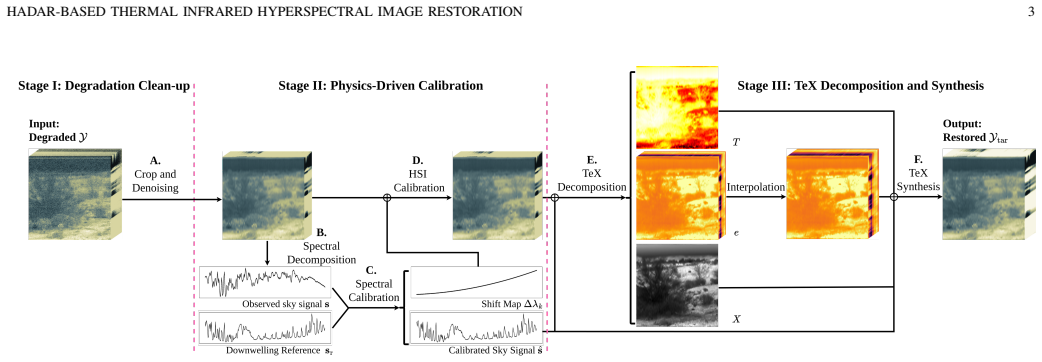
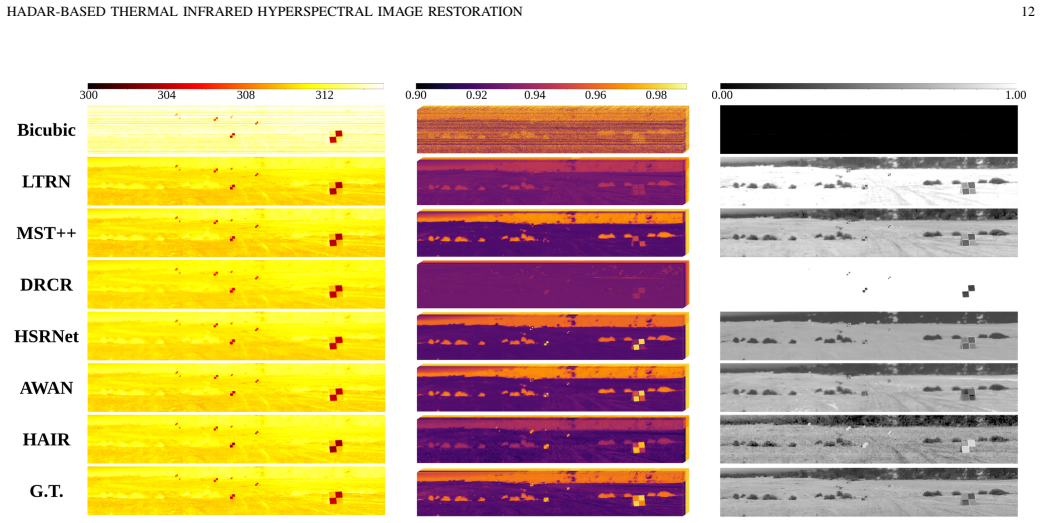
HAIR models TIR-HSI via the HADAR rendering equation and atmospheric RTE to enable a TeX decompose-synthesize strategy that guarantees physical consistency and spatio-spectral noise resilience, outperforming state-of-the-art methods in objective accuracy and visual quality on the DARPA Invisible Headlights dataset and in-lab FTIR measurements for denoising, inpainting, spectral calibration, and spectral super-resolution.
What carries the argument
The TeX triplet decomposition (temperature, emissivity, texture) from the HADAR rendering equation combined with atmospheric downwelling RTE, which drives a decompose-synthesize restoration process while incorporating forward-modeled atmospheric references, emissivity smoothness, and blackbody radiation for calibration.
If this is right
- The TeX strategy enables spectral calibration and super-resolution that rely on physical constraints like emissivity smoothness and blackbody radiation, tasks that are otherwise difficult without such modeling.
- Restoration becomes resilient to combined spatio-spectral noise because the decomposition separates physical components before synthesis.
- The framework establishes a benchmark for objective and perceptual quality in TIR-HSI restoration on both outdoor and controlled lab data.
- Forward modeling of atmospheric downwelling provides a reference that supports consistent performance across multiple degradation types simultaneously.
Where Pith is reading between the lines
- If the TeX decomposition generalizes, the same physical modeling could reduce reliance on large paired training datasets for other hyperspectral restoration problems.
- Extending the approach to airborne or spaceborne TIR-HSI would require incorporating additional atmospheric layers but could test the limits of the current ground-based RTE assumptions.
- Hybrid use with learned priors on texture could address cases where the physical model alone underfits highly textured scenes.
Load-bearing premise
The HADAR rendering equation and atmospheric radiative transfer equation with the TeX decomposition fully capture the dominant sensor degradations and scene physics in ground-based TIR-HSI without major unmodeled effects.
What would settle it
Failure of HAIR to outperform data-driven baselines on a new outdoor TIR-HSI dataset containing complex atmospheric conditions or unmodeled sensor effects not present in the DARPA Invisible Headlights set would falsify the claim of consistent superiority.
Figures


read the original abstract
Thermal-infrared (TIR) hyperspectral imagery (HSI) provides critical scene information for various applications. However, its practical utility is severely limited by unique sensor degradations beyond the capabilities of existing restoration methods, which are ignorant of underlying thermal physics. Here, we propose HAIR (HADAR-based Image Restoration) as a physics-driven framework for ground-based TIR-HSI restoration. HAIR utilizes the HADAR rendering equation (HRE) and combines it with the atmospheric downwelling radiative transfer equation (RTE) to model TIR-HSI using temperature, emissivity, and texture (TeX) physical triplets. This physical model leads to a TeX decompose-synthesize strategy that guarantees physical consistency and spatio-spectral noise resilience, in stark contrast to existing approaches. Moreover, our framework uses a forward-modeled atmospheric downwelling reference, along with spectral smoothness of emissivity and blackbody radiation, to enable spectral calibration and generation that would otherwise be elusive. Our extensive experiments on the outdoor DARPA Invisible Headlights dataset and in-lab FTIR measurements show that HAIR consistently outperforms state-of-the-art methods across denoising, inpainting, spectral calibration, and spectral super-resolution, establishing a benchmark in objective accuracy and visual quality.
Editorial analysis
A structured set of objections, weighed in public.
Referee Report
Summary. The manuscript proposes HAIR, a physics-driven framework for ground-based TIR-HSI restoration that combines the HADAR rendering equation (HRE) with the atmospheric downwelling radiative transfer equation (RTE) to decompose scenes into temperature-emissivity-texture (TeX) triplets. This leads to a decompose-synthesize strategy claimed to guarantee physical consistency and spatio-spectral resilience, enabling tasks including denoising, inpainting, spectral calibration, and super-resolution. Experiments on the outdoor DARPA Invisible Headlights dataset and in-lab FTIR measurements are reported to show consistent outperformance over state-of-the-art methods in objective accuracy and visual quality.
Significance. If the quantitative results and physical model completeness hold, HAIR would establish a new benchmark for physics-informed restoration in thermal hyperspectral imaging by moving beyond purely data-driven approaches to explicit thermal physics modeling, with potential impact on applications requiring accurate temperature and emissivity recovery.
major comments (2)
- [Abstract] Abstract: the central claim of consistent outperformance across four tasks is asserted without any quantitative metrics, error bars, ablation studies, or specific numerical comparisons, so the magnitude and reliability of the reported gains cannot be assessed from the provided information.
- [Method] Method section (TeX decompose-synthesize strategy): the guarantee of physical consistency rests on the assumption that HRE combined with atmospheric RTE captures all dominant sensor degradations; unmodeled effects such as stray light, nonlinear detector response, or scene-dependent multiple scattering would render the TeX triplets under-constrained, turning spectral smoothness and blackbody priors into regularizers rather than physics constraints.
minor comments (1)
- [Abstract] Abstract: the description of the forward-modeled atmospheric downwelling reference could be clarified with a brief equation reference or diagram pointer for readers unfamiliar with RTE.
Simulated Author's Rebuttal
We sincerely thank the referee for the detailed and constructive feedback. We address each major comment below with proposed revisions to improve the manuscript's clarity and rigor.
read point-by-point responses
-
Referee: [Abstract] Abstract: the central claim of consistent outperformance across four tasks is asserted without any quantitative metrics, error bars, ablation studies, or specific numerical comparisons, so the magnitude and reliability of the reported gains cannot be assessed from the provided information.
Authors: We agree that the abstract would benefit from quantitative support. In the revised manuscript, we will add specific metrics (e.g., average PSNR/SSIM gains with standard deviations across the four tasks) drawn from the experimental results to allow direct assessment of the reported improvements. revision: yes
-
Referee: [Method] Method section (TeX decompose-synthesize strategy): the guarantee of physical consistency rests on the assumption that HRE combined with atmospheric RTE captures all dominant sensor degradations; unmodeled effects such as stray light, nonlinear detector response, or scene-dependent multiple scattering would render the TeX triplets under-constrained, turning spectral smoothness and blackbody priors into regularizers rather than physics constraints.
Authors: The referee correctly notes that physical consistency depends on model completeness. While HRE+RTE capture the dominant effects validated by our DARPA and FTIR experiments, we will revise the text to replace 'guarantees' with 'promotes' physical consistency, explicitly list the modeling assumptions, add a limitations subsection discussing unmodeled effects, and include an ablation on the priors to demonstrate their physics-informed role. revision: partial
Circularity Check
No significant circularity detected
full rationale
The derivation relies on the HADAR rendering equation (HRE) and atmospheric RTE as external physical inputs, then introduces a TeX triplet decomposition as a modeling choice. No equation reduces a prediction to a fitted parameter on the same data, no self-citation chain bears the central claim, and the decompose-synthesize strategy is presented as a consequence of the forward model rather than a tautology. Experiments on independent DARPA outdoor and lab FTIR datasets supply external benchmarks.
Axiom & Free-Parameter Ledger
axioms (2)
- domain assumption HADAR rendering equation accurately models TIR-HSI formation
- domain assumption Atmospheric downwelling radiative transfer equation holds for the target scenes
Reference graph
Works this paper leans on
-
[1]
Heat-assisted detection and ranging,
F. Bao, X. Wang, S. H. Sureshbabu, G. Sreekumar, L. Yang, V . Aggarwal, V . N. Boddeti, and Z. Jacob, “Heat-assisted detection and ranging,” Nature, vol. 619, no. 7971, pp. 743–748, 2023
2023
-
[3]
Why thermal images are blurry,
F. Bao, S. Jape, A. Schramka, J. Wang, T. E. McGraw, and Z. Jacob, “Why thermal images are blurry,”Optics Express, vol. 32, no. 3, pp. 3852–3865, 2024
2024
-
[4]
Absorption-based, passive range imaging from hyperspectral thermal measurements,
U. D. Gallastegi, H. Rueda-Chac ´on, M. J. Stevens, and V . K. Goyal, “Absorption-based, passive range imaging from hyperspectral thermal measurements,”IEEE Transactions on Pattern Analysis and Machine Intelligence, vol. 47, no. 5, pp. 4044–4060, 2025
2025
-
[5]
Affine transform representation for reducing calibration cost on absorption-based lwir depth sensing,
T. Kushida, R. Nakamura, H. Matsuda, W. Chen, and K. Tanaka, “Affine transform representation for reducing calibration cost on absorption-based lwir depth sensing,”Scientific Reports, vol. 14, no. 1, p. 26429, 2024
2024
-
[6]
Thermal voyager: A comparative study of rgb and thermal cameras for night-time autonomous navigation,
N. Aditya, P. Dhruvalet al., “Thermal voyager: A comparative study of rgb and thermal cameras for night-time autonomous navigation,” in 2024 IEEE International Conference on Robotics and Automation (ICRA). IEEE, 2024, pp. 14 116–14 122
2024
-
[7]
Concurrent band selection and traversability estimation from long-wave hyperspectral imagery in off-road settings,
F. Yellin, S. McCloskey, C. Hill, E. Smith, and B. Clipp, “Concurrent band selection and traversability estimation from long-wave hyperspectral imagery in off-road settings,” inProceedings of the IEEE/CVF Winter Conference on Applications of Computer Vision, 2024, pp. 7483–7492
2024
-
[8]
TADAR: Thermal array-based detection and rang- ing for privacy-preserving human sensing,
X. Zhang and C. Wu, “TADAR: Thermal array-based detection and rang- ing for privacy-preserving human sensing,” inProceedings of the Twenty- fifth International Symposium on Theory, Algorithmic Foundations, and Protocol Design for Mobile Networks and Mobile Computing, 2024, pp. 11–20
2024
-
[9]
Hyperspectral phasor thermog- raphy,
D. Han, C. Zheng, Z. Ling, and S. Jia, “Hyperspectral phasor thermog- raphy,”Cell Reports Physical Science, vol. 6, no. 3, 2025
2025
-
[10]
Thermal-nerf: Neural radiance fields from an infrared camera,
T. Ye, Q. Wu, J. Deng, G. Liu, L. Liu, S. Xia, L. Pang, W. Yu, and L. Pei, “Thermal-nerf: Neural radiance fields from an infrared camera,” in2024 IEEE/RSJ International Conference on Intelligent Robots and Systems (IROS). IEEE, 2024, pp. 1046–1053
2024
-
[11]
Color router-based long-wave infrared multispectral imaging,
N. Xu, Z. Zhuge, H. Li, B. Chen, Z. Xu, H. Feng, Q. Li, and Y . Chen, “Color router-based long-wave infrared multispectral imaging,”Optics Express, vol. 32, no. 21, pp. 36 875–36 887, 2024
2024
-
[12]
Fast hyperspectral image denoising and inpainting based on low-rank and sparse representations,
L. Zhuang and J. M. Bioucas-Dias, “Fast hyperspectral image denoising and inpainting based on low-rank and sparse representations,”IEEE Journal of Selected Topics in Applied Earth Observations and Remote Sensing, vol. 11, no. 3, pp. 730–742, 2018
2018
-
[13]
Tensor robust principal component analysis with a new tensor nuclear norm,
C. Lu, J. Feng, Y . Chen, W. Liu, Z. Lin, and S. Yan, “Tensor robust principal component analysis with a new tensor nuclear norm,”IEEE transactions on pattern analysis and machine intelligence, vol. 42, no. 4, pp. 925–938, 2019
2019
-
[14]
Tensor ring decompo- sition with rank minimization on latent space: An efficient approach for tensor completion,
L. Yuan, C. Li, D. Mandic, J. Cao, and Q. Zhao, “Tensor ring decompo- sition with rank minimization on latent space: An efficient approach for tensor completion,” inProceedings of the AAAI conference on artificial intelligence, vol. 33, no. 01, 2019, pp. 9151–9158
2019
-
[15]
Non-local meets global: An iterative paradigm for hyperspectral image restoration,
W. He, Q. Yao, C. Li, N. Yokoya, Q. Zhao, H. Zhang, and L. Zhang, “Non-local meets global: An iterative paradigm for hyperspectral image restoration,”IEEE Transactions on Pattern Analysis and Machine Intel- ligence, vol. 44, no. 4, pp. 2089–2107, 2020
2089
-
[16]
Deep hyperspectral prior: Single-image denoising, inpainting, super-resolution,
O. Sidorov and J. Y . Hardeberg, “Deep hyperspectral prior: Single-image denoising, inpainting, super-resolution,” in2019 IEEE/CVF International Conference on Computer Vision Workshop (ICCVW), 2019, pp. 3844– 3851
2019
-
[17]
Dds2m: Self-supervised denoising diffusion spatio-spectral model for hyperspectral image restora- tion,
Y . Miao, L. Zhang, L. Zhang, and D. Tao, “Dds2m: Self-supervised denoising diffusion spatio-spectral model for hyperspectral image restora- tion,” inProceedings of the IEEE/CVF international conference on computer vision, 2023, pp. 12 086–12 096. HADAR-BASED THERMAL INFRARED HYPERSPECTRAL IMAGE RESTORATION 12 Fig. 12. HADAR retrievals in the8×spectral su...
2023
-
[18]
Physical limitations to nonuniformity correction in ir focal plane arrays,
D. A. Scribner, M. R. Kruer, J. Gridley, and K. Sarkady, “Physical limitations to nonuniformity correction in ir focal plane arrays,” inFocal plane arrays: technology and applications, vol. 865. SPIE, 1988, pp. 185–202
1988
-
[19]
Efficient single image non-uniformity correction algorithm,
Y . Tendero, J. Gilles, S. Landeau, and J.-M. Morel, “Efficient single image non-uniformity correction algorithm,”Proceedings of SPIE - The International Society for Optical Engineering, vol. 7834, 10 2010
2010
-
[20]
Hgcdte infrared detectors,
P. Norton, “Hgcdte infrared detectors,”Optoelectronics review, no. 3, pp. 159–174, 2002
2002
-
[22]
Correction of instrument line shape in fourier transform spectrometry using matrix inversion,
R. Desbiens, J. Genest, P. Tremblay, and J.-P. Bouchard, “Correction of instrument line shape in fourier transform spectrometry using matrix inversion,”Appl. Opt., vol. 45, no. 21, pp. 5270–5280, Jul 2006. [Online]. Available: https://opg.optica.org/ao/abstract.cfm?URI=ao-45-21-5270
2006
-
[23]
Preprocessing of hyper- spectral imagery with consideration of smile and keystone properties,
N. Yokoya, N. Miyamura, and A. Iwasaki, “Preprocessing of hyper- spectral imagery with consideration of smile and keystone properties,” inMultispectral, Hyperspectral, and Ultraspectral Remote Sensing Tech- nology, Techniques, and Applications III, vol. 7857. SPIE, 2010, pp. 73–81
2010
-
[26]
Thermal hyperspectral image denois- ing using total variation based on bidirectional estimation and brightness temperature smoothing,
X. Miao, Y . Zhang, and J. Zhang, “Thermal hyperspectral image denois- ing using total variation based on bidirectional estimation and brightness temperature smoothing,”IEEE Geoscience and Remote Sensing Letters, vol. 19, pp. 1–5, 2021
2021
-
[27]
Spectral noise resistance split window atmospheric compensation for airborne thermal infrared hyperspectral,
D. Wang, L. Cao, L. Gao, F. Ye, and Y . Zhong, “Spectral noise resistance split window atmospheric compensation for airborne thermal infrared hyperspectral,” inIGARSS 2025-2025 IEEE International Geoscience and Remote Sensing Symposium. IEEE, 2025, pp. 1244–1248
2025
-
[28]
A novel land surface temperature retrieval method using channel correlation for atmospheric parameter modeling from sdgsat-1 data,
L.-Q. Cao, H. Zhao, D. Wang, Y .-F. Zhong, and F.-W. Ye, “A novel land surface temperature retrieval method using channel correlation for atmospheric parameter modeling from sdgsat-1 data,”Remote Sensing of Environment, vol. 334, p. 115190, 2026
2026
-
[29]
Hyperspectral subspace identification,
J. M. Bioucas-Dias and J. M. Nascimento, “Hyperspectral subspace identification,”IEEE Transactions on Geoscience and Remote Sensing, vol. 46, no. 8, pp. 2435–2445, 2008
2008
-
[30]
Hyperspectral image restoration using low-rank matrix recovery,
H. Zhang, W. He, L. Zhang, H. Shen, and Q. Yuan, “Hyperspectral image restoration using low-rank matrix recovery,”IEEE transactions on geoscience and remote sensing, vol. 52, no. 8, pp. 4729–4743, 2013
2013
-
[31]
Weighted nuclear norm minimization with application to image denoising,
S. Gu, L. Zhang, W. Zuo, and X. Feng, “Weighted nuclear norm minimization with application to image denoising,” inProceedings of the IEEE conference on computer vision and pattern recognition, 2014, pp. 2862–2869
2014
-
[32]
Image denoising by sparse 3-d transform-domain collaborative filtering,
K. Dabov, A. Foi, V . Katkovnik, and K. Egiazarian, “Image denoising by sparse 3-d transform-domain collaborative filtering,”IEEE Transactions on image processing, vol. 16, no. 8, pp. 2080–2095, 2007. HADAR-BASED THERMAL INFRARED HYPERSPECTRAL IMAGE RESTORATION 13
2080
-
[33]
Video denoising, deblocking, and enhancement through separable 4-d nonlocal spatiotem- poral transforms,
M. Maggioni, G. Boracchi, A. Foi, and K. Egiazarian, “Video denoising, deblocking, and enhancement through separable 4-d nonlocal spatiotem- poral transforms,”IEEE Transactions on image processing, vol. 21, no. 9, pp. 3952–3966, 2012
2012
-
[34]
Nonlocal similarity based nonnegative tucker decomposition for hyperspectral image denoising,
X. Bai, F. Xu, L. Zhou, Y . Xing, L. Bai, and J. Zhou, “Nonlocal similarity based nonnegative tucker decomposition for hyperspectral image denoising,”IEEE Journal of Selected Topics in Applied Earth Observations and Remote Sensing, vol. 11, no. 3, pp. 701–712, 2018
2018
-
[35]
Hyperspectral image denoising us- ing spatio-spectral total variation,
H. K. Aggarwal and A. Majumdar, “Hyperspectral image denoising us- ing spatio-spectral total variation,”IEEE Geoscience and Remote Sensing Letters, vol. 13, no. 3, pp. 442–446, 2016
2016
-
[36]
Hyperspectral image restoration using weighted group sparsity-regularized low-rank tensor decomposition,
Y . Chen, W. He, N. Yokoya, and T.-Z. Huang, “Hyperspectral image restoration using weighted group sparsity-regularized low-rank tensor decomposition,”IEEE transactions on cybernetics, vol. 50, no. 8, pp. 3556–3570, 2019
2019
-
[37]
Enhanced 3dtv regularization and its applications on hsi denoising and compressed sensing,
J. Peng, Q. Xie, Q. Zhao, Y . Wang, L. Yee, and D. Meng, “Enhanced 3dtv regularization and its applications on hsi denoising and compressed sensing,”IEEE Transactions on Image Processing, vol. 29, pp. 7889– 7903, 2020
2020
-
[38]
K. Bredies, K. Kunisch, and T. Pock, “Total generalized variation,” SIAM Journal on Imaging Sciences, vol. 3, no. 3, pp. 492–526, 2010. [Online]. Available: https://doi.org/10.1137/090769521
-
[39]
Sparse recovery of hyperspectral signal from natural rgb images,
B. Arad and O. Ben-Shahar, “Sparse recovery of hyperspectral signal from natural rgb images,” inEuropean conference on computer vision. Springer, 2016, pp. 19–34
2016
-
[40]
Spatial-spectral structured sparse low-rank representation for hyperspec- tral image super-resolution,
J. Xue, Y .-Q. Zhao, Y . Bu, W. Liao, J. C.-W. Chan, and W. Philips, “Spatial-spectral structured sparse low-rank representation for hyperspec- tral image super-resolution,”IEEE Transactions on Image Processing, vol. 30, pp. 3084–3097, 2021
2021
-
[41]
A generalized tensor formulation for hyperspectral image super-resolution under general spatial blurring,
Y . Wang, W. Li, Y . Gui, Q. Du, and J. E. Fowler, “A generalized tensor formulation for hyperspectral image super-resolution under general spatial blurring,”IEEE Transactions on Pattern Analysis and Machine Intelligence, vol. 47, no. 6, pp. 4684–4698, 2025
2025
-
[42]
Adaptive weighted attention network with camera spectral sensitivity prior for spectral reconstruction from rgb images,
J. Li, C. Wu, R. Song, Y . Li, and F. Liu, “Adaptive weighted attention network with camera spectral sensitivity prior for spectral reconstruction from rgb images,” inProceedings of the IEEE/CVF Conference on Computer Vision and Pattern Recognition (CVPR) Workshops, June 2020
2020
-
[43]
3-d quasi-recurrent neural network for hyperspectral image denoising,
K. Wei, Y . Fu, and H. Huang, “3-d quasi-recurrent neural network for hyperspectral image denoising,”IEEE Transactions on Neural Networks and Learning Systems, vol. 32, no. 1, pp. 363–375, 2021
2021
-
[44]
Spectral response function-guided deep optimization-driven network for spectral super- resolution,
J. He, J. Li, Q. Yuan, H. Shen, and L. Zhang, “Spectral response function-guided deep optimization-driven network for spectral super- resolution,”IEEE Transactions on Neural Networks and Learning Sys- tems, vol. 33, no. 9, pp. 4213–4227, 2022
2022
-
[45]
Drcr net: Dense residual channel re-calibration network with non-local purification for spectral super resolution,
J. Li, S. Du, C. Wu, Y . Leng, R. Song, and Y . Li, “Drcr net: Dense residual channel re-calibration network with non-local purification for spectral super resolution,” in2022 IEEE/CVF Conference on Computer Vision and Pattern Recognition Workshops (CVPRW), 2022, pp. 1258– 1267
2022
-
[46]
Spectral super-resolution via deep low- rank tensor representation,
R. Dian, Y . Liu, and S. Li, “Spectral super-resolution via deep low- rank tensor representation,”IEEE Transactions on Neural Networks and Learning Systems, vol. 36, no. 3, pp. 5140–5150, 2025
2025
-
[47]
Hyperspectral image denoising via spatial–spectral recurrent transformer,
G. Fu, F. Xiong, J. Lu, J. Zhou, J. Zhou, and Y . Qian, “Hyperspectral image denoising via spatial–spectral recurrent transformer,”IEEE Trans- actions on Geoscience and Remote Sensing, vol. 62, pp. 1–14, 2024
2024
-
[48]
Spatial-spectral transformer for hyper- spectral image denoising,
M. Li, Y . Fu, and Y . Zhang, “Spatial-spectral transformer for hyper- spectral image denoising,” inProceedings of the AAAI Conference on Artificial Intelligence, vol. 37, no. 1, 2023, pp. 1368–1376
2023
-
[49]
Mst++: Multi-stage spectral-wise transformer for efficient spectral reconstruction,
Y . Cai, J. Lin, Z. Lin, H. Wang, Y . Zhang, H. Pfister, R. Timofte, and L. Van Gool, “Mst++: Multi-stage spectral-wise transformer for efficient spectral reconstruction,” inProceedings of the IEEE/CVF Conference on Computer Vision and Pattern Recognition, 2022, pp. 745–755
2022
-
[50]
Hlrtf: Hierarchical low-rank tensor factorization for inverse problems in multi-dimensional imaging,
Y . Luo, X. Zhao, D. Meng, and T. Jiang, “Hlrtf: Hierarchical low-rank tensor factorization for inverse problems in multi-dimensional imaging,” in2022 IEEE/CVF Conference on Computer Vision and Pattern Recog- nition (CVPR), 2022, pp. 19 281–19 290
2022
-
[51]
Mac-net: Model- aided nonlocal neural network for hyperspectral image denoising,
F. Xiong, J. Zhou, Q. Zhao, J. Lu, and Y . Qian, “Mac-net: Model- aided nonlocal neural network for hyperspectral image denoising,”IEEE Transactions on Geoscience and Remote Sensing, vol. 60, pp. 1–14, 2022
2022
-
[52]
Flex-dld: Deep low- rank decomposition model with flexible priors for hyperspectral image denoising and restoration,
Y . Chen, H. Zhang, Y . Wang, Y . Yang, and J. Wu, “Flex-dld: Deep low- rank decomposition model with flexible priors for hyperspectral image denoising and restoration,”IEEE Transactions on Image Processing, vol. 33, pp. 1211–1226, 2024
2024
-
[53]
Unmixing diffusion for self-supervised hyperspectral image denoising,
H. Zeng, J. Cao, K. Zhang, Y . Chen, H. Luong, and W. Philips, “Unmixing diffusion for self-supervised hyperspectral image denoising,” inProceedings of the IEEE/CVF Conference on Computer Vision and Pattern Recognition, 2024, pp. 27 820–27 830
2024
-
[54]
The infrared absolute radiance interferometer (ari) for clarreo,
J. K. Taylor, H. E. Revercomb, F. A. Best, D. C. Tobin, and P. J. Gero, “The infrared absolute radiance interferometer (ari) for clarreo,”Remote Sensing, vol. 12, no. 12, p. 1915, 2020
1915
-
[55]
Least square regression based non-uniformity correction for infra-red focal plane arrays,
N. Kumar, M. Massey, and N. Kandpal, “Least square regression based non-uniformity correction for infra-red focal plane arrays,” in2019 International Conference on Range Technology (ICORT), 2019, pp. 1– 5
2019
-
[56]
Nonuniformity correction and correctability of infrared focal plane arrays,
M. Schulz and L. Caldwell, “Nonuniformity correction and correctability of infrared focal plane arrays,”Infrared physics & technology, vol. 36, no. 4, pp. 763–777, 1995
1995
-
[57]
Multispectral thermal imager: overview,
W. R. Bell and P. G. Weber, “Multispectral thermal imager: overview,” Algorithms for Multispectral, Hyperspectral, and Ultraspectral Imagery VII, vol. 4381, pp. 173–183, 2001
2001
-
[58]
Imaging spectrometry for earth remote sensing,
A. F. Goetz, G. Vane, J. E. Solomon, and B. N. Rock, “Imaging spectrometry for earth remote sensing,”science, vol. 228, no. 4704, pp. 1147–1153, 1985
1985
-
[59]
A method for emccd multiplication gain measurement with comprehensive correction,
L. Qiao, M. Wang, and Z. Jin, “A method for emccd multiplication gain measurement with comprehensive correction,”Scientific Reports, vol. 11, no. 1, p. 6058, 2021
2021
-
[60]
Strong non-uniformity correction algorithm based on spectral shaping statistics and lms,
T. Liu, X. Sui, Y . Wang, Y . Wang, Q. Chen, Z. Guan, and X. Chen, “Strong non-uniformity correction algorithm based on spectral shaping statistics and lms,”Opt. Express, vol. 31, no. 19, pp. 30 693–30 709, Sep
-
[61]
Available: https://opg.optica.org/oe/abstract.cfm?URI= oe-31-19-30693
[Online]. Available: https://opg.optica.org/oe/abstract.cfm?URI= oe-31-19-30693
-
[62]
Infrared non-uniformity correction model via deep convolutional neural network,
S. Chen, F. Deng, H. Zhang, S. Lyu, Z. Kou, and J. Yang, “Infrared non-uniformity correction model via deep convolutional neural network,” in9th International Symposium on Test Automation & Instrumentation (ISTAI 2022), vol. 2022, 2022, pp. 178–184
2022
-
[63]
Baseline correction with asymmetric least squares smoothing,
P. H. Eilers and H. F. Boelens, “Baseline correction with asymmetric least squares smoothing,”Leiden University Medical Centre Report, vol. 1, no. 1, p. 5, 2005
2005
-
[64]
Quality of high resolution synthesised images: Is there a simple criterion?
L. Wald, “Quality of high resolution synthesised images: Is there a simple criterion?” inThird Conference: Fusion of Earth Data: Merg- ing Point Measurements, Raster Maps and Remotely Sensed Images. SEE/URISCA, 2000, pp. 99–103
2000
-
[65]
Discrimination among semi-arid landscape endmembers using the spectral angle mapper (sam) algorithm,
R. H. Yuhas, A. F. Goetz, and J. W. Boardman, “Discrimination among semi-arid landscape endmembers using the spectral angle mapper (sam) algorithm,” inJPL, Summaries of the Third Annual JPL Airborne Geoscience Workshop. Volume 1: AVIRIS Workshop, 1992
1992
-
[66]
The ecostress spectral library version 1.0,
S. K. Meerdink, S. J. Hook, D. A. Roberts, and E. A. Abbott, “The ecostress spectral library version 1.0,”Remote Sensing of Environment, vol. 230, p. 111196, 2019. [Online]. Available: https: //www.sciencedirect.com/science/article/pii/S0034425719302081
2019
-
[67]
Deep diversity-enhanced feature representation of hyperspectral images,
J. Hou, Z. Zhu, J. Hou, H. Liu, H. Zeng, and D. Meng, “Deep diversity-enhanced feature representation of hyperspectral images,”IEEE Transactions on Pattern Analysis and Machine Intelligence, vol. 46, no. 12, pp. 8123–8138, 2024
2024
-
[68]
Spectral enhanced rectangle transformer for hyperspectral image denoising,
M. Li, J. Liu, Y . Fu, Y . Zhang, and D. Dou, “Spectral enhanced rectangle transformer for hyperspectral image denoising,” in2023 IEEE/CVF Conference on Computer Vision and Pattern Recognition (CVPR), 2023, pp. 5805–5814. HADAR-BASED THERMAL INFRARED HYPERSPECTRAL IMAGE RESTORATION 14 APPENDIXA DESTRIPERSUB-ALGORITHM A. ADMM Formulation This appendix supp...
2023
-
[69]
Wright and Y
J. Wright and Y . Ma,High-dimensional data analysis with low- dimensional models: Principles, computation, and applications. Cam- bridge University Press, 2022
2022
-
[70]
Chandrasekhar,Radiative transfer
S. Chandrasekhar,Radiative transfer. Courier Corporation, 2013
2013
-
[71]
Liou,An Introduction to Atmospheric Radiation, ser
K. Liou,An Introduction to Atmospheric Radiation, ser. International Geophysics. Academic Press, 2002. [Online]. Available: https: //books.google.com.sg/books?id=mQ1DiDpX34UC
2002
-
[72]
Pierrehumbert,Principles of Planetary Climate
R. Pierrehumbert,Principles of Planetary Climate. Cambridge University Press, 2010. [Online]. Available: https://books.google.com. sg/books?id=bO U8f5pVR8C
2010
-
[73]
The HITRAN2024 molecular spectroscopic database,
I. Gordon, L. Rothman, R. Hargreaves, F. Gomez, T. Bertin, C. Hill, R. Kochanov, Y . Tan, P. Wcisło, V . Y . Makhnev, P. Bernath, M. Birk, V . Boudon, A. Campargue, A. Coustenis, B. Drouin, R. Gamache, J. Hodges, D. Jacquemart, E. Mlawer, A. Nikitin, V . Perevalov, M. Rotger, S. Robert, J. Tennyson, G. Toon, H. Tran, V . Tyuterev, E. Adkins, A. Barbe, D. ...
2026
-
[74]
Numerically stable algorithm for discrete-ordinate-method radiative transfer in multiple scattering and emitting layered media,
K. Stamnes, S.-C. Tsay, W. Wiscombe, and K. Jayaweera, “Numerically stable algorithm for discrete-ordinate-method radiative transfer in multiple scattering and emitting layered media,”Appl. Opt., vol. 27, no. 12, pp. 2502–2509, Jun 1988. [Online]. Available: https: //opg.optica.org/ao/abstract.cfm?URI=ao-27-12-2502
1988
-
[75]
The libradtran software package for radiative transfer calculations (version 2.0.1),
C. Emde, R. Buras-Schnell, A. Kylling, B. Mayer, J. Gasteiger, U. Hamann, J. Kylling, B. Richter, C. Pause, T. Dowlinget al., “The libradtran software package for radiative transfer calculations (version 2.0.1),”Geoscientific Model Development, vol. 9, no. 5, pp. 1647–1672, 2016
2016
-
[76]
Noise sources in imaging static fourier transform spectrometers,
Y . Ferrec, N. Ayari-Matallah, P. Chavel, F. Goudail, H. Sauer, J. Taboury, J.-C. Fontanella, C. Coudrain, and J. Primot, “Noise sources in imaging static fourier transform spectrometers,”Optical Engineering, vol. 51, no. 11, pp. 111 716–111 716, 2012
2012
-
[77]
Physical limitations to nonuniformity correction in ir focal plane arrays,
D. A. Scribner, M. R. Kruer, J. Gridley, and K. Sarkady, “Physical limitations to nonuniformity correction in ir focal plane arrays,” inFocal Plane Arrays: Technology and Applications, vol. 865. SPIE, 1988, pp. 185–202
1988
-
[78]
Concurrent band selection and traversability estimation from long-wave hyperspec- tral imagery in off-road settings,
F. Yellin, S. McCloskey, C. Hill, E. Smith, and B. Clipp, “Concurrent band selection and traversability estimation from long-wave hyperspec- tral imagery in off-road settings,” inProceedings of the IEEE/CVF Winter Conference on Applications of Computer Vision, 2024, pp. 7483– 7492
2024
-
[79]
Heat-assisted detection and ranging,
F. Bao, X. Wang, S. H. Sureshbabu, G. Sreekumar, L. Yang, V . Aggar- wal, V . N. Boddeti, and Z. Jacob, “Heat-assisted detection and ranging,” Nature, vol. 619, no. 7971, pp. 743–748, 2023
2023
-
[80]
Universal computational thermal imaging overcoming the ghosting effect,
H. Xu, D. Wang, C. Zhao, J. Chen, J. Lin, L. Cao, Y . Zhong, Y . She, and F. Bao, “Universal computational thermal imaging overcoming the ghosting effect,” 2026. [Online]. Available: https: //arxiv.org/abs/2604.01542 HADAR-BASED THERMAL INFRARED HYPERSPECTRAL IMAGE RESTORATION 17 Fig. A5. Robustness of HAIR under diverse real-world conditions. The upper p...
discussion (0)
Sign in with ORCID, Apple, or X to comment. Anyone can read and Pith papers without signing in.