Recognition: unknown
Stochastic modeling of Fourier modes in two-dimensional turbulence via filtered white noise
Pith reviewed 2026-05-14 17:47 UTC · model grok-4.3
The pith
A stochastic model of Fourier modes driven by filtered white noise reproduces the effective diffusion of passive tracers in two-dimensional turbulence.
A machine-rendered reading of the paper's core claim, the machinery that carries it, and where it could break.
Core claim
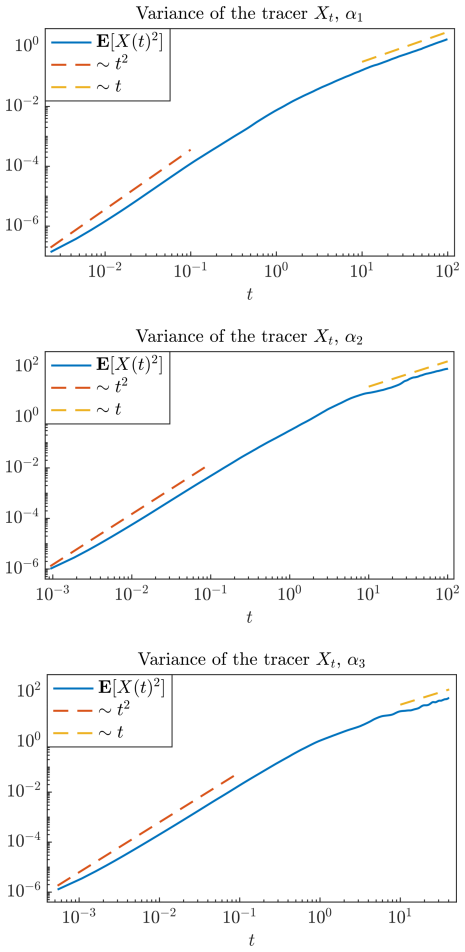
The authors propose modeling the Fourier components of the velocity field in two-dimensional turbulence as independent Ornstein-Uhlenbeck-like processes driven by filtered white noise, with a single correlation length chosen to match the observed time correlations. When this model is substituted into the advection equation for a passive scalar, the resulting mean-square displacement and effective diffusivity match those computed from full direct numerical simulations of the Navier-Stokes equations.
What carries the argument
The stochastic model for Fourier modes, where each mode is driven by filtered white noise with a fitted correlation time.
Load-bearing premise
That the Fourier modes behave as independent processes whose individual time correlations fully determine the transport statistics, without significant contributions from nonlinear cross-mode interactions.
What would settle it
Running the stochastic model with the same correlation length but observing a mismatch in the tracer's mean-square displacement beyond statistical error bars in a new simulation at higher Reynolds number.
Figures





read the original abstract
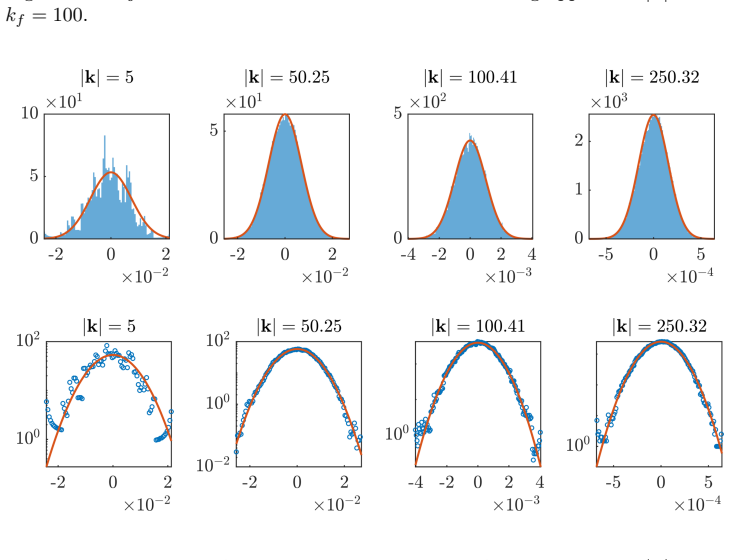
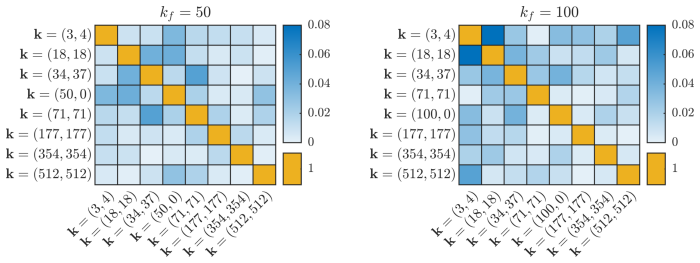
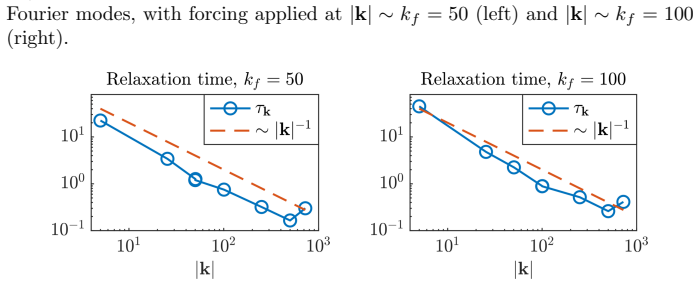
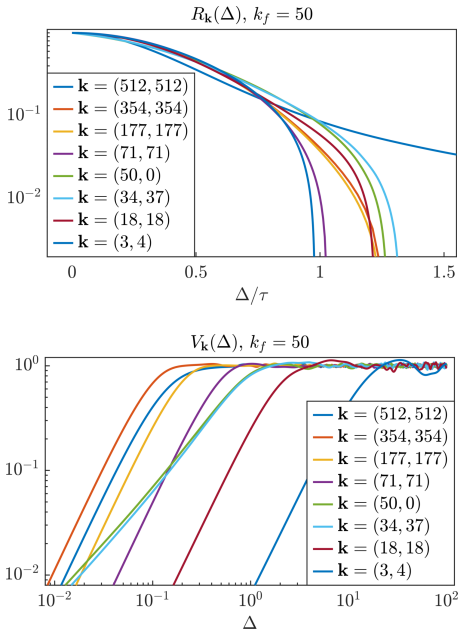
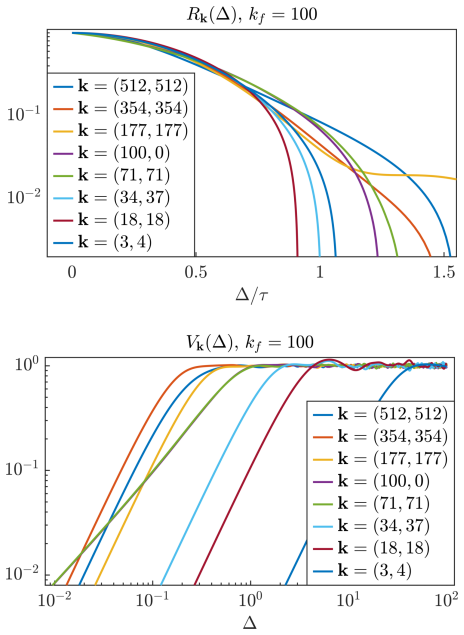
Modeling turbulent flows by a random Fourier decomposition is a classical procedure in order to use simplified models of turbulence in heat transport and other applications. We carefully investigate the Fourier time series of two-dimensional turbulent flows forced at intermediate scales and identify significant statistical structures. In particular, we find the existence of a typical time correlation length, and propose a stochastic model for the Fourier components. Finally, we compute the transport of a passive tracer under purely convective dynamics by means of direct numerical simulation of the turbulent flow and compare it with the effective diffusion produced by the stochastic model.
Editorial analysis
A structured set of objections, weighed in public.
Referee Report
Summary. The paper examines Fourier time series from two-dimensional turbulence forced at intermediate scales, identifies a characteristic time correlation length, and constructs a stochastic model in which each Fourier mode evolves as an independent process driven by filtered white noise. It then computes the long-time effective diffusivity of a passive tracer advected by the reconstructed velocity field and compares this diffusivity with the value obtained from direct numerical simulation of the full Navier-Stokes equations.
Significance. If the reported agreement in effective diffusivity is confirmed by quantitative metrics, the approach would supply a low-dimensional stochastic surrogate for turbulent advection that avoids resolving nonlinear mode coupling, offering a practical simplification for transport calculations in two-dimensional flows.
major comments (3)
- [Abstract] Abstract: the claim that the stochastic model reproduces the DNS effective diffusivity is stated without any quantitative measure (error bars, relative error, or statistical test), without specification of how the filter parameters were selected, and without description of the Reynolds-number or forcing-scale range tested. This absence leaves the central claim unsupported by visible evidence.
- [Model construction and validation sections] Model construction and validation sections: the single correlation length used to define the filter is extracted from the identical DNS runs whose tracer statistics are later compared to the model output. This procedure renders the comparison circular; the model is tuned to the very data it is asked to reproduce.
- [Independence assumption for Fourier modes] Independence assumption for Fourier modes: the model treats modes as statistically independent, yet the Navier-Stokes nonlinearity generates non-zero cross-spectra and phase correlations that contribute to coherent structures and integrated advection. The manuscript provides no test showing that these omitted correlations are negligible for the long-time tracer dispersion.
minor comments (2)
- [Notation and filter definition] Clarify the precise functional form of the filter applied to the white-noise forcing and the numerical procedure used to extract the correlation length from the time series.
- [Results] Add a brief discussion of the Reynolds-number dependence of the reported correlation length to indicate the regime of validity.
Simulated Author's Rebuttal
We thank the referee for the insightful comments on our manuscript arXiv:2605.13671. We address each of the major comments below and outline the revisions we plan to make.
read point-by-point responses
-
Referee: [Abstract] Abstract: the claim that the stochastic model reproduces the DNS effective diffusivity is stated without any quantitative measure (error bars, relative error, or statistical test), without specification of how the filter parameters were selected, and without description of the Reynolds-number or forcing-scale range tested. This absence leaves the central claim unsupported by visible evidence.
Authors: We agree with the referee that the abstract should include quantitative measures to support the claim. In the revised manuscript, we will add the relative error between the effective diffusivities from the stochastic model and DNS, along with standard deviations from ensemble runs. We will also specify the method for selecting filter parameters and the tested ranges of Reynolds numbers and forcing scales. revision: yes
-
Referee: [Model construction and validation sections] Model construction and validation sections: the single correlation length used to define the filter is extracted from the identical DNS runs whose tracer statistics are later compared to the model output. This procedure renders the comparison circular; the model is tuned to the very data it is asked to reproduce.
Authors: The referee is correct that the correlation length is determined from the same DNS simulations used for the tracer comparison, which introduces a degree of circularity. We will revise the manuscript to explicitly state this and discuss the implications. Additionally, we will include a sensitivity analysis showing how the effective diffusivity depends on the choice of correlation length, and consider using correlation lengths from independent runs or theoretical predictions in future extensions. revision: yes
-
Referee: [Independence assumption for Fourier modes] Independence assumption for Fourier modes: the model treats modes as statistically independent, yet the Navier-Stokes nonlinearity generates non-zero cross-spectra and phase correlations that contribute to coherent structures and integrated advection. The manuscript provides no test showing that these omitted correlations are negligible for the long-time tracer dispersion.
Authors: We recognize that assuming statistical independence of Fourier modes neglects cross-correlations arising from nonlinear interactions. The manuscript does not provide a direct test of their impact on tracer dispersion. In the revision, we will add a section comparing the power spectrum and velocity correlations with and without the independence assumption, and perform additional numerical experiments to quantify the effect on long-time effective diffusivity. revision: yes
Circularity Check
Correlation length fitted from DNS Fourier time series then used to drive stochastic model whose tracer diffusivity is compared to the same DNS
specific steps
-
fitted input called prediction
[Abstract (model construction and comparison paragraph)]
"we find the existence of a typical time correlation length, and propose a stochastic model for the Fourier components. Finally, we compute the transport of a passive tracer under purely convective dynamics by means of direct numerical simulation of the turbulent flow and compare it with the effective diffusion produced by the stochastic model."
The correlation length is measured on the DNS velocity field; that measured length is then used to define the stochastic forcing of the model; the model's output diffusivity is finally compared to the diffusivity measured on the same DNS. The match is therefore a test of whether the model, once its single parameter has been set to the data, reproduces a statistic derived from the same data.
full rationale
The paper extracts a typical time correlation length directly from the Fourier time series of the forced 2D turbulence DNS. This single length is inserted into the filtered-white-noise driving term of the independent-mode stochastic model. The model is then integrated to produce an effective diffusivity for a passive tracer, which is compared to the diffusivity obtained from the original DNS. Because the sole free parameter of the stochastic model is taken from the identical data set whose transport statistics are later reproduced, the reported agreement reduces to a consistency check on the fitted input rather than an independent derivation or out-of-sample prediction.
Axiom & Free-Parameter Ledger
free parameters (1)
- time correlation length
axioms (1)
- domain assumption Fourier modes evolve independently
Reference graph
Works this paper leans on
-
[1]
Apolin´ ario, Geoffrey Beck, Laurent Chevillard, Isabelle Gal- lagher, and Ricardo Grande
Gabriel B. Apolin´ ario, Geoffrey Beck, Laurent Chevillard, Isabelle Gal- lagher, and Ricardo Grande. A linear stochastic model of turbulent cas- cades and fractional fields.Ann. Sc. Norm. Super. Pisa Cl. Sci. (5), 26(4):2043–2103, 2025
2043
-
[2]
Apolin´ ario, Laurent Chevillard, and Jean-Christophe Mourrat
Gabriel B. Apolin´ ario, Laurent Chevillard, and Jean-Christophe Mourrat. Dynamical fractional and multifractal fields.J. Stat. Phys., 186(1):Paper No. 15, 35, 2022
2022
-
[3]
Stochastic model reduction: convergence and applications to climate equations.J
Sigurd Assing, Franco Flandoli, and Umberto Pappalettera. Stochastic model reduction: convergence and applications to climate equations.J. Evol. Equ., 21(4):3813–3848, 2021
2021
-
[4]
Boffetta and S
G. Boffetta and S. Musacchio. Evidence for the double cascade scenario in two-dimensional turbulence.Phys. Rev. E, 82:016307, Jul 2010
2010
-
[5]
Guido Boffetta and Robert E. Ecke. Two-dimensional turbulence. InAn- nual review of fluid mechanics. Volume 44, 2012, volume 44 ofAnnu. Rev. Fluid Mech., pages 427–451. Annual Reviews, Palo Alto, CA, 2012
2012
-
[6]
George E. P. Box and Gwilym M. Jenkins.Time series analysis: forecasting and control. Holden-Day Series in Time Series Analysis. Holden-Day, San Francisco, Calif.-D¨ usseldorf-Johannesburg, revised edition, 1976
1976
-
[7]
Canuto, M
C. Canuto, M. Y. Hussaini, A. Quarteroni, and T. A. Zang.Spectral meth- ods. Scientific Computation. Springer, Berlin, 2007. Evolution to complex geometries and applications to fluid dynamics
2007
-
[8]
Springer, Cham, [2023]©2023
Bertrand Chapron, Dan Crisan, Darryl Holm, Etienne M´ emin, and Anna Radomska, editors.Stochastic transport in upper ocean dynamics, vol- ume 10 ofMathematics of Planet Earth. Springer, Cham, [2023]©2023. STUOD 2021 Workshop, London, UK, September 20–23
2023
- [9]
-
[10]
Diffusion properties of small-scale frac- tional transport models.J
Paolo Cifani and Franco Flandoli. Diffusion properties of small-scale frac- tional transport models.J. Stat. Phys., 192(11):Paper No. 152, 20, 2025
2025
-
[11]
Variational principles for fully coupled stochastic fluid dynamics across scales.Phys
Arnaud Debussche and Etienne M´ emin. Variational principles for fully coupled stochastic fluid dynamics across scales.Phys. D, 481:Paper No. 134777, 11, 2025
2025
-
[12]
Second order perturbation theory of two-scale systems in fluid dynamics.J
Arnaud Debussche and Umberto Pappalettera. Second order perturbation theory of two-scale systems in fluid dynamics.J. Eur. Math. Soc. (JEMS), 28(4):1533–1595, 2026. 28
2026
-
[13]
Ephrati, Paolo Cifani, Erwin Luesink, and Bernard J
Sagy R. Ephrati, Paolo Cifani, Erwin Luesink, and Bernard J. Geurts. Data-driven stochastic Lie transport modeling of the 2D euler equations. Journal of Advances in Modeling Earth Systems, 15(1):e2022MS003268,
-
[14]
e2022MS003268 2022MS003268
-
[15]
Ephrati, Paolo Cifani, Milo Viviani, and Bernard J
Sagy R. Ephrati, Paolo Cifani, Milo Viviani, and Bernard J. Geurts. Data- driven stochastic spectral modeling for coarsening of the two-dimensional euler equations on the sphere.Physics of Fluids, 35(9):096601, 09 2023
2023
-
[16]
Falkovich, K
G. Falkovich, K. Gaw¸ edzki, and M. Vergassola. Particles and fields in fluid turbulence.Rev. Modern Phys., 73(4):913–975, 2001
2001
-
[17]
Eddy heat exchange at the boundary under white noise turbulence.Philos
Franco Flandoli, Lucio Galeati, and Dejun Luo. Eddy heat exchange at the boundary under white noise turbulence.Philos. Trans. Roy. Soc. A, 380(2219):Paper No. 20210096, 13, 2022
2022
-
[18]
Heat diffusion in a channel under white noise modeling of turbulence.Math
Franco Flandoli and Eliseo Luongo. Heat diffusion in a channel under white noise modeling of turbulence.Math. Eng., 4(4):Paper No. 034, 21, 2022
2022
-
[19]
Springer, Singapore, [2023]©2023
Franco Flandoli and Eliseo Luongo.Stochastic partial differential equations in fluid mechanics, volume 2330 ofLecture Notes in Mathematics. Springer, Singapore, [2023]©2023
2023
-
[20]
Stochastic transport by Gaussian noise.Atti Accad
Franco Flandoli and Francesco Russo. Stochastic transport by Gaussian noise.Atti Accad. Naz. Lincei Rend. Lincei Mat. Appl., 2026
2026
-
[21]
Stretching of polymers and turbu- lence: Fokker Planck equation, special stochastic scaling limit and station- ary law.J
Franco Flandoli and Yassine Tahraoui. Stretching of polymers and turbu- lence: Fokker Planck equation, special stochastic scaling limit and station- ary law.J. Differential Equations, 452:Paper No. 113789, 74, 2026
2026
-
[22]
Kadri Harouna and E
S. Kadri Harouna and E. M´ emin. Stochastic representation of the Reynolds transport theorem: revisiting large-scale modeling.Comput. & Fluids, 156:456–469, 2017
2017
-
[23]
Darryl D. Holm. Variational principles for stochastic fluid dynamics.Proc. A, 471(2176):20140963, 19, 2015
2015
-
[24]
Kraichnan
Robert H. Kraichnan. Anomalous scaling of a randomly advected passive scalar.Phys. Rev. Lett., 72:1016–1019, Feb 1994
1994
-
[25]
Kraichnan and David Montgomery
Robert H. Kraichnan and David Montgomery. Two-dimensional turbu- lence.Rep. Progr. Phys., 43(5):547–619, 1980
1980
-
[26]
Kluwer Academic Publishers Group, Dordrecht, third edition, 1997
Marcel Lesieur.Turbulence in fluids, volume 40 ofFluid Mechanics and its Applications. Kluwer Academic Publishers Group, Dordrecht, third edition, 1997
1997
-
[27]
Majda, Ilya Timofeyev, and Eric Vanden Eijnden
Andrew J. Majda, Ilya Timofeyev, and Eric Vanden Eijnden. A mathemat- ical framework for stochastic climate models.Comm. Pure Appl. Math., 54(8):891–974, 2001. 29
2001
-
[28]
Statens Skogsforskningsinstitut, Stockholm, 1960
Bertil Mat´ ern.Spatial variation: Stochastic models and their applica- tion to some problems in forest surveys and other sampling investiga- tions. Statens Skogsforskningsinstitut, Stockholm, 1960. Meddelanden Fran Statens Skogsforskningsinstitut, Band 49, Nr. 5
1960
-
[29]
Fluid flow dynamics under location uncertainty.Geophys
Etienne M´ emin. Fluid flow dynamics under location uncertainty.Geophys. Astrophys. Fluid Dyn., 108(2):119–146, 2014
2014
-
[30]
Turbulence enhance- ment of coagulation: the role of eddy diffusion in velocity.Phys
Andrea Papini, Franco Flandoli, and Ruojun Huang. Turbulence enhance- ment of coagulation: the role of eddy diffusion in velocity.Phys. D, 448:Pa- per No. 133726, 16, 2023
2023
-
[31]
Quantitative mixing and dissipation enhancement property of Ornstein-Uhlenbeck flow.Comm
Umberto Pappalettera. Quantitative mixing and dissipation enhancement property of Ornstein-Uhlenbeck flow.Comm. Partial Differential Equa- tions, 47(12):2309–2340, 2022
2022
-
[32]
Pasquero, A
C. Pasquero, A. Provenzale, and A. Babiano. Parameterization of dis- persion in two-dimensional turbulence.Journal of Fluid Mechanics, 439:279–303, 2001
2001
-
[33]
Picardo, Emmanuel L
Jason R. Picardo, Emmanuel L. C. VI M. Plan, and Dario Vincenzi. Poly- mers in turbulence: stretching statistics and the role of extreme strain rate fluctuations.J. Fluid Mech., 969:Paper No. A24, 26, 2023
2023
-
[34]
Pope.Turbulent flows
Stephen B. Pope.Turbulent flows. Cambridge University Press, Cambridge, 2000
2000
-
[35]
Resseguier, E
V. Resseguier, E. M´ emin, and B. Chapron. Geophysical flows under loca- tion uncertainty, Part I Random transport and general models.Geophys. Astrophys. Fluid Dyn., 111(3):149–176, 2017
2017
-
[36]
Two-dimensional turbulence: a physicist approach
Patrick Tabeling. Two-dimensional turbulence: a physicist approach. Physics Reports, 362(1):1–62, 2002
2002
-
[37]
G. I. Taylor. Diffusion by Continuous Movements.Proc. London Math. Soc. (2), 20(3):196–212, 1921. 30
1921
discussion (0)
Sign in with ORCID, Apple, or X to comment. Anyone can read and Pith papers without signing in.