Recognition: no theorem link
MoZoo:Unleashing Video Diffusion power in animal fur and muscle simulation
Pith reviewed 2026-05-15 06:49 UTC · model grok-4.3
The pith
MoZoo generates high-fidelity animal fur and muscle videos directly from coarse meshes using video diffusion.
A machine-rendered reading of the paper's core claim, the machinery that carries it, and where it could break.
Core claim
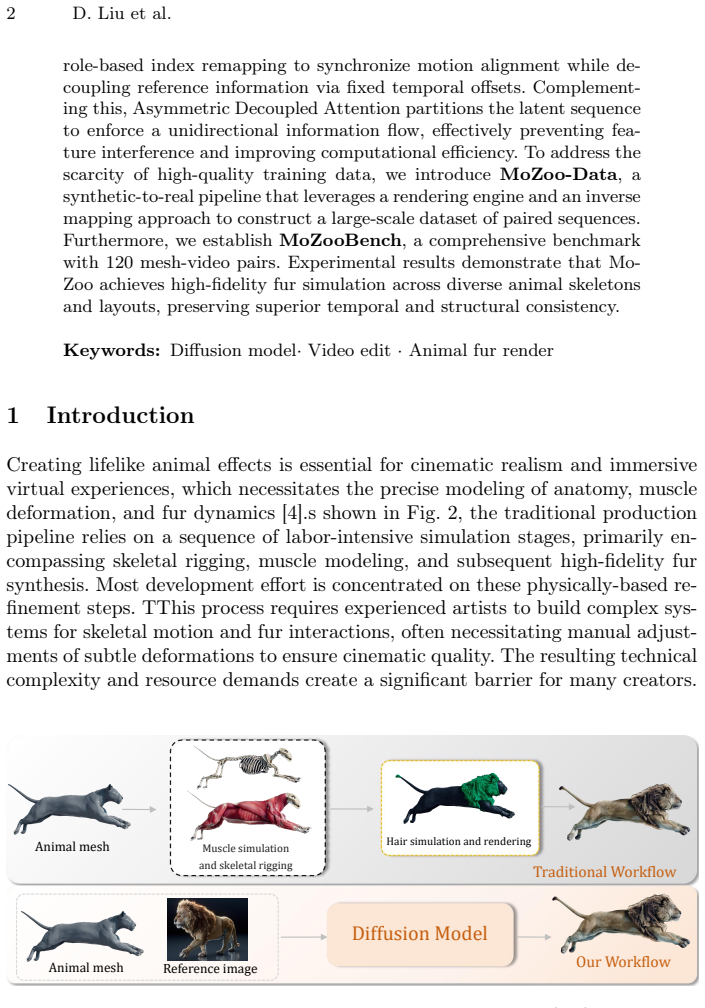
MoZoo bypasses conventional refinement steps to synthesize high-fidelity animal videos from coarse meshes under multimodal guidance. It employs Role-Aware RoPE to synchronize motion alignment through role-based index remapping and fixed temporal offsets for decoupling references. Asymmetric Decoupled Attention partitions the latent sequence to enforce unidirectional information flow, preventing interference and boosting efficiency. Trained on the MoZoo-Data dataset constructed via a synthetic-to-real pipeline, the model is assessed on the MoZooBench benchmark comprising 120 mesh-video pairs, demonstrating high-fidelity fur simulation with superior temporal and structural consistency across a
What carries the argument
Role-Aware RoPE (RAR-RoPE) with role-based index remapping and fixed temporal offsets, paired with Asymmetric Decoupled Attention that partitions latents for unidirectional flow.
If this is right
- Enables synthesis of animal videos without conventional refinement steps.
- Achieves superior temporal and structural consistency in fur simulations across diverse skeletons.
- Supports multimodal guidance for controlling motion and appearance.
- Provides MoZooBench as a standardized evaluation set with 120 mesh-video pairs.
- Reduces computational expense compared to traditional production workflows.
Where Pith is reading between the lines
- The attention partitioning technique could transfer to other video generation tasks involving long sequences with reference images.
- Similar synthetic-to-real pipelines might address data scarcity in related domains such as cloth or fluid simulation.
- Integration with existing mesh authoring tools could allow animators to preview dynamics without separate physics solvers.
- The approach opens a path toward controllable, high-resolution animal effects in real-time rendering contexts.
Load-bearing premise
The synthetic-to-real pipeline used to create MoZoo-Data produces training examples whose distribution is close enough to real animal videos that the model generalizes without large domain gaps or artifacts.
What would settle it
Large visual discrepancies, flickering, or loss of structural detail in MoZoo outputs when tested on real captured animal videos outside the training distribution would falsify the generalization claim.
Figures



read the original abstract
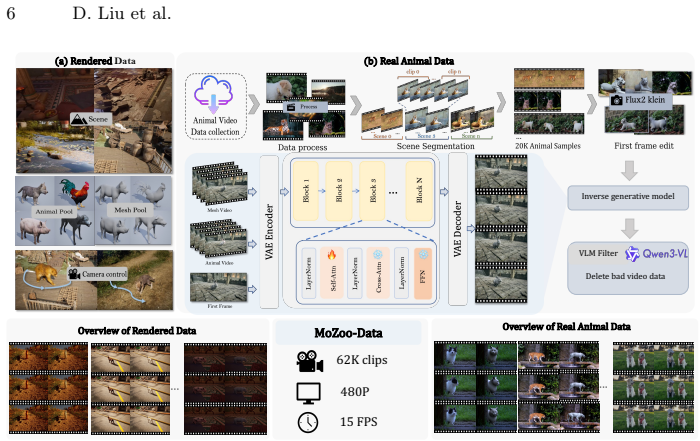
The creation of cinematic-quality animal effects necessitates the precise modeling of muscle and fur dynamics, a process that remains both labor-intensive and computationally expensive within traditional production workflows. While generative diffusion models have shown promise in diverse artistic workflows, their capacity for high-fidelity animal simulation remains largely unexploited. We present MoZoo, a generative dynamics solver that bypasses conventional refinement to synthesize high-fidelity animal videos from coarse meshes under multimodal guidance. We propose Role-Aware RoPE (RAR-RoPE) which employs role-based index remapping to synchronize motion alignment while decoupling reference information via fixed temporal offsets. Complementing this, Asymmetric Decoupled Attention partitions the latent sequence to enforce a unidirectional information flow, effectively preventing feature interference and improving computational efficiency. To address the scarcity of high-quality training data, we introduce MoZoo-Data, a synthetic-to-real pipeline that leverages a rendering engine and an inverse mapping approach to construct a large-scale dataset of paired sequences. Furthermore, we establish MoZooBench, a comprehensive benchmark with 120 mesh-video pairs. Experimental results demonstrate that MoZoo achieves high-fidelity fur simulation across diverse animal skeletons and layouts, preserving superior temporal and structural consistency.
Editorial analysis
A structured set of objections, weighed in public.
Referee Report
Summary. The manuscript introduces MoZoo, a video diffusion-based generative dynamics solver that synthesizes high-fidelity animal fur and muscle videos from coarse meshes under multimodal guidance. It proposes Role-Aware RoPE (RAR-RoPE) for role-based index remapping to align motion while decoupling references via fixed temporal offsets, and Asymmetric Decoupled Attention to partition latent sequences for unidirectional flow and efficiency. To mitigate data scarcity, it introduces the MoZoo-Data synthetic-to-real pipeline using a rendering engine and inverse mapping, plus the MoZooBench benchmark with 120 mesh-video pairs. The central claim is that experimental results show high-fidelity fur simulation across diverse skeletons with superior temporal and structural consistency.
Significance. If the performance claims are substantiated with quantitative evidence, MoZoo could meaningfully extend video diffusion techniques to physics-informed animal dynamics in computer graphics, offering a potential shortcut past labor-intensive traditional simulation pipelines for cinematic effects. The MoZoo-Data pipeline and MoZooBench benchmark represent concrete resources that could accelerate follow-on work in generative modeling of deformable biological structures. The architectural proposals (RAR-RoPE and asymmetric attention) target specific temporal consistency issues in video generation, which, if shown to be effective, would be of interest to the graphics and generative modeling communities.
major comments (3)
- [Abstract and Experimental Results] The abstract and experimental claims assert 'high-fidelity fur simulation' and 'superior temporal and structural consistency' yet supply no quantitative metrics, baselines, error bars, ablation studies, or statistical comparisons. This absence is load-bearing because the entire performance argument rests on these unspecified results.
- [MoZoo-Data Pipeline] The MoZoo-Data synthetic-to-real pipeline is described only at a high level (rendering engine plus inverse mapping) with no validation that it closes the domain gap to real animal videos (e.g., no FID, distribution distances, or physics-fidelity metrics on held-out real footage). This directly undermines the generalization claims that rely on the training distribution matching real dynamics such as wind-driven fur or gravity-induced muscle deformation.
- [Method] Role-Aware RoPE (RAR-RoPE) and Asymmetric Decoupled Attention are introduced as novel components, but the manuscript provides no explicit equations, derivations, or analysis showing how the role-based remapping and unidirectional partitioning achieve the claimed alignment and efficiency gains without introducing new free parameters or artifacts.
minor comments (2)
- [Title] The title string 'MoZoo:Unleashing' is missing a space after the colon.
- [Abstract] The abstract refers to 'Experimental results demonstrate...' without previewing the specific metrics or comparison methods that will be reported.
Simulated Author's Rebuttal
We thank the referee for the constructive and detailed review. We appreciate the recognition of MoZoo's potential contributions to generative modeling in graphics. We agree that the manuscript requires stronger quantitative support, explicit validation of the data pipeline, and detailed mathematical descriptions of the proposed components. All major comments will be addressed through additions and clarifications in the revised version.
read point-by-point responses
-
Referee: [Abstract and Experimental Results] The abstract and experimental claims assert 'high-fidelity fur simulation' and 'superior temporal and structural consistency' yet supply no quantitative metrics, baselines, error bars, ablation studies, or statistical comparisons. This absence is load-bearing because the entire performance argument rests on these unspecified results.
Authors: We acknowledge the need for explicit quantitative evidence to support the performance claims. While the current manuscript emphasizes qualitative results and visual comparisons, the revised version will include a dedicated quantitative evaluation section. This will report metrics such as Fréchet Video Distance (FVD), temporal warping error, and structural similarity measures, with comparisons against baselines including standard video diffusion models and physics-based simulators. Ablation studies on RAR-RoPE and Asymmetric Decoupled Attention will be added, along with error bars from multiple runs and statistical analysis. These changes will be incorporated to substantiate the claims of high-fidelity simulation and superior consistency. revision: yes
-
Referee: [MoZoo-Data Pipeline] The MoZoo-Data synthetic-to-real pipeline is described only at a high level (rendering engine plus inverse mapping) with no validation that it closes the domain gap to real animal videos (e.g., no FID, distribution distances, or physics-fidelity metrics on held-out real footage). This directly undermines the generalization claims that rely on the training distribution matching real dynamics such as wind-driven fur or gravity-induced muscle deformation.
Authors: We agree that validation of the synthetic-to-real pipeline is critical. In the revised manuscript, we will expand the MoZoo-Data description with quantitative validation. This includes FID scores and other distributional distances computed between the generated synthetic videos and held-out real animal footage. We will also report physics-fidelity metrics, such as average fur displacement errors and muscle deformation accuracy under simulated wind and gravity conditions, to demonstrate effective closure of the domain gap and support the generalization claims. revision: yes
-
Referee: [Method] Role-Aware RoPE (RAR-RoPE) and Asymmetric Decoupled Attention are introduced as novel components, but the manuscript provides no explicit equations, derivations, or analysis showing how the role-based remapping and unidirectional partitioning achieve the claimed alignment and efficiency gains without introducing new free parameters or artifacts.
Authors: We thank the referee for highlighting this omission. The revised manuscript will include explicit mathematical formulations in the Method section. For RAR-RoPE, we will provide the equations for role-based index remapping and the fixed temporal offset decoupling mechanism, along with analysis showing motion alignment without additional free parameters. For Asymmetric Decoupled Attention, we will detail the latent sequence partitioning, unidirectional attention masks, and derivations demonstrating efficiency improvements (e.g., reduced computational complexity) and artifact prevention. Pseudocode and parameter analysis will be added to the main text and appendix. revision: yes
Circularity Check
No circularity: method components and results are independently specified
full rationale
The paper introduces RAR-RoPE and Asymmetric Decoupled Attention as architectural proposals, plus a synthetic-to-real data pipeline and MoZooBench benchmark. No equations, fitted parameters, or self-citations are shown that reduce the high-fidelity simulation claims or temporal consistency results to quantities defined by construction from the inputs. Performance is reported via experimental evaluation on held-out mesh-video pairs rather than any self-referential derivation or renaming of known patterns.
Axiom & Free-Parameter Ledger
axioms (1)
- domain assumption Video diffusion models trained on artistic workflows can be repurposed for high-fidelity physical simulation of fur and muscle when given appropriate conditioning and architectural modifications.
invented entities (2)
-
Role-Aware RoPE (RAR-RoPE)
no independent evidence
-
Asymmetric Decoupled Attention
no independent evidence
Reference graph
Works this paper leans on
-
[1]
Carion, N., Gustafson, L., Hu, Y.T., Debnath, S., Hu, R., Suris, D., Ryali, C., Alwala, K.V., Khedr, H., Huang, A., Lei, J., Ma, T., Guo, B., Kalla, A., Marks, M., Greer, J., Wang, M., Sun, P., Rädle, R., Afouras, T., Mavroudi, E., Xu, K., Wu, T.H., Zhou, Y., Momeni, L., Hazra, R., Ding, S., Vaze, S., Porcher, F., Li, F., Li, S., Kamath, A., Cheng, H.K., ...
work page internal anchor Pith review Pith/arXiv arXiv 2025
- [2]
-
[3]
Chen, H., Zhang, Y., Cun, X., Xia, M., Wang, X., Weng, C., Shan, Y.: Videocrafter2: Overcoming data limitations for high-quality video diffusion models (2024)
work page 2024
-
[4]
Chiang, M.J.Y., Bitterli, B., Tappan, C., Burley, B.: A practical and control- lable hair and fur model for production path tracing. In: ACM SIGGRAPH 2015 Talks. SIGGRAPH ’15, Association for Computing Machinery, New York, NY, USA (2015).https://doi.org/10.1145/2775280.2792559,https: //doi.org/10.1145/2775280.2792559
-
[5]
Dhariwal, P., Nichol, A.: Diffusion models beat gans on image synthesis (2021), https://arxiv.org/abs/2105.05233
work page internal anchor Pith review Pith/arXiv arXiv 2021
-
[6]
Epic Games: Unreal engine 5.5 (2026),https://www.unrealengine.com, version 5.7
work page 2026
- [7]
- [8]
-
[9]
LTX-Video: Realtime Video Latent Diffusion
HaCohen, Y., Chiprut, N., Brazowski, B., Shalem, D., Moshe, D., Richardson, E., Levin, E., Shiran, G., Zabari, N., Gordon, O., Panet, P., Weissbuch, S., Kulikov, V., Bitterman, Y., Melumian, Z., Bibi, O.: Ltx-video: Realtime video latent diffusion. arXiv preprint arXiv:2501.00103 (2024)
work page internal anchor Pith review Pith/arXiv arXiv 2024
- [10]
-
[11]
Ho, J., Jain, A., Abbeel, P.: Denoising diffusion probabilistic models (2020),https: //arxiv.org/abs/2006.11239
work page internal anchor Pith review Pith/arXiv arXiv 2020
-
[12]
Ho, J., Salimans, T., Gritsenko, A., Chan, W., Norouzi, M., Fleet, D.J.: Video diffusion models (2022),https://arxiv.org/abs/2204.03458
work page internal anchor Pith review Pith/arXiv arXiv 2022
- [13]
-
[14]
In: Proceedings of the IEEE/CVF Conference on Computer Vision and Pattern Recognition (2024)
Huang, Z., He, Y., Yu, J., Zhang, F., Si, C., Jiang, Y., Zhang, Y., Wu, T., Jin, Q., Chanpaisit, N., Wang, Y., Chen, X., Wang, L., Lin, D., Qiao, Y., Liu, Z.: VBench: Comprehensive benchmark suite for video generative models. In: Proceedings of the IEEE/CVF Conference on Computer Vision and Pattern Recognition (2024)
work page 2024
-
[15]
In: Proceedings of the IEEE/CVF International Conference on Computer Vision
Jiang, Z., Han, Z., Mao, C., Zhang, J., Pan, Y., Liu, Y.: Vace: All-in-one video creation and editing. In: Proceedings of the IEEE/CVF International Conference on Computer Vision. pp. 17191–17202 (2025) 16 D. Liu et al
work page 2025
- [16]
- [17]
-
[18]
Kingma, D.P., Welling, M.: Auto-encoding variational bayes (2022),https://ar xiv.org/abs/1312.6114
work page internal anchor Pith review Pith/arXiv arXiv 2022
-
[19]
HunyuanVideo: A Systematic Framework For Large Video Generative Models
Kong, W., Tian, Q., Zhang, Z., Min, R., Dai, Z., Zhou, J., Xiong, J., Li, X., Wu, B., Zhang, J., et al.: Hunyuanvideo: A systematic framework for large video generative models. arXiv preprint arXiv:2412.03603 (2024)
work page internal anchor Pith review Pith/arXiv arXiv 2024
-
[20]
Labs, B.F.: FLUX.2: Frontier Visual Intelligence.https://bfl.ai/blog/flux-2 (2025)
work page 2025
- [21]
- [22]
- [23]
- [24]
-
[25]
Liu, X., Gong, C., Liu, Q.: Flow straight and fast: Learning to generate and transfer data with rectified flow (2022),https://arxiv.org/abs/2209.03003
work page internal anchor Pith review Pith/arXiv arXiv 2022
- [26]
-
[27]
Marschner, S.R., Jensen, H.W., Cammarano, M., Worley, S., Hanrahan, P.: Light scattering from human hair fibers. ACM Trans. Graph.22(3), 780–791 (Jul 2003). https://doi.org/10.1145/882262.882345,https://doi.org/10.1145/882262 .882345
-
[28]
Moon, J.T., Walter, B., Marschner, S.: Efficient multiple scattering in hair using spherical harmonics. In: ACM SIGGRAPH 2008 Papers. SIGGRAPH ’08, Associ- ation for Computing Machinery, New York, NY, USA (2008).https://doi.org/ 10.1145/1399504.1360630,https://doi.org/10.1145/1399504.1360630
-
[29]
Peebles, W., Xie, S.: Scalable diffusion models with transformers (2023),https: //arxiv.org/abs/2212.09748
work page internal anchor Pith review Pith/arXiv arXiv 2023
-
[30]
Pexels: Pexels: Free stock photos & videos.https://www.pexels.com/(2026), accessed: 2026-01-22
work page 2026
-
[31]
Radford, A., Kim, J.W., Hallacy, C., Ramesh, A., Goh, G., Agarwal, S., Sastry, G., Askell, A., Mishkin, P., Clark, J., Krueger, G., Sutskever, I.: Learning transferable visual models from natural language supervision (2021),https://arxiv.org/ab s/2103.00020
work page internal anchor Pith review Pith/arXiv arXiv 2021
- [32]
-
[33]
Schuhmann, C., Beaumont, R., Vencu, R., Gordon, C., Wightman, R., Cherti, M., Coombes, T., Katta, A., Mullis, C., Wortsman, M., Schramowski, P., Kundurthy, S., Crowson, K., Schmidt, L., Kaczmarczyk, R., Jitsev, J.: Laion-5b: An open Abbreviated paper title 17 large-scale dataset for training next generation image-text models (2022),https: //arxiv.org/abs/...
work page internal anchor Pith review Pith/arXiv arXiv 2022
- [34]
-
[35]
SideFX: Houdini.https://www.sidefx.com/(2026), accessed: 2026-03-02
work page 2026
-
[36]
Singer, U., Polyak, A., Hayes, T., Yin, X., An, J., Zhang, S., Hu, Q., Yang, H., Ashual, O., Gafni, O., Parikh, D., Gupta, S., Taigman, Y.: Make-a-video: Text-to- video generation without text-video data (2022),https://arxiv.org/abs/2209.1 4792
work page 2022
- [37]
- [38]
-
[39]
Song, J., Meng, C., Ermon, S.: Denoising diffusion implicit models (2022),https: //arxiv.org/abs/2010.02502
work page internal anchor Pith review Pith/arXiv arXiv 2022
- [40]
-
[41]
Wan: Open and Advanced Large-Scale Video Generative Models
Wan, T., Wang, A., Ai, B., Wen, B., Mao, C., Xie, C.W., Chen, D., Yu, F., Zhao, H., Yang, J., Zeng, J., Wang, J., Zhang, J., Zhou, J., Wang, J., Chen, J., Zhu, K., Zhao, K., Yan, K., Huang, L., Feng, M., Zhang, N., Li, P., Wu, P., Chu, R., Feng, R., Zhang, S., Sun, S., Fang, T., Wang, T., Gui, T., Weng, T., Shen, T., Lin, W., Wang, W., Wang, W., Zhou, W.,...
work page internal anchor Pith review Pith/arXiv arXiv 2025
-
[42]
IEEE Transactions on Image Process- ing13(4), 600–612 (2004)
Wang, Z., Bovik, A.C., Sheikh, H.R., Simoncelli, E.P.: Image quality assessment: From error visibility to structural similarity. IEEE Transactions on Image Process- ing13(4), 600–612 (2004)
work page 2004
- [43]
- [44]
-
[45]
Xia, Z., Wang, Y., Lu, Z., Liu, K., Xiao, J., Wonka, P.: OMEGA-avatar: One-shot modeling of 360-degree gaussian avatars (2026),https://arxiv.org/abs/2602.1 1693
work page 2026
-
[46]
Xing, J., Xia, M., Liu, Y., Zhang, Y., Zhang, Y., He, Y., Liu, H., Chen, H., Cun, X., Wang, X., Shan, Y., Wong, T.T.: Make-your-video: Customized video generation using textual and structural guidance (2023),https://arxiv.org/abs/2306.009 43
work page 2023
- [47]
-
[48]
CogVideoX: Text-to-Video Diffusion Models with An Expert Transformer
Yang, Z., Teng, J., Zheng, W., Ding, M., Huang, S., Xu, J., Yang, Y., Hong, W., Zhang, X., Feng, G., et al.: Cogvideox: Text-to-video diffusion models with an expert transformer. arXiv preprint arXiv:2408.06072 (2024) 18 D. Liu et al
work page internal anchor Pith review Pith/arXiv arXiv 2024
-
[49]
Ye, H., Zhang, J., Liu, S., Han, X., Yang, W.: Ip-adapter: Text compatible image prompt adapter for text-to-image diffusion models (2023),https://arxiv.org/ab s/2308.06721
work page internal anchor Pith review Pith/arXiv arXiv 2023
- [50]
- [51]
- [52]
-
[53]
Zhang, R., Isola, P., Efros, A.A., Shechtman, E., Wang, O.: The unreasonable effectiveness of deep features as a perceptual metric. In: CVPR (2018)
work page 2018
-
[54]
Zheng, Z., Peng, X., Yang, T., Shen, C., Li, S., Liu, H., Zhou, Y., Li, T., You, Y.: Open-sora: Democratizing efficient video production for all (2024),https: //arxiv.org/abs/2412.20404
work page internal anchor Pith review Pith/arXiv arXiv 2024
-
[55]
Zhou, Y., Chai, M., Wang, D., Winberg, S., Wood, E., Sarkar, K., Gross, M., Beeler, T.: Groomcap: High-fidelity prior-free hair capture. ACM Transactions on Graphics43(6), 1–15 (Nov 2024).https://doi.org/10.1145/3687768,http: //dx.doi.org/10.1145/3687768
-
[56]
Zinke, A., Yuksel, C., Weber, A., Keyser, J.: Dual scattering approximation for fast multiple scattering in hair. ACM Trans. Graph.27(3), 1–10 (Aug 2008).https: //doi.org/10.1145/1360612.1360631,https://doi.org/10.1145/1360612.13 60631
discussion (0)
Sign in with ORCID, Apple, or X to comment. Anyone can read and Pith papers without signing in.