Recognition: 2 theorem links
· Lean TheoremLarge Language Models for Web Accessibility: A Systematic Literature Review
Pith reviewed 2026-05-15 07:26 UTC · model grok-4.3
The pith
A review of 38 studies finds LLMs mainly applied to text-centric and structural web accessibility tasks using WCAG as the core framework.
A machine-rendered reading of the paper's core claim, the machinery that carries it, and where it could break.
Core claim
After analyzing 38 studies, the authors establish that LLM applications in web accessibility predominantly address text-centric and structurally explicit tasks, reference WCAG as the primary guideline framework with minimal engagement of cognitive accessibility guidelines, rely on general-purpose models and prompt-based interactions, and employ varied evaluation practices that rarely involve users with disabilities directly.
What carries the argument
The comparative analysis of accessibility tasks addressed, LLM models and prompting strategies, system architectures, guidelines considered, and evaluation methods used across the 38 studies.
If this is right
- Future LLM tools for accessibility should expand beyond text and structure to include dynamic and cognitive dimensions.
- Research should prioritize evaluations that directly involve people with disabilities rather than relying on automated or proxy metrics.
- Development of specialized prompting techniques or domain-adapted models could improve performance on accessibility remediation.
- The review serves as a reference point to avoid duplicating work on already-covered text-centric tasks.
Where Pith is reading between the lines
- Integrating LLMs with existing accessibility checking tools could create hybrid systems that combine rule-based detection with generative fixes.
- Expanding to real-time web applications might require new architectures that handle live content changes more reliably than current prompt-only methods.
- The observed gaps in cognitive guidelines suggest an opportunity to adapt LLMs using targeted training data drawn from COGA principles.
Load-bearing premise
The search strategy and inclusion criteria captured a representative sample of all relevant peer-reviewed work without significant publication bias or missed studies.
What would settle it
A broader search or updated database query that identifies many additional studies showing substantially more coverage of cognitive guidelines or user-involved evaluations would contradict the reported distribution.
Figures


read the original abstract
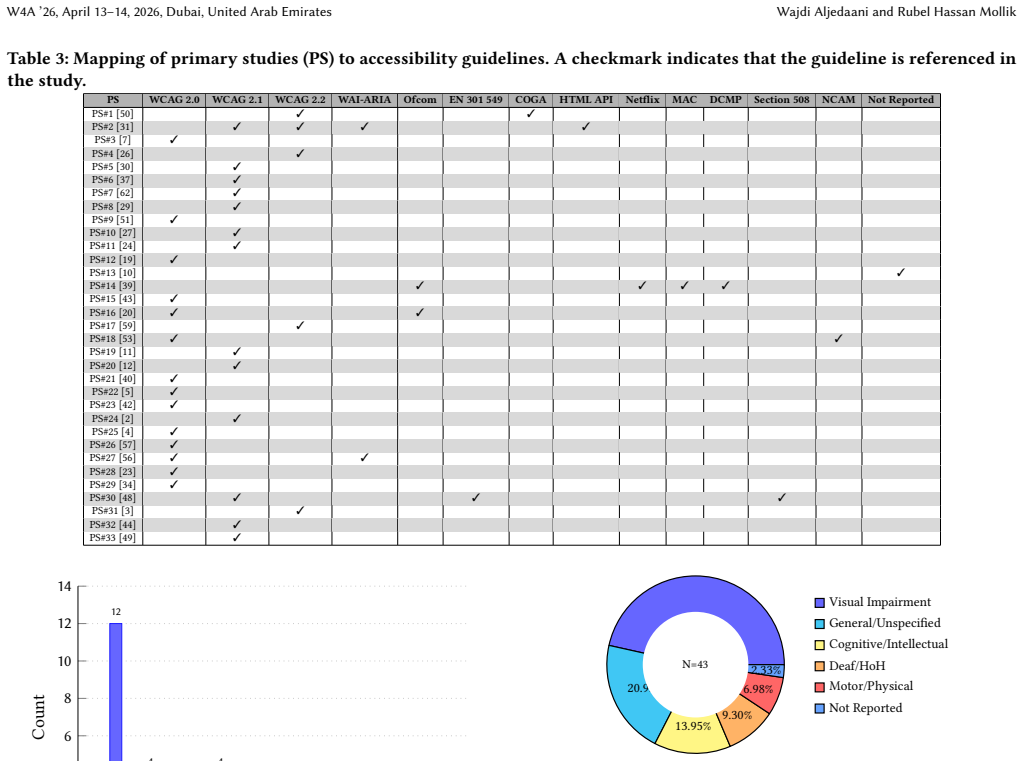
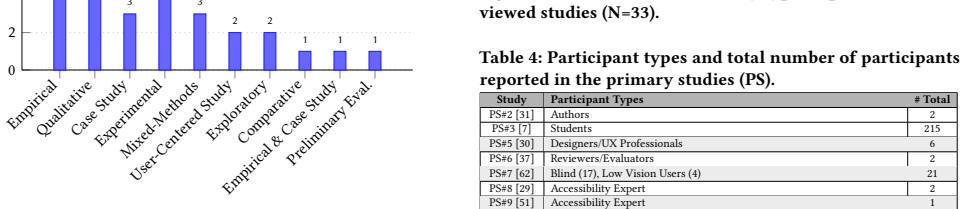
Web accessibility aims to ensure that web content and services are usable by people with diverse abilities. In recent years, Large Language Models (LLMs) have been increasingly explored to support accessibility-related tasks on the web, such as content generation, issue detection, and remediation. However, little is known about the characteristics of these approaches, the accessibility issues they target, the standards they follow, and how they are evaluated. In this paper, we present a systematic literature review of 38 peer-reviewed studies that investigate the use of LLMs in web accessibility contexts. We begin by performing a comprehensive search of scientific publications to identify relevant studies. We then conduct a comparative analysis to examine the accessibility tasks addressed, the LLM models and prompting strategies employed, the system architectures adopted, the accessibility issues and guidelines considered, and the evaluation methods used across studies. Our findings show that most studies apply LLMs to text-centric and structurally explicit accessibility tasks, with WCAG serving as the primary reference framework and limited consideration of cognitive accessibility guidelines (COGA). The reviewed approaches predominantly rely on general-purpose LLMs and prompt-based interactions, while evaluation practices vary widely and often lack direct involvement of users with disabilities. We envision this review as a consolidated reference for researchers and practitioners seeking to understand the current landscape of LLM-supported web accessibility, and as a foundation to guide future research and tool development in this area.
Editorial analysis
A structured set of objections, weighed in public.
Referee Report
Summary. The paper presents a systematic literature review of 38 peer-reviewed studies on the use of Large Language Models (LLMs) for web accessibility tasks such as content generation, issue detection, and remediation. It performs a comparative analysis of the accessibility tasks addressed, LLM models and prompting strategies employed, system architectures, accessibility issues and guidelines considered (with WCAG as primary and limited COGA coverage), and evaluation methods used. The central findings are that most studies focus on text-centric and structurally explicit tasks, rely on general-purpose LLMs with prompt-based interactions, and employ varied evaluations that often lack direct involvement of users with disabilities.
Significance. If the review methodology is robust, the synthesis provides a useful consolidated reference for an emerging interdisciplinary area, identifying clear patterns (text-centric focus, WCAG dominance) and gaps (limited cognitive guidelines, infrequent user involvement in evaluation) that can directly inform future research priorities and tool development in LLM-supported web accessibility.
major comments (2)
- [Methods] Methods section: The description of the search process provides no specific search strings, databases, date ranges, or inter-rater reliability metrics. This detail is load-bearing for the claim of a 'comprehensive search' and the representativeness of the 38 studies that underpins every reported pattern.
- [Results] Results section: The claim that 'most studies apply LLMs to text-centric and structurally explicit accessibility tasks' is presented without a quantitative breakdown (e.g., counts or percentages per task category or reference to a supporting table), making it impossible to gauge the strength or distribution of the observed pattern.
minor comments (1)
- [Abstract] Abstract: The phrase 'comprehensive search of scientific publications' could be strengthened by naming the primary databases or key terms used.
Simulated Author's Rebuttal
We thank the referee for the constructive comments on our systematic literature review. We address each major comment below and will revise the manuscript to incorporate the suggested improvements.
read point-by-point responses
-
Referee: [Methods] Methods section: The description of the search process provides no specific search strings, databases, date ranges, or inter-rater reliability metrics. This detail is load-bearing for the claim of a 'comprehensive search' and the representativeness of the 38 studies that underpins every reported pattern.
Authors: We agree that the Methods section currently lacks these specific details. In the revised manuscript, we will expand the search process description to include the exact search strings, the databases queried, the date ranges applied, and inter-rater reliability metrics (such as Cohen's kappa) for study selection. This addition will strengthen the justification for the comprehensiveness of the search and the representativeness of the included studies. revision: yes
-
Referee: [Results] Results section: The claim that 'most studies apply LLMs to text-centric and structurally explicit accessibility tasks' is presented without a quantitative breakdown (e.g., counts or percentages per task category or reference to a supporting table), making it impossible to gauge the strength or distribution of the observed pattern.
Authors: We acknowledge that the Results section presents this finding without supporting quantitative data. We will revise the section to include explicit counts and percentages for each task category and will add or expand a table summarizing the distribution of accessibility tasks across the 38 studies. This will provide readers with a clear, evidence-based view of the observed pattern. revision: yes
Circularity Check
No significant circularity
full rationale
The paper is a systematic literature review synthesizing patterns across 38 peer-reviewed studies on LLMs for web accessibility. No mathematical derivations, statistical models, fitted parameters, or self-referential predictions exist. The central claims (text-centric tasks dominant, WCAG primary, limited COGA coverage) are descriptive observations drawn from the included literature rather than quantities generated from the paper's own equations or prior self-citations. The search strategy and inclusion criteria define the sample but do not create circular reductions in the reported findings.
Axiom & Free-Parameter Ledger
axioms (1)
- domain assumption A systematic literature review following standard search and inclusion protocols produces a representative sample of the field.
Reference graph
Works this paper leans on
-
[1]
2021.Making Content Usable for People with Cognitive and Learning Disabilities. W3C Working Group Note. W3C. https://www.w3.org/TR/coga-usable/
work page 2021
-
[2]
Iyad Abu Doush and Reem Kassem. 2025. Can generative AI create accessible web code? A benchmark analysis of AI-generated HTML against accessibility standards.Universal Access in the Information Society24, 4 (2025), 3483–3506
work page 2025
-
[3]
Patricia Acosta-Vargas, Gloria Acosta-Vargas, Belén Salvador-Acosta, and Janio Jadán-Guerrero. 2024. Addressing web accessibility challenges with generative artificial intelligence tools for inclusive education. In2024 Tenth International Conference on eDemocracy & eGovernment (ICEDEG). IEEE, 1–7
work page 2024
-
[4]
CP Afsal and KS Kuppusamy. 2024. Comparative Assessment of Accessibility and Readability in Generative AI: A Case Study of GPT and Google BARD. InInternational Conference on Emerging Trends and Technologies on Intelligent Large Language Models for Web Accessibility: A Systematic Literature Review W4A ’26, April 13–14, 2026, Dubai, United Arab Emirates Sys...
work page 2024
-
[5]
CP Afsal and KS Kuppusamy. 2025. WEBSumm: A Chrome Extension for Sum- marizing Web Content Using LLMs for Visually Impaired Users.SN Computer Science6, 2 (2025), 1–15
work page 2025
-
[6]
Muhammad Ali. 2025. Use of AI in improving website accessibility: a systematic literature review and conceptual framework for digital inclusion. (2025)
work page 2025
-
[7]
Wajdi Aljedaani, Marcelo Medeiros Eler, and PD Parthasarathy. 2025. Enhanc- ing accessibility in software engineering projects with large language models (llms). InProceedings of the 56th ACM Technical Symposium on Computer Science Education V. 1. 25–31
work page 2025
-
[8]
Wajdi Aljedaani, Abdulrahman Habib, Ahmed Aljohani, Marcelo Eler, and Yunhe Feng. 2024. Does chatgpt generate accessible code? investigating accessibility challenges in llm-generated source code. InProceedings of the 21st International Web for All Conference. 165–176
work page 2024
-
[9]
Wajdi Aljedaani, Rubel Hassan Mollik, Eysha Saad, Marcelo M Eler, and As- maa Mansour Alghamdi. 2025. Challenges and barriers faced by blind and visually impaired users on social media: a systematic literature review.Universal Access in the Information Society(2025), 1–30
work page 2025
-
[10]
Katharina Anderer, Karin Müller, Lukas Strobel, Matthias Wölfel, Jan Niehues, and Kathrin Gerling. 2025. Making Lecture Videos Accessible for Students who are Blind or have Low Vision through AI-Assisted Navigation and Visual Question Answering. InProceedings of the 27th International ACM SIGACCESS Conference on Computers and Accessibility. 1–15
work page 2025
-
[11]
Manuel Andruccioli, Barry Bassi, Giovanni Delnevo, and Paola Salomoni. 2025. Leveraging Large Language Models for Sustainable and Inclusive Web Accessi- bility.Big Data and Cognitive Computing9, 10 (2025), 247
work page 2025
-
[12]
Manuel Andruccioli, Barry Bassi, Giovanni Delnevo, and Paola Salomoni. 2025. The Tabular Accessibility Dataset: A Benchmark for LLM-Based Web Accessibility Auditing.Data10, 9 (2025), 149
work page 2025
-
[13]
Jinat Ara, Cecilia Sik-Lanyi, and Arpad Kelemen. 2024. Accessibility engineering in web evaluation process: a systematic literature review.Universal Access in the Information Society23, 2 (2024), 653–686
work page 2024
-
[14]
Mateo Borina, Edi Kalister, and Tihomir Orehovački. 2022. Web accessibility for people with cognitive disabilities: a systematic literature review from 2015 to 2021. InInternational Conference on Human-Computer Interaction. Springer, 261–276
work page 2022
-
[15]
Peter Brophy and Jenny Craven. 2007. Web accessibility.Library trends55, 4 (2007), 950–972
work page 2007
-
[16]
Ben Caldwell, Michael Cooper, Loretta Guarino Reid, Gregg Vanderheiden, Wendy Chisholm, John Slatin, and Jason White. 2008. Web content accessibility guide- lines (WCAG) 2.0.WWW Consortium (W3C)290, 1-34 (2008), 5–12
work page 2008
-
[17]
Milton Campoverde-Molina, Sergio Lujan-Mora, and Llorenc Valverde Garcia
-
[18]
Empirical studies on web accessibility of educational websites: A systematic literature review.IEEE access8 (2020), 91676–91700
work page 2020
-
[19]
Milton Campoverde-Molina, Sergio Luján-Mora, and Llorenç Valverde. 2023. Accessibility of university websites worldwide: a systematic literature review. Universal Access in the Information Society22, 1 (2023), 133–168
work page 2023
-
[20]
Xinyun Cao, Kexin Phyllis Ju, Chenglin Li, and Dhruv Jain. 2025. SceneGenA11y: How can Runtime Generative tools improve the Accessibility of a Virtual 3D Scene?. InProceedings of the Extended Abstracts of the CHI Conference on Human Factors in Computing Systems. 1–10
work page 2025
-
[21]
Maryam Cheema, Hasti Seifi, and Pooyan Fazli. 2025. Describe Now: User-Driven Audio Description for Blind and Low Vision Individuals. InProceedings of the 2025 ACM Designing Interactive Systems Conference. 458–474
work page 2025
-
[22]
Andy Coverdale, Sarah Lewthwaite, and Sarah Horton. 2024. Digital accessibility education in context: expert perspectives on building capacity in academia and the workplace.ACM Transactions on Accessible Computing17, 2 (2024), 1–21
work page 2024
-
[23]
Mauricio Cruz-Portilla, Juan Carlos Pérez-Arriaga, Jorge Octavio Ocharán- Hernández, and Ángel J Sánchez-García. 2021. Accessibility in the software development life cycle: a systematic literature review. In2021 9th International Conference in Software Engineering Research and Innovation (CONISOFT). IEEE, 97–103
work page 2021
-
[24]
Giovanni Delnevo, Manuel Andruccioli, and Silvia Mirri. 2024. On the interaction with large language models for web accessibility: Implications and challenges. In2024 IEEE 21st Consumer Communications & Networking Conference (CCNC). IEEE, 1–6
work page 2024
-
[25]
Iyad Abu Doush and Reem Kassem. 2024. Evaluating ai-generated web code for accessibility compliance: A metric-driven approach. InProceedings of the 11th International Conference on Software Development and Technologies for Enhancing Accessibility and Fighting Info-exclusion. 338–344
work page 2024
-
[26]
Nikolaos Droutsas, Fotios Spyridonis, Damon Daylamani-Zad, and Gheorghita Ghinea. 2025. Web accessibility barriers and their cross-disability impact in eSystems: A scoping review.Computer Standards & Interfaces92 (2025), 103923
work page 2025
-
[27]
Carlos Duarte, Miguel Costa, Letícia Seixas Pereira, and João Guerreiro. 2025. Expanding Automated Accessibility Evaluations: Leveraging Large Language Models for Heading-Related Barriers. InCompanion Proceedings of the 30th Inter- national Conference on Intelligent User Interfaces. 39–42
work page 2025
-
[28]
Nadeen Fathallah, Daniel Hernández, and Steffen Staab. 2025. AccessGuru: Leveraging LLMs to Detect and Correct Web Accessibility Violations in HTML Code. InProceedings of the 27th International ACM SIGACCESS Conference on Computers and Accessibility. 1–22
work page 2025
-
[29]
Katia Romero Felizardo, Emilia Mendes, Marcos Kalinowski, Érica Ferreira Souza, and Nandamudi L Vijaykumar. 2016. Using forward snowballing to update systematic reviews in software engineering. InProceedings of the 10th ACM/IEEE International Symposium on Empirical Software Engineering and Measurement. 1–6
work page 2016
-
[30]
Alexandra-Elena Gurita and Radu-Daniel Vatavu. 2025. When LLM-Generated Code Perpetuates User Interface Accessibility Barriers, How Can We Break the Cycle?. InProceedings of the 22nd International Web for All Conference. 124–134
work page 2025
-
[31]
Alexandra-Elena Gurit,ă. 2025. Exploring the Intersection of UI Accessibility and Generative AI: A Framework for Human-AI Collaboration. InCompanion Publication of the 2025 ACM Designing Interactive Systems Conference. 116–120
work page 2025
-
[32]
Ziyao He, Syed Fatiul Huq, and Sam Malek. 2025. Enhancing Web Accessibility: Automated Detection of Issues with Generative AI.Proceedings of the ACM on Software Engineering2, FSE (2025), 2264–2287
work page 2025
-
[33]
Dylan H Hewitt and Yingchen He. 2021. Internet Accessibility for blind and visually-impaired users: An evaluation of official us state and territory covid-19 websites. InProceedings of the Human Factors and Ergonomics Society Annual Meeting, Vol. 65. SAGE Publications Sage CA: Los Angeles, CA, 154–158
work page 2021
-
[34]
Lei Huang, Weijiang Yu, Weitao Ma, Weihong Zhong, Zhangyin Feng, Haotian Wang, Qianglong Chen, Weihua Peng, Xiaocheng Feng, Bing Qin, et al. 2025. A survey on hallucination in large language models: Principles, taxonomy, chal- lenges, and open questions.ACM Transactions on Information Systems43, 2 (2025), 1–55
work page 2025
-
[35]
Gia Ky Huynh and Wenjun Lin. 2024. SmartCaption AI-Enhancing Web Accessi- bility with Context-Aware Image Descriptions Using Large Language Models. In 2024 International Conference on Computer and Applications (ICCA). IEEE, 1–7
work page 2024
-
[36]
Samireh Jalali and Claes Wohlin. 2012. Systematic literature studies: database searches vs. backward snowballing. InProceedings of the ACM-IEEE international symposium on Empirical software engineering and measurement. 29–38
work page 2012
-
[37]
Barbara Kitchenham, O Pearl Brereton, David Budgen, Mark Turner, John Bai- ley, and Stephen Linkman. 2009. Systematic literature reviews in software engineering–a systematic literature review.Information and software technology 51, 1 (2009), 7–15
work page 2009
-
[38]
Katelyn Leedy, Makenzie Preston, Jinjuan Feng, and Jeba Rezwana. 2025. Acces- sibility in the Age of Generative AI Web Based Builders: Evaluating Web Design Tools for Inclusive Practices. InProceedings of the 28th International Academic Mindtrek Conference. 304–314
work page 2025
-
[39]
Sarah Lewthwaite. 2014. Web accessibility standards and disability: developing critical perspectives on accessibility.Disability and Rehabilitation36, 16 (2014), 1375–1383
work page 2014
-
[40]
Chaoyu Li, Sid Padmanabhuni, Maryam S Cheema, Hasti Seifi, and Pooyan Fazli. 2025. Videoa11y: Method and dataset for accessible video description. In Proceedings of the 2025 CHI Conference on Human Factors in Computing Systems. 1–29
work page 2025
-
[41]
Juan-Miguel López-Gil and Juanan Pereira. 2025. Turning manual web accessibil- ity success criteria into automatic: an LLM-based approach.Universal Access in the Information Society24, 1 (2025), 837–852
work page 2025
-
[42]
Shridhar Mehendale and Ankit Walishetti. 2025. DexAssist: A Voice-Enabled Dual- LLM Framework for Accessible Web Navigation. InIntelligent Human Computer Interaction, Dhananjay Singh, Jan-Willem van ’t Klooster, and Uma Shanker Tiwary (Eds.). Springer Nature Switzerland, Cham, 171–177
work page 2025
-
[43]
Pedro Afonso F Michalichem, Leonardo Tórtoro Pereira, and Kamila Rios da Hora Rodrigues. 2025. A gamified solution to promote positive habits in children and adolescents with Intellectual Disabilities.Journal on Interactive Systems16, 1 (2025), 833–849
work page 2025
-
[44]
Ye Mo, Gang Huang, liangcheng li, Dazhen Deng, Zhi Yu, Yilun Xu, Kai Ye, Sheng Zhou, and Jiajun Bu. 2025. TableNarrator: Making Image Tables Accessible to Blind and Low Vision People. InProceedings of the 2025 CHI Conference on Human Factors in Computing Systems. 1–17
work page 2025
-
[45]
Yunseo Moon, Hyunmin Lee, SeungYoung Oh, and Hyunggu Jung. 2024. SaGol: using MiniGPT-4 to generate alt text for improving image accessibility. InPro- ceedings of the Thirty-ThirdInternational Joint Conference on Artificial Intelligence. International Joint Conferences on Artificial Intelligence Organization Jeju . . . , 8745–8748
work page 2024
-
[46]
Peya Mowar, Yi-Hao Peng, Jason Wu, Aaron Steinfeld, and Jeffrey P Bigham. 2025. CodeA11y: Making AI Coding Assistants Useful for Accessible Web Development. InProceedings of the 2025 CHI Conference on Human Factors in Computing Systems. 1–15
work page 2025
-
[47]
Humza Naveed, Asad Ullah Khan, Shi Qiu, Muhammad Saqib, Saeed Anwar, Muhammad Usman, Naveed Akhtar, Nick Barnes, and Ajmal Mian. 2025. A com- prehensive overview of large language models.ACM Transactions on Intelligent Systems and Technology16, 5 (2025), 1–72
work page 2025
-
[48]
Karla Ordoñez, José Hilera, and Samanta Cueva. 2022. Model-driven development of accessible software: a systematic literature review.Universal Access in the Information Society21, 1 (2022), 295–324. W4A ’26, April 13–14, 2026, Dubai, United Arab Emirates Wajdi Aljedaani and Rubel Hassan Mollik
work page 2022
-
[49]
Sushil K Oswal and Hitender K Oswal. 2024. Examining the accessibility of gener- ative AI website builder tools for blind and low vision users: 21 best practices for designers and developers. In2024 IEEE International Professional Communication Conference (ProComm). IEEE, 121–128
work page 2024
-
[50]
Achraf Othman, Amira Dhouib, and Aljazi Nasser Al Jabor. 2023. Fostering websites accessibility: A case study on the use of the Large Language Models ChatGPT for automatic remediation. InProceedings of the 16th international conference on pervasive technologies related to assistive environments. 707–713
work page 2023
-
[51]
Ruchi Panchanadikar, Mitali Shrikant Bhosekar, and Emma Dixon. 2025. Can Generative AI Create Accessible Websites?. InProceedings of the 27th International ACM SIGACCESS Conference on Computers and Accessibility. 1–6
work page 2025
-
[52]
Fabio Paternò, Manuela Vinci, Marco Manca, and Nicola Iannuzzi. 2025. How an LLM Can Improve Automatic Web Accessibility Validation?. InProceedings of the 16th Biannual Conference of the Italian SIGCHI Chapter. 1–8
work page 2025
-
[53]
Cecilia Maria Patino and Juliana Carvalho Ferreira. 2018. Inclusion and exclusion criteria in research studies: definitions and why they matter.Jornal Brasileiro de Pneumologia44 (2018), 84–84
work page 2018
-
[54]
Giacomo Pedemonte, Maurizio Leotta, Marina Ribaudo, et al. 2025. Improving web accessibility with an llm-based tool: A preliminary evaluation for stem images.IEEE ACCESS13 (2025), 107566–107582
work page 2025
-
[55]
Nataša Rajh, Klaus Miesenberger, and Reinhard Koutny. 2024. Accessibility in the software engineering (SE) process and in integrated development environments (IDEs): a systematic literature review. InInternational Conference on Computers Helping People with Special Needs. Springer, 11–18
work page 2024
-
[56]
Aylin Sarioğlu, Haydar Metin, and Dominik Bork. 2025. Accessibility in concep- tual modeling—A systematic literature review, a keyboard-only UML modeling tool, and a research roadmap.Data & Knowledge Engineering(2025), 102423
work page 2025
-
[57]
Jorge Sassaki Resende Silva, Paula Christina Figueira Cardoso, Raphael Winck- ler De Bettio, Daniela Cardoso Tavares, Carlos Alberto Silva, Willian Massami Watanabe, and André Pimenta Freire. 2024. In-page navigation aids for screen- reader users with automatic topicalisation and labelling.ACM Transactions on Accessible Computing17, 2 (2024), 1–45
work page 2024
-
[58]
Utkarsha Singh, Jeevithashree Divya Venkatesh, Anujith Muraleedharan, Ka- malPreet Singh Saluja, Anamika JH, and Pradipta Biswas. 2024. Accessibility analysis of educational websites using WCAG 2.0.Digital Government: Research and Practice5, 3 (2024), 1–28
work page 2024
-
[59]
Pedro Teixeira, Celeste Eusebio, and Leonor Teixeira. 2024. Understanding the integration of accessibility requirements in the development process of infor- mation systems: a systematic literature review.Requirements Engineering29, 2 (2024), 143–176
work page 2024
-
[60]
Guillermo Vera-Amaro and Jose Rafael Rojano-Caceres. 2025. Accessible Web Content Generation Using LLMs: An Empirical Study on Prompting Strategies and Template-Guided Remediation.IEEE Latin America Transactions23, 12 (2025), 1230–1239
work page 2025
-
[61]
Markel Vigo, Justin Brown, and Vivienne Conway. 2013. Benchmarking web accessibility evaluation tools: measuring the harm of sole reliance on automated tests. InProceedings of the 10th international cross-disciplinary conference on web accessibility. 1–10
work page 2013
-
[62]
Web Accessibility In Mind WebAIM. 2020. The WebAIM MillionAn annual accessibility analysis of the top 1,000,000 home pages.Retrieved October13 (2020), 2020
work page 2020
-
[63]
Yaman Yu, Bektur Ryskeldiev, Ayaka Tsutsui, Matthew Gillingham, and Yang Wang. 2025. From cluttered to clear: Improving the web accessibility design for screen reader users in e-commerce with generative AI. InProceedings of the 27th International ACM SIGACCESS Conference on Computers and Accessibility. 1–19
work page 2025
-
[64]
Yehong Zhou and Chun-Hsien Chen. 2025. Examining the Impact of Large Language Models on Design: Functions, Strengths, Limitations, and Roles.Design and Artificial Intelligence(2025), 100017
work page 2025
discussion (0)
Sign in with ORCID, Apple, or X to comment. Anyone can read and Pith papers without signing in.