Recognition: no theorem link
A Non-Destructive Methodological Framework for Modernizing Legacy Clinical Reporting Systems for AI-Driven Pharmacoinformatics: A SAS Case Study
Pith reviewed 2026-05-15 05:58 UTC · model grok-4.3
The pith
A metadata layer wraps legacy SAS reporting systems to enable AI integration without altering source code.
A machine-rendered reading of the paper's core claim, the machinery that carries it, and where it could break.
Core claim
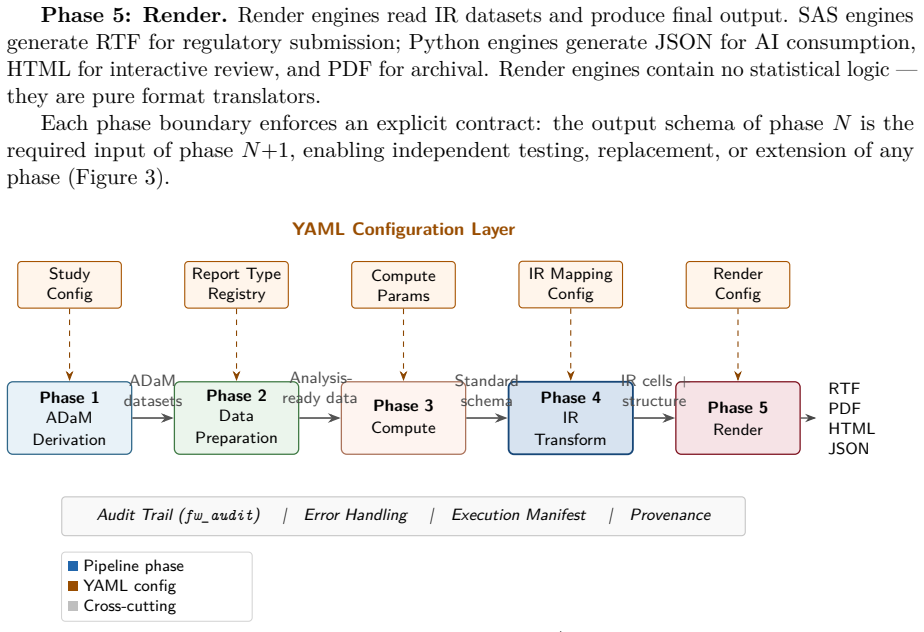
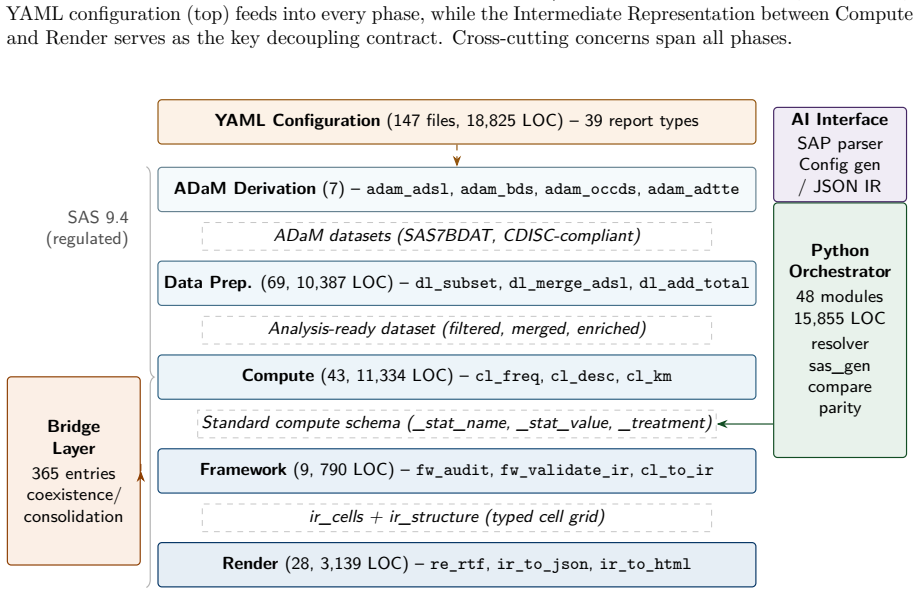
We present a non-destructive methodological framework achieving AI-driven pharmacoinformatics readiness without altering legacy source code. A metadata layer—comprising a bridge map, a typed Intermediate Representation (IR), and an orchestrator—wraps existing components and re-exposes their outputs as structured data consumable by LLMs. It enables optional incremental consolidation, replacing selected legacy components with metadata-configured core routines while the remainder operates unchanged.
What carries the argument
Metadata layer with bridge map, typed Intermediate Representation (IR), and orchestrator that wraps legacy components to produce structured, LLM-consumable output.
Load-bearing premise
The metadata layer and typed IR can accurately capture all regulatory-grade logic from the legacy SAS components without loss of fidelity or introduction of errors.
What would settle it
Running the framework on a new report type and finding that the IR output deviates materially from the legacy SAS output or produces LLM summaries that fail manual expert review for regulatory accuracy.
Figures



read the original abstract
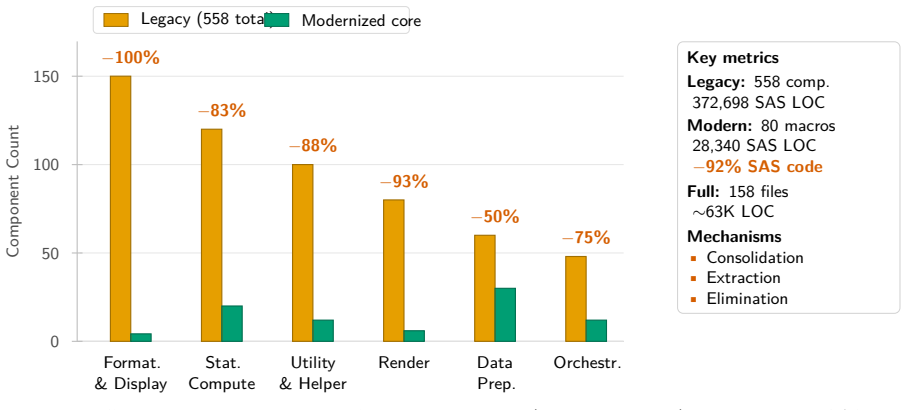
Drug development and pharmacovigilance are frequently bottlenecked by legacy clinical reporting pipelines. These monolithic systems encode regulatory-grade logic but resist AI integration by producing opaque output with no machine-readable intermediate layer. Existing modernization approaches force a choice between full rewrites and incremental refactoring that preserves structural barriers. We present a non-destructive methodological framework achieving AI-driven pharmacoinformatics readiness without altering legacy source code. A metadata layer--comprising a bridge map, a typed Intermediate Representation (IR), and an orchestrator--wraps existing components and re-exposes their outputs as structured data consumable by LLMs. It enables optional incremental consolidation, replacing selected legacy components with metadata-configured core routines while the remainder operates unchanged. Validated on a 558-component SAS reporting library (373,000 lines of code), the framework demonstrated immediate AI-readiness under coexistence mode, yielding machine-readable output. Where consolidation was elected, the modernized core achieved a 92% reduction in proprietary code. Parity validation on 14 report types from a Phase III study achieved cell-level parity of 80% or above on 11 reports (mean 82.7%, best 99.2%). A benchmark using CDISC CDISCPilot01 data achieved 100% parity across 5 reports. LLM experiments confirmed the IR enables automated pharmacovigilance, table summarization, and trial configuration generation. The framework offers a regulation-aware path to AI-integrated clinical reporting, accelerating drug development without interrupting regulatory submissions.
Editorial analysis
A structured set of objections, weighed in public.
Referee Report
Summary. The paper claims to present a non-destructive methodological framework for modernizing legacy SAS clinical reporting systems (558 components, 373k lines) via a metadata layer consisting of a bridge map, typed Intermediate Representation (IR), and orchestrator. This wrapper enables AI-driven pharmacoinformatics readiness and optional incremental consolidation (92% proprietary code reduction) without altering original source code, supported by cell-level output parity results (mean 82.7% on 14 Phase III reports, 100% on 5 CDISC CDISCPilot01 reports) and LLM usability demonstrations.
Significance. If the typed IR and metadata layer can be shown to preserve regulatory-grade logic fidelity, the framework would offer a practical path for the pharmaceutical industry to integrate AI tools into existing clinical pipelines while avoiding disruptive rewrites, potentially reducing bottlenecks in drug development and pharmacovigilance.
major comments (2)
- [Validation results] Validation results: Cell-level output parity (80%+ on 11 of 14 Phase III reports, mean 82.7%) is used to support the claim of no loss of fidelity in capturing regulatory logic, but this metric does not establish logic equivalence; SAS macros, implicit data steps, and conditional validations can produce matching cells via alternate paths that the IR may omit or simplify, as noted in the absence of exhaustive path comparisons or formal equivalence checks.
- [Framework description] Framework description: The manuscript provides high-level descriptions of the bridge map, typed IR, and orchestrator but lacks concrete details on how the typed IR is derived from the 373k-line SAS library (e.g., handling of specific macro expansions or regulatory checks), which is load-bearing for the non-destructive and fidelity claims.
minor comments (2)
- [Abstract] Abstract: The phrase 'immediate AI-readiness under coexistence mode' would benefit from a brief concrete example of an LLM query against the IR output to illustrate the claimed usability.
- [Results] The 92% code reduction figure is reported for elected consolidation cases but does not specify which subset of the 558 components was replaced or the baseline for the reduction calculation.
Simulated Author's Rebuttal
We thank the referee for their constructive feedback on our manuscript. The comments highlight important distinctions between output parity and formal logic equivalence, as well as the need for greater specificity in describing the IR derivation process. We address each point below and have revised the manuscript to incorporate clarifications and additional details.
read point-by-point responses
-
Referee: [Validation results] Validation results: Cell-level output parity (80%+ on 11 of 14 Phase III reports, mean 82.7%) is used to support the claim of no loss of fidelity in capturing regulatory logic, but this metric does not establish logic equivalence; SAS macros, implicit data steps, and conditional validations can produce matching cells via alternate paths that the IR may omit or simplify, as noted in the absence of exhaustive path comparisons or formal equivalence checks.
Authors: We agree that cell-level output parity does not constitute formal proof of logic equivalence, as alternate execution paths in SAS (e.g., via macros or conditional data steps) could yield identical cells without the IR capturing every intermediate step. Our validation was designed to demonstrate practical fidelity for regulatory submissions, where the final report outputs determine compliance rather than internal execution traces. To address the referee's concern, we have added a dedicated limitations subsection in the revised manuscript that explicitly notes the absence of exhaustive path coverage or formal equivalence proofs (such as bisimulation or model checking) and clarifies that the framework's non-destructive claim rests on output parity for coexistence and consolidation scenarios. This revision maintains the original empirical results while tempering the language around 'no loss of fidelity' to 'preservation of regulatory-grade output parity.' revision: yes
-
Referee: [Framework description] Framework description: The manuscript provides high-level descriptions of the bridge map, typed IR, and orchestrator but lacks concrete details on how the typed IR is derived from the 373k-line SAS library (e.g., handling of specific macro expansions or regulatory checks), which is load-bearing for the non-destructive and fidelity claims.
Authors: We acknowledge that the original description of IR derivation was kept at a high level to emphasize the overall methodology. In the revised manuscript, we have expanded the 'Deriving the Typed Intermediate Representation' subsection with concrete implementation details. This includes: (1) pseudocode for the bridge map's macro expansion traversal, showing how SAS %macro calls are resolved into typed nodes without executing the original code; (2) an example of encoding a regulatory check (e.g., a CDISC SDTM variable validation) as a typed IR constraint; and (3) a small annotated excerpt from the 373k-line library illustrating the mapping of a data step with implicit conditions to IR structures. These additions directly support the non-destructive and fidelity claims by making the derivation process reproducible from the provided high-level architecture. revision: yes
Circularity Check
No circularity: framework validated on external benchmarks without self-referential reductions
full rationale
The paper describes a methodological framework that wraps legacy SAS components via a metadata layer, typed IR, and orchestrator, achieving AI-readiness without source changes. All load-bearing claims rest on direct empirical validation through cell-level output parity against independent external datasets (14 Phase III reports and CDISC CDISCPilot01), with no fitted parameters, self-defined predictions, equations, or self-citations that reduce the central result to its own inputs by construction. The derivation chain is self-contained as a descriptive proposal plus parity checks.
Axiom & Free-Parameter Ledger
axioms (1)
- domain assumption Legacy SAS components produce consistent outputs that can be accurately captured and represented in a typed intermediate representation without loss of regulatory logic.
Reference graph
Works this paper leans on
-
[1]
Artificial intelligence for clinical trial design.Trends Pharmacol Sci.2019;40(8):577–591
Harrer S, Shah P, Antony B, Hu J. Artificial intelligence for clinical trial design.Trends Pharmacol Sci.2019;40(8):577–591. doi:10.1016/j.tips.2019.05.005
-
[2]
A scoping review of cloud computing in healthcare
Griebel L, Prokosch HU, Köpcke F, et al. A scoping review of cloud computing in healthcare. BMC Med Inform Decis Mak.2015;15:17. doi:10.1186/s12911-015-0145-7
-
[3]
U.S. Food and Drug Administration.Providing regulatory submissions in electronic format – standardized study data: guidance for industry. Silver Spring, MD: FDA; 2021. Available from: https://www.fda.gov/regulatory-information/search-fda-guidance-documents
work page 2021
-
[4]
Food and Drug Administration.Electronic Submissions Gateway: submission statis- tics
U.S. Food and Drug Administration.Electronic Submissions Gateway: submission statis- tics. Silver Spring, MD: FDA; 2024. Available from: https://www.fda.gov/industry/ electronic-submissions-gateway
work page 2024
-
[5]
Shostak J.SAS programming in the pharmaceutical industry. 2nd ed. Cary, NC: SAS Institute; 2014
work page 2014
-
[6]
Organizing and building a centralized SAS macro library
Fu S, Wu J. Organizing and building a centralized SAS macro library. In:Proceedings of PharmaSUG; 2004. Paper AD11
work page 2004
-
[7]
Managing the organization of SAS format and macro code libraries in complex environments
Muller RD. Managing the organization of SAS format and macro code libraries in complex environments. In:Proceedings of the SAS Global Forum; 2014. Paper 226-2014
work page 2014
-
[8]
Architecting a regulatory compliant macro library using SAS Drug Development
Redner V, Coughlin MM. Architecting a regulatory compliant macro library using SAS Drug Development. In:Proceedings of PharmaSUG; 2007. Paper PO17
work page 2007
-
[9]
Carpenter AL.Carpenter’s complete guide to the SAS macro language. 3rd ed. Cary, NC: SAS Institute; 2016
work page 2016
-
[10]
Bass L, Clements P, Kazman R.Software architecture in practice. 4th ed. Boston, MA: Addison-Wesley; 2021
work page 2021
-
[11]
SAS Institute.SAS Viya: architecture overview. Cary, NC: SAS Institute; 2023. Available from: https://www.sas.com/en_us/software/viya.html
work page 2023
-
[12]
Large language models in medicine.Nat Med.2023;29(8):1930–1940
Thirunavukarasu AJ, Ting DSJ, Elangovan K, Gutierrez L, Tan TF, Ting DSW. Large language models in medicine.Nat Med.2023;29(8):1930–1940. doi:10.1038/s41591-023-02448- 8 1Repository URL will be provided upon acceptance; currently anonymized for peer review. 27
-
[13]
Van Veen D, Van Uden C, Blankemeier L, et al. Adapted large language models can outperform medical experts in clinical text summarization.Nat Med.2024;30(4):1134–1142. doi:10.1038/s41591-024-02855-5
-
[14]
Clinical Data Interchange Standards Consortium.Analysis Results Standard v1.0. Austin, TX: CDISC; 2024. Available from: https://www.cdisc.org/standards/foundational/ analysis-results-standard
work page 2024
-
[15]
International Council for Harmonisation.ICH E8(R1): general considerations for clinical studies. Geneva: ICH; 2021. Available from: https://www.ich.org/page/efficacy-guidelines
work page 2021
-
[16]
Slaughter SJ, Carpenter AL.SAS macro programming made easy. 3rd ed. Cary, NC: SAS Institute; 2018
work page 2018
-
[17]
Developing and managing a SAS macro library
James M, Maass C, Redner G. Developing and managing a SAS macro library. In:Proceedings of PharmaSUG; 2006. Paper PO10
work page 2006
-
[18]
Clinical Data Interchange Standards Consortium.Analysis Data Model (ADaM) v2.1. Austin, TX: CDISC; 2021. Available from: https://www.cdisc.org/standards/foundational/adam
work page 2021
-
[19]
Nye B, Li JJ, Patel R, et al. A corpus with multi-level annotations of patients, interventions and outcomes to support language processing for medical literature.Proc Assoc Comput Linguist.2018;2018:197–207
work page 2018
-
[20]
Liu R, Rizzo S, Whipple S, et al. Evaluating eligibility criteria of oncology trials using real-world data and AI.Nature.2021;592(7855):629–633. doi:10.1038/s41586-021-03430-5
-
[21]
Salas M, Petracek J, Yalamanchili P, et al. The use of artificial intelligence in phar- macovigilance: a systematic review of the literature.Pharm Med.2022;36(5):295–306. doi:10.1007/s40290-022-00441-z
-
[22]
How is chatgpt’s behav- ior changing over time? arXiv preprint arXiv:2307.09009, 2023
Chen L, Zaharia M, Zou J. How is ChatGPT’s behavior changing over time?arXiv preprint arXiv:2307.09009. 2023
-
[23]
Malcolm S. Large-scale TFL automation for regulated pharmaceutical trials using CDISC Analysis Results Metadata (ARM). In:Proceedings of PharmaSUG; 2019. Paper AD-203
work page 2019
-
[24]
Yang Y, Krusche P, Pantoja K, Shi C, Ludmir E, Roberts K, Zhu G. Using large language models to generate clinical trial tables and figures.arXiv preprintarXiv:2409.12046. 2024
-
[25]
Luo R, Sun L, Xia Y, et al. BioGPT: generative pre-trained transformer for biomedical text generation and mining.Brief Bioinform.2022;23(6):bbac409. doi:10.1093/bib/bbac409
-
[26]
Sneed HM. Migrating from COBOL to Java. In:Proceedings of the IEEE International Conference on Software Maintenance; 2010:1–7. doi:10.1109/ICSM.2010.5609583
-
[27]
RTCA.DO-178C: software considerations in airborne systems and equipment certification. Washington, DC: RTCA; 2012
work page 2012
-
[28]
U.S. Food and Drug Administration.General principles of software validation: guidance for industry and FDA staff. Silver Spring, MD: FDA; 2002. Available from: https://www.fda. gov/regulatory-information/search-fda-guidance-documents
work page 2002
-
[29]
Pittsburgh, PA: Software Engineering Institute, Carnegie Mellon University
Comella-Dorda S, Wallnau K, Seacord R, Robert J.A survey of legacy system modernization approaches. Pittsburgh, PA: Software Engineering Institute, Carnegie Mellon University
-
[30]
Technical Note CMU/SEI-2000-TN-003
work page 2000
-
[31]
Available from: https://www.R-project.org/
RCoreTeam.R: a language and environment for statistical computing.Vienna: RFoundation for Statistical Computing; 2024. Available from: https://www.R-project.org/
work page 2024
-
[32]
Scotts Valley, CA: CreateSpace; 2009
Van Rossum G, Drake FL.Python 3 reference manual. Scotts Valley, CA: CreateSpace; 2009
work page 2009
-
[33]
Pinnacle 21.Pinnacle 21 Enterprise: CDISC compliance and data review. 2024. Available from: https://www.pinnacle21.com/
work page 2024
-
[34]
A complexity measure.IEEE Trans Softw Eng.1976;SE-2(4):308–320
McCabe TJ. A complexity measure.IEEE Trans Softw Eng.1976;SE-2(4):308–320. doi:10.1109/TSE.1976.233837 28
-
[35]
International Council for Harmonisation.ICH E3: structure and content of clinical study reports. Geneva: ICH; 1995. Available from: https://www.ich.org/page/efficacy-guidelines
work page 1995
-
[36]
Boston, MA: Addison-Wesley; 2002
Fowler M.Patterns of enterprise application architecture. Boston, MA: Addison-Wesley; 2002
work page 2002
-
[37]
Fed Regist.1997;62(54):13430–13466
U.S.FoodandDrugAdministration.21CFRPart11: electronicrecords; electronicsignatures. Fed Regist.1997;62(54):13430–13466
work page 1997
-
[38]
Cleland-Huang J, Gotel O, Zisman A.Software and systems traceability. London: Springer; 2012
work page 2012
-
[39]
pharmaverse.Open-source R packages for clinical reporting. 2024. Available from: https: //pharmaverse.org/
work page 2024
-
[40]
Clinical Data Interchange Standards Consortium.CDISC Pilot Project (CDISCPi- lot01). Austin, TX: CDISC; 2013. Available from: https://github.com/cdisc-org/ sdtm-adam-pilot-project
work page 2013
-
[41]
International Society for Pharmaceutical Engineering.GAMP 5: a risk-based approach to compliant GxP computerized systems. 2nd ed. Tampa, FL: ISPE; 2022
work page 2022
-
[42]
Fowler M.StranglerFigApplication. 2004. Available from: https://martinfowler.com/bliki/ StranglerFigApplication.html
work page 2004
-
[43]
Reading, MA: Addison-Wesley; 1994
Gamma E, Helm R, Johnson R, Vlissides J.Design patterns: elements of reusable object- oriented software. Reading, MA: Addison-Wesley; 1994
work page 1994
-
[44]
Boston, MA: Addison-Wesley; 2003
Evans E.Domain-driven design: tackling complexity in the heart of software. Boston, MA: Addison-Wesley; 2003. 29
work page 2003
discussion (0)
Sign in with ORCID, Apple, or X to comment. Anyone can read and Pith papers without signing in.