Recognition: no theorem link
Generalized Model Fractional Quantum Hall States on Lattices
Pith reviewed 2026-05-15 04:55 UTC · model grok-4.3
The pith
Lattice wave functions for the full Z_k fractional quantum Hall series are constructed with modified clustering that preserves topological order.
A machine-rendered reading of the paper's core claim, the machinery that carries it, and where it could break.
Core claim
Lattice-specific model wave functions for the Laughlin, Moore-Read, and Z_k Read-Rezayi series can be constructed by transplanting conformal Hilbert space organizing principles to lattices; the resulting states exhibit idealized energy and entanglement spectra but display modified clustering behavior that sets them apart from continuum counterparts while preserving topological order.
What carries the argument
Lattice-adapted model wave functions generated from conformal Hilbert space rules, which enforce a modified clustering property on the discrete geometry while maintaining the topological order of the Z_k series.
Load-bearing premise
The same conformal Hilbert space principles and clustering rules that organize continuum fractional quantum Hall states can be transplanted directly to lattices and still preserve topological order for the full Z_k series without extra lattice-specific adjustments.
What would settle it
A calculation on a torus geometry that finds the constructed lattice states lack the expected ground-state degeneracy or exhibit an entanglement spectrum inconsistent with the Z_k topological order would falsify the claim.
Figures
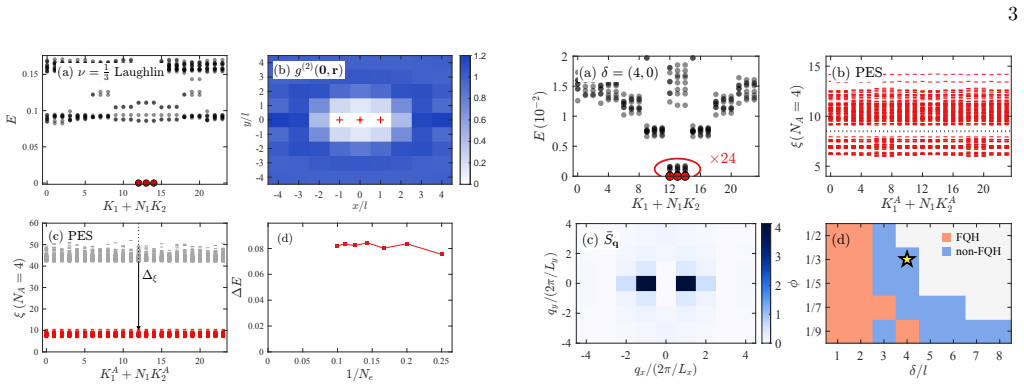

read the original abstract
Model wave functions are essential for studying fractional quantum Hall phases, yet lattice model states have so far been limited to bosonic systems with on-site interactions. In this work, by combining analytical and numerical methods, we systematically construct lattice model states for the Laughlin, Moore--Read, and general $\mathbb{Z}_k$ Read--Rezayi series. Our lattice-specific states are characterized by their idealized energy and entanglement features and are distinguished from their continuum counterparts by a modified clustering behavior. Our theory advances the understanding of the stability of topologically ordered phases and illustrates the organizing principles of the conformal Hilbert space on lattices. Practically, this work paves the way for further studying lattice-specific excitations and offers a constructive route for engineering topological orders within density interactions, with potential immediate implications for cold-atom and synthetic flat-band platforms.
Editorial analysis
A structured set of objections, weighed in public.
Referee Report
Summary. The manuscript claims to systematically construct lattice model wave functions for the Laughlin, Moore-Read, and general Z_k Read-Rezayi fractional quantum Hall states via a combination of analytical and numerical methods. These lattice-specific states are asserted to exhibit idealized energy spectra and entanglement features while being distinguished from their continuum counterparts by a modified clustering behavior; the work is presented as advancing the understanding of topological order stability on lattices and providing a route to engineering such phases with density interactions.
Significance. If the construction preserves the expected topological order and degeneracy for the full Z_k series, the results would offer a useful bridge between continuum model states and lattice realizations, with direct relevance to cold-atom and synthetic flat-band experiments. The emphasis on conformal Hilbert space organizing principles adapted to lattices could provide new insight into the robustness of these phases under discretization.
major comments (2)
- [Abstract] Abstract: The central claim that modified clustering behavior preserves idealized energy and entanglement features (and thus topological order) for the full Z_k Read-Rezayi series is load-bearing, yet the provided summary contains no explicit verification of torus ground-state degeneracy or anyonic statistics for k>2 states; without such checks the distinction from continuum versions risks altering quasiparticle content.
- [Numerical results] The assumption that continuum conformal Hilbert space and clustering rules can be transplanted directly to lattices without additional tuning is stated but not demonstrated for the full series; a concrete comparison of the zero-energy subspace dimension or entanglement spectrum between lattice and continuum versions (e.g., in the numerical results section) is required to substantiate the claim.
minor comments (2)
- Clarify the precise definition of the lattice-modified clustering rules and how they differ from the continuum case, including any changes to the allowed quasiparticle sectors.
- Include error bars or convergence data for the numerical spectra and entanglement calculations to support the assertion of 'idealized' features.
Simulated Author's Rebuttal
We thank the referee for their careful reading and constructive comments on our manuscript. We address the major points raised below, providing clarifications on the scope of our verifications while agreeing that additional explicit comparisons would improve the presentation.
read point-by-point responses
-
Referee: [Abstract] Abstract: The central claim that modified clustering behavior preserves idealized energy and entanglement features (and thus topological order) for the full Z_k Read-Rezayi series is load-bearing, yet the provided summary contains no explicit verification of torus ground-state degeneracy or anyonic statistics for k>2 states; without such checks the distinction from continuum versions risks altering quasiparticle content.
Authors: We agree that the abstract is concise and does not enumerate all verifications. The main text provides the full analytical construction for the Z_k series together with numerical evidence of idealized energy spectra and entanglement spectra for the Laughlin (k=1) and Moore-Read (k=2) cases, including explicit checks of torus ground-state degeneracy on small lattices. For k>2 the same clustering rules are applied analytically, but explicit numerical degeneracy scans are limited by system size; the topological order is inferred from the preserved zero-energy subspace structure and modified clustering. We will revise the abstract to state the range of explicit numerical checks performed. Direct computation of anyonic statistics lies outside the present scope and is noted as future work. revision: partial
-
Referee: [Numerical results] The assumption that continuum conformal Hilbert space and clustering rules can be transplanted directly to lattices without additional tuning is stated but not demonstrated for the full series; a concrete comparison of the zero-energy subspace dimension or entanglement spectrum between lattice and continuum versions (e.g., in the numerical results section) is required to substantiate the claim.
Authors: Section III defines the lattice-adapted clustering rules that replace the continuum ones while preserving the conformal Hilbert space structure. Numerical results in Section IV explicitly construct the zero-energy states for the full series and report entanglement spectra whose counting matches the expected topological order for the cases studied. We acknowledge that a side-by-side comparison of subspace dimensions and entanglement level counting would make the distinction clearer. We will add a table and brief discussion in the numerical results section comparing these quantities for k=1 and k=2 between the lattice and continuum realizations. revision: yes
- Explicit numerical verification of torus degeneracy and anyonic statistics for all k>2 states (computational cost precludes exhaustive checks in the present work)
Circularity Check
No significant circularity; states constructed independently then characterized
full rationale
The paper constructs lattice model states for the Laughlin, Moore-Read, and Z_k Read-Rezayi series via analytical and numerical methods before characterizing them by energy and entanglement spectra. No load-bearing step reduces by definition or self-citation to its own fitted outputs; the modified clustering is introduced as an output distinction rather than an input assumption that forces the result. The derivation chain remains self-contained against external benchmarks of topological order.
Axiom & Free-Parameter Ledger
axioms (1)
- domain assumption Conformal Hilbert space organizes the low-energy states on lattices in the same manner as in the continuum.
Reference graph
Works this paper leans on
-
[1]
H. L. Stormer, D. C. Tsui, and A. C. Gossard, The frac- tional quantum hall effect, Rev. Mod. Phys.71, S298 (1999)
work page 1999
-
[2]
N. Regnault and B. A. Bernevig, Fractional chern insu- lator, Phys. Rev. X1, 021014 (2011)
work page 2011
- [3]
-
[4]
T. Cao, L. Fu, L. Ju, D. Xiao, and X. Xu, Fractional quantum anomalous hall effect, Annual Review of Con- densed Matter Physics17, 233 (2026)
work page 2026
-
[5]
L. W. Clark, N. Schine, C. Baum, N. Jia, and J. Simon, Observation of laughlin states made of light, Nature582, 41 (2020)
work page 2020
-
[6]
J. L´ eonard, S. Kim, J. Kwan, P. Segura, F. Grusdt, C. Repellin, N. Goldman, and M. Greiner, Realization of a fractional quantum hall state with ultracold atoms, Nature619, 495 (2023)
work page 2023
-
[7]
C. Wang, F.-M. Liu, M.-C. Chen, H. Chen, X.-H. Zhao, C. Ying, Z.-X. Shang, J.-W. Wang, Y.-H. Huo, C.-Z. Peng, X. Zhu, C.-Y. Lu, and J.-W. Pan, Realization of fractional quantum hall state with interacting photons, Science384, 579 (2024)
work page 2024
-
[8]
R. B. Laughlin, Anomalous Quantum Hall Effect: An In- compressible Quantum Fluid with Fractionally Charged Excitations, Phys. Rev. Lett.50, 1395 (1983)
work page 1983
-
[9]
F. D. M. Haldane, Fractional Quantization of the Hall Effect: A Hierarchy of Incompressible Quantum Fluid States, Phys. Rev. Lett.51, 605 (1983)
work page 1983
-
[10]
T. H. Hansson, M. Hermanns, S. H. Simon, and S. F. Viefers, Quantum hall physics: Hierarchies and confor- mal field theory techniques, Rev. Mod. Phys.89, 025005 (2017)
work page 2017
-
[11]
B. A. Bernevig and F. D. M. Haldane, Model fractional quantum hall states and jack polynomials, Phys. Rev. Lett.100, 246802 (2008)
work page 2008
- [12]
- [13]
-
[14]
A. Sterdyniak, N. Regnault, and B. A. Bernevig, Extract- ing excitations from model state entanglement, Phys. Rev. Lett.106, 100405 (2011)
work page 2011
-
[15]
J. Wang, J. Cano, A. J. Millis, Z. Liu, and B. Yang, Exact Landau Level Description of Geometry and Interaction in a Flatband, Phys. Rev. Lett.127, 246403 (2021)
work page 2021
-
[16]
Z. Liu, B. Mera, M. Fujimoto, T. Ozawa, and J. Wang, Theory of generalized landau levels and its implications for non-abelian states, Phys. Rev. X15, 031019 (2025)
work page 2025
-
[17]
P. J. Ledwith, A. Vishwanath, and D. E. Parker, Vor- texability: A unifying criterion for ideal fractional chern insulators, Phys. Rev. B108, 205144 (2023)
work page 2023
-
[18]
B. Mera and T. Ozawa, K¨ ahler geometry and chern in- sulators: Relations between topology and the quantum metric, Phys. Rev. B104, 045104 (2021)
work page 2021
-
[19]
N. Read and E. Rezayi, Beyond paired quantum Hall states: Parafermions and incompressible states in the first excited Landau level, Phys. Rev. B59, 8084 (1999)
work page 1999
-
[20]
M. Greiter, X.-G. Wen, and F. Wilczek, Paired hall state at half filling, Phys. Rev. Lett.66, 3205 (1991)
work page 1991
-
[21]
S. H. Simon, Wavefunctionology: The special structure of certain fractional quantum hall wavefunctions, inFrac- tional Quantum Hall Effects: New Developments(World Scientific, 2020) pp. 377–434
work page 2020
-
[22]
E. Kapit and E. Mueller, Exact parent hamiltonian for the quantum hall states in a lattice, Phys. Rev. Lett.105, 215303 (2010)
work page 2010
-
[23]
J. Behrmann, Z. Liu, and E. J. Bergholtz, Model frac- tional chern insulators, Phys. Rev. Lett.116, 216802 (2016)
work page 2016
- [24]
-
[25]
F. D. M. Haldane and E. H. Rezayi, Periodic laughlin- jastrow wave functions for the fractional quantized hall effect, Phys. Rev. B31, 2529(R) (1985). 6
work page 1985
-
[26]
F. D. M. Haldane, Many-particle translational symme- tries of two-dimensional electrons at rational landau-level filling, Phys. Rev. Lett.55, 2095 (1985)
work page 2095
-
[27]
F. Haldane, The origin of holomorphic states in landau levels from non-commutative geometry and a new for- mula for their overlaps on the torus, Journal of Mathe- matical Physics59(2018)
work page 2018
-
[28]
J. Wang, S. D. Geraedts, E. H. Rezayi, and F. D. M. Haldane, Lattice monte carlo for quantum hall states on a torus, Phys. Rev. B99, 125123 (2019)
work page 2019
-
[29]
X. G. Wen and Q. Niu, Ground-state degeneracy of the fractional quantum hall states in the presence of a ran- dom potential and on high-genus riemann surfaces, Phys. Rev. B41, 9377 (1990)
work page 1990
- [30]
-
[31]
S. A. Trugman and S. Kivelson, Exact results for the fractional quantum hall effect with general interactions, Phys. Rev. B31, 5280 (1985)
work page 1985
-
[32]
Generally the parent Hamiltonian is a positive lin- ear combination of the corresponding clustering termsP r P l λl : ˆnrˆnr+δl : withλ l >0. This is directly anal- ogous to continuum Haldane pseudopotential Hamiltoni- ans, where arbitrary positive pseudopotential coefficients impose the same excluded relative-angular-momentum channels
-
[33]
M. M. Fogler, Effective theory of incompressible quantum hall liquid crystals, Europhysics Letters66, 572 (2004)
work page 2004
-
[34]
K. Musaelian and R. Joynt, Broken rotation symmetry in the fractional quantum hall system, Journal of Physics: Condensed Matter8, L105 (1996)
work page 1996
-
[35]
C. Wexler and O. Ciftja, Liquid crystalline states in quan- tum hall systems, Journal of Physics: Condensed Matter 14, 3705 (2002)
work page 2002
- [36]
-
[37]
R.-Z. Qiu, F. D. M. Haldane, X. Wan, K. Yang, and S. Yi, Model anisotropic quantum hall states, Phys. Rev. B85, 115308 (2012)
work page 2012
-
[38]
H. Wang, R. Narayanan, X. Wan, and F. Zhang, Frac- tional quantum hall states in two-dimensional electron systems with anisotropic interactions, Phys. Rev. B86, 035122 (2012)
work page 2012
-
[39]
S. Pu, A. C. Balram, J. Taylor, E. Fradkin, and Z. Papi´ c, Microscopic model for fractional quantum hall nematics, Phys. Rev. Lett.132, 236503 (2024)
work page 2024
- [40]
-
[41]
G. Moore and N. Read, Nonabelions in the fractional quantum hall effect, Nuclear Physics B360, 362 (1991)
work page 1991
-
[42]
M. Greiter, X. G. Wen, and F. Wilczek, Paired hall states in double-layer electron systems, Phys. Rev. B46, 9586 (1992)
work page 1992
-
[43]
N. Read and D. Green, Paired states of fermions in two dimensions with breaking of parity and time-reversal symmetries and the fractional quantum hall effect, Phys. Rev. B61, 10267 (2000)
work page 2000
-
[44]
B. I. Halperin, P. A. Lee, and N. Read, Theory of the half-filled landau level, Phys. Rev. B47, 7312 (1993)
work page 1993
-
[45]
D. T. Son, Is the composite fermion a dirac particle?, Phys. Rev. X5, 031027 (2015)
work page 2015
-
[46]
Wang, Dirac fermion hierarchy of composite fermi liq- uids, Phys
J. Wang, Dirac fermion hierarchy of composite fermi liq- uids, Phys. Rev. Lett.122, 257203 (2019)
work page 2019
-
[47]
H. Goldman and E. Fradkin, Dirac composite fermions and emergent reflection symmetry about even-denominator filling fractions, Phys. Rev. B98, 165137 (2018)
work page 2018
-
[48]
Bosonic Read–Rezayi states stabilized by on-site repul- sion, includingν= 1/2 Laughlin and theν= 1 Pfaffian states [22, 23], correspond to the zero-displacement limit of our construction
-
[49]
W. Yuzhu and Y. Bo, Geometric fluctuation of conformal hilbert spaces and multiple graviton modes in fractional quantum hall effect, Nature Communications14, 2317 (2023)
work page 2023
-
[50]
Q. Xu, G. Ji, Y. Wang, H. Q. Trung, and B. Yang, Dy- namics of anyon clusters in fractional quantum hall fluids, Phys. Rev. B112, 235112 (2025)
work page 2025
-
[51]
M. Gattu and J. K. Jain, Molecular anyons in the frac- tional quantum hall effect, Phys. Rev. Lett.135, 236601 (2025)
work page 2025
-
[52]
Anyon molecules in fractional quantum Hall states
T. Wang and M. P. Zaletel, Anyon molecules in fractional quantum Hall states, arXiv e-prints , arXiv:2604.09798 (2026), arXiv:2604.09798 [cond-mat.mes-hall]
work page internal anchor Pith review Pith/arXiv arXiv 2026
- [53]
-
[54]
H. B. Xavier, Z. Bacciconi, T. Chanda, D. T. Son, and M. Dalmonte, Chiral graviton modes on the lattice, Phys. Rev. Lett.135, 196501 (2025)
work page 2025
-
[55]
G. M¨ oller and N. R. Cooper, Composite fermion theory for bosonic quantum hall states on lattices, Phys. Rev. Lett.103, 105303 (2009)
work page 2009
-
[56]
S. D. Geraedts, J. Wang, E. H. Rezayi, and F. D. M. Hal- dane, Berry phase and model wave function in the half- filled landau level, Phys. Rev. Lett.121, 147202 (2018)
work page 2018
- [57]
- [58]
-
[59]
Shi, Quantum mechanics of composite fermions, Phys
J. Shi, Quantum mechanics of composite fermions, Phys. Rev. Res.6, 023306 (2024)
work page 2024
- [60]
-
[61]
A. Sterdyniak, C. Repellin, B. A. Bernevig, and N. Reg- nault, Series of abelian and non-abelian states inC >1 fractional chern insulators, Phys. Rev. B87, 205137 (2013)
work page 2013
-
[62]
J. Wang, S. Klevtsov, and Z. Liu, Origin of model frac- tional chern insulators in all topological ideal flatbands: Explicit color-entangled wave function and exact density algebra, Phys. Rev. Res.5, 023167 (2023)
work page 2023
-
[63]
J. Wang and Z. Liu, Hierarchy of ideal flatbands in chi- ral twisted multilayer graphene models, Phys. Rev. Lett. 128, 176403 (2022)
work page 2022
- [64]
-
[65]
Roy, Band geometry of fractional topological insula- tors, Phys
R. Roy, Band geometry of fractional topological insula- tors, Phys. Rev. B90, 165139 (2014)
work page 2014
-
[66]
Generalized Model F ractional Quantum Hall States on Lattices
T. S. Jackson, G. M¨ oller, and R. Roy, Geometric stability of topological lattice phases, Nature Communications6, 7 8629 (2015). 1 Supplemental Material for “Generalized Model F ractional Quantum Hall States on Lattices” This Supplemental Material is organized to follow the order of the main text. In Sec. SI, we test the spectral flow of the fermionicν= ...
work page 2015
discussion (0)
Sign in with ORCID, Apple, or X to comment. Anyone can read and Pith papers without signing in.