Recognition: 2 theorem links
· Lean TheoremRapid and robust simulation-based inference for kilonovae
Pith reviewed 2026-05-15 02:36 UTC · model grok-4.3
The pith
Simulation-based inference recovers kilonova parameters rapidly from light curves without the biases that affect MCMC fits to emulator outputs.
A machine-rendered reading of the paper's core claim, the machinery that carries it, and where it could break.
Core claim
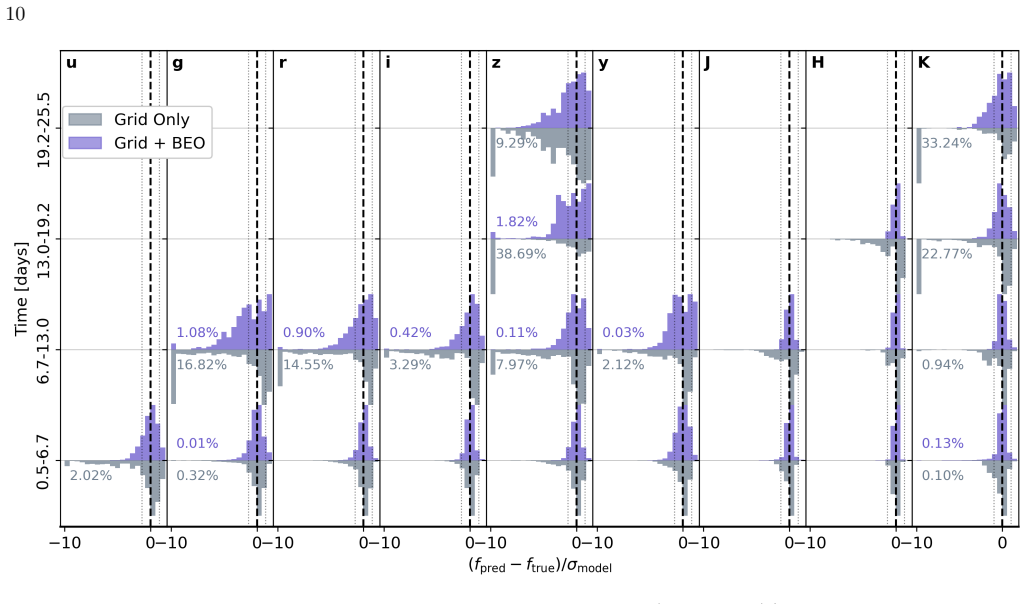
The central claim is that density-estimation likelihood-free inference, trained on a Gaussian process emulator of roughly 1300 POSSIS radiative-transfer simulations, yields accurate posterior distributions for kilonova parameters by incorporating the full predictive distribution of the emulator. On simulated data the method recovers injected parameters correctly and produces posterior-predictive light curves consistent with the observations, whereas MCMC suffers systematic bias from likelihood misspecification. Applied to AT2017gfo, both approaches give similar light-curve predictions, yet the MCMC posteriors differ from the SBI posteriors and exhibit pile-up at prior boundaries.
What carries the argument
Density-estimation likelihood-free inference that learns the posterior directly from forward simulations generated by a Gaussian process emulator of the POSSIS radiative transfer code.
If this is right
- SBI recovers injected parameters accurately on simulated kilonova data where MCMC shows systematic bias.
- Posterior predictive light curves generated by SBI remain consistent with the input observations.
- After training, the framework produces approximately 20,000 posterior samples in seconds.
- MCMC posteriors for AT2017gfo pile up at prior boundaries while SBI posteriors do not.
- SBI incorporates the full non-Gaussian correlated emulator uncertainty that an explicit likelihood misses.
Where Pith is reading between the lines
- The same trained emulator could be reused for rapid inference on future kilonova candidates detected by wide-field surveys.
- Extending the training set to include a wider range of ejecta compositions and viewing angles would test robustness against model variations not present in the current simulations.
- The speed of the trained SBI model makes it practical to run on large numbers of candidate events triggered by gravitational-wave alerts.
- Comparison of SBI and MCMC posteriors on additional well-observed kilonovae could reveal which parameter degeneracies are most sensitive to likelihood misspecification.
Load-bearing premise
The Gaussian process emulator trained on the available simulations fully captures the non-Gaussian and correlated structure of the predictive uncertainty for any real kilonova.
What would settle it
Generate a fresh set of kilonova light curves with a different radiative-transfer code or with physical parameters outside the training range, then check whether the SBI posteriors still recover the injected values within the reported credible intervals.
Figures




read the original abstract
With the next generation of both electromagnetic and gravitational wave observatories beginning to come online, rapid analysis methods for kilonova data are becoming increasingly important in astronomy. Traditional Bayesian parameter estimation using Markov chain Monte Carlo (MCMC) is time-consuming and relies on explicit likelihood approximations that can break down when modeling uncertainties are significant. We develop a simulation-based inference (SBI) framework for kilonova parameter estimation using density-estimation likelihood-free inference. The framework uses a Gaussian process emulator trained on $\sim1300$ radiative transfer simulations generated with the POSSIS code. We demonstrate that SBI provides a rapid alternative to MCMC for inference with emulators or approximate likelihoods that is robust to emulator uncertainty and likelihood misspecification. On simulated data, the SBI method accurately recovers injected parameters and produces posterior predictive light curves consistent with the data, but the MCMC posterior recovery suffers from systematic bias caused by likelihood misspecification. When analyzing AT2017gfo, the SBI and MCMC methods yield similar light-curve predictions but different posterior distributions, with a subset of the MCMC posteriors piling up at prior boundaries. The likelihood in the MCMC fails to capture the non-Gaussian, correlated structure of the emulator uncertainty, but SBI learns the posterior directly from forward simulations that include the full predictive distribution. Once trained, the SBI framework generates $\sim2\times10^4$ posterior samples in seconds.
Editorial analysis
A structured set of objections, weighed in public.
Referee Report
Summary. The paper develops a simulation-based inference (SBI) framework for kilonova parameter estimation. It trains a Gaussian process emulator on ~1300 POSSIS radiative transfer simulations and applies density-estimation likelihood-free inference to learn posteriors directly from forward simulations. The central claim is that SBI provides a rapid alternative to MCMC that is robust to emulator uncertainty and likelihood misspecification, shown via accurate recovery of injected parameters on simulated data (where MCMC exhibits bias) and application to AT2017gfo yielding similar light-curve predictions but different posteriors.
Significance. If the robustness claim holds, the approach could enable real-time inference for kilonovae from next-generation GW and EM facilities, addressing computational bottlenecks in traditional methods. The explicit incorporation of emulator predictive distributions into the SBI training is a methodological strength that distinguishes it from standard likelihood approximations.
major comments (2)
- [§4] §4 (simulated-data recovery tests): The demonstration that SBI is robust to emulator uncertainty and likelihood misspecification relies exclusively on recovery of injected parameters from light curves generated by the identical ~1300 POSSIS runs used to train the GP emulator. This in-distribution test cannot expose systematic biases from real-physics discrepancies (e.g., incomplete atomic line lists or 3D ejecta structure not captured in POSSIS), leaving the central robustness claim only partially supported.
- [§5] §5 (AT2017gfo analysis): While SBI and MCMC produce differing posteriors, the manuscript provides no external validation metric or alternative model comparison to determine which (if either) is closer to reality; the observation that MCMC piles up at prior boundaries is noted but not quantified with coverage or calibration diagnostics.
minor comments (2)
- [§3] The abstract and §3 should explicitly state the GP kernel choice and hyperparameter optimization procedure, as these directly affect the claimed capture of non-Gaussian correlated emulator uncertainty.
- [Figures 3-5] Figure captions for posterior predictive checks should include quantitative metrics (e.g., reduced chi-squared or posterior predictive p-values) rather than qualitative statements of consistency.
Simulated Author's Rebuttal
We thank the referee for their constructive and detailed comments. We address each major comment below and indicate where revisions will be made to strengthen the manuscript.
read point-by-point responses
-
Referee: [§4] §4 (simulated-data recovery tests): The demonstration that SBI is robust to emulator uncertainty and likelihood misspecification relies exclusively on recovery of injected parameters from light curves generated by the identical ~1300 POSSIS runs used to train the GP emulator. This in-distribution test cannot expose systematic biases from real-physics discrepancies (e.g., incomplete atomic line lists or 3D ejecta structure not captured in POSSIS), leaving the central robustness claim only partially supported.
Authors: We agree that the recovery tests use light curves drawn from the same ~1300 POSSIS simulations that trained the emulator, making them in-distribution. This design specifically isolates robustness to the emulator's predictive uncertainty (including its non-Gaussian, correlated structure) and to likelihood misspecification within the POSSIS model family—the central methodological claim of the paper. We acknowledge that the tests do not address potential systematic biases from real-physics discrepancies such as incomplete atomic data or 3D ejecta geometry. In the revised manuscript we will add explicit discussion of this scope limitation in §4 and the conclusions, and we will outline future work using alternative radiative-transfer codes for out-of-distribution validation. revision: partial
-
Referee: [§5] §5 (AT2017gfo analysis): While SBI and MCMC produce differing posteriors, the manuscript provides no external validation metric or alternative model comparison to determine which (if either) is closer to reality; the observation that MCMC piles up at prior boundaries is noted but not quantified with coverage or calibration diagnostics.
Authors: We concur that no ground-truth parameters exist for AT2017gfo, precluding external validation or definitive model comparison. The section's intent is to demonstrate that SBI, by directly incorporating the emulator's full predictive distribution, avoids the boundary accumulation observed in the MCMC posteriors, which we attribute to the Gaussian likelihood approximation. In the revision we will quantify the boundary piling (reporting the fraction of samples at each prior edge) and add a short discussion of calibration challenges for real data. We will also note that future cross-validation against independent kilonova models could provide additional insight. revision: partial
Circularity Check
SBI framework derivation is self-contained with no circular reductions
full rationale
The paper trains a GP emulator on ~1300 POSSIS simulations and uses density-estimation SBI to learn posteriors directly from forward simulations that incorporate the emulator's full predictive distribution. Recovery of injected parameters on simulated data follows from the method's explicit modeling of non-Gaussian correlated uncertainty, which is an independent choice rather than a quantity defined in terms of the target result. The MCMC comparison illustrates a difference in likelihood handling but does not reduce any claimed robustness to a fitted input or self-citation by construction. No load-bearing step matches the enumerated circularity patterns.
Axiom & Free-Parameter Ledger
free parameters (1)
- Gaussian process hyperparameters
axioms (1)
- domain assumption POSSIS radiative transfer simulations provide a sufficiently accurate forward model of kilonova light curves
Lean theorems connected to this paper
-
IndisputableMonolith/Cost/FunctionalEquation.leanwashburn_uniqueness_aczel unclear?
unclearRelation between the paper passage and the cited Recognition theorem.
We develop a simulation-based inference (SBI) framework for kilonova parameter estimation using density-estimation likelihood-free inference. The framework uses a Gaussian process emulator trained on ∼1300 radiative transfer simulations generated with the possis code.
-
IndisputableMonolith/Foundation/RealityFromDistinction.leanreality_from_one_distinction unclear?
unclearRelation between the paper passage and the cited Recognition theorem.
SBI learns the posterior directly from forward simulations that include the full predictive distribution.
What do these tags mean?
- matches
- The paper's claim is directly supported by a theorem in the formal canon.
- supports
- The theorem supports part of the paper's argument, but the paper may add assumptions or extra steps.
- extends
- The paper goes beyond the formal theorem; the theorem is a base layer rather than the whole result.
- uses
- The paper appears to rely on the theorem as machinery.
- contradicts
- The paper's claim conflicts with a theorem or certificate in the canon.
- unclear
- Pith found a possible connection, but the passage is too broad, indirect, or ambiguous to say the theorem truly supports the claim.
Reference graph
Works this paper leans on
- [1]
-
[2]
B. P. Abbott and R. Abbott and T. D. Abbott and F. Acernese and K. Ackley and C. Adams and T. Adams and P. Addesso and R. X. Adhikari and V. B. Adya and others , doi =. GW170817: Observation of Gravitational Waves from a Binary Neutron Star Inspiral , volume =. , month = oct, pmid =
-
[3]
B. P. Abbott and R. Abbott and T. D. Abbott and F. Acernese and K. Ackley and C. Adams and T. Adams and P. Addesso and R. X. Adhikari and V. B. Adya and others , doi =. Gravitational Waves and Gamma-Rays from a Binary Neutron Star Merger: GW170817 and GRB 170817A , volume =. , month = oct, pages =
-
[4]
B. P. Abbott and R. Abbott and T. D. Abbott and F. Acernese and K. Ackley and C. Adams and T. Adams and P. Addesso and R. X. Adhikari and V. B. Adya and others , doi =. Multi-messenger Observations of a Binary Neutron Star Merger , volume =. , month = nov, pages =
-
[5]
B. P. Abbott and R. Abbott and T. D. Abbott and F. Acernese and K. Ackley and C. Adams and T. Adams and P. Addesso and R. X. Adhikari and V. B. Adya and others , doi =. A gravitational-wave standard siren measurement of the Hubble constant , volume =. Nature , month = nov, pages =
-
[6]
B. P. Abbott and R. Abbott and T. D. Abbott and F. Acernese and K. Ackley and C. Adams and T. Adams and P. Addesso and R. X. Adhikari and others , doi =. Estimating the Contribution of Dynamical Ejecta in the Kilonova Associated with GW170817 , volume =. , month =
-
[7]
Andreas Bauswein and Nikolaos Stergioulas , doi =. Semi-analytic derivation of the threshold mass for prompt collapse in binary neutron-star mergers , volume =. Monthly Notices of the Royal Astronomical Society , keywords =
-
[8]
Neutron-star Radius Constraints from GW170817 and Future Detections , volume =
Andreas Bauswein and Oliver Just and Hans-Thomas Janka and Nikolaos Stergioulas , doi =. Neutron-star Radius Constraints from GW170817 and Future Detections , volume =. , month =
-
[9]
Ben Margalit and Brian D. Metzger , doi =. Constraining the Maximum Mass of Neutron Stars from Multi-messenger Observations of GW170817 , volume =. The Astrophysical Journal Letters , month =
-
[10]
Daniel Kasen and Brian Metzger and Jennifer Barnes and Eliot Quataert and Enrico Ramirez-Ruiz , doi =. Origin of the heavy elements in binary neutron-star mergers from a gravitational-wave event , volume =. Nature , month =
-
[11]
E. Troja and L. Piro and G. Ryan and H. van Eerten and R. Ricci and M. H. Wieringa and S. Lotti and T. Sakamoto and S. B. Cenko , doi =. The outflow structure of GW170817 from late-time broad-band observations , volume =. Monthly Notices of the Royal Astronomical Society: Letters , keywords =
-
[12]
A Hubble constant measurement from superluminal motion of the jet in GW170817
A Hubble constant measurement from superluminal motion of the jet in GW170817. NatAs , keywords =. doi:10.1038/s41550-019-0820-1 , archivePrefix =. 1806.10596 , primaryClass =
work page internal anchor Pith review Pith/arXiv arXiv doi:10.1038/s41550-019-0820-1
-
[13]
Michael W Coughlin and Tim Dietrich and Zoheyr Doctor and Daniel Kasen and Scott Coughlin and Anders Jerkstrand and Giorgos Leloudas and Owen McBrien and Brian D Metzger and Richard O’Shaughnessy and Stephen J Smartt , doi =. Constraints on the neutron star equation of state from AT2017gfo using radiative transfer simulations , volume =. , month =
-
[14]
Gravitational-Wave Constraints on the Neutron-Star-Matter Equation of State , volume =
Eemeli Annala and Tyler Gorda and Aleksi Kurkela and Aleksi Vuorinen , doi =. Gravitational-Wave Constraints on the Neutron-Star-Matter Equation of State , volume =. , month =
-
[15]
Elias R. Most and Lukas R. Weih and Luciano Rezzolla and Jürgen Schaffner-Bielich , doi =. New Constraints on Radii and Tidal Deformabilities of Neutron Stars from GW170817 , volume =. , month =
-
[16]
David Radice and Albino Perego and Francesco Zappa and Sebastiano Bernuzzi , doi =. GW170817: Joint Constraint on the Neutron Star Equation of State from Multimessenger Observations , volume =. , month =
-
[17]
Raithel and Feryal Özel and Dimitrios Psaltis , doi =
Carolyn A. Raithel and Feryal Özel and Dimitrios Psaltis , doi =. Tidal Deformability from GW170817 as a Direct Probe of the Neutron Star Radius , volume =. The Astrophysical Journal Letters , month =
-
[18]
Shapiro and Antonios Tsokaros , doi =
Milton Ruiz and Stuart L. Shapiro and Antonios Tsokaros , doi =. GW170817, general relativistic magnetohydrodynamic simulations, and the neutron star maximum mass , volume =. , month =. 2018 , pages =
work page 2018
-
[19]
I. Tews and J. Margueron and S. Reddy , doi =. Critical examination of constraints on the equation of state of dense matter obtained from GW170817 , volume =. Physical Review C , month =
-
[20]
Coughlin and Tim Dietrich and Ben Margalit and Brian D
Michael W. Coughlin and Tim Dietrich and Ben Margalit and Brian D. Metzger , doi =. Multimessenger Bayesian parameter inference of a binary neutron star merger , volume =. , keywords =
-
[21]
Tanja Hinderer and Samaya Nissanke and Francois Foucart and Kenta Hotokezaka and Trevor Vincent and Mansi Kasliwal and Patricia Schmidt and Andrew R. Williamson and David A. Nichols and Matthew D. Duez and Lawrence E. Kidder and Harald P. Pfeiffer and Mark A. Scheel , doi =. Distinguishing the nature of comparable-mass neutron star binary systems with mul...
work page 2019
-
[22]
Multimessenger parameter estimation of GW170817 , volume =
David Radice and Liang Dai , doi =. Multimessenger parameter estimation of GW170817 , volume =. European Physical Journal A , month =
-
[23]
Masaru Shibata and Kenta Hotokezaka , doi =. Annual Review of Nuclear and Particle Science Merger and Mass Ejection of Neutron Star Binaries , url =
-
[24]
J. Heinzel and M. W. Coughlin and T. Dietrich and M. Bulla and S. Antier and N. Christensen and D. A. Coulter and R. J. Foley and L. Issa and N. Khetan , doi =. Comparing inclination dependent analyses of kilonova transients , url =
-
[25]
Multimessenger constraints on the neutron-star equation of state and the Hubble constant. Science , keywords =. doi:10.1126/science.abb4317 , archivePrefix =. 2002.11355 , primaryClass =
-
[26]
The Physics of Kilonovae , volume =
Jennifer Barnes , doi =. The Physics of Kilonovae , volume =. Frontiers in Physics , keywords =
-
[27]
Michael W. Coughlin and Tim Dietrich and Sarah Antier and Mouza Almualla and Shreya Anand and Mattia Bulla and Francois Foucart and Nidhal Guessoum and Kenta Hotokezaka and Vishwesh Kumar and Geert Raaijmakers and Samaya Nissanke , doi =. Implications of the search for optical counterparts during the second part of the Advanced LIGO's and Advanced Virgo's...
-
[28]
Reed Essick and Philippe Landry and Daniel E. Holz , doi =. Nonparametric inference of neutron star composition, equation of state, and maximum mass with GW170817 , volume =. Physical Review D , month =
-
[29]
G. Raaijmakers and S. K. Greif and T. E. Riley and T. Hinderer and K. Hebeler and A. Schwenk and A. L. Watts and S. Nissanke and S. Guillot and J. M. Lattimer and R. M. Ludlam , doi =. Constraining the Dense Matter Equation of State with Joint Analysis of NICER and LIGO/Virgo Measurements , volume =. , month =
-
[30]
Matt Nicholl and Ben Margalit and Patricia Schmidt and Graham P. Smith and Evan J. Ridley and James Nuttall , doi =. Tight multimessenger constraints on the neutron star equation of state from GW170817 and a forward model for kilonova light-curve synthesis , volume =. Monthly Notices of the Royal Astronomical Society , keywords =
-
[31]
Matteo Breschi and Albino Perego and Sebastiano Bernuzzi and Walter Del Pozzo and Vsevolod Nedora and David Radice and Diego Vescovi , doi =. AT2017gfo: Bayesian inference and model selection of multicomponent kilonovae and constraints on the neutron star equation of state , volume =. Monthly Notices of the Royal Astronomical Society , keywords =
-
[32]
Geert Raaijmakers and Samaya Nissanke and Francois Foucart and Mansi M. Kasliwal and Mattia Bulla and Rodrigo Fernández and Amelia Henkel and Tanja Hinderer and Kenta Hotokezaka and Kamilė Lukošiūtė and Tejaswi Venumadhav and Sarah Antier and Michael W. Coughlin and Tim Dietrich and Thomas D. P. Edwards , doi =. The Challenges Ahead for Multimessenger Ana...
-
[33]
Peter T. H. Pang and Ingo Tews and Michael W. Coughlin and Mattia Bulla and Chris Van Den Broeck and Tim Dietrich , doi =. Nuclear Physics Multimessenger Astrophysics Constraints on the Neutron Star Equation of State: Adding NICER’s PSR J0740+6620 Measurement , volume =. , month =
-
[34]
Sabrina Huth and Peter T.H. Pang and Ingo Tews and Tim Dietrich and Arnaud Le Fèvre and Achim Schwenk and Wolfgang Trautmann and Kshitij Agarwal and Mattia Bulla and Michael W. Coughlin and Chris Van Den Broeck , doi =. Constraining neutron-star matter with microscopic and macroscopic collisions , volume =. Nature , month =
-
[35]
Peter T. H. Pang and Tim Dietrich and Michael W. Coughlin and Mattia Bulla and Ingo Tews and Mouza Almualla and Tyler Barna and Ramodgwendé Weizmann Kiendrebeogo and Nina Kunert and Gargi Mansingh and Brandon Reed and Niharika Sravan and Andrew Toivonen and Sarah Antier and Robert O. VandenBerg and Jack Heinzel and Vsevolod Nedora and Pouyan Salehi and Ri...
-
[36]
Geoffrey Ryan and Hendrik van Eerten and Eleonora Troja and Luigi Piro and Brendan O'Connor and Roberto Ricci , month =. Modelling of Long-Term Afterglow Counterparts to Gravitational Wave Events: The Full View of GRB 170817A , url =
-
[37]
Towards inferring the geometry of kilonovae. , keywords =. doi:10.1093/mnras/stae571 , archivePrefix =. 2309.05579 , primaryClass =
-
[38]
Donggeun Tak and Z. Lucas Uhm and James H. Gillanders , doi =. Exploring the Impact of Ejecta Velocity Profile on Kilonova Evolution: Diversity of the Kilonova Lightcurves , url =
-
[39]
The first direct double neutron star merger detection: implications for cosmic nucleosynthesis
The first direct double neutron star merger detection: Implications for cosmic nucleosynthesis. , keywords =. doi:10.1051/0004-6361/201732117 , archivePrefix =. 1710.05445 , primaryClass =
work page internal anchor Pith review Pith/arXiv arXiv doi:10.1051/0004-6361/201732117
-
[40]
S. Rosswog and P. Diener and F. Torsello and T. M. Tauris and N. Sarin , month =. Mergers of double neutron stars with one high-spin component: brighter kilonovae and fallback accretion, weaker gravitational waves , url =
-
[41]
On using the counting method to constrain the anisotropy of kilonova radiation , url =
Siqi Zhang and Furen Deng and Youjun Lu , month =. On using the counting method to constrain the anisotropy of kilonova radiation , url =
-
[42]
Kilonova light-curve interpolation with neural networks. PhRvR , keywords =. doi:10.1103/PhysRevResearch.6.033078 , archivePrefix =. 2402.05871 , primaryClass =
-
[43]
An Analytic Description of Electron Thermalization in Kilonovae Ejecta , url =
Ben Shenhar and Or Guttman and Eli Waxman , month =. An Analytic Description of Electron Thermalization in Kilonovae Ejecta , url =
-
[44]
Kilonova Parameter Estimation with LSST at Vera C. Rubin Observatory. , keywords =. doi:10.3847/1538-4357/ad35c1 , archivePrefix =. 2403.14016 , primaryClass =
-
[45]
Heintz and Nicholas Vieira and Petri Väisänen and Antoine Mahor , month =
Albert Sneppen and Darach Watson and Rasmus Damgaard and Kasper E. Heintz and Nicholas Vieira and Petri Väisänen and Antoine Mahor , month =. Emergence hour-by-hour of r -process features in the kilonova AT2017gfo , url =
-
[46]
What we can learn about compact binary mergers from their kilonova signals? , url =
Agnieszka Janiuk and Joseph Saji and Gerardo Urrutia , month =. What we can learn about compact binary mergers from their kilonova signals? , url =
-
[47]
Kyohei Kawaguchi and Nanae Domoto and Sho Fujibayashi and Kota Hayashi and Hamid Hamidani and Masaru Shibata and Masaomi Tanaka and Shinya Wanajo , month =. Three dimensional end-to-end simulation for kilonova emission from a black-hole neutron-star merger , url =
-
[48]
Savchenko, V. and Ferrigno, C. and Kuulkers, E. and Bazzano, A. and Bozzo, E. and Brandt, S. and Chenevez, J. and Courvoisier, T. J.-L. and Diehl, R. and Domingo, A. and Hanlon, L. and Jourdain, E. and von Kienlin, A. and Laurent, P. and Lebrun, F. and Lutovinov, A. and Martin-Carrillo, A. and Mereghetti, S. and Natalucci, L. and Rodi, J. and Roques, J.-P...
-
[49]
A. Goldstein and P. Veres and E. Burns and M. S. Briggs and R. Hamburg and D. Kocevski and C. A. Wilson-Hodge and R. D. Preece and S. Poolakkil and O. J. Roberts and C. M. Hui and V. Connaughton and J. Racusin and A. von Kienlin and T. Dal Canton and N. Christensen and T. Littenberg and K. Siellez and L. Blackburn and J. Broida and E. Bissaldi and W. H. C...
-
[50]
D. A. Coulter and R. J. Foley and C. D. Kilpatrick and M. R. Drout and A. L. Piro and B. J. Shappee and M. R. Siebert and J. D. Simon and N. Ulloa and D. Kasen and B. F. Madore and A. Murguia-Berthier and Y. C. Pan and J. X. Prochaska and E. Ramirez-Ruiz and A. Rest and C. Rojas-Bravo , doi =. Swope Supernova Survey 2017a (SSS17a), the optical counterpart...
-
[51]
The Combined Ultraviolet, Optical, and Near-infrared Light Curves of the Kilonova Associated with the Binary Neutron Star Merger GW170817: Unified Data Set, Analytic Models, and Physical Implications. , keywords =. doi:10.3847/2041-8213/aa9c84 , archivePrefix =. 1710.11576 , primaryClass =
work page internal anchor Pith review Pith/arXiv arXiv doi:10.3847/2041-8213/aa9c84 2041
-
[52]
C. Guidorzi and R. Margutti and D. Brout and D. Scolnic and W. Fong and K. D. Alexander and P. S. Cowperthwaite and J. Annis and E. Berger and P. K. Blanchard and R. Chornock and D. L. Coppejans and T. Eftekhari and J. A. Frieman and D. Huterer and M. Nicholl and M. Soares-Santos and G. Terreran and V. A. Villar and P. K. G. Williams , doi =. Improved con...
-
[53]
Multimessenger Parameter Estimation of GW170817: From Jet Structure to the Hubble Constant. , keywords =. doi:10.3847/1538-4357/abd39c , archivePrefix =. 2009.04427 , primaryClass =
-
[54]
Michael W. Coughlin and Tim Dietrich and Jack Heinzel and Nandita Khetan and Sarah Antier and Mattia Bulla and Nelson Christensen and David A. Coulter and Ryan J. Foley , doi =. Standardizing kilonovae and their use as standard candles to measure the Hubble constant , volume =. PhRvR , month =. 2020 , pages =
work page 2020
-
[55]
Capano and Ingo Tews and Stephanie M
Collin D. Capano and Ingo Tews and Stephanie M. Brown and Ben Margalit and Soumi De and Sumit Kumar and Duncan A. Brown and Badri Krishnan and Sanjay Reddy , doi =. Stringent constraints on neutron-star radii from multimessenger observations and nuclear theory , url =. 2019 , journal =
work page 2019
-
[56]
Kasliwal and Daniel Kasen and Ryan M
Mansi M. Kasliwal and Daniel Kasen and Ryan M. Lau and Daniel A. Perley and Stephan Rosswog and Eran O. Ofek and Kenta Hotokezaka and Ranga Ram Chary and Jesper Sollerman and Ariel Goobar and David L. Kaplan , doi =. Spitzer mid-infrared detections of neutron star merger GW170817 suggests synthesis of the heaviest elements , volume =. , keywords =
-
[57]
P. S. Cowperthwaite and E. Berger and V. A. Villar and B. D. Metzger and M. Nicholl and R. Chornock and P. K. Blanchard and W. Fong and R. Margutti and M. Soares-Santos and K. D. Alexander and S. Allam and J. Annis and D. Brout and D. A. Brown and R. E. Butler and H.-Y. Chen and H. T. Diehl and Z. Doctor and M. R. Drout and T. Eftekhari and B. Farr and D....
-
[58]
Swift and NuSTAR observations of GW170817: detection of a blue kilonova
Swift and NuSTAR observations of GW170817: Detection of a blue kilonova. Science , keywords =. doi:10.1126/science.aap9580 , archivePrefix =. 1710.05437 , primaryClass =
work page internal anchor Pith review Pith/arXiv arXiv doi:10.1126/science.aap9580
-
[59]
Mattia Bulla , doi =. The critical role of nuclear heating rates, thermalization efficiencies, and opacities for kilonova modelling and parameter inference , volume =. , keywords =
-
[60]
Mattia Bulla , doi =. PossiS: Predicting spectra, light curves, and polarization for multidimensional models of supernovae and kilonovae , volume =. , keywords =
-
[61]
Barbary, Kyle and Bailey, Stephen and Barentsen, Geert and Barclay, Tom and Biswas, Rahul and Boone, Kyle and Craig, Matt and Feindt, Ulrich and Friesen, Brian and Goldstein, Danny and Jha, Saurabh W. and Jones, David O. and Mondon, Florian and Papadogiannakis, Seméli and Perrefort, Daniel and Pierel, Justin and Rodney, Steve and Rose, Benjamin and Saunde...
-
[62]
Lupton, Robert H. and Gunn, James E. and Szalay, Alexander S. , year=. A Modified Magnitude System that Produces Well-Behaved Magnitudes, Colors, and Errors Even for Low Signal-to-Noise Ratio Measurements , volume=. , publisher=. doi:10.1086/301004 , number=
-
[63]
C. E. Rasmussen and C. K. I. Williams , title =
-
[64]
Korobkin, Oleg and Wollaeger, Ryan T. and Fryer, Christopher L. and Hungerford, Aimee L. and Rosswog, Stephan and Fontes, Christopher J. and Mumpower, Matthew R. and Chase, Eve A. and Even, Wesley P. and Miller, Jonah and Misch, G. Wendell and Lippuner, Jonas , year=. Axisymmetric Radiative Transfer Models of Kilonovae , volume=. , publisher=. doi:10.3847...
-
[65]
Adam: A Method for Stochastic Optimization
Diederik P. Kingma and Jimmy Ba , editor =. Adam:. 3rd International Conference on Learning Representations , address =. 2015 , archivePrefix =. 1412.6980 , timestamp =
work page internal anchor Pith review Pith/arXiv arXiv 2015
-
[66]
GPyTorch: Blackbox Matrix-Matrix Gaussian Process Inference with GPU Acceleration , url =
Gardner, Jacob and Pleiss, Geoff and Weinberger, Kilian and Bindel, David and Wilson, Andrew G , booktitle =. GPyTorch: Blackbox Matrix-Matrix Gaussian Process Inference with GPU Acceleration , url =
-
[67]
Breschi, Matteo and Gamba, Rossella and Carullo, Gregorio and Godzieba, Daniel and Bernuzzi, Sebastiano and Perego, Albino and Radice, David , year=. Bayesian inference of multi-messenger astrophysical data: Joint and coherent inference of gravitational waves and kilonovae , volume=. doi:10.1051/0004-6361/202449173 , journal=
-
[68]
and Almualla, Mouza and Bellm, Eric C
Andreoni, Igor and Coughlin, Michael W. and Almualla, Mouza and Bellm, Eric C. and Bianco, Federica B. and Bulla, Mattia and Cucchiara, Antonino and Dietrich, Tim and Goobar, Ariel and Kool, Erik C. and Li, Xiaolong and Ragosta, Fabio and Sagués-Carracedo, Ana and Singer, Leo P. , year=. Optimizing Cadences with Realistic Light-curve Filtering for Serendi...
- [69]
-
[70]
Cosmic Explorer: The U.S. Contribution to Gravitational-Wave Astronomy beyond LIGO
Cosmic Explorer: The U.S. Contribution to Gravitational-Wave Astronomy beyond LIGO. Astro2020 APC White Papers , series =. doi:10.48550/arXiv.1907.04833 , archivePrefix =. 1907.04833 , primaryClass =
work page internal anchor Pith review Pith/arXiv arXiv doi:10.48550/arxiv.1907.04833 1907
-
[71]
Science case for the Einstein telescope , volume=
Maggiore, Michele and Broeck, Chris Van Den and Bartolo, Nicola and Belgacem, Enis and Bertacca, Daniele and Bizouard, Marie Anne and Branchesi, Marica and Clesse, Sebastien and Foffa, Stefano and García-Bellido, Juan and Grimm, Stefan and Harms, Jan and Hinderer, Tanja and Matarrese, Sabino and Palomba, Cristiano and Peloso, Marco and Ricciardone, Angelo...
-
[72]
Multi-messenger observations in the Einstein Telescope era: Binary neutron star and black hole─neutron star mergers. , keywords =. doi:10.1051/0004-6361/202554326 , archivePrefix =. 2503.00116 , primaryClass =
-
[73]
Modelling populations of kilonovae , volume=
Setzer, Christian N and Peiris, Hiranya V and Korobkin, Oleg and Rosswog, Stephan , year=. Modelling populations of kilonovae , volume=. , publisher=. doi:10.1093/mnras/stad257 , number=
-
[74]
Lukošiute, K and Raaijmakers, G and Doctor, Z and Soares-Santos, M and Nord, B , year=. <tt>KilonovaNet</tt>: Surrogate models of kilonova spectra with conditional variational autoencoders , volume=. , publisher=. doi:10.1093/mnras/stac2342 , number=
-
[75]
Interpolating detailed simulations of kilonovae: Adaptive learning and parameter inference applications , author =. PhRvR , volume =. 2022 , month =. doi:10.1103/PhysRevResearch.4.013046 , url =
-
[76]
Chemical Distribution of the Dynamical Ejecta in the Neutron Star Merger GW170817. arXiv e-prints , keywords =. doi:10.48550/arXiv.2307.11080 , archivePrefix =. 2307.11080 , primaryClass =
-
[77]
Inferring Neutron Star Merger Ejecta Morphology with Kilonovae. , keywords =. doi:10.1088/1538-3873/ae10df , archivePrefix =. 2505.16876 , primaryClass =
-
[78]
Massive optimal data compression and density estimation for scalable, likelihood-free inference in cosmology. , keywords =. doi:10.1093/mnras/sty819 , archivePrefix =. 1801.01497 , primaryClass =
work page internal anchor Pith review Pith/arXiv arXiv doi:10.1093/mnras/sty819
-
[79]
Fast likelihood-free cosmology with neural density estimators and active learning , ISSN=
Alsing, Justin and Charnock, Tom and Feeney, Stephen and Wandelt, Benjamin , year=. Fast likelihood-free cosmology with neural density estimators and active learning , ISSN=. doi:10.1093/mnras/stz1960 , journal=
-
[80]
Opacities and Spectra of the r-process Ejecta from Neutron Star Mergers
Opacities and Spectra of the r-process Ejecta from Neutron Star Mergers. , keywords =. doi:10.1088/0004-637X/774/1/25 , archivePrefix =. 1303.5788 , primaryClass =
work page internal anchor Pith review Pith/arXiv arXiv doi:10.1088/0004-637x/774/1/25
discussion (0)
Sign in with ORCID, Apple, or X to comment. Anyone can read and Pith papers without signing in.