Recognition: no theorem link
Constraining the Galactic Center Dark Cluster with ELT/MICADO Observations
Pith reviewed 2026-05-15 02:06 UTC · model grok-4.3
The pith
ELT/MICADO observations can deliver the first quantitative constraints on the dark cluster of stellar compact objects around Sgr A*.
A machine-rendered reading of the paper's core claim, the machinery that carries it, and where it could break.
Core claim
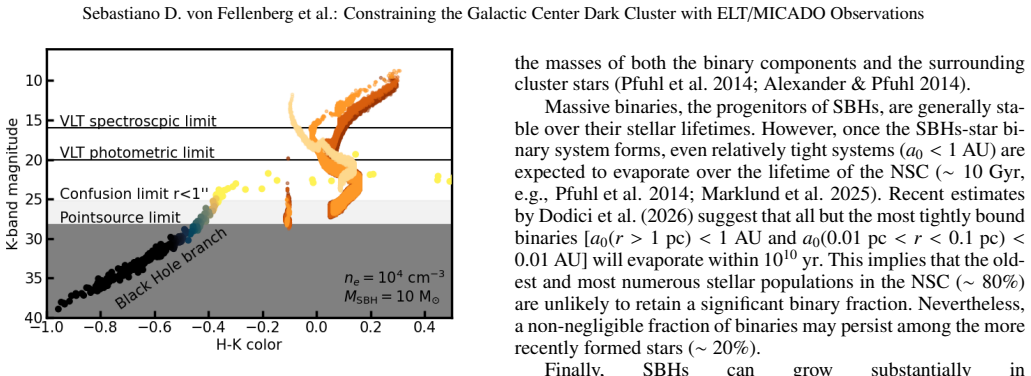
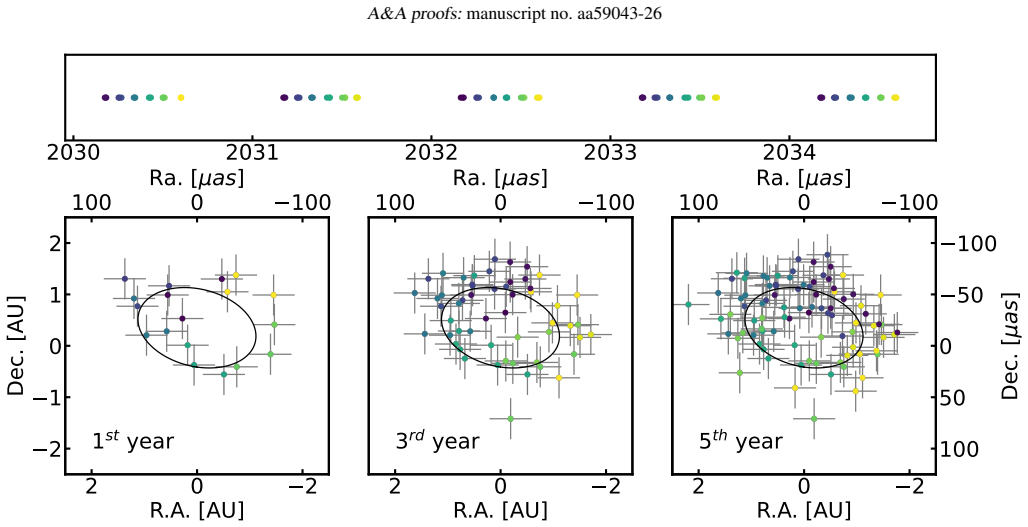
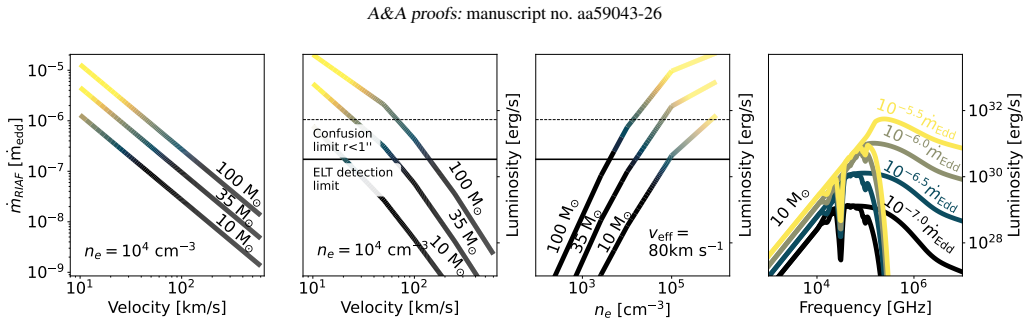
ELT/MICADO observations can provide the first quantitative constraints on the dark cluster population by enabling systematic searches for stellar compact object binaries through photometric variability and astrometric orbital signatures, together with direct detection of isolated accreting black holes in the gas-rich Galactic Center environment.
What carries the argument
MICADO's combination of deep photometry, high spatial resolution, and precise astrometry to identify variability and orbital motions of compact-object binaries amid crowding and extinction.
If this is right
- The number, mass distribution, and radial profile of stellar black holes, neutron stars, and white dwarfs near Sgr A* become directly measurable for the first time.
- Models of mass segregation and dynamical relaxation in nuclear star clusters can be tested against data rather than assumed.
- Rates of extreme mass ratio inspirals for LISA and similar gravitational-wave detectors can be placed on an observational footing.
- The role of compact remnants in the overall energy and angular-momentum budget of the Galactic Center becomes quantifiable.
Where Pith is reading between the lines
- Similar imaging programs on other nearby galactic nuclei could test whether dark clusters are a generic outcome of dense stellar environments.
- A non-detection would force revisions in models of compact-object retention and ejection in galactic centers.
- The same data set could simultaneously constrain the binary fraction among ordinary stars and the gas accretion properties of isolated black holes.
Load-bearing premise
MICADO will achieve its planned sensitivity and astrometric precision in the actual crowded and extincted Galactic Center field, and the predicted observable signatures from SCO-star binaries and accreting black holes will appear at the expected levels.
What would settle it
A sufficiently deep MICADO campaign that finds neither photometric or astrometric binary signatures nor isolated accreting black holes at the levels needed to match current theoretical predictions would indicate that the dark cluster population is substantially smaller or differently distributed than expected.
Figures




read the original abstract
The Galactic Center hosts the densest known stellar environment in the Milky Way, dominated by the massive black hole Sgr A* and the surrounding nuclear star cluster. Theory predicts that this region should also contain a large population of stellar compact objects (SCOs) - black holes, neutron stars, and white dwarfs - forming a "dark cluster" whose distribution and properties remain observationally unconstrained. These unseen stellar remnants are central to questions of mass segregation, cluster dynamics, and the expected rate of extreme mass ratio inspirals (EMRIs) detectable by future gravitational-wave observatories including LISA. Current evidence for SCOs in the Galactic Center is indirect, relying on dynamical mass measurements, X-ray surveys, and a small number of transient sources. Direct detections remain elusive due to crowding, extinction, and the sensitivity limits of existing instruments. We explore how upcoming facilities, in particular the Extremely Large Telescope (ELT) with its first-light imager MICADO, can fundamentally transform this field. MICADO's combination of deep photometry, high spatial resolution, and precise astrometry will enable systematic searches for SCO-star binaries via photometric variability and orbital astrometric signatures, as well as direct detection of isolated accreting black holes interacting with the gas-rich Galactic Center environment. We outline the observational pathways, technical challenges, and expected sensitivities, showing that ELT/MICADO observations can provide the first quantitative constraints on the dark cluster population. Establishing these constraints will be pivotal for understanding the dynamical evolution of the Galactic Center, the role of compact remnants in nuclear star clusters, and the astrophysical context of gravitational-wave sources in galactic nuclei.
Editorial analysis
A structured set of objections, weighed in public.
Referee Report
Summary. The manuscript proposes that ELT/MICADO observations can deliver the first quantitative constraints on the Galactic Center dark cluster of stellar compact objects (SCOs) by enabling systematic searches for SCO-star binaries through photometric variability and orbital astrometric wobbles, together with direct detection of isolated accreting black holes in the gas-rich environment. It outlines observational pathways, technical challenges, and expected sensitivities based on the instrument's high spatial resolution, deep photometry, and precise astrometry.
Significance. If the projected sensitivities are realized, the work would be significant for resolving the distribution and properties of unseen compact remnants in the densest stellar environment, directly informing models of mass segregation, nuclear cluster dynamics, and the astrophysical rates of extreme mass ratio inspirals for LISA. It positions next-generation facilities to convert indirect dynamical and X-ray evidence into measurable population constraints.
major comments (2)
- [§3 (Observational Pathways and Expected Sensitivities)] The sensitivity forecasts for astrometric wobbles and photometric variability amplitudes (outlined in the sections on observational pathways) do not include quantitative error budgets or Monte Carlo simulations that fold in realistic crowding, differential extinction, and residual AO halo effects at the GC source densities; without these, the assertion that signals will remain above the effective noise floor is not demonstrated and is load-bearing for the central claim of quantitative constraints.
- [§4 (Detection of Isolated Accreting Black Holes)] The discussion of direct detection of accreting black holes assumes interaction signatures will be identifiable above background, but provides no specific accretion luminosity thresholds, variability timescales, or comparisons against current X-ray survey limits that would establish the improvement factor needed to move from indirect to direct constraints.
minor comments (2)
- [Abstract] The abstract states that the work 'shows' the observations can provide constraints, yet the manuscript presents forward-looking pathways rather than explicit calculations or results; rephrasing would better match the content.
- [Introduction] Notation for stellar compact objects (SCOs) is introduced clearly, but subsequent references to 'dark cluster' could benefit from a brief reminder of the assumed mass and spatial distribution to aid readers.
Simulated Author's Rebuttal
We thank the referee for their detailed and constructive report. The comments identify areas where our sensitivity projections can be placed on a firmer quantitative footing. We have revised the manuscript to incorporate additional error-budget estimates and luminosity-threshold comparisons while preserving the paper’s focus on outlining observational pathways rather than delivering end-to-end simulations. Below we respond point by point.
read point-by-point responses
-
Referee: The sensitivity forecasts for astrometric wobbles and photometric variability amplitudes do not include quantitative error budgets or Monte Carlo simulations that fold in realistic crowding, differential extinction, and residual AO halo effects at the GC source densities; without these, the assertion that signals will remain above the effective noise floor is not demonstrated.
Authors: We agree that a more explicit error budget strengthens the central claim. In the revised §3 we have added a dedicated subsection that (i) adopts published crowding-noise models for the GC (e.g., from existing VLT and HST data), (ii) incorporates differential extinction maps from Schödel et al., and (iii) uses MICADO’s nominal Strehl ratio and residual halo profiles to estimate the effective noise floor. These calculations show that, for sources brighter than K≈18, the expected astrometric and photometric signals remain above the combined noise for orbital periods ≲10 yr and variability amplitudes ≳0.05 mag. We have also inserted a short paragraph acknowledging that full Monte-Carlo end-to-end simulations lie beyond the scope of the present work and will be pursued in follow-up studies. The language of the abstract and conclusions has been moderated from “will deliver” to “can deliver” quantitative constraints. revision: partial
-
Referee: The discussion of direct detection of accreting black holes assumes interaction signatures will be identifiable above background, but provides no specific accretion luminosity thresholds, variability timescales, or comparisons against current X-ray survey limits.
Authors: We have expanded §4 with explicit estimates. Using Bondi accretion rates appropriate for the GC gas density and temperature, we derive minimum detectable X-ray luminosities of ∼10^32–10^33 erg s^−1 for isolated black holes. These thresholds are compared directly to the sensitivity limits of the Chandra GC survey (Muno et al.) and the expected improvement factor of ∼30–100 in near-IR continuum sensitivity with MICADO. Variability timescales of hours to days for accretion flares are now stated, together with the corresponding photometric precision reachable in a single MICADO epoch. These additions demonstrate that ELT/MICADO observations would reach sources below current X-ray detection limits, thereby moving from indirect to direct constraints for the brightest members of the population. revision: yes
Circularity Check
No circularity: forward-looking observational proposal with no derivations or self-referential predictions
full rationale
The paper is an observational proposal outlining how ELT/MICADO could detect SCO-star binaries and accreting black holes to constrain the dark cluster. No equations, fitted parameters, or derivations appear in the provided text. Claims rest on expected instrument performance and external theoretical models rather than any internal reduction to inputs by construction. The work is self-contained as a strategy document without load-bearing self-citations or ansatzes that collapse into the target result.
Axiom & Free-Parameter Ledger
axioms (1)
- domain assumption A substantial population of stellar compact objects exists in the Galactic Center forming a dark cluster whose distribution follows theoretical predictions.
Reference graph
Works this paper leans on
-
[1]
2005, Phys
Alexander, T. 2005, Phys. Rep., 419, 65
2005
-
[2]
2017, ARA&A, 55, 17
Alexander, T. 2017, ARA&A, 55, 17
2017
-
[3]
& Hopman, C
Alexander, T. & Hopman, C. 2009, ApJ, 697, 1861
2009
-
[4]
& Pfuhl, O
Alexander, T. & Pfuhl, O. 2014, ApJ, 780, 148
2014
-
[5]
2007, Classical and Quantum Gravity, 24, R113
Amaro-Seoane, Gair, J., Freitag, M., et al. 2007, Classical and Quantum Gravity, 24, R113
2007
-
[6]
2012, Classical and Quantum Gravity, 29, 124016
Amaro-Seoane, P., Aoudia, S., Babak, S., et al. 2012, Classical and Quantum Gravity, 29, 124016
2012
-
[7]
Laser Interferometer Space Antenna
Amaro-Seoane, P., Audley, H., Babak, S., et al. 2017, arXiv e-prints, arXiv:1702.00786 Amaro Seoane, P. & Zhao, S.-D. 2025, J. Cosmology Astropart. Phys., 2025, 015
work page internal anchor Pith review Pith/arXiv arXiv 2017
-
[8]
Bahcall, J. N. & Wolf, R. A. 1976, ApJ, 209, 214
1976
-
[9]
Bahcall, J. N. & Wolf, R. A. 1977, ApJ, 216, 883
1977
-
[10]
K., et al
Bartko, H., Martins, F., Fritz, T. K., et al. 2009, ApJ, 697, 1741
2009
-
[11]
2010, ApJ, 708, 834
Bartko, H., Martins, F., Trippe, S., et al. 2010, ApJ, 708, 834
2010
-
[12]
D., Ramírez, S
Blum, R. D., Ramírez, S. V ., Sellgren, K., & Olsen, K. 2003, ApJ, 597, 323
2003
-
[13]
M., Schödel, R., et al
Boehle, A., Ghez, A. M., Schödel, R., et al. 2016, ApJ, 830, 17
2016
-
[14]
& Hoyle, F
Bondi, H. & Hoyle, F. 1944, MNRAS, 104, 273
1944
-
[15]
2018, in Society of Photo- Optical Instrumentation Engineers (SPIE) Conference Series, V ol
Bonnet, H., Biancat-Marchet, F., Dimmler, M., et al. 2018, in Society of Photo- Optical Instrumentation Engineers (SPIE) Conference Series, V ol. 10703, Adaptive Optics Systems VI, ed. L. M. Close, L. Schreiber, & D. Schmidt, 1070310
2018
-
[16]
C., Deller, A., Demorest, P., et al
Bower, G. C., Deller, A., Demorest, P., et al. 2014, ApJ, 780, L2
2014
-
[17]
C., Markoff, S., Dexter, J., et al
Bower, G. C., Markoff, S., Dexter, J., et al. 2015, ApJ, 802, 69
2015
-
[18]
C., Roberts, D
Bower, G. C., Roberts, D. A., Yusef-Zadeh, F., et al. 2005, ApJ, 633, 218
2005
-
[19]
Breivik, K., Chatterjee, S., & Larson, S. L. 2017, ApJ, 850, L13
2017
-
[20]
M., Schödel, R., & Eckart, A
Buchholz, R. M., Schödel, R., & Eckart, A. 2009, A&A, 499, 483
2009
-
[21]
Burkert, A., Gillessen, S., Lin, D. N. C., et al. 2024, ApJ, 962, 81 Calderón, D., Cuadra, J., Schartmann, M., Burkert, A., & Russell, C. M. P. 2020, ApJ, 888, L2
2024
-
[22]
Chael, A., Narayan, R., & Johnson, M. D. 2019, MNRAS, 486, 2873
2019
-
[23]
2025, ApJ, 992, 210
Chatterjee, K., Mondal, S., Palit, B., et al. 2025, ApJ, 992, 210
2025
-
[24]
K., Gerhard, O., et al
Chatzopoulos, S., Fritz, T. K., Gerhard, O., et al. 2015, MNRAS, 447, 948
2015
-
[25]
M., et al
Chen, Z., Do, T., Ghez, A. M., et al. 2023, ApJ, 944, 79
2023
-
[26]
S., Narayan, R., et al
Cho, H., Prather, B. S., Narayan, R., et al. 2023, ApJ, 959, L22
2023
-
[27]
M., Kramer, M., Lazio, T
Cordes, J. M., Kramer, M., Lazio, T. J. W., et al. 2004, New A Rev., 48, 1413
2004
-
[28]
2008, MNRAS, 383, 458
Cuadra, J., Nayakshin, S., & Martins, F. 2008, MNRAS, 383, 458
2008
-
[29]
& Genzel, R
Davies, R. & Genzel, R. 2010, The Messenger, 140, 32
2010
-
[30]
2021, The Messenger, 182, 17
Davies, R., Hörmann, V ., Rabien, S., et al. 2021, The Messenger, 182, 17
2021
-
[31]
K., Ciurlo, A., Morris, M
Dinh, C. K., Ciurlo, A., Morris, M. R., et al. 2024, AJ, 167, 41
2024
-
[32]
2016, in Society of Photo-Optical Instru- mentation Engineers (SPIE) Conference Series, V ol
Diolaiti, E., Ciliegi, P., Abicca, R., et al. 2016, in Society of Photo-Optical Instru- mentation Engineers (SPIE) Conference Series, V ol. 9909, Adaptive Optics Systems V , ed. E. Marchetti, L. M. Close, & J.-P. Véran, 99092D
2016
-
[33]
R., Ghez, A
Do, T., Lu, J. R., Ghez, A. M., et al. 2013, ApJ, 764, 154
2013
-
[34]
K., et al
Do, T., Witzel, G., Gautam, A. K., et al. 2019, Astrophysical Journal, 882, L27
2019
-
[35]
E., & Farr, B
Doctor, Z., Wysocki, D., O’Shaughnessy, R., Holz, D. E., & Farr, B. 2020, ApJ, 893, 35
2020
-
[36]
2026, ApJ, 1000, 226
Dodici, M., Tremaine, S., & Wu, Y . 2026, ApJ, 1000, 226
2026
-
[37]
Eatough, R., Lazio, T. J. W., Casanellas, J., et al. 2015, in Advancing Astro- physics with the Square Kilometre Array (AASKA14), 45
2015
-
[38]
P., Falcke, H., Karuppusamy, R., et al
Eatough, R. P., Falcke, H., Karuppusamy, R., et al. 2013, Nature, 501, 391
2013
-
[39]
2004, New A Rev., 48, 843
Edgar, R. 2004, New A Rev., 48, 843
2004
-
[40]
1936, Science, 84, 506
Einstein, A. 1936, Science, 84, 506
1936
-
[41]
El-Badry, K., Rix, H.-W., & Heintz, T. M. 2021, MNRAS, 506, 2269
2021
-
[42]
W., et al
El-Badry, K., Rix, H.-W., Latham, D. W., et al. 2024, The Open Journal of As- trophysics, 7, 58
2024
-
[43]
2023b, MNRAS, 518, 1057 ESO
El-Badry, K., Rix, H.-W., Quataert, E., et al. 2023b, MNRAS, 518, 1057 ESO. 2024, The Extremely Large Telescope,https://www.eso.org/sci/ facilities/eelt/ Event Horizon Telescope Collaboration, Akiyama, K., Alberdi, A., et al. 2022, ApJ, 930, L16 Event Horizon Telescope Collaboration, Akiyama, K., Alberdi, A., et al. 2019, ApJ, 875, L5
2024
-
[44]
2025, A&A, 699, A239
Feldmeier-Krause, A., Veršiˇc, T., van de Ven, G., Gallego-Cano, E., & Neu- mayer, N. 2025, A&A, 699, A239
2025
-
[45]
F., Rich, R
Figer, D. F., Rich, R. M., Kim, S. S., Morris, M., & Serabyn, E. 2004, ApJ, 601, 319
2004
-
[46]
A., Polisensky, E., Hyman, S
Frail, D. A., Polisensky, E., Hyman, S. D., et al. 2024, ApJ, 975, 34
2024
-
[47]
2006, ApJ, 649, 91
Freitag, M., Amaro-Seoane, P., & Kalogera, V . 2006, ApJ, 649, 91
2006
-
[48]
2010, MNRAS, 401, 1177
Fritz, T., Gillessen, S., Trippe, S., et al. 2010, MNRAS, 401, 1177
2010
-
[49]
K., Chatzopoulos, S., Gerhard, O., et al
Fritz, T. K., Chatzopoulos, S., Gerhard, O., et al. 2016, ApJ, 821, 44
2016
-
[50]
K., Gillessen, S., Dodds-Eden, K., et al
Fritz, T. K., Gillessen, S., Dodds-Eden, K., et al. 2011, ApJ, 737, 73
2011
-
[51]
Fujita, Y ., Inoue, S., Nakamura, T., Manmoto, T., & Nakamura, K. E. 1998, ApJ, 495, L85 Gaia Collaboration, Brown, A. G. A., Vallenari, A., et al. 2016, A&A, 595, A2 Gaia Collaboration, Vallenari, A., Brown, A. G. A., et al. 2023, A&A, 674, A1
1998
-
[52]
2025, ApJ, 978, 148
Galishnikova, A., Philippov, A., Quataert, E., Chatterjee, K., & Liska, M. 2025, ApJ, 978, 148
2025
-
[53]
2024, A&A, 689, A190
Gallego-Cano, E., Fritz, T., Schödel, R., et al. 2024, A&A, 689, A190
2024
-
[54]
M., et al
Gautam, Do, T., Ghez, A. M., et al. 2019, ApJ, 871, 103
2019
-
[55]
K., Do, T., Ghez, A
Gautam, A. K., Do, T., Ghez, A. M., et al. 2024, Astrophysical Journal, 964, 164
2024
-
[56]
R., Najarro, F., Rigaut, F., & Roy, J
Geballe, T. R., Najarro, F., Rigaut, F., & Roy, J. R. 2006, ApJ, 652, 370
2006
-
[57]
M., Balman, ¸ S., Kızıloˇglu, Ü., et al
Gelino, D. M., Balman, ¸ S., Kızıloˇglu, Ü., et al. 2006, ApJ, 642, 438
2006
-
[58]
& Madigan, A.-M
Generozov, A. & Madigan, A.-M. 2020, ApJ, 896, 137
2020
-
[59]
C., Metzger, B
Generozov, A., Stone, N. C., Metzger, B. D., & Ostriker, J. P. 2018, MNRAS, 478, 4030
2018
-
[60]
1997, MNRAS, 291, 219
Genzel, R., Eckart, A., Ott, T., & Eisenhauer, F. 1997, MNRAS, 291, 219
1997
-
[61]
2010, Reviews of Modern Physics, 82, 3121
Genzel, R., Eisenhauer, F., & Gillessen, S. 2010, Reviews of Modern Physics, 82, 3121
2010
-
[62]
2003, The Astrophysical Journal, 812
Genzel, R., Schoedel, R., Alexander, T., et al. 2003, The Astrophysical Journal, 812
2003
-
[63]
M., Becklin, E., Duchjne, G., et al
Ghez, A. M., Becklin, E., Duchjne, G., et al. 2003, Astronomische Nachrichten Supplement, 324, 527
2003
-
[64]
M., Klein, B
Ghez, A. M., Klein, B. L., Morris, M., & Becklin, E. E. 1998, Astrophysical Journal, 509, 678
1998
-
[65]
M., Salim, S., Weinberg, N
Ghez, A. M., Salim, S., Weinberg, N. N., et al. 2008, ApJ, 689, 1044
2008
-
[66]
2018, MNRAS, 475, L15
Giesers, B., Dreizler, S., Husser, T.-O., et al. 2018, MNRAS, 475, L15
2018
-
[67]
2009, ApJ, 692, 1075
Gillessen, S., Eisenhauer, F., Trippe, S., et al. 2009, ApJ, 692, 1075
2009
-
[68]
M., Eisenhauer, F., et al
Gillessen, S., Plewa, P. M., Eisenhauer, F., et al. 2017, Astrophysical Journal, 837, 30
2017
-
[69]
M., Widmann, F., et al
Gillessen, S., Plewa, P. M., Widmann, F., et al. 2019, ApJ, 871, 126
2019
-
[70]
& Spyromilio, J
Gilmozzi, R. & Spyromilio, J. 2007, The Messenger, 127, 11
2007
-
[71]
2021b, MNRAS, 504, 5907 Gravity Collaboration, Abd El Dayem, K., Abuter, R., et al
Gomel, R., Faigler, S., Mazeh, T., & Pawlak, M. 2021b, MNRAS, 504, 5907 Gravity Collaboration, Abd El Dayem, K., Abuter, R., et al. 2024, A&A, 692, A242 GRA VITY Collaboration, Abuter, R., Aimar, N., et al. 2022, A&A, 657, L12 GRA VITY Collaboration, Abuter, R., Amorim, A., et al. 2018, Astronomy & Astrophysics, 615, L15 Gravity Collaboration, Abuter, R.,...
2024
-
[72]
M., Quataert, E., & Kim, C.-G
Guo, M., Stone, J. M., Quataert, E., & Kim, C.-G. 2024, ApJ, 973, 141
2024
-
[73]
2019, ApJ, 872, L15
Habibi, M., Gillessen, S., Pfuhl, O., et al. 2019, ApJ, 872, L15
2019
-
[74]
J., Mori, K., Bauer, F
Hailey, C. J., Mori, K., Bauer, F. E., et al. 2018, Nature, 556, 70
2018
-
[75]
Hills, J. G. 1988, Nature, 331, 687
1988
-
[76]
A., & Dosopoulou, F
Hoang, B.-M., Naoz, S., Kocsis, B., Rasio, F. A., & Dosopoulou, F. 2018, ApJ, 856, 140
2018
-
[77]
& Lyttleton, R
Hoyle, F. & Lyttleton, R. A. 1939, Proceedings of the Cambridge Philosophical Society, 35, 405
1939
-
[78]
R., et al
Jia, S., Xu, N., Lu, J. R., et al. 2023, ApJ, 949, 18
2023
-
[79]
A., Burrows, D
Kennea, J. A., Burrows, D. N., Kouveliotou, C., et al. 2013, ApJ, 770, L24
2013
-
[80]
1991, ApJ, 382, L19
Krabbe, A., Genzel, R., Drapatz, S., & Rotaciuc, V . 1991, ApJ, 382, L19
1991
discussion (0)
Sign in with ORCID, Apple, or X to comment. Anyone can read and Pith papers without signing in.