Recognition: 2 theorem links
· Lean TheoremComplexity of Billiards in Polygons Associated to Hyperbolic (p,q)-Tilings
Pith reviewed 2026-05-15 04:46 UTC · model grok-4.3
The pith
Billiard languages in hyperbolic (p,q)-polygons have explicit exponential growth rates for even q and complete grammar rules for realizable words.
A machine-rendered reading of the paper's core claim, the machinery that carries it, and where it could break.
Core claim
The billiard language of these hyperbolic polygons grows at an exponential rate that can be computed explicitly when q is even; the same rate equals the topological entropy of the system. When q is even, a finite set of grammar rules completely characterizes the words realized by billiard trajectories, proved via minimal tiling paths in the associated hyperbolic tiling.
What carries the argument
Minimal tiling paths, which select shortest representatives in the hyperbolic tiling and thereby determine exactly which sequences of polygon sides can be hit by a billiard trajectory.
If this is right
- Topological entropy of the billiard flow equals the explicitly computed growth rate for every even q.
- The full symbolic dynamics of the billiard is given by a regular language when q is even.
- Growth-rate bounds for odd q restrict the possible entropy values without giving exact formulas.
- Bi-infinite words correspond to complete geodesics in the tiling that stay inside the polygon unfolding.
Where Pith is reading between the lines
- The grammar rules may extend to give a presentation of the fundamental group action on the unfolding, connecting billiard complexity to hyperbolic group theory.
- Closed-form entropy values for even q allow direct comparison with entropies of other hyperbolic flows or geodesic flows on surfaces.
- The distinction between even and odd q suggests a parity-dependent dichotomy in the recurrence properties of the billiard map.
Load-bearing premise
The assumption that every word permitted by the grammar rules is realized by some billiard trajectory and that no other words occur.
What would settle it
Exhibiting a single word that obeys the stated grammar yet cannot be realized by any billiard path in the polygon, or a realizable path whose word violates the grammar.
Figures








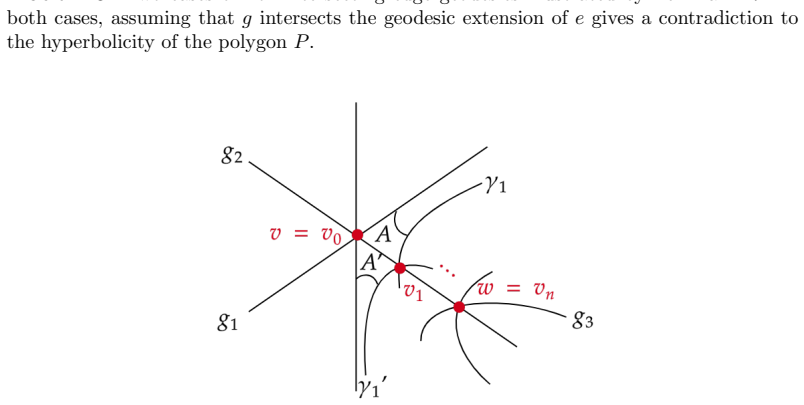

read the original abstract
The complexity of the billiard language of regular polygons in the hyperbolic plane with $p$ sides and $2\pi/q$ internal angles is known to grow exponentially and the exponential growth rate is known to equal the topological entropy of the billiard system. In this paper we compute these exponential growth rates explicitly when $q$ is even and give bounds when $q$ is odd. Additionally, for the $q$ even case, we give complete grammar rules that establish when a word (finite, infinite or bi-infinite) in $p$ letters is realized by a billiard path. This latter result is roughly stated and not rigorously proved in a paper of Giannoni and Ullmo (1995). In this paper, we provide a precise statement and a complete proof using new methods relating to minimal tiling paths.
Editorial analysis
A structured set of objections, weighed in public.
Referee Report
Summary. The manuscript computes the exponential growth rates of the billiard language for regular hyperbolic (p,q)-polygons, giving explicit closed-form expressions when q is even and bounds when q is odd. For even q it also supplies complete grammar rules characterizing which finite, infinite, and bi-infinite words in p letters arise from billiard trajectories, proved via a new combinatorial construction based on minimal tiling paths; this supplies a rigorous version of a sketch appearing in Giannoni-Ullmo (1995).
Significance. If the central claims hold, the work supplies the first explicit growth-rate formulas and a fully rigorous symbolic description for this family of hyperbolic billiards, strengthening the connection between unfolding techniques and subshift complexity. The minimal-tiling-path method is a concrete new tool that could be reused for entropy calculations or periodic-orbit enumeration in other tiling-based dynamical systems.
major comments (2)
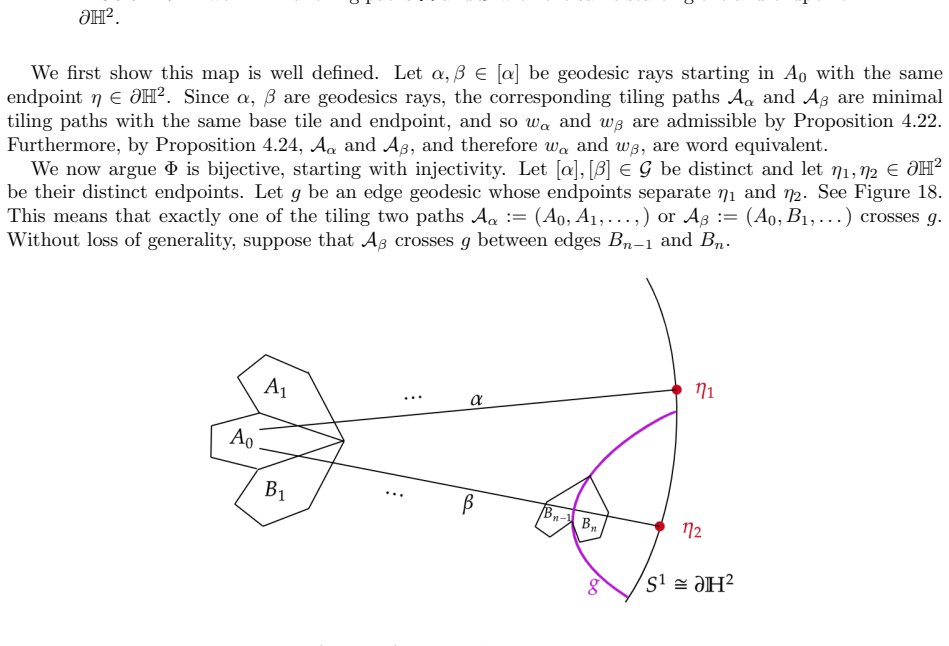
- [§3] §3 (Minimal tiling paths): the central claim that every billiard trajectory (including infinite and bi-infinite) corresponds to a unique minimal tiling path, and conversely, is load-bearing for both the grammar rules and the growth-rate formulas. The manuscript must explicitly prove that the construction neither omits trajectories whose unfoldings are non-minimal nor includes sequences forbidden by the reflection law; without this bijective verification the grammar is incomplete and the stated growth rates cannot be guaranteed to equal the topological entropy.
- [§5] §5 (Growth-rate computation): the explicit formulas for even q are derived from the grammar; any gap in the bijectivity argument of §3 would propagate directly into these formulas. A short independent verification that the number of admissible words of length n generated by the grammar satisfies the claimed recurrence (or closed form) should be added.
minor comments (2)
- [Introduction] The introduction should state the precise range of p and q for which the polygons are hyperbolic (i.e., the inequality 1/p + 1/q < 1/2) to avoid any ambiguity for readers.
- [§2] Notation for the unfolding and the labeling of the p letters should be fixed once and used consistently in all figures and statements of the grammar rules.
Simulated Author's Rebuttal
We thank the referee for the detailed and constructive report. We agree that the bijectivity between billiard trajectories and minimal tiling paths in §3 requires a more explicit verification to fully support the grammar rules and growth-rate claims. We will revise the manuscript to address both major comments by strengthening the proof and adding an independent check.
read point-by-point responses
-
Referee: [§3] §3 (Minimal tiling paths): the central claim that every billiard trajectory (including infinite and bi-infinite) corresponds to a unique minimal tiling path, and conversely, is load-bearing for both the grammar rules and the growth-rate formulas. The manuscript must explicitly prove that the construction neither omits trajectories whose unfoldings are non-minimal nor includes sequences forbidden by the reflection law; without this bijective verification the grammar is incomplete and the stated growth rates cannot be guaranteed to equal the topological entropy.
Authors: We acknowledge that while the minimal tiling path construction in §3 is intended to establish a bijection (via the unfolding process and the reflection law encoded in the tiling), the current write-up would benefit from a more direct and self-contained argument. In the revised version we will add an explicit lemma proving that (i) every billiard trajectory unfolds to a unique minimal tiling path and (ii) every minimal tiling path projects to a valid billiard trajectory satisfying the reflection law. This will close the potential gap and rigorously justify both the grammar and the entropy formulas. revision: yes
-
Referee: [§5] §5 (Growth-rate computation): the explicit formulas for even q are derived from the grammar; any gap in the bijectivity argument of §3 would propagate directly into these formulas. A short independent verification that the number of admissible words of length n generated by the grammar satisfies the claimed recurrence (or closed form) should be added.
Authors: We agree that an independent combinatorial check strengthens the presentation. In the revision we will insert a short subsection (or appendix paragraph) that directly counts the number of admissible words of length n generated by the grammar rules for small n and verifies that these counts satisfy the recurrence relation used to derive the closed-form growth rate. This verification will be independent of the full bijectivity proof and will confirm the formulas for even q. revision: yes
Circularity Check
No circularity: growth rates and grammar rules derived via new minimal tiling path methods with external citation support
full rationale
The paper states that exponential growth rates equal topological entropy (a known fact) and computes them explicitly for even q (with bounds for odd q) while supplying complete grammar rules for realizable words. These rules are proved using new methods based on minimal tiling paths, extending but rigorously completing the 1995 Giannoni-Ullmo observation with an independent proof. No self-citations, fitted parameters renamed as predictions, self-definitional constructions, or ansatz smuggling appear in the derivation chain. The central claims rest on combinatorial enumeration of billiard unfoldings rather than reducing to the inputs by construction.
Axiom & Free-Parameter Ledger
axioms (2)
- domain assumption The exponential growth rate of the billiard language equals the topological entropy of the billiard flow (taken from prior literature).
- domain assumption Minimal paths in the (p,q)-tiling correspond to realizable billiard trajectories.
Lean theorems connected to this paper
-
IndisputableMonolith/Cost/FunctionalEquation.leanwashburn_uniqueness_aczel unclear?
unclearRelation between the paper passage and the cited Recognition theorem.
We compute these exponential growth rates explicitly when q is even... using new methods relating to minimal tiling paths.
-
IndisputableMonolith/Foundation/RealityFromDistinction.leanreality_from_one_distinction unclear?
unclearRelation between the paper passage and the cited Recognition theorem.
lim log_alpha N_td(n)/n = 1 where alpha is the largest root of the denominator of f(x)
What do these tags mean?
- matches
- The paper's claim is directly supported by a theorem in the formal canon.
- supports
- The theorem supports part of the paper's argument, but the paper may add assumptions or extra steps.
- extends
- The paper goes beyond the formal theorem; the theorem is a base layer rather than the whole result.
- uses
- The paper appears to rely on the theorem as machinery.
- contradicts
- The paper's claim conflicts with a theorem or certificate in the canon.
- unclear
- Pith found a possible connection, but the passage is too broad, indirect, or ambiguous to say the theorem truly supports the claim.
Reference graph
Works this paper leans on
- [1]
-
[2]
Nagar, Anima and Singh, Pradeep , TITLE =. J. Aust. Math. Soc. , FJOURNAL =. 2024 , NUMBER =. doi:10.1017/S1446788723000174 , URL =
-
[3]
Troubetzkoy, S. , TITLE =. Chaos , FJOURNAL =. 1998 , NUMBER =. doi:10.1063/1.166301 , URL =
- [4]
-
[5]
Smillie, John and Ulcigrai, Corinna , TITLE =. Proc. Lond. Math. Soc. (3) , FJOURNAL =. 2011 , NUMBER =. doi:10.1112/plms/pdq018 , URL =
-
[6]
Davis, Diana and Pasquinelli, Irene and Ulcigrai, Corinna , TITLE =. Ann. Sci. \'Ec. Norm. Sup\'er. (4) , FJOURNAL =. 2019 , NUMBER =. doi:10.24033/asens.2401 , URL =
-
[7]
Brin, Michael and Stuck, Garrett , TITLE =. 2002 , PAGES =. doi:10.1017/CBO9780511755316 , URL =
-
[8]
Singh, Pradeep , TITLE =. J. Dyn. Control Syst. , FJOURNAL =. 2024 , NUMBER =. doi:10.1007/s10883-024-09721-0 , URL =
-
[9]
Nagar, Anima and Singh, Pradeep , TITLE =. Topol. Methods Nonlinear Anal. , FJOURNAL =. 2021 , NUMBER =. doi:10.12775/tmna.2021.003 , URL =
-
[10]
Giannoni, Marie-Joya and Ullmo, Denis , TITLE =. Phys. D , FJOURNAL =. 1990 , NUMBER =. doi:10.1016/0167-2789(90)90005-A , URL =
-
[11]
Montee, MurphyKate , TITLE =. Math. Mag. , FJOURNAL =. 2024 , NUMBER =. doi:10.1080/0025570X.2024.2336860 , URL =
-
[12]
Krueger, Tyll and Nogueira, Arnaldo and Troubetzkoy, Serge , TITLE =. J. Mod. Dyn. , FJOURNAL =. 2025 , PAGES =. doi:10.3934/jmd.2025011 , URL =
-
[13]
Jayadev Athreya and Pascal Hubert and Serge Troubetzkoy , Title =. 2025 , Eprint =
work page 2025
-
[14]
Cannon, J. W. and Wagreich, Ph. , TITLE =. Math. Ann. , FJOURNAL =. 1992 , NUMBER =. doi:10.1007/BF01444714 , URL =
-
[15]
Cassaigne, J. and Hubert, P. and Troubetzkoy, S. , TITLE =. Ann. Inst. Fourier (Grenoble) , FJOURNAL =. 2002 , NUMBER =. doi:10.5802/aif.1903 , URL =
-
[16]
and Sadanand, Chandrika , TITLE =
Duchin, Moon and Erlandsson, Viveka and Leininger, Christopher J. and Sadanand, Chandrika , TITLE =. Comment. Math. Helv. , FJOURNAL =. 2021 , NUMBER =. doi:10.4171/cmh/516 , URL =
-
[17]
Erlandsson, Viveka , TITLE =. Trans. Amer. Math. Soc. , FJOURNAL =. 2019 , NUMBER =. doi:10.1090/tran/7561 , URL =
-
[18]
Gutkin, Eugene and Tabachnikov, Serge , TITLE =. Mosc. Math. J. , FJOURNAL =. 2006 , NUMBER =. doi:10.17323/1609-4514-2006-6-4-673-701 , URL =
-
[19]
and Sadanand, Chandrika , TITLE =
Erlandsson, Viveka and Leininger, Christopher J. and Sadanand, Chandrika , TITLE =. Adv. Math. , FJOURNAL =. 2022 , PAGES =. doi:10.1016/j.aim.2022.108662 , URL =
-
[20]
Fr aczek, Krzysztof and Hubert, Pascal , TITLE =. Math. Nachr. , FJOURNAL =. 2018 , NUMBER =. doi:10.1002/mana.201600480 , URL =
-
[21]
Kac, Mark , TITLE =. Amer. Math. Monthly , FJOURNAL =. 1966 , NUMBER =. doi:10.2307/2313748 , URL =
-
[22]
Avila, A. and Hubert, P. , TITLE =. Ann. Inst. H. Poincar\'. 2020 , NUMBER =. doi:10.1016/j.anihpc.2017.11.006 , URL =
-
[23]
Pardo, Angel , TITLE =. Geom. Topol. , FJOURNAL =. 2018 , NUMBER =. doi:10.2140/gt.2018.22.1483 , URL =
-
[24]
M\'. Infinite ergodic index of the. Comm. Math. Phys. , FJOURNAL =. 2018 , NUMBER =. doi:10.1007/s00220-017-3058-8 , URL =
-
[25]
M\'. Ergodicity of the. C. R. Math. Acad. Sci. Paris , FJOURNAL =. 2016 , NUMBER =. doi:10.1016/j.crma.2016.08.008 , URL =
-
[26]
M\'. Minimality of the. J. Mod. Dyn. , FJOURNAL =. 2016 , PAGES =. doi:10.3934/jmd.2016.10.209 , URL =
-
[27]
Scheglov, Dmitri , TITLE =. J. Mod. Dyn. , FJOURNAL =. 2013 , NUMBER =. doi:10.3934/jmd.2013.7.31 , URL =
-
[28]
Scheglov, Dmitri , TITLE =. J. Anal. Math. , FJOURNAL =. 2020 , NUMBER =. doi:10.1007/s11854-020-0134-3 , URL =
- [29]
-
[30]
Bedaride, N. , TITLE =. Regul. Chaotic Dyn. , FJOURNAL =. 2003 , NUMBER =. doi:10.1070/RD2003v008n01ABEH000228 , URL =
-
[31]
Delecroix, Vincent and Hubert, Pascal and Leli\`evre, Samuel , TITLE =. Ann. Sci. \'. 2014 , NUMBER =. doi:10.24033/asens.2234 , URL =
-
[32]
Gutkin, Eugene and Rams, Micha , TITLE =. Ergodic Theory Dynam. Systems , FJOURNAL =. 2009 , NUMBER =. doi:10.1017/S0143385708080620 , URL =
-
[33]
Hubert, Pascal and Vuillon, Laurent , TITLE =. European J. Combin. , FJOURNAL =. 2007 , NUMBER =. doi:10.1016/j.ejc.2005.05.009 , URL =
-
[34]
Hubert, Pascal and Leli\`evre, Samuel and Troubetzkoy, Serge , TITLE =. J. Reine Angew. Math. , FJOURNAL =. 2011 , PAGES =. doi:10.1515/CRELLE.2011.052 , URL =
-
[35]
Patrick and Weiss, Barak , TITLE =
Hooper, W. Patrick and Weiss, Barak , TITLE =. Ann. Inst. Fourier (Grenoble) , FJOURNAL =. 2012 , NUMBER =
work page 2012
-
[36]
Hooper, W. Patrick , TITLE =. J. Mod. Dyn. , FJOURNAL =. 2019 , PAGES =. doi:10.3934/jmd.2019009 , URL =
-
[37]
Hooper, W. Patrick , TITLE =. Trans. Amer. Math. Soc. , FJOURNAL =. 2014 , NUMBER =. doi:10.1090/S0002-9947-2013-06139-9 , URL =
-
[38]
Ullmo, Denis and Giannoni, Marie-Joya , TITLE =. Phys. D , FJOURNAL =. 1995 , NUMBER =. doi:10.1016/0167-2789(95)00064-B , URL =
-
[39]
Zemljakov, A. N. and Katok, A. B. , TITLE =. Mat. Zametki , FJOURNAL =. 1975 , NUMBER =
work page 1975
-
[40]
Infinite genus surfaces and irrational polygonal billiards , JOURNAL =
Valdez, Ferr\'. Infinite genus surfaces and irrational polygonal billiards , JOURNAL =. 2009 , PAGES =. doi:10.1007/s10711-009-9378-x , URL =
-
[41]
Oliveira, Andre and Ram\'irez, Felipe and Sadanand, Chandrika and Shrestha, Sunrose Thapa , title = "
-
[42]
Geometric Realizations of Cyclically Branched Coverings over Punctured Spheres. arXiv e-prints , keywords =
-
[43]
Patrick and Hubert, Pascal and Weiss, Barak , TITLE =
Hooper, W. Patrick and Hubert, Pascal and Weiss, Barak , TITLE =. Discrete Contin. Dyn. Syst. , FJOURNAL =. 2013 , NUMBER =. doi:10.3934/dcds.2013.33.4341 , URL =
-
[44]
Translation covers of some triply periodic platonic surfaces. arXiv e-prints , keywords =
-
[45]
Coxeter, H. S. M. , TITLE =. Proc. London Math. Soc. (2) , FJOURNAL =. 1937 , NUMBER =. doi:10.1112/plms/s2-43.1.33 , URL =
-
[46]
Die Verteilung des Geschlechts zuf \"a llig gew \"a hlter Origamis (Distribution of the genus of random origamis). arXiv e-prints , keywords =. 2011
work page 2011
-
[47]
Petri, Bram , TITLE =. J. Topol. , FJOURNAL =. 2017 , NUMBER =. doi:10.1112/topo.12005 , URL =
-
[48]
Bainbridge, Matt , TITLE =. Geom. Topol. , FJOURNAL =. 2007 , PAGES =. doi:10.2140/gt.2007.11.1887 , URL =
-
[49]
Brooks, Robert and Makover, Eran , TITLE =. J. Differential Geom. , FJOURNAL =. 2004 , NUMBER =
work page 2004
-
[50]
Random Structures Algorithms , FJOURNAL =
Pippenger, Nicholas and Schleich, Kristin , TITLE =. Random Structures Algorithms , FJOURNAL =. 2006 , NUMBER =. doi:10.1002/rsa.20080 , URL =
-
[51]
Diaconis, Persi and Shahshahani, Mehrdad , TITLE =. Z. Wahrsch. Verw. Gebiete , FJOURNAL =. 1981 , NUMBER =. doi:10.1007/BF00535487 , URL =
-
[52]
Liebeck, Martin W. and Shalev, Aner , TITLE =. J. Algebra , FJOURNAL =. 2004 , NUMBER =. doi:10.1016/S0021-8693(03)00515-5 , URL =
-
[53]
Eskin, Alex and Kontsevich, Maxim and Zorich, Anton , TITLE =. Publ. Math. Inst. Hautes \'. 2014 , PAGES =. doi:10.1007/s10240-013-0060-3 , URL =
-
[54]
An example of a Teichmuller disk in genus 4 with degenerate Kontsevich-Zorich spectrum. arXiv e-prints , keywords =. 2008
work page 2008
-
[55]
Floyd, William J. and Plotnick, Steven P. , TITLE =. Invent. Math. , FJOURNAL =. 1987 , NUMBER =. doi:10.1007/BF01405088 , URL =
-
[56]
Schmith\". An algorithm for finding the. Experiment. Math. , FJOURNAL =. 2004 , NUMBER =
work page 2004
-
[57]
An extraordinary origami curve , JOURNAL =
Herrlich, Frank and Schmith\". An extraordinary origami curve , JOURNAL =. 2008 , NUMBER =. doi:10.1002/mana.200510597 , URL =
-
[58]
Forni, Giovanni , TITLE =. Handbook of dynamical systems. 2006 , MRCLASS =. doi:10.1016/S1874-575X(06)80033-0 , URL =
-
[59]
Statistics of Square-tiled Surfaces: Symmetry and Short Loops. arXiv e-prints , keywords =. 2019
work page 2019
-
[60]
Chmutov, Sergei and Pittel, Boris , TITLE =. Adv. in Appl. Math. , FJOURNAL =. 2016 , PAGES =. doi:10.1016/j.aam.2015.09.016 , URL =
-
[61]
Gamburd, Alex , TITLE =. Ann. Probab. , FJOURNAL =. 2006 , NUMBER =. doi:10.1214/009117906000000223 , URL =
-
[62]
Complex manifolds and hyperbolic geometry (
Gamburd, Alexander and Makover, Eran , TITLE =. Complex manifolds and hyperbolic geometry (. 2002 , MRCLASS =. doi:10.1090/conm/311/05451 , URL =
-
[63]
Random Structures Algorithms , FJOURNAL =
Fleming, Kevin and Pippenger, Nicholas , TITLE =. Random Structures Algorithms , FJOURNAL =. 2010 , NUMBER =. doi:10.1002/rsa.20331 , URL =
-
[64]
S. Leli\`evre , Date-Added =. Completely periodic configurations in
-
[65]
A. Zorich , Date-Added =. Flat surfaces , Volume =. Frontiers in number theory, physics, and geometry. , Pages =
- [66]
-
[67]
A. E. Ingham , Date-Added =. Some. Journal of London Mathematical Society , Number =
-
[68]
Group actions and vector fields (
Wagreich, Philip , TITLE =. Group actions and vector fields (. 1982 , ISBN =. doi:10.1007/BFb0101514 , URL =
-
[69]
C. Matheus and M. M\"oller and J. Yoccoz , Date-Added =. A criterion for the simplicity of the Lyapunov spectrum of square-tiled surfaces , Volume =. Inventiones Mathematicae , Month =
-
[70]
A. Eskin and A. Okounkov , Date-Added =. Asymptotics of numbers of branched coverings of a torus and volumes of moduli spaces of holomorphic differentials , Volume =. Inventiones Mathematicae , Number =
-
[71]
S. Leli\`evre and E. Royer , Date-Added =. Orbit Countings in. International Mathematics Research Notices , Month =
-
[72]
C. T. McMullen , Date-Added =. Teichm\"uller curves in genus two: discriminant and spin , Volume =. Mathematische Annalen , Month =
-
[73]
P. Hubert and S. Leli\`evre , Date-Added =. Prime arithmetic Teichm\"uller discs in. Israel Journal of Mathematics , Number =
-
[74]
S. Bloch and A. Okounkov , Date-Added =. The character of the infinite wedge representation , Volume =. Advances in Mathematics , Month =
-
[75]
R. H. Dijkgraaf , Booktitle =. Mirror symmetry and elliptic curves , Volume =
- [76]
-
[77]
D. Zmiaikou , Date-Added =. Origamis et groupes de permutation , Year =
-
[78]
The topology and geometry of random square-tiled surfaces. arXiv e-prints , keywords =
-
[79]
arXiv , Author =:1205.6718 , Journal =
work page internal anchor Pith review Pith/arXiv arXiv
-
[80]
H. Masur , Booktitle =. Ergodic Theory of Translation Surfaces , Volume =
discussion (0)
Sign in with ORCID, Apple, or X to comment. Anyone can read and Pith papers without signing in.