Recognition: 2 theorem links
· Lean TheoremImproved Speed via Regional Fulfillment
Pith reviewed 2026-05-15 02:07 UTC · model grok-4.3
The pith
Regionalizing fulfillment networks lowers order delay in a greedy equilibrium model.
A machine-rendered reading of the paper's core claim, the machinery that carries it, and where it could break.
Core claim
Fulfillment assignments satisfying an equilibrium condition based on the greedy fulfillment strategy can be characterized, and the resulting fulfillment delay decreases when the network is regionalized.
What carries the argument
The greedy fulfillment equilibrium, which assigns each incoming order to the nearest available warehouse while respecting capacities and stabilizes into a consistent assignment pattern.
If this is right
- Regional partitions achieve lower equilibrium delay than the corresponding global network.
- Low-delay assignments can be computed by algorithms supplied in the paper.
- Simulations confirm that the equilibrium framework reproduces observed speed advantages.
Where Pith is reading between the lines
- Operators could experiment with region sizes to find the scale that minimizes measured delay in their specific demand patterns.
- The model implies that speed gains come from tighter local matching rather than from network size alone.
- Extending the framework to time-varying demand or cross-region spillover would test how robust the regional advantage remains.
Load-bearing premise
The simple abstract model and its greedy equilibrium condition capture the dominant dynamics that cause regional networks to outperform global ones in real e-retail systems.
What would settle it
Measure average order-to-delivery times in an e-retail system before and after a controlled split into regions, holding warehouse capacities and demand patterns fixed.
Figures





read the original abstract
In e-retail, order fulfillment speed has become one of the most important metrics affecting customer satisfaction. While common wisdom dictates that maintaining a large global fulfillment network maximizes efficiency via economies of scale, recent evidence has shown that breaking up the network into smaller regions can yield significant speed improvements. In this paper, we consider a simple abstract model of order fulfillment by which we explain this phenomenon. We characterize fulfillment assignments satisfying an equilibrium condition based on the greedy fulfillment strategy, and quantify how the resulting fulfillment delay can be decreased by regionalizing the network. Finally, we provide some algorithmic results for computing low delay assignments, and some simulations supporting our equilibrium framework.
Editorial analysis
A structured set of objections, weighed in public.
Referee Report
Summary. The paper presents a simple abstract model of order fulfillment in e-retail. It characterizes fulfillment assignments satisfying an equilibrium condition based on the greedy fulfillment strategy, quantifies the reduction in fulfillment delay from regionalizing the network, provides algorithmic results for computing low-delay assignments, and includes simulations supporting the framework.
Significance. If the results hold, the work supplies a theoretical explanation for observed speed gains from regional networks over global ones, with direct implications for e-retail logistics design. The equilibrium characterization and algorithmic contributions are valuable to algorithmic operations research; the simulations provide initial empirical grounding for the model.
major comments (1)
- Abstract: the central quantification of delay reduction rests on an unverified model; no equations, error analysis, or data-exclusion rules are supplied, so the support for the claim that regionalization decreases delay cannot be checked from the available text.
Simulated Author's Rebuttal
Thank you for the referee's detailed comments. We respond to the major comment below.
read point-by-point responses
-
Referee: Abstract: the central quantification of delay reduction rests on an unverified model; no equations, error analysis, or data-exclusion rules are supplied, so the support for the claim that regionalization decreases delay cannot be checked from the available text.
Authors: Our paper develops an abstract mathematical model rather than an empirical one. The central claim regarding delay reduction is quantified through a theoretical analysis: we define the equilibrium condition for greedy fulfillment assignments and derive closed-form expressions for the expected delay in both global and regional settings. We prove that regionalization reduces the delay (see the equilibrium characterization in Section 3 and the delay comparison in Theorem 4.1). As the model is not data-driven, there are no associated error analyses or data-exclusion criteria. The equations are fully specified in the main text. To address the concern about verifiability from the abstract alone, we will update the abstract to explicitly reference the theoretical nature of the quantification and point to the relevant sections. revision: yes
Circularity Check
No significant circularity; derivation self-contained
full rationale
The paper defines a simple abstract model of order fulfillment and characterizes assignments that satisfy an equilibrium condition constructed directly from the greedy strategy. It then quantifies delay reduction under regionalization from this characterization, followed by algorithmic results and simulations. No step reduces a claimed prediction or result to a fitted parameter, self-citation chain, or definitional tautology by construction. The equilibrium definition is internal to the model but does not force the regional delay quantification; the central claims remain independent of the inputs.
Axiom & Free-Parameter Ledger
axioms (1)
- domain assumption Fulfillment assignments satisfy an equilibrium condition based on the greedy fulfillment strategy.
Lean theorems connected to this paper
-
IndisputableMonolith/Cost/FunctionalEquation.leanwashburn_uniqueness_aczel unclear?
unclearRelation between the paper passage and the cited Recognition theorem.
Theorem 2.4. The set of equilibrium solutions is precisely the set of optimal primal/dual solution pairs to (P) and (D).
-
IndisputableMonolith/Foundation/RealityFromDistinction.leanreality_from_one_distinction unclear?
unclearRelation between the paper passage and the cited Recognition theorem.
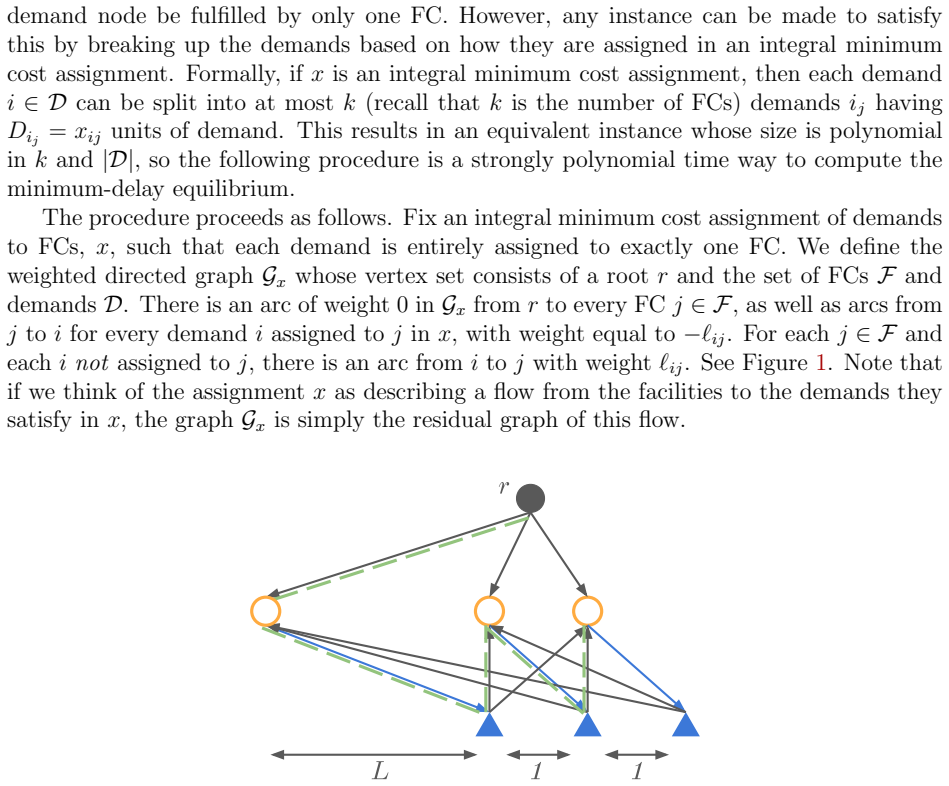
We characterize fulfillment assignments satisfying an equilibrium condition based on the greedy fulfillment strategy
What do these tags mean?
- matches
- The paper's claim is directly supported by a theorem in the formal canon.
- supports
- The theorem supports part of the paper's argument, but the paper may add assumptions or extra steps.
- extends
- The paper goes beyond the formal theorem; the theorem is a base layer rather than the whole result.
- uses
- The paper appears to rely on the theorem as machinery.
- contradicts
- The paper's claim conflicts with a theorem or certificate in the canon.
- unclear
- Pith found a possible connection, but the passage is too broad, indirect, or ambiguous to say the theorem truly supports the claim.
Reference graph
Works this paper leans on
-
[1]
Sizing down to scale up: How Amazon reworked its fulfillment network to meet customer demand , author=
-
[2]
The rise of quick commerce: transforming India’s retail, consumer behaviors, and employment dynamics , author=
-
[3]
Manufacturing & Service Operations Management , volume=
Understanding the Value of Fulfillment Flexibility in an Online Retailing Environment , author=. Manufacturing & Service Operations Management , volume=. 2021 , publisher=
work page 2021
-
[4]
Manufacturing & Service Operations Management , volume=
Benefits of Reevaluating Real-Time Order Fulfillment Decisions , author=. Manufacturing & Service Operations Management , volume=. 2008 , publisher=
work page 2008
-
[5]
Inventory Allocation under the Greedy Fulfillment Policy: The (Potential) Perils of the Hindsight Approach , author=. Available at SSRN: https://ssrn.com/abstract=4815848 or http://dx.doi.org/10.2139/ssrn.4815848 , year=
-
[6]
Rise of Quick Commerce in India: Business Models and Infrastructure Requirements , author=. 2023 , note =
work page 2023
-
[7]
Omnichannel Operations: Challenges, Opportunities, and Models
Jasin, Stefanus and Sinha, Amitabh and Uichanco, Joline. Omnichannel Operations: Challenges, Opportunities, and Models. Operations in an Omnichannel World. 2019. doi:10.1007/978-3-030-20119-7_2
-
[8]
Principles on the Benefits of Manufacturing Process Flexibility , author=. Management science , volume=. 1995 , publisher=
work page 1995
-
[9]
INFORMS Journal on Applied Analytics , volume=
Regionalize and Scale: Amazon’s Fulfillment Network Design for Faster and Cheaper Delivery , author=. INFORMS Journal on Applied Analytics , volume=. 2026 , publisher=
work page 2026
-
[10]
Kuhn, H. W. , title =. Naval Research Logistics Quarterly , volume =. doi:https://doi.org/10.1002/nav.3800020109 , url =. https://onlinelibrary.wiley.com/doi/pdf/10.1002/nav.3800020109 , year =
-
[11]
Bertsekas, Dimitri P. , title=. Mathematical Programming , year=. doi:10.1007/BF01584237 , url=
-
[12]
Edmonds, Jack and Karp, Richard M. , title =. 1972 , issue_date =. doi:10.1145/321694.321699 , journal =
-
[13]
Michel L. Balinski , title =. Oper. Res. , volume =. 1985 , url =. doi:10.1287/OPRE.33.3.527 , timestamp =
-
[14]
Multi-Item Auctions , urldate =
Gabrielle Demange and David Gale and Marilda Sotomayor , journal =. Multi-Item Auctions , urldate =
-
[15]
Shapley, L. S. and Shubik, M. , title=. International Journal of Game Theory , year=. doi:10.1007/BF01753437 , url=
discussion (0)
Sign in with ORCID, Apple, or X to comment. Anyone can read and Pith papers without signing in.