Recognition: 2 theorem links
· Lean TheoremKeyed Nonlinear Transform: Lightweight Privacy-Enhancing Feature Sharing for Medical Image Analysis
Pith reviewed 2026-05-15 02:09 UTC · model grok-4.3
The pith
A keyed nonlinear transform applied to split-inference features cuts re-identification AUC from 0.635 to 0.586 with 0.15 ms overhead and no backbone retraining.
A machine-rendered reading of the paper's core claim, the machinery that carries it, and where it could break.
Core claim
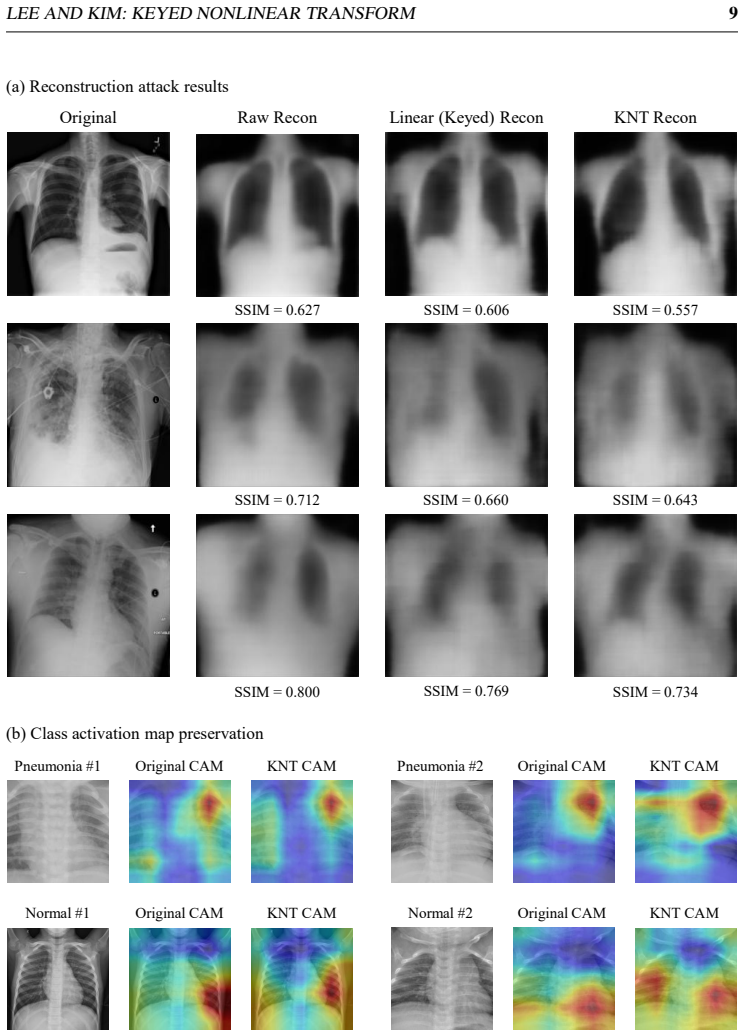
KNT is a drop-in feature transformation that applies key-conditioned nonlinear obfuscation to intermediate representations before transmission in split inference. When inserted into medical-image classification pipelines, it lowers re-identification AUC from 0.635 to 0.586, corresponding to a 36 percent reduction in above-chance identity leakage, at a computational cost of 0.15 ms per sample and with classification performance preserved within 1.0 percentage point. The nonlinearity ensures that inversion has no closed-form solution, forcing any recovery attempt under full key compromise into expensive iterative optimization. The identical transform generalizes directly to dense-prediction (e
What carries the argument
The Keyed Nonlinear Transform: a secret-key-conditioned nonlinear function applied to feature vectors that blocks closed-form inversion and shifts recovery to iterative gradient descent.
If this is right
- Classification accuracy on the original medical task drops by less than one percentage point.
- Re-identification risk falls without any retraining of the backbone network.
- The same layer can be reused for segmentation, producing only a 4.4 point Dice reduction.
- Recovery of the raw features requires iterative optimization rather than direct inversion.
Where Pith is reading between the lines
- Hospitals could insert KNT as a one-line post-processing step on existing split-inference deployments to satisfy stricter privacy regulations.
- Periodic key rotation would further raise the cost of long-term inversion attempts.
- The same keyed-nonlinear principle may apply to other resource-constrained feature-sharing settings such as video or sensor streams.
Load-bearing premise
The secret key remains unknown to the attacker and the nonlinear mapping prevents closed-form inversion even when the key is known.
What would settle it
An experiment in which an attacker given the key recovers the original features via a closed-form equation or in which re-identification AUC remains at or above 0.62 after KNT application would falsify the central claim.
Figures


read the original abstract
Feature sharing via split inference offers a lightweight alternative to federated learning for resource-constrained hospitals, but transmitted features still leak patient identity information and lack practical mechanisms for controlled feature sharing. We propose Keyed Nonlinear Transform (KNT), a drop-in feature transformation that applies key-conditioned obfuscation to intermediate representations. KNT reduces re-identification AUC from 0.635 to 0.586, corresponding to a 36% reduction in above-chance identity signal, while introducing only 0.15 ms CPU overhead, without backbone retraining, and preserving classification performance within 1.0 pp. Our analysis shows that KNT's nonlinear transform prevents closed-form inversion and shifts recovery to iterative gradient-based optimization under full key compromise, substantially increasing inversion difficulty. The same transform generalizes to dense prediction tasks, incurring only a 4.4 pp Dice reduction on skin-lesion segmentation without retraining. These results position KNT as a practical and efficient privacy layer for split inference deployments.
Editorial analysis
A structured set of objections, weighed in public.
Referee Report
Summary. The paper proposes Keyed Nonlinear Transform (KNT), a drop-in key-conditioned nonlinear feature transformation for split inference in medical image analysis. It claims to reduce re-identification AUC from 0.635 to 0.586 (a 36% reduction in above-chance identity signal) with only 0.15 ms CPU overhead, without backbone retraining, while preserving classification accuracy within 1.0 pp and generalizing to segmentation with a 4.4 pp Dice reduction on skin-lesion tasks. The analysis asserts that the nonlinear transform prevents closed-form inversion and forces recovery into iterative gradient-based optimization even under full key compromise.
Significance. If the results hold, KNT provides a lightweight, practical privacy layer for feature sharing in resource-constrained medical imaging deployments. The concrete empirical numbers (AUC drop, 0.15 ms overhead, no-retraining constraint, and cross-task generalization) and the avoidance of federated-learning overhead represent a useful engineering contribution for split-inference pipelines.
major comments (1)
- [Abstract and privacy analysis] Abstract and privacy analysis: the claim that KNT 'substantially increasing inversion difficulty' under full key compromise rests on the assertion that the nonlinear transform prevents closed-form inversion and shifts recovery to iterative gradient-based optimization, yet the manuscript supplies no iteration-count bounds, no Lipschitz analysis of the inversion loss, and no empirical comparison against stronger attacks (learned inversion networks or alternating optimization). If any such attack recovers features with re-identification AUC remaining above ~0.60, the reported 36% above-chance reduction is not demonstrated.
minor comments (2)
- [Results] Results tables/figures: the AUC values (0.635 to 0.586) are presented without error bars, dataset cardinality, or full attack-model specification, which limits assessment of statistical reliability and reproducibility.
- [Method] Notation: the precise functional form of the key-conditioned nonlinear transform and the manner in which the secret key is injected should be stated explicitly (e.g., as an equation) to support independent implementation.
Simulated Author's Rebuttal
We thank the referee for the constructive comments on our manuscript. We address the major comment on the abstract and privacy analysis below.
read point-by-point responses
-
Referee: [Abstract and privacy analysis] Abstract and privacy analysis: the claim that KNT 'substantially increasing inversion difficulty' under full key compromise rests on the assertion that the nonlinear transform prevents closed-form inversion and shifts recovery to iterative gradient-based optimization, yet the manuscript supplies no iteration-count bounds, no Lipschitz analysis of the inversion loss, and no empirical comparison against stronger attacks (learned inversion networks or alternating optimization). If any such attack recovers features with re-identification AUC remaining above ~0.60, the reported 36% above-chance reduction is not demonstrated.
Authors: We acknowledge that the manuscript does not supply explicit iteration-count bounds, Lipschitz analysis of the inversion loss, or empirical comparisons against stronger attacks such as learned inversion networks or alternating optimization. Our analysis establishes that the key-conditioned nonlinearity precludes closed-form inversion, thereby forcing recovery into iterative gradient-based optimization. To address the referee's concern and strengthen the claim of substantially increased inversion difficulty, we will revise the manuscript to add: (1) iteration-count bounds derived from the optimization landscape, (2) a Lipschitz constant estimate for the inversion objective, and (3) new experiments evaluating re-identification AUC under learned inversion networks and alternating optimization with full key compromise. These additions will directly test whether the reported AUC reduction holds against the suggested stronger attacks. revision: yes
Circularity Check
No circularity in derivation chain
full rationale
The paper reports empirical measurements of re-identification AUC reduction (0.635 to 0.586), CPU overhead (0.15 ms), and task performance preservation as direct experimental outcomes on held-out data. No equations, fitted parameters, or self-citations are shown that reduce these quantities to inputs by construction. The description of the nonlinear transform shifting inversion to gradient-based optimization is a qualitative claim about attack difficulty, not a self-referential derivation or renamed known result. The central claims remain independent of any load-bearing self-citation or ansatz smuggling.
Axiom & Free-Parameter Ledger
Lean theorems connected to this paper
-
IndisputableMonolith/Cost/FunctionalEquation.leanwashburn_uniqueness_aczel unclear?
unclearRelation between the paper passage and the cited Recognition theorem.
KNT’s nonlinear transform prevents closed-form inversion and shifts recovery to iterative gradient-based optimization under full key compromise
-
IndisputableMonolith/Foundation/AlphaCoordinateFixation.leancostAlphaLog_high_calibrated_iff unclear?
unclearRelation between the paper passage and the cited Recognition theorem.
per-patch multi-layer nonlinear transform with key-derived parameters … ReLU(Wk h + bk)
What do these tags mean?
- matches
- The paper's claim is directly supported by a theorem in the formal canon.
- supports
- The theorem supports part of the paper's argument, but the paper may add assumptions or extra steps.
- extends
- The paper goes beyond the formal theorem; the theorem is a base layer rather than the whole result.
- uses
- The paper appears to rely on the theorem as machinery.
- contradicts
- The paper's claim conflicts with a theorem or certificate in the canon.
- unclear
- Pith found a possible connection, but the passage is too broad, indirect, or ambiguous to say the theorem truly supports the claim.
Reference graph
Works this paper leans on
-
[1]
Brendan McMahan, Ilya Mironov, Kunal Talwar, and Li Zhang
Martin Abadi, Andy Chu, Ian Goodfellow, H. Brendan McMahan, Ilya Mironov, Kunal Talwar, and Li Zhang. Deep learning with differential privacy. InProceedings of the 2016 ACM SIGSAC Conference on Computer and Communications Security (CCS ’16), pages 308–318. ACM, 2016. doi: 10.1145/2976749.2978318
-
[2]
Saheed Ademola Bello, Muhammad Shahid Jabbar, Muhammad Sohail Ibrahim, and Shujaat Khan. Privacy-preserving collaborative medical image segmentation using la- tent transform networks.arXiv preprint arXiv:2603.05541, 2026
-
[3]
Nicholas Carlini, Samuel Deng, Sanjam Garg, Somesh Jha, Saeed Mahloujifar, Mo- hammad Mahmoody, Shuang Song, Abhradeep Thakurta, and Florian Tramèr. Is pri- vate learning possible with instance encoding? InProceedings of the 2021 IEEE Sym- posium on Security and Privacy (S&P), pages 410–427. IEEE, 2021
work page 2021
-
[4]
Noel C. F. Codella, Veronica Rotemberg, Philipp Tschandl, M. Emre Celebi, Stephen Dusza, David Gutman, Brian Helba, Aadi Kalloo, Konstantinos Liopyris, Michael Marchetti, Harald Kittler, and Allan Halpern. Skin lesion analysis toward melanoma detection 2018: A challenge hosted by the international skin imaging collaboration (isic).arXiv preprint arXiv:190...
work page internal anchor Pith review Pith/arXiv arXiv 2018
-
[5]
The algorithmic foundations of differential privacy
Cynthia Dwork and Aaron Roth. The algorithmic foundations of differential privacy. Foundations and Trends in Theoretical Computer Science, 9(3-4):211–407, 2014. doi: 10.1561/0400000042
-
[6]
Ege Erdogan, Alptekin Küpçü, and A. Ercüment Çiçek. Unsplit: Data-oblivious model inversion, model stealing, and label inference attacks against split learning. InProceed- ings of the 21st Workshop on Privacy in the Electronic Society (WPES@CCS), pages 115–124, 2022. doi: 10.1145/3559613.3563201
-
[7]
Keyed chaotic dynamics for privacy-preserving neural inference
Peter David Fagan. Keyed chaotic dynamics for privacy-preserving neural inference. arXiv preprint arXiv:2505.23655, 2025
-
[8]
PCAT: Functionality and data stealing from split learning by pseudo-client attack
Xinben Gao and Lan Zhang. PCAT: Functionality and data stealing from split learning by pseudo-client attack. InProceedings of the 32nd USENIX Security Symposium, pages 5271–5288, 2023
work page 2023
-
[9]
Griffin Higgins, Roozbeh Razavi-Far, Xichen Zhang, Amir David, Ali Ghorbani, and Tongyu Ge. Towards privacy-preserving split learning: Destabilizing adversarial infer- ence and reconstruction attacks in the cloud.Internet of Things, 31:101558, 2025. doi: 10.1016/j.iot.2025.101558
-
[10]
Instahide: Instance-hiding schemes for private distributed learning
Yangsibo Huang, Zhao Song, Kai Li, and Sanjeev Arora. Instahide: Instance-hiding schemes for private distributed learning. InProceedings of the 37th International Con- ference on Machine Learning (ICML), pages 4507–4518. PMLR, 2020
work page 2020
-
[11]
Matthew S. Macpherson, Charles E. Hutchinson, Carolyn Horst, Vicky Goh, and Gio- vanni Montana. Patient reidentification from chest radiographs: An interpretable deep metric learning approach and its applications.Radiology: Artificial Intelligence, 5(6): e230019, 2023. doi: 10.1148/ryai.230019. 16LEE AND KIM: KEYED NONLINEAR TRANSFORM
-
[12]
Ex- ploiting unintended feature leakage in collaborative learning
Luca Melis, Congzheng Song, Emiliano De Cristofaro, and Vitaly Shmatikov. Ex- ploiting unintended feature leakage in collaborative learning. InProceedings of the IEEE Symposium on Security and Privacy (S&P), pages 691–706, 2019. doi: 10.1109/SP.2019.00029
-
[13]
Tullsen, and Hadi Esmaeilzadeh
Fatemehsadat Mireshghallah, Mohammadkazem Taram, Prakash Ramrakhyani, Ali Jalali, Dean M. Tullsen, and Hadi Esmaeilzadeh. Shredder: Learning noise distribu- tions to protect inference privacy. InProceedings of the 25th International Conference on Architectural Support for Programming Languages and Operating Systems (ASP- LOS), pages 3–18, 2020. doi: 10.11...
-
[14]
Shoko Niwa, Sayaka Shiota, and Hitoshi Kiya. Speech privacy-preserving methods us- ing secret key for convolutional neural network models and their robustness evaluation. APSIPA Transactions on Signal and Information Processing, 13(1), 2024
work page 2024
-
[15]
Kai Packhäuser, Sebastian Gundel, Nicolas Münster, Christopher Syben, Vincent Christlein, and Andreas Maier. Deep learning-based patient re-identification is able to exploit the biometric nature of medical chest x-ray data.Scientific Reports, 12: 14851, 2022. doi: 10.1038/s41598-022-19045-3
-
[16]
Kai Packhäuser, Sebastian Gündel, Florian Thamm, Felix Denzinger, and Andreas Maier. Deep learning-based anonymization of chest radiographs: A utility-preserving measure for patient privacy. InMedical Image Computing and Computer-Assisted In- tervention – MICCAI 2023, volume 14222 ofLecture Notes in Computer Science, pages 262–272. Springer, 2023. doi: 10...
-
[17]
Shanghao Shi, Ning Wang, Yang Xiao, Chaoyu Zhang, Yi Shi, Y . Thomas Hou, and Wenjing Lou. Scale-MIA: A scalable model inversion attack against secure federated learning via latent space reconstruction. InProceedings of the Network and Distributed System Security Symposium (NDSS), 2025
work page 2025
-
[18]
DISCO: Dynamic and invariant sensitive channel obfuscation for deep neural networks
Abhishek Singh, Ayush Chopra, Ethan Garza, Emily Zhang, Praneeth Vepakomma, Vivek Sharma, and Ramesh Raskar. DISCO: Dynamic and invariant sensitive channel obfuscation for deep neural networks. InProceedings of the IEEE/CVF Conference on Computer Vision and Pattern Recognition (CVPR), pages 12125–12135, 2021
work page 2021
-
[19]
Split learning for health: Distributed deep learning without sharing raw patient data
Praneeth Vepakomma, Otkrist Gupta, Tristan Swedish, and Ramesh Raskar. Split learning for health: Distributed deep learning without sharing raw patient data.arXiv preprint arXiv:1812.00564, 2018
work page internal anchor Pith review Pith/arXiv arXiv 2018
-
[20]
Nopeek: Information leakage reduction to share activations in distributed deep learning
Praneeth Vepakomma, Abhishek Singh, Otkrist Gupta, and Ramesh Raskar. Nopeek: Information leakage reduction to share activations in distributed deep learning. InPro- ceedings of the IEEE International Conference on Data Mining Workshops (ICDMW), pages 933–942, 2020. doi: 10.1109/ICDMW51313.2020.00134
-
[21]
Xiaosong Wang, Yifan Peng, Le Lu, Zhiyong Lu, Mohammadhadi Bagheri, and Ronald M. Summers. Chestx-ray8: Hospital-scale chest x-ray database and bench- marks on weakly-supervised classification and localization of common thorax diseases. InProceedings of the IEEE Conference on Computer Vision and Pattern Recognition (CVPR), pages 3462–3471, 2017. doi: 10.1...
-
[22]
Edward Suh, and Srinivas Devadas
Hanshen Xiao, G. Edward Suh, and Srinivas Devadas. Formal privacy proof of data encoding: The possibility and impossibility of learnable encryption. InProceedings of the 2024 ACM SIGSAC Conference on Computer and Communications Security (CCS ’24), New York, NY , USA, 2024. ACM. doi: 10.1145/3658644.3670277
-
[23]
A stealthy wrongdoer: Feature-oriented reconstruction attack against split learning
Xiaoyang Xu, Mengda Yang, Wenzhe Yi, Ziang Li, Juan Wang, Hongxin Hu, Yong Zhuang, and Yaxin Liu. A stealthy wrongdoer: Feature-oriented reconstruction attack against split learning. InProceedings of the IEEE/CVF Conference on Computer Vision and Pattern Recognition (CVPR), pages 12130–12139, 2024
work page 2024
-
[24]
Jiancheng Yang, Rui Shi, Donglai Wei, Zequan Liu, Lin Zhao, Bilian Ke, Hanspeter Pfister, and Bingbing Ni. Medmnist v2 – a large-scale lightweight benchmark for 2d and 3d biomedical image classification.Scientific Data, 10(41), 2023. doi: 10.1038/ s41597-022-01721-8
work page 2023
-
[25]
Privacy-preserving split learning via patch shuffling over transformers
Dixi Yao, Liyao Xiang, Hengyuan Xu, Hangyu Ye, and Min Chen. Privacy-preserving split learning via patch shuffling over transformers. InProceedings of the IEEE Inter- national Conference on Data Mining (ICDM), pages 638–647, 2022. doi: 10.1109/ ICDM54844.2022.00074
-
[26]
Hongyao Yu, Yixiang Qiu, Hao Fang, Tianqu Zhuang, Bin Chen, Sijin Yu, Bin Wang, Shu-Tao Xia, and Ke Xu. Rank matters: Understanding and defending model inver- sion attacks via low-rank feature filtering.arXiv preprint arXiv:2410.05814, 2024. Accepted at KDD 2026
-
[27]
Medical imaging deep learning with differential privacy.Scientific Reports, 11:13524, 2021
Alexander Ziller, Dmitrii Usynin, Rickmer Braren, Marcus Makowski, and Georgios Kaissis. Medical imaging deep learning with differential privacy.Scientific Reports, 11:13524, 2021. doi: 10.1038/s41598-021-93030-0
discussion (0)
Sign in with ORCID, Apple, or X to comment. Anyone can read and Pith papers without signing in.