Stochastic Mackey-Glass Equations and Other Negative Feedback Systems: Existence of Invariant Measures
Pith reviewed 2026-05-15 02:02 UTC · model grok-4.3
The pith
Non-trivial invariant measures exist for stochastic negative feedback systems if and only if solutions from at least one initial condition remain bounded away from zero in probability.
A machine-rendered reading of the paper's core claim, the machinery that carries it, and where it could break.
Core claim
For stochastic negative feedback systems like the perturbed Mackey-Glass equation, a non-trivial invariant measure exists if and only if there exists at least one initial condition for which the corresponding solution remains bounded away from zero in probability. This characterization holds when the driving noise is a square integrable Lévy process with finite intensity, and solutions are globally persistent and upper bounded in probability under the paper's mild assumptions. The result is obtained via the Krylov-Bogoliubov method, with numerical simulations illustrating the measures and their link to long-term dynamics.
What carries the argument
The equivalence between existence of a non-trivial invariant measure and the existence of an initial condition yielding solutions bounded away from zero in probability, established through the Krylov-Bogoliubov method.
If this is right
- Solutions that avoid approaching zero in probability admit an invariant measure that captures their asymptotic distribution.
- The result extends to other negative feedback systems such as Nicholson's blowflies equation under similar noise conditions.
- Global persistence and upper boundedness in probability are sufficient to apply the Krylov-Bogoliubov theorem for existence.
- Numerical simulations can identify these invariant measures and confirm their relation to the system's behavior over time.
Where Pith is reading between the lines
- This condition may help determine when multiplicative noise preserves positive population densities in biological models.
- Similar techniques could apply to other stochastic delay differential equations in population dynamics.
- Testing the bounded-away-from-zero condition numerically could predict the existence of invariant measures without full proof.
- If the noise intensity increases, it might push solutions toward zero, eliminating the invariant measure.
Load-bearing premise
The mild assumptions that ensure global persistence and upper boundedness in probability for the solutions hold, along with the noise being a square integrable Lévy process with finite intensity.
What would settle it
A counterexample where all solutions approach zero in probability yet a non-trivial invariant measure still exists, or conversely where some solutions stay bounded away from zero but no invariant measure is found.
Figures


read the original abstract
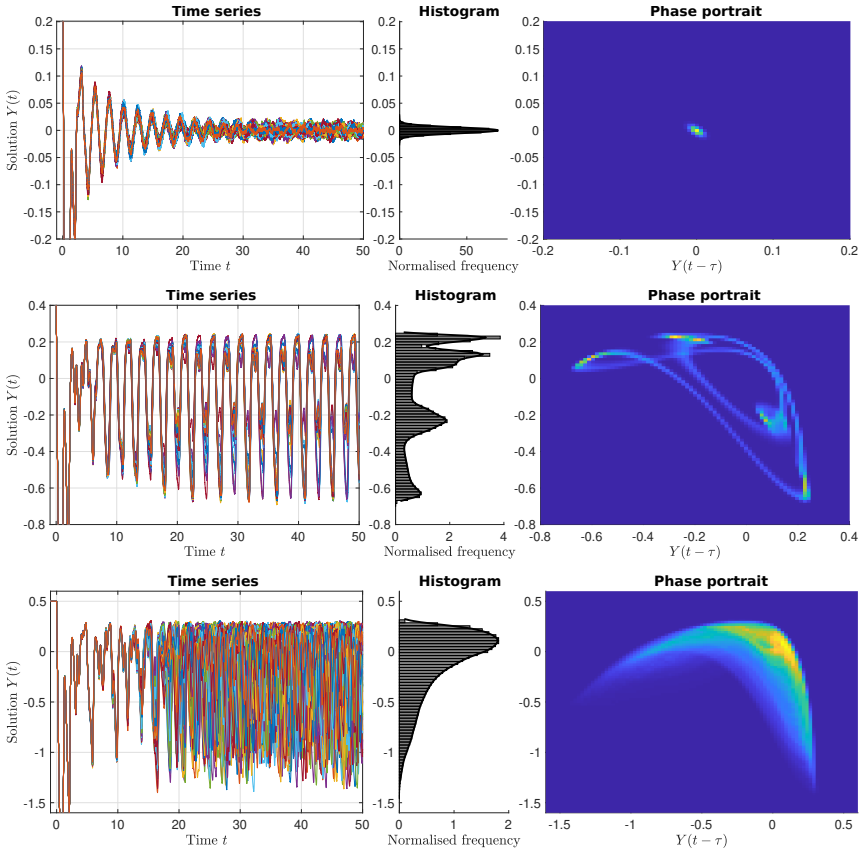
We study equations like the Mackey-Glass equations and Nicholson's blowflies equation, each perturbed by a (small) multiplicative noise term. Solutions to these stochastic negative feedback systems persist globally and are bounded above in probability under mild assumptions. A non-trivial invariant measure is proved to exist if and only if there is at least one initial condition for which the solution remains bounded away from zero in probability. The noise driving the dynamical system is allowed to be a square integrable L\'evy process with finite intensity. Existence of invariant measures is obtained via the Krylov-Bogoliubov method. In addition to our theoretical results, we present numerical simulations identifying the invariant measures obtained via the Krylov-Bogoliubov method and illustrating their connection to the system's long-term behaviour.
Editorial analysis
A structured set of objections, weighed in public.
Referee Report
Summary. The paper establishes an if-and-only-if criterion for the existence of a non-trivial invariant measure for stochastic negative-feedback delay equations (including stochastic Mackey-Glass and Nicholson's blowflies models) driven by square-integrable Lévy noise with finite intensity. Under mild assumptions guaranteeing global existence, persistence, and upper boundedness in probability of the scalar process, the authors apply the Krylov-Bogoliubov theorem to show that a non-trivial invariant measure exists precisely when there is at least one initial condition for which the solution remains bounded away from zero in probability. Numerical simulations are included to illustrate the long-term behavior and the obtained measures.
Significance. If the central result holds, the work supplies a concrete, checkable criterion for invariant-measure existence in a biologically relevant class of stochastic delay equations, extending classical deterministic persistence results to the Lévy-driven setting. The iff character of the theorem and the allowance for finite-intensity Lévy noise are practically useful; the numerical component further aids verification of the long-term dynamics.
major comments (1)
- [Proof of the main existence theorem (Krylov-Bogoliubov application)] In the proof that applies the Krylov-Bogoliubov theorem (the main existence result), tightness of the family of averaged occupation measures μ_T in the space of probability measures on D([-τ,0],ℝ) equipped with the Skorohod topology is asserted on the basis of global boundedness in probability of the scalar process X(t). However, no uniform-in-t Kolmogorov-type moment bounds of the form E[sup_{|θ|≤τ} |X(t+θ)-X(t)|^p] are derived to control the modulus of continuity of the history segments X_t under the jumps of the multiplicative Lévy noise. Without such bounds the passage from marginal boundedness to tightness in the function space is not justified and constitutes a load-bearing gap.
minor comments (3)
- [Theorem statement] The statement of the main theorem would benefit from an explicit list of the precise assumptions on the feedback function f and the Lévy measure that are used to obtain global existence and the upper bound in probability.
- [Numerical simulations] In the numerical section the discretization scheme for the stochastic delay equation and the method used to approximate the invariant measure from long trajectories should be stated more precisely, including step-size and burn-in choices.
- [Preliminaries] Notation for the history segment X_t(·) and the Skorohod metric is introduced without a dedicated preliminary subsection; a short paragraph recalling the topology on D([-τ,0],ℝ) would improve readability.
Simulated Author's Rebuttal
We thank the referee for the thorough review and constructive criticism of our manuscript. We address the single major comment below and will revise the paper to incorporate the requested justification.
read point-by-point responses
-
Referee: [Proof of the main existence theorem (Krylov-Bogoliubov application)] In the proof that applies the Krylov-Bogoliubov theorem (the main existence result), tightness of the family of averaged occupation measures μ_T in the space of probability measures on D([-τ,0],ℝ) equipped with the Skorohod topology is asserted on the basis of global boundedness in probability of the scalar process X(t). However, no uniform-in-t Kolmogorov-type moment bounds of the form E[sup_{|θ|≤τ} |X(t+θ)-X(t)|^p] are derived to control the modulus of continuity of the history segments X_t under the jumps of the multiplicative Lévy noise. Without such bounds the passage from marginal boundedness to tightness in the function space is not justified and constitutes a load-bearing gap.
Authors: We agree with the referee that the tightness argument in the application of the Krylov-Bogoliubov theorem requires additional justification to be fully rigorous. The manuscript currently relies on marginal boundedness in probability of X(t) but does not explicitly derive the uniform Kolmogorov moment bounds needed for the history segments in the Skorohod topology on D([-τ,0],ℝ). In the revised version we will add a new lemma (placed before the main theorem) that establishes these bounds. Because the driving Lévy noise has finite intensity, it is a compound Poisson process plus a drift; on any finite time interval there are only finitely many jumps almost surely. Combined with the global existence, persistence, and upper boundedness in probability already assumed in the paper, and using the Lipschitz continuity of the negative-feedback drift term, we obtain E[sup_{|θ|≤τ} |X(t+θ)-X(t)|^p] ≤ C_p uniformly in t for a suitable p>0 (e.g., p=1). These estimates, together with the marginal tightness, verify the standard tightness criterion for cadlag processes (e.g., Billingsley, Convergence of Probability Measures, Theorem 15.6). The main existence result and its if-and-only-if character remain unchanged; only the proof is completed. revision: yes
Circularity Check
No circularity; standard Krylov-Bogoliubov application under external assumptions
full rationale
The derivation applies the classical Krylov-Bogoliubov theorem to averaged occupation measures once global existence, upper boundedness in probability, and the persistence-away-from-zero condition are established from the stochastic delay equation and Lévy noise assumptions. These inputs are independent of the target invariant measure; the iff statement is a characterization of when the theorem yields a non-trivial measure rather than a self-definition. No fitted parameters, self-citation chains, or ansatz smuggling appear in the load-bearing steps. The result is self-contained against the external theorem and does not reduce to its inputs by construction.
Axiom & Free-Parameter Ledger
axioms (2)
- standard math Existence and properties of solutions to stochastic functional differential equations driven by square integrable Lévy processes with finite intensity
- standard math Krylov-Bogoliubov theorem for existence of invariant measures from tightness conditions
Reference graph
Works this paper leans on
-
[1]
R. J. Adler and J. E. Taylor (2009). Random fields and geometry. Springer Science & Business Media
work page 2009
-
[2]
D. Applebaum (2009). L´ evy Processes and Stochastic Calculus. Second edition. Cambridge Stud- ies in Advanced Mathematics. Cambridge University Press
work page 2009
-
[3]
J. A. D. Appleby and E. Buckwar (2003). Noise induced oscillation in solutions of stochastic delay differential equations. Tech. rep. SFB 373 Discussion Paper
work page 2003
-
[4]
J. A. D. Appleby and C. Kelly (2004). Oscillation and non-oscillation in solutions of nonlinear stochastic delay differential equations. Electronic Communications in Probability 9, 106–118
work page 2004
-
[5]
J. Bao, G. Yin, and C. Yuan (2016). Asymptotic Analysis for Functional Stochastic Differential Equations. SpringerBriefs in Mathematics. Springer International Publishing
work page 2016
-
[6]
F. A. Bartha, T. Krisztin, and A. V´ ıgh (2021). Stable periodic orbits for the Mackey–Glass equa- tion. Journal of Differential Equations 296, 15–49
work page 2021
-
[7]
L. Berezansky and E. Braverman (2006). Mackey–Glass equation with variable coefficients.Com- puters & Mathematics with Applications 51.1, 1–16
work page 2006
-
[8]
L. Berezansky, E. Braverman, and L. Idels (2010). Nicholson’s blowflies differential equations revisited: main results and open problems. Applied Mathematical Modelling 34.6, 1405–1417
work page 2010
-
[9]
L. Berezansky, E. Braverman, and L. Idels (2012). The Mackey–Glass model of respiratory dy- namics: review and new results. Nonlinear Analysis: Theory, Methods & Applications 75.16, 6034–6052
work page 2012
-
[10]
L. Berezansky, E. Braverman, and L. Idels (2013). Mackey–Glass model of hematopoiesis with non-monotone feedback: stability, oscillation and control.Applied Mathematics and Computa- tion 219.11, 6268–6283
work page 2013
-
[11]
P. Billingsley (1999). Convergence of Probability Measures. Second edition. Wiley Series in Prob- ability and Statistics. Wiley
work page 1999
-
[12]
A. Blumenthal and L.-S. Young (2026). Ergodic Theory: A Probabilistic Approach to Dynamical Systems. Springer Nature
work page 2026
-
[13]
V. I. Bogachev and M. A. S. Ruas (2007). Measure theory. Vol. 2. Springer
work page 2007
-
[14]
M. van den Bosch (2024). Notes on stochastic integration theory with respect to c` adl` ag semi- martingales and a brief introduction to L´ evy processes.arXiv preprint arXiv:2501.00140
-
[15]
M. van den Bosch, O. W. van Gaans, and S. M. Verduyn Lunel (2026a). Existence of Invari- ant Probability Measures for Stochastic Differential Equations with Finite Time Delay. SIAM Journal on Applied Dynamical Systems 25.2
-
[16]
Stochastic Wright's Equation: Existence of Invariant Measures
M. van den Bosch, O. W. van Gaans, and S. M. Verduyn Lunel (2026b). Stochastic Wright’s Equation: Existence of Invariant Measures. arXiv preprint arXiv:2605.09805
work page internal anchor Pith review Pith/arXiv arXiv
-
[17]
M. van den Bosch and H. J. Hupkes (2025). Multidimensional Stability of Planar Traveling Waves for Stochastically Perturbed Reaction–Diffusion Systems.Studies in Applied Mathematics155.3, e70114. 31
work page 2025
-
[18]
E. Buckwar et al. (2008). Weak convergence of the Euler scheme for stochastic differential delay equations. LMS journal of Computation and Mathematics 11, 60–99
work page 2008
-
[19]
V. V. Buldygin and Y. V. Kozachenko (1980). Sub-Gaussian random variables.Ukrainian Math- ematical Journal 32, 483–489
work page 1980
-
[20]
J. Busse (2024). Extinction properties of population models with non locally Lipschitz noise coefficients. MA thesis. Leiden University
work page 2024
-
[21]
O. Butkovsky and M. Scheutzow (2017). Invariant measures for stochastic functional differential equations. Electronic Journal of Probability 22.98, 1–24
work page 2017
-
[22]
K. L. Chung and R. Williams (1990). Introduction to Stochastic Integration. Second edition. Probability and Its Applications. Birkh¨ auser Boston
work page 1990
-
[23]
R. M. Corless et al. (1996). On the Lambert W function. Advances in Computational mathe- matics 5, 329–359
work page 1996
-
[24]
G. Da Prato and J. Zabczyk (2014). Stochastic equations in infinite dimensions. Cambridge uni- versity press
work page 2014
-
[25]
G. Da Prato and P. J. Zabczyk (1996). Ergodicity for Infinite Dimensional Systems . London Mathematical Society Lecture Note Series. Cambridge University Press
work page 1996
-
[26]
B. Davis (1976). On the Lp norms of stochastic integrals and other martingales. Duke mathe- matical journal
work page 1976
-
[27]
O. Diekmann et al. (2012). Delay equations: functional-, complex-, and nonlinear analysis. Vol. 110. Springer Science & Business Media
work page 2012
-
[28]
V. Duruisseaux and A. R. Humphries (2022). Bistability, bifurcations and chaos in the Mackey- Glass equation. Journal of Computational Dynamics 9.3, 421–450
work page 2022
-
[29]
J.-P. Eckmann and D. Ruelle (1985). Ergodic theory of chaos and strange attractors. Reviews of modern physics 57.3, 617
work page 1985
-
[30]
J. D. Farmer (1982). Chaotic attractors of an infinite-dimensional dynamical system. Physica D: Nonlinear Phenomena 4.3, 366–393
work page 1982
-
[31]
L. Glass (2001). Synchronization and rhythmic processes in physiology. Nature 410.6825, 277– 284
work page 2001
-
[32]
L. Glass and M. C. Mackey (1979). Pathological conditions resulting from instabilities in phys- iological control systems. Annals of the New York Academy of Sciences 316.1, 214–235
work page 1979
-
[33]
L. Glass and C. P. Malta (1990). Chaos in multi-looped negative feedback systems. Journal of theoretical biology 145.2, 217–223
work page 1990
-
[34]
W. S. C. Gurney, S. P. Blythe, and R. M. Nisbet (1980). Nicholson’s blowflies revisited. Nature 287.5777, 17–21
work page 1980
-
[35]
J. K. Hale and S. M. Verduyn Lunel (1993). Introduction to Functional Differential Equations. Applied Mathematical Sciences. Springer-Verlag New York
work page 1993
-
[36]
C. H. S. Hamster and H. J. Hupkes (2020). Stability of traveling waves on exponentially long timescales in stochastic reaction-diffusion equations.SIAM Journal on Applied Dynamical Sys- tems 19.4, 2469–2499. 32
work page 2020
-
[37]
O. H´ enot, J.-P. Lessard, and J. D. Mireles James (2023). Numerical computation of transverse homoclinic orbits for periodic solutions of delay differential equations.SIAM Journal on Applied Dynamical Systems 22.4, 3093–3129
work page 2023
- [38]
-
[39]
J. Jacod and A. N. Shiryaev (2003). Limit Theorems for Stochastic Processes. Second edition. Grundlehren der mathematischen Wissenschaften. Springer-Verlag Berlin Heidelberg
work page 2003
-
[40]
L. Junges and J. A. C. Gallas (2012). Intricate routes to chaos in the Mackey–Glass delayed feedback system. Physics letters A 376.30-31, 2109–2116
work page 2012
-
[41]
O. Kallenberg (2002). Foundations of modern probability. Second edition. Probability and its Applications. Springer-Verlag New York, xx+638
work page 2002
-
[42]
J. Kallsen and A. N. Shiraev (2002). Time change representation of stochastic integrals. Theory of Probability & Its Applications 46.3, 522–528
work page 2002
-
[43]
I. Karatzas and S. E. Shreve (1998). Brownian Motion and Stochastic Calculus. Second edition. Graduate Texts in Mathematics. Springer Science+Business Media New York
work page 1998
-
[44]
G. Kiss and G. R¨ ost (2017). Controlling mackey–glass chaos.Chaos: An Interdisciplinary Jour- nal of Nonlinear Science 27.11
work page 2017
-
[45]
E. Kojima and Y. Sato (2025). Resonance and chaos in the stochastic Mackey-Glass equation. arXiv preprint arXiv:2505.04874
-
[46]
V. Kolmanovskii and A. Myshkis (1999). Introduction to the theory and applications of functional differential equations. Springer Science+Business Media Dordrecht
work page 1999
-
[47]
T. Krisztin (2008). Global dynamics of delay differential equations.Periodica Mathematica Hun- garica 56.1, 83–95
work page 2008
-
[48]
T. Krisztin (2020). Periodic solutions with long period for the Mackey–Glass equation. Elec- tronic Journal of Qualitative Theory of Differential Equations 2020, Terjedelem–12
work page 2020
-
[49]
N. Krylov and N. Bogoliubov (1937). La th´ eorie g´ en´ erale de la mesure dans son application ` a l’´ etude des syst` emes dynamiques de la m´ ecanique non lin´ eaire.Annals of mathematics, 65–113
work page 1937
-
[50]
F. K¨ uhn and R. L. Schilling (2023). Maximal inequalities and some applications. Probability Surveys 20, 382–485
work page 2023
-
[51]
A. E. Kyprianou (2014). Fluctuations of L´ evy Processes with Applications: Introductory Lectures. Second edition. Universitext. Springer-Verlag Berlin Heidelberg
work page 2014
-
[52]
B. Lani-Wayda and H.-O. Walther (1996). Chaotic motion generated by delayed negative feed- back part II: Construction of nonlinearities. Mathematische Nachrichten 180.1, 141–211
work page 1996
- [53]
-
[54]
R. Liptser and A. N. Shiryayev (2012). Theory of martingales. Vol. 49. Springer Science & Busi- ness Media
work page 2012
-
[55]
On the Global Attractor of Delay Differential Equations with Unimodal Feedback
E. Liz and G. R¨ ost (2008). On the global attractor of delay differential equations with unimodal feedback. arXiv preprint arXiv:0807.3022. 33
work page internal anchor Pith review Pith/arXiv arXiv 2008
- [56]
-
[57]
J. Lossom et al. (2020). Density Evolution Under Delayed Dynamics. Fields Institute Mono- graphs 38
work page 2020
- [58]
-
[59]
G. Lowther (2020). Pathwise Burkholder–Davis–Gundy inequalities. URL: https://almostsuremath.com/2020/06/22/pathwise-burkholder-davis-gundy- inequalities/. Accessed: 2024-09-05
work page 2020
-
[60]
M. C. Mackey and L. Glass (1977). Oscillation and chaos in physiological control systems. Sci- ence 197.4300, 287–289
work page 1977
- [61]
-
[62]
X. Mao (2007). Stochastic Differential Equations and Applications. Second edition. Woodhead Publishing Limited
work page 2007
-
[63]
R. M. May and W. J. Leonard (1975). Nonlinear aspects of competition between three species. SIAM journal on applied mathematics 29.2, 243–253
work page 1975
-
[64]
J. D. Meiss (2007). Differential dynamical systems. SIAM
work page 2007
-
[65]
P. A. Meyer and G. Denzel (1966). Probability and Potentials. Blaisdell Publishing Company
work page 1966
-
[66]
J. G. Milton et al. (1989). Complex dynamics and bifurcations in neurology.Journal of theoretical biology 138.2, 129–147
work page 1989
-
[67]
P. J. Mitkowski and W. Mitkowski (2012). Ergodic theory approach to chaos: Remarks and com- putational aspects. International Journal of Applied Mathematics and Computer Science 22.2, 259–267
work page 2012
-
[68]
J. van Neerven and M. Veraar (2020). Maximal inequalities for stochastic convolutions in 2- smooth Banach spaces and applications to stochastic evolution equations.Philosophical Trans- actions of the Royal Society A 378.2185, 20190622
work page 2020
-
[69]
A. J. Nicholson (1954). An outline of the dynamics of animal populations. Australian journal of Zoology 2.1, 9–65
work page 1954
-
[70]
B. Øksendal and A. Sulem-Bialobroda (2005). Applied Stochastic Control of Jump Diffusions. Universitext. Springer-Verlag Berlin Heidelberg
work page 2005
-
[71]
P. E. Protter (2005). Stochastic Integration and Differential Equations. second. Stochastic Mod- elling and Applied Probability. Springer-Verlag Berlin Heidelberg
work page 2005
-
[72]
M. Reiß, M. Riedle, and O. W. van Gaans (2006). Delay differential equations driven by L´ evy processes: stationarity and Feller properties.Stochastic Processes and their Applications116.10, 1409–1432
work page 2006
-
[73]
D. Revuz and M. Yor (2005). Continuous Martingales and Brownian Motion . Third edition. Grundlehren der mathematischen Wissenschaften. Springer-Verlag Berlin Heidelberg. 34
work page 2005
-
[74]
P. Rigollet and J.-C. H¨ utter (2023). High-dimensional statistics. arXiv preprint arXiv:2310.19244
-
[75]
G. R¨ ost and J. Wu (2007). Domain-decomposition method for the global dynamics of delay dif- ferential equations with unimodal feedback. Proceedings of the Royal Society A: Mathematical, Physical and Engineering Sciences 463.2086, 2655–2669
work page 2007
-
[76]
K. Sato (1999). L´ evy Processes and Infinitely Divisible Distributions. Cambridge Studies in Ad- vanced Mathematics. Cambridge University Press
work page 1999
-
[77]
Sepp¨ al¨ ainen (2014).Basics of Stochastic Analysis
T. Sepp¨ al¨ ainen (2014).Basics of Stochastic Analysis. Lecture notes, November 16
work page 2014
-
[78]
M. Talagrand (2005). The generic chaining: upper and lower bounds of stochastic processes. Springer Science & Business Media
work page 2005
-
[79]
J. P. Tarigo et al. (2022). Characterizing multistability regions in the parameter space of the Mackey–Glass delayed system. The European Physical Journal Special Topics231.3, 273–281
work page 2022
-
[80]
R. Vershynin (2018). High-dimensional probability: An introduction with applications in data science. Vol. 47. Cambridge university press
work page 2018
discussion (0)
Sign in with ORCID, Apple, or X to comment. Anyone can read and Pith papers without signing in.