Recognition: no theorem link
Counting symmetric unimodular triangulations
Pith reviewed 2026-05-15 02:06 UTC · model grok-4.3
The pith
Lower and upper bounds are established for the number of symmetric unimodular triangulations of the dilated standard triangle with a fixed symmetry axis, along with complete enumerations for small cases.
A machine-rendered reading of the paper's core claim, the machinery that carries it, and where it could break.
Core claim
For the dilated standard triangle, the symmetric unimodular triangulations with a fixed symmetry axis admit lower and upper bounds on their numbers, and the paper supplies the complete list of all such triangulations when the dilation is small.
What carries the argument
The symmetric unimodular triangulation with a fixed symmetry axis, which enforces reflection symmetry across the axis while maintaining unimodularity on the integer lattice points.
If this is right
- The total number of such triangulations lies between the provided lower and upper bounds for any dilation.
- Exact counts are available for the smallest values of the dilation parameter.
- This enumeration can serve as a basis for generating or classifying symmetric structures in related geometric problems.
Where Pith is reading between the lines
- These bounds might extend to counting symmetric triangulations in higher-dimensional polytopes.
- Symmetry constraints could lead to recursive formulas for the numbers at larger dilations.
- The connection to T-curves suggests applications in real algebraic geometry for counting real curves with symmetry.
Load-bearing premise
The symmetry must be with respect to one fixed axis and the triangulations must be unimodular in the lattice sense.
What would settle it
A computation or construction of a symmetric unimodular triangulation for a dilation size where the count exceeds the upper bound or falls below the lower bound would falsify the claims.
Figures



read the original abstract
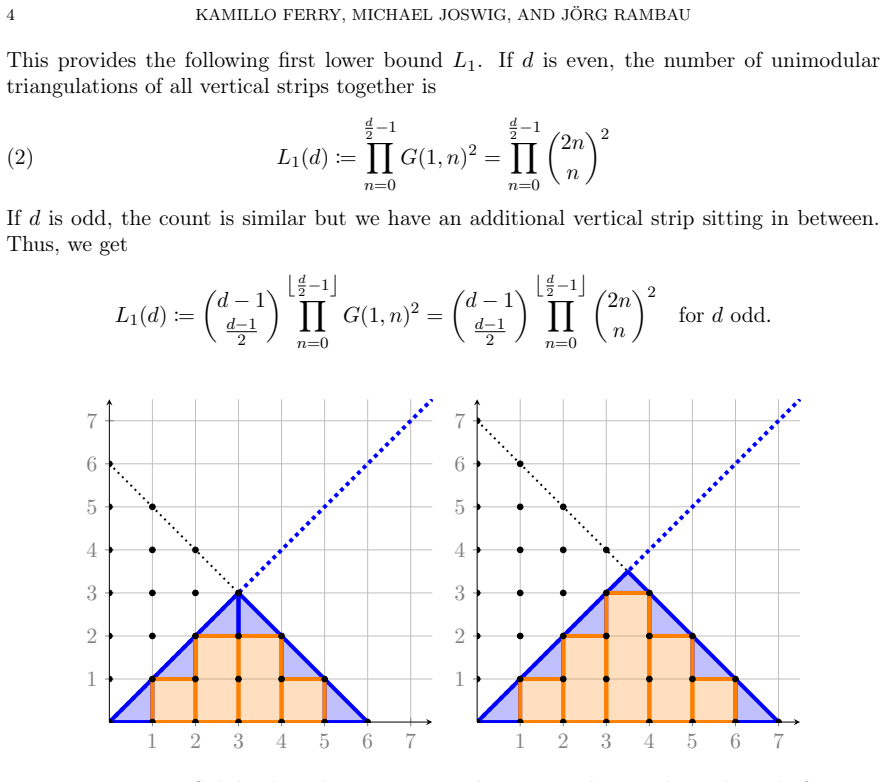
The objects of study are triangulations of the dilated standard triangle in the plane. Motivated by work on T-curves (Geiselmann et al., 2026), the focus lies on unimodular triangulations with a fixed symmetry axis. Lower and upper bounds are given, in combination with full enumerations of a few small cases.
Editorial analysis
A structured set of objections, weighed in public.
Referee Report
Summary. The manuscript defines symmetric unimodular triangulations of the dilated standard triangle with respect to a fixed axis. It supplies explicit lower and upper bounds on the number of such triangulations for general dilation parameters together with exhaustive enumerations for small values of the dilation parameter, motivated by work on T-curves.
Significance. If the bounds and enumerations hold, the work supplies concrete combinatorial data and estimates for symmetric lattice triangulations. The small-case enumerations provide verifiable test points that can support further asymptotic analysis or connections to T-curves in algebraic geometry.
minor comments (3)
- The abstract mentions 'a few small cases' but does not specify the exact range of dilation parameters enumerated; adding this would improve clarity for readers.
- §2: the definition of the fixed symmetry axis could include an explicit coordinate description or diagram to make the reflection-invariance condition immediately visible.
- The references section should confirm that the 2026 Geiselmann et al. citation is complete and that all prior literature on unimodular triangulations is consistently cited.
Simulated Author's Rebuttal
We thank the referee for their positive assessment of our manuscript on counting symmetric unimodular triangulations of dilated triangles and for recommending minor revision. We appreciate the recognition of the combinatorial data and potential links to T-curves.
read point-by-point responses
-
Referee: The manuscript defines symmetric unimodular triangulations of the dilated standard triangle with respect to a fixed axis. It supplies explicit lower and upper bounds on the number of such triangulations for general dilation parameters together with exhaustive enumerations for small values of the dilation parameter, motivated by work on T-curves.
Authors: We thank the referee for this accurate summary of the paper's contributions. The bounds and enumerations are indeed the core results, and the motivation from T-curves (Geiselmann et al., 2026) is correctly noted. revision: no
Circularity Check
No significant circularity identified
full rationale
The manuscript defines symmetric unimodular triangulations of the dilated standard triangle via the standard lattice-point and volume-1 conditions together with explicit reflection invariance across a fixed axis. Lower/upper bounds and exhaustive enumerations for small dilation parameters are derived directly from these combinatorial definitions and standard T-curve conventions cited from external literature (Geiselmann et al., 2026). No parameter is fitted to a subset of the target counts and then re-used as a prediction, no uniqueness theorem is imported from the authors' own prior work, and no ansatz or renaming reduces the central counting claims to the inputs by construction. The derivation chain is therefore self-contained.
Axiom & Free-Parameter Ledger
Reference graph
Works this paper leans on
-
[1]
Rambau, J\"org , title =
-
[2]
and Rambau, J\"org and Santos, Francisco , TITLE =
De Loera, Jes\'us A. and Rambau, J\"org and Santos, Francisco , TITLE =. 2010 , ISBN =. doi:10.1007/978-3-642-12971-1 , URL =
-
[3]
Orevkov, S. Yu. , TITLE =. J. Combin. Theory Ser. A , FJOURNAL =. 1999 , NUMBER =. doi:10.1006/jcta.1998.2921 , URL =
-
[4]
Anclin, Emile E. , TITLE =. J. Combin. Theory Ser. A , FJOURNAL =. 2003 , NUMBER =. doi:10.1016/S0097-3165(03)00097-9 , URL =
-
[5]
Aichholzer, Oswin and Hurtado, Ferran and Noy, Marc , TITLE =. Comput. Geom. , FJOURNAL =. 2004 , NUMBER =. doi:10.1016/j.comgeo.2004.02.003 , URL =
-
[6]
Welzl, Emo , TITLE =. Graph drawing , SERIES =. 2007 , ISBN =. doi:10.1007/978-3-540-70904-6\_1 , URL =
- [7]
-
[8]
Orevkov, S. Yu. , TITLE =. Mat. Sb. , FJOURNAL =. 2022 , NUMBER =. doi:10.4213/sm9727 , URL =
-
[9]
Orevkov, S. Yu. , title =. 2022 , eprint =
work page 2022
-
[10]
Aichholzer, Oswin and Hackl, Thomas and Huemer, Clemens and Hurtado, Ferran and Krasser, Hannes and Vogtenhuber, Birgit , TITLE =. Graphs Combin. , FJOURNAL =. 2007 , PAGES =. doi:10.1007/s00373-007-0704-5 , _URL =
-
[11]
and Filliman, Paul and Sturmfels, Bernd , TITLE =
Billera, Louis J. and Filliman, Paul and Sturmfels, Bernd , TITLE =. Adv. Math. , FJOURNAL =. 1990 , NUMBER =. doi:10.1016/0001-8708(90)90077-Z , _URL =
-
[12]
Geiselmann, Zoe and Joswig, Michael and Kastner, Lars and Mundinger, Konrad and Pokutta, Sebastian and Spiegel, Christoph and Wack, Marcel and Zimmer, Max , title =. 2026 , note =
work page 2026
- [13]
-
[14]
Discriminants, resultants and multidimensional determinants , publisher =. 2008 , author =
work page 2008
- [15]
-
[16]
Viro, O. Ya. , TITLE =. Topology (. 1984 , ISBN =. doi:10.1007/BFb0099934 , URL =
-
[17]
Sharir, Micha and Sheffer, Adam , TITLE =. Electron. J. Combin. , FJOURNAL =. 2011 , NUMBER =. doi:10.37236/557 , URL =
-
[18]
Avis, David and Fukuda, Komei , Title =. Discrete Appl. Math. , Volume =. 1996 , DOI =
work page 1996
discussion (0)
Sign in with ORCID, Apple, or X to comment. Anyone can read and Pith papers without signing in.