Recognition: 2 theorem links
· Lean TheoremThe Distribution of Blue Straggler Stars in the Color-Magnitude Diagrams of Old Open Clusters
Pith reviewed 2026-05-15 01:35 UTC · model grok-4.3
The pith
Half of blue straggler stars in old open clusters sit in the final third of their main-sequence lifetimes because of helium enrichment during formation.
A machine-rendered reading of the paper's core claim, the machinery that carries it, and where it could break.
Core claim
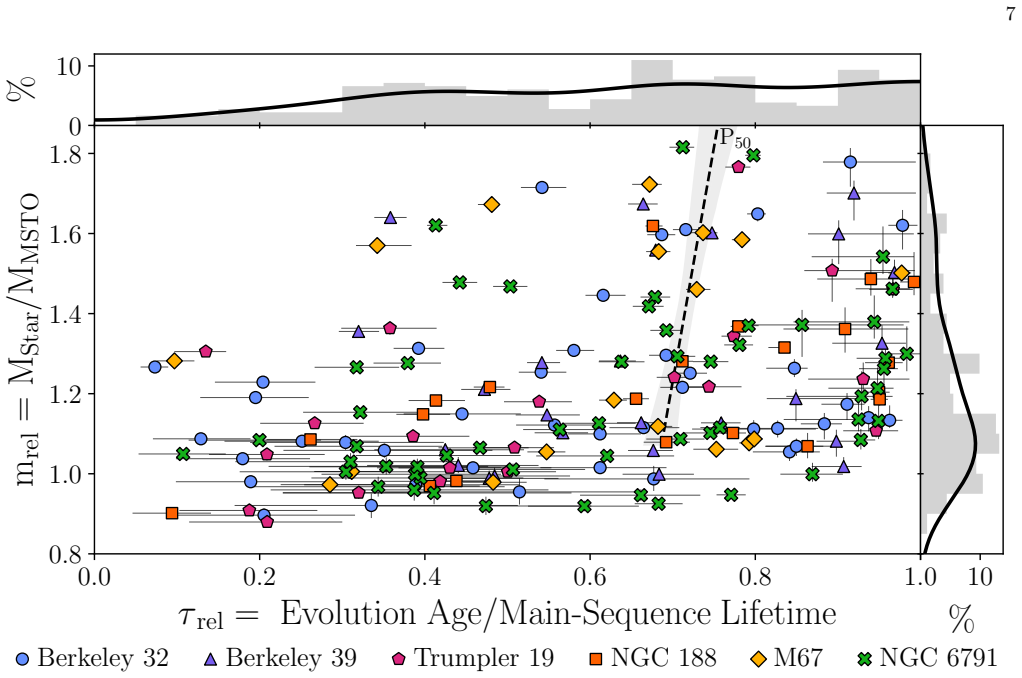
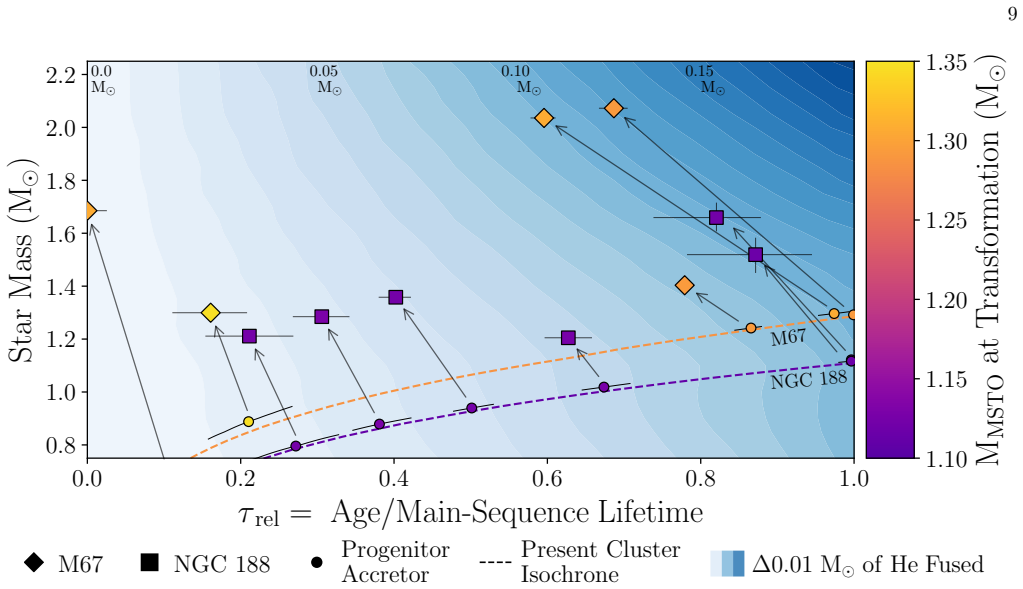
Fifty percent of the blue straggler stars have color-magnitude diagram locations corresponding to single stars in the final third of their main-sequence lifetimes. This build-up near the terminal-age main sequence is primarily, but not solely, driven by more massive blue stragglers. Inferred core helium amounts of late-evolution-age blue stragglers match the helium fused by cluster main-sequence stars near the turnoffs, indicating that helium enrichment of progenitor accretors produces the observed prevalence near the terminal-age main sequence.
What carries the argument
Color-magnitude diagram positions of blue stragglers relative to the terminal-age main sequence, combined with white-dwarf companion cooling ages that trace formation timing.
Load-bearing premise
Color-magnitude diagram positions and white-dwarf cooling ages accurately trace the evolutionary stages and formation times of blue stragglers without major effects from unresolved binaries, photometric errors, or non-conservative mass transfer.
What would settle it
Direct measurement of surface helium abundance in blue stragglers near the terminal-age main sequence that shows no excess helium relative to single-star models at the same position.
Figures



read the original abstract
We examine the blue straggler star (BSS) populations of six old ($\geq$4 Gyr) open clusters: M67, NGC 188, NGC 6791, Berkeley 32, Berkeley 39, and Trumpler 19. We find that 50% of BSSs have color-magnitude diagram (CMD) locations corresponding to single stars in the final third of their main-sequence lifetimes. This build-up of BSSs near the terminal-age main sequence (TAMS) is primarily, but not solely, driven by more massive BSSs. Eleven of the BSSs have white dwarf companions with measured cooling ages; their evolution age distributions indicate that more massive BSSs typically form far from the zero-age main sequence, whereas lower mass BSSs can form at every evolutionary age. We show that inferred core helium amounts (above primordial) of late-evolution-age BSSs correspond to the core helium fused by cluster main-sequence stars near the turnoffs. We also find that the masses of asymptotic giant branch (AGB) mass-transfer BSSs require evolved main-sequence accretors and conservative mass transfer. These findings indicate that helium enrichment of progenitor accretors leads to the prevalence of BSSs near the TAMS. We further classify the evolutionary stages of the progenitor donors in M67 and NGC 188 and find mass transfer during the AGB accounts for at least half of the BSSs. We trace how the main-sequence binary population of NGC 188 evolves, and find that only 30-40% of interacting binaries create BSSs and that progenitor orbits must change to match current BSS periods.
Editorial analysis
A structured set of objections, weighed in public.
Referee Report
Summary. The paper analyzes blue straggler star (BSS) populations in six old open clusters (M67, NGC 188, NGC 6791, Berkeley 32, Berkeley 39, Trumpler 19), reporting that 50% of BSSs occupy CMD positions matching single-star models in the final third of main-sequence lifetimes. This TAMS build-up is attributed primarily to more massive BSSs, with supporting evidence from 11 BSSs having white-dwarf companions whose cooling ages indicate mass-dependent formation epochs; the work concludes that helium enrichment of accretors drives the distribution, that AGB mass transfer accounts for at least half the BSSs in M67 and NGC 188, and that only 30-40% of interacting binaries produce BSSs.
Significance. If the central mapping and helium-enrichment interpretation hold, the result supplies quantitative observational constraints on BSS formation channels in old open clusters, particularly the relative importance of AGB mass transfer and the role of accretor helium enrichment in shifting BSSs toward the TAMS. This strengthens empirical tests of binary-evolution models and has direct implications for population-synthesis predictions of blue-straggler fractions and period distributions.
major comments (2)
- [CMD placement and isochrone comparison (abstract and §3)] The derivation of the headline 50% fraction (final third of MS lifetime) places observed BSSs on standard single-star isochrones without adjustment for the helium enrichment that the paper itself concludes is responsible for the TAMS build-up. Because helium enrichment shifts tracks blueward and brighter, the inferred fractional ages are model-dependent; this assumption is load-bearing for both the distribution claim and the causal link to helium enrichment.
- [WD cooling-age analysis (abstract and §4)] For the 11 BSSs with measured WD companions, the inference that more massive BSSs form far from the ZAMS while lower-mass ones form at all ages rests on WD cooling ages directly tracing BSS formation epochs. This requires conservative mass transfer and no significant contamination from unresolved companions or non-conservative mass loss, yet the manuscript discusses non-conservative aspects elsewhere; the robustness of the age distributions therefore needs explicit testing.
minor comments (2)
- [Data tables and methods] The manuscript text provides no tabulated BSS photometry, individual mass or age estimates, or error bars on the reported 50% fraction, which limits independent verification of the CMD placements.
- [Helium-enrichment section] Notation for core-helium content and evolutionary-age bins should be defined explicitly with reference to the adopted isochrone grid before the quantitative comparisons in the helium-enrichment discussion.
Simulated Author's Rebuttal
We thank the referee for their careful reading and insightful comments, which have prompted us to strengthen several aspects of the analysis. We address each major comment below with point-by-point responses.
read point-by-point responses
-
Referee: [CMD placement and isochrone comparison (abstract and §3)] The derivation of the headline 50% fraction (final third of MS lifetime) places observed BSSs on standard single-star isochrones without adjustment for the helium enrichment that the paper itself concludes is responsible for the TAMS build-up. Because helium enrichment shifts tracks blueward and brighter, the inferred fractional ages are model-dependent; this assumption is load-bearing for both the distribution claim and the causal link to helium enrichment.
Authors: We agree that the fractional main-sequence ages derived by placing BSSs on standard single-star isochrones carry model dependence, since helium enrichment shifts tracks to brighter and bluer positions. Our headline 50% statistic is therefore an approximate observational measure of CMD location relative to single-star turnoff models rather than a precise age. The causal interpretation of helium enrichment is supported independently in §3 by showing that the excess core helium inferred for the late-evolution BSSs matches the helium that would have been fused by cluster turnoff stars. In the revised manuscript we will add a short sensitivity test using available helium-enriched tracks to quantify the possible shift in inferred fractional age; preliminary checks indicate the TAMS build-up remains statistically significant. We therefore classify this as a partial revision. revision: partial
-
Referee: [WD cooling-age analysis (abstract and §4)] For the 11 BSSs with measured WD companions, the inference that more massive BSSs form far from the ZAMS while lower-mass ones form at all ages rests on WD cooling ages directly tracing BSS formation epochs. This requires conservative mass transfer and no significant contamination from unresolved companions or non-conservative mass loss, yet the manuscript discusses non-conservative aspects elsewhere; the robustness of the age distributions therefore needs explicit testing.
Authors: The WD cooling ages are interpreted as lower limits on the time since mass transfer ceased, under the assumption that the WD begins cooling once the donor detaches. For the 11 systems the observed BSS and WD masses are consistent with conservative transfer from AGB donors. While §5 discusses non-conservative evolution for the broader NGC 188 binary population, the specific WD+BSS binaries show no evidence for significant mass loss or third-light contamination. In the revision we will add an explicit robustness check by recomputing the formation-age distributions after allowing 10–20% non-conservative mass loss; the qualitative result that higher-mass BSSs form later persists. This constitutes a partial revision. revision: partial
Circularity Check
No circularity: observational CMD mapping and age inferences are independent of fitted inputs
full rationale
The paper reports direct counts of BSS locations on standard single-star isochrones (50% in final third of MS lifetime) and compares WD cooling ages to formation epochs. No equations, self-citations, or ansatze are quoted that reduce these counts or the helium-enrichment interpretation to a fitted parameter renamed as prediction, a self-definitional loop, or a load-bearing prior result by the same authors. The derivation chain remains self-contained against external isochrone models and cluster data.
Axiom & Free-Parameter Ledger
free parameters (2)
- Cluster ages and turnoff masses
- Inferred BSS masses and core helium contents
axioms (2)
- domain assumption Standard single-star and binary evolution tracks accurately predict CMD locations and core helium fusion amounts
- domain assumption White dwarf cooling ages equal time since mass transfer ended
Lean theorems connected to this paper
-
IndisputableMonolith/Cost/FunctionalEquation.leanwashburn_uniqueness_aczel unclear?
unclearRelation between the paper passage and the cited Recognition theorem.
We use the properties of their host clusters determined through isochrone fitting... fit MIST isochrones... to estimate the masses and evolution ages of BSSs, we fit the photometry of each BSS using MIST evolutionary tracks.
-
IndisputableMonolith/Foundation/AlphaCoordinateFixation.leanJ_uniquely_calibrated_via_higher_derivative unclear?
unclearRelation between the paper passage and the cited Recognition theorem.
50% of BSSs have color-magnitude diagram locations corresponding to single stars in the final third of their main-sequence lifetimes... helium enrichment of progenitor accretors leads to the prevalence of BSSs near the TAMS.
What do these tags mean?
- matches
- The paper's claim is directly supported by a theorem in the formal canon.
- supports
- The theorem supports part of the paper's argument, but the paper may add assumptions or extra steps.
- extends
- The paper goes beyond the formal theorem; the theorem is a base layer rather than the whole result.
- uses
- The paper appears to rely on the theorem as machinery.
- contradicts
- The paper's claim conflicts with a theorem or certificate in the canon.
- unclear
- Pith found a possible connection, but the passage is too broad, indirect, or ambiguous to say the theorem truly supports the claim.
Reference graph
Works this paper leans on
-
[1]
Astronomy & Astrophysics , author =
Binary origin of blue straggler stars in. Astronomy & Astrophysics , author =. 2024 , pages =. doi:10.1051/0004-6361/202347499 , abstract =
- [2]
- [3]
-
[4]
The Astrophysical Journal , author =
The. The Astrophysical Journal , author =. 1995 , note =. doi:10.1086/187855 , abstract =
-
[5]
The Astrophysical Journal , author =
Stellar. The Astrophysical Journal , author =. 2025 , pages =. doi:10.3847/1538-4357/ade9bc , abstract =
-
[6]
Astronomy & Astrophysics , author =
Wind. Astronomy & Astrophysics , author =. 2013 , pages =. doi:10.1051/0004-6361/201220007 , abstract =
-
[7]
Monthly Notices of the Royal Astronomical Society , author =
A catalogue of masses, structural parameters and velocity dispersion profiles of 112. Monthly Notices of the Royal Astronomical Society , author =. 2018 , note =. doi:10.1093/mnras/sty1057 , abstract =
-
[8]
Nature Communications , author =
A binary-related origin mediated by environmental conditions for blue straggler stars , volume =. Nature Communications , author =. 2026 , note =. doi:10.1038/s41467-025-68159-5 , abstract =
-
[9]
Astronomy & Astrophysics , author =
Differential reddening in 48 globular clusters:. Astronomy & Astrophysics , author =. 2024 , pages =. doi:10.1051/0004-6361/202449462 , abstract =
-
[10]
2016, ApJS, 222, 8, doi: 10.3847/0067-0049/222/1/8 Ekstr¨ om, S., Georgy, C., Eggenberger, P., et al
The Astrophysical Journal Supplement Series , author =. 2016 , note =. doi:10.3847/0067-0049/222/1/8 , abstract =
-
[12]
The Astrophysical Journal Letters , author =. 2015 , note =. doi:10.1088/2041-8205/808/1/L25 , abstract =
-
[13]
The Astrophysical Journal , author =. 2025 , pages =. doi:10.3847/1538-4357/adcd73 , abstract =
- [14]
- [15]
-
[16]
Mathieu, R. D. , month = jan, year =. The
- [17]
-
[18]
Mohamed, S. and Podsiadlowski, Ph. , month = sep, year =. Wind. Astronomical
-
[19]
The Astrophysical Journal , author =
A. The Astrophysical Journal , author =. 1959 , note =. doi:10.1086/146661 , abstract =
-
[20]
Astrophysical Letters , author =
Stellar. Astrophysical Letters , author =. 1976 , note =
work page 1976
-
[21]
Blue straggler production in globular clusters , volume =. Monthly Notices of the Royal Astronomical Society , author =. 2004 , pages =. doi:10.1111/j.1365-2966.2004.07474.x , abstract =
-
[22]
The Astrophysical Journal , author =
A. The Astrophysical Journal , author =. 2001 , note =. doi:10.1086/320560 , abstract =
-
[24]
Publications of the Astronomical Society of the Pacific , author =
The. Publications of the Astronomical Society of the Pacific , author =. 2018 , note =. doi:10.1088/1538-3873/aae8ac , abstract =
work page internal anchor Pith review doi:10.1088/1538-3873/aae8ac 2018
-
[25]
The Astrophysical Journal Supplement Series , author =. 2025 , note =. doi:10.3847/1538-4365/adfb78 , abstract =
-
[26]
Collapse of a molecular cloud core to stellar densities: the formation and evolution of pre-stellar discs , volume =. Monthly Notices of the Royal Astronomical Society , author =. 2011 , pages =. doi:10.1111/j.1365-2966.2011.19386.x , abstract =
-
[27]
Journal of the British Astronomical Association , author =
A light history of photometry: from. Journal of the British Astronomical Association , author =. 2007 , note =
work page 2007
-
[28]
Monthly Notices of the Royal Astronomical Society , author =
Long-term evolution of a magnetic massive merger product , volume =. Monthly Notices of the Royal Astronomical Society , author =. 2020 , note =. doi:10.1093/mnras/staa1326 , abstract =
-
[29]
Astronomy and Astrophysics , author =
Seismic signature of electron degeneracy in the core of red giants:. Astronomy and Astrophysics , author =. 2022 , note =. doi:10.1051/0004-6361/202142094 , abstract =
-
[30]
Monthly Notices of the Royal Astronomical Society , author =
Asteroseismic fingerprints of stellar mergers , volume =. Monthly Notices of the Royal Astronomical Society , author =. 2021 , note =. doi:10.1093/mnras/stab2528 , abstract =
-
[31]
Astronomy & Astrophysics , author =
Red horizontal branch stars:. Astronomy & Astrophysics , author =. 2023 , note =. doi:10.1051/0004-6361/202245746 , abstract =
-
[32]
The Astronomical Journal , author =
A. The Astronomical Journal , author =. 2026 , pages =. doi:10.3847/1538-3881/ae3b42 , abstract =
-
[33]
Monthly Notices of the Royal Astronomical Society , author =
The white dwarf binary pathways survey –. Monthly Notices of the Royal Astronomical Society , author =. 2024 , pages =. doi:10.1093/mnras/stae807 , abstract =
-
[34]
Post-common envelope binaries from. Monthly Notices of the Royal Astronomical Society , author =. 2010 , note =. doi:10.1111/j.1365-2966.2009.15915.x , abstract =
-
[35]
Monthly Notices of the Royal Astronomical Society , author =
The white dwarf binary pathways survey -. Monthly Notices of the Royal Astronomical Society , author =. 2017 , note =. doi:10.1093/mnras/stx2259 , abstract =
-
[36]
Astronomy and Astrophysics , author =
A stellar census in globular clusters with. Astronomy and Astrophysics , author =. 2019 , note =. doi:10.1051/0004-6361/201936203 , abstract =
-
[37]
Astronomy and Astrophysics , author =
Barium and related stars, and their white-dwarf companions. Astronomy and Astrophysics , author =. 2019 , note =. doi:10.1051/0004-6361/201935390 , abstract =
-
[38]
Zeitschrift Fur Wissenschaftliche Photographie , author =
Zur. Zeitschrift Fur Wissenschaftliche Photographie , author =. 1905 , note =
work page 1905
-
[39]
Publikationen des Astrophysikalischen Observatoriums zu Potsdam , author =
Ueber die. Publikationen des Astrophysikalischen Observatoriums zu Potsdam , author =. 1911 , note =
work page 1911
- [40]
-
[41]
The Astrophysical Journal , author =. 2020 , note =. doi:10.3847/1538-4357/ab9d85 , abstract =
-
[43]
Monthly Notices of the Royal Astronomical Society , author =
Asteroseismology of overmassive, undermassive, and potential past members of the open cluster. Monthly Notices of the Royal Astronomical Society , author =. 2021 , pages =. doi:10.1093/mnras/stab2183 , abstract =
-
[44]
Latham, D. W. and Milone, A. A. E. , year =. Spectroscopic. The origins, evolution, and destinies of binary stars in clusters , publisher =
-
[45]
Milone, A. A. E. and Latham, D. W. , month = jan, year =. The. Evolutionary
-
[46]
The Astronomical Journal , author =
Radial. The Astronomical Journal , author =. 1994 , note =. doi:10.1086/117195 , abstract =
-
[47]
Annual Review of Astronomy and Astrophysics , author =
Evolutionary. Annual Review of Astronomy and Astrophysics , author =. 1971 , note =. doi:10.1146/annurev.aa.09.090171.001151 , urldate =
-
[48]
Methodology and a fast-fitting algorithm
Binary coalescence from case. Monthly Notices of the Royal Astronomical Society , author =. 2008 , pages =. doi:10.1111/j.1365-2966.2007.12617.x , abstract =
-
[49]
The Astrophysical Journal , author =
The galactic cluster. The Astrophysical Journal , author =. 1955 , note =. doi:10.1086/146027 , abstract =
-
[50]
Zeitschrift für wissenschaftliche photographie, photophysik und photochemie. , url =. 1903 , keywords =
work page 1903
-
[51]
Annals of Harvard College Observatory , author =
Spectra of bright stars photographed with the 11-inch. Annals of Harvard College Observatory , author =. 1897 , note =
-
[52]
Annals of Harvard College Observatory , author =
Spectra of bright southern stars photographed with the 13-inch. Annals of Harvard College Observatory , author =. 1901 , note =
work page 1901
-
[53]
Publications of the Yerkes Observatory , author =
A. Publications of the Yerkes Observatory , author =. 1900 , note =
work page 1900
-
[54]
The Astrophysical Journal , author =
An. The Astrophysical Journal , author =. 1964 , note =. doi:10.1086/147946 , abstract =
-
[55]
The Astrophysical Journal , author =
The. The Astrophysical Journal , author =. 1964 , pages =. doi:10.1086/147948 , abstract =
-
[56]
The Critical Importance of Russell's Diagram
The. ASP Conference Series , author =. 2013 , note =. doi:10.48550/arXiv.1302.0862 , abstract =
work page internal anchor Pith review Pith/arXiv arXiv doi:10.48550/arxiv.1302.0862 2013
-
[57]
Townsend, Richard H. D. , year =. Stellar
-
[58]
Kratter, K. M. , month = sep, year =. The. doi:10.48550/arXiv.1109.3740 , abstract =
work page internal anchor Pith review Pith/arXiv arXiv doi:10.48550/arxiv.1109.3740
-
[59]
The Astrophysical Journal , author =
Dynamical. The Astrophysical Journal , author =. 2018 , pages =. doi:10.3847/1538-4357/aaa6d2 , abstract =
-
[60]
Annual Review of Astronomy and Astrophysics , author =
The. Annual Review of Astronomy and Astrophysics , author =. 2002 , note =. doi:10.1146/annurev.astro.40.060401.093810 , abstract =
-
[61]
Annual Review of Astronomy and Astrophysics , author =
Pre-. Annual Review of Astronomy and Astrophysics , author =. 1994 , note =. doi:10.1146/annurev.aa.32.090194.002341 , urldate =
-
[62]
Kippenhahn, Rudolf and Weigert, Alfred and Weiss, Achim , month = jan, year =. Stellar. doi:10.1007/978-3-642-30304-3 , note =
-
[63]
Pols, Onno R. , month = apr, year =. Stellar structure and evolution lecture notes , url =
-
[64]
The Astrophysical Journal , author =
Magnetic. The Astrophysical Journal , author =. 2023 , note =. doi:10.3847/1538-4357/acc86e , abstract =
-
[65]
Stellar mergers as the origin of magnetic massive stars , volume =. Nature , author =. 2019 , note =. doi:10.1038/s41586-019-1621-5 , abstract =
-
[66]
The Astrophysical Journal , author =
Aproximations to the radii of. The Astrophysical Journal , author =. 1983 , note =. doi:10.1086/160960 , abstract =
-
[67]
The Astrophysical Journal , author =
The response of main-sequence stars within a common envelope , volume =. The Astrophysical Journal , author =. 1991 , pages =. doi:10.1086/169854 , abstract =
-
[68]
The Astrophysical Journal , author =
Stellar. The Astrophysical Journal , author =. 2024 , pages =. doi:10.3847/1538-4357/ad54be , abstract =
-
[69]
The Astrophysical Journal , author =
Wind. The Astrophysical Journal , author =. 2024 , pages =. doi:10.3847/1538-4357/ad47c1 , abstract =
-
[70]
The Astrophysical Journal , author =
Rotation. The Astrophysical Journal , author =. 2019 , pages =. doi:10.3847/1538-4357/ab2ed2 , abstract =
-
[71]
The. The Astrophysical Journal Supplement Series , author =. 2022 , note =. doi:10.3847/1538-4365/ac4414 , abstract =
-
[72]
The Astronomical Journal , author =
What. The Astronomical Journal , author =. 2000 , note =. doi:10.1086/301472 , abstract =
-
[73]
The Astronomical Journal , author =
Metal-poor. The Astronomical Journal , author =. 2005 , pages =. doi:10.1086/426566 , abstract =
-
[74]
The non-peculiar velocity dispersion profile of the stellar system ω. Monthly Notices of the Royal Astronomical Society , author =. 2009 , pages =. doi:10.1111/j.1365-2966.2009.14864.x , abstract =
-
[75]
The Astrophysical Journal , author =
Asteroseismic. The Astrophysical Journal , author =. 2025 , pages =. doi:10.3847/1538-4357/ae12f2 , abstract =
-
[76]
The Astrophysical Journal , author =
On the. The Astrophysical Journal , author =. 2003 , note =. doi:10.1086/367639 , abstract =
-
[77]
The Astronomical Journal , author =
Toward. The Astronomical Journal , author =. 2019 , note =. doi:10.3847/1538-3881/ab3c53 , abstract =
-
[78]
Journal of Open Source Software , author =
lifelines: survival analysis in. Journal of Open Source Software , author =. 2019 , pages =. doi:10.21105/joss.01317 , abstract =
-
[79]
Accurate distances to. Monthly Notices of the Royal Astronomical Society , author =. 2021 , note =. doi:10.1093/mnras/stab1474 , abstract =
-
[80]
Monthly Notices of the Royal Astronomical Society , author =
Spherical models of star clusters with potential escapers , volume =. Monthly Notices of the Royal Astronomical Society , author =. 2019 , note =. doi:10.1093/mnras/stz1109 , abstract =
-
[81]
Astronomy & Astrophysics , author =
Fast. Astronomy & Astrophysics , author =. 2026 , note =. doi:10.1051/0004-6361/202557251 , abstract =
-
[82]
Chen, Yingtian and Gnedin, Oleg Y. and Price-Whelan, Adrian M. , month = oct, year =. doi:10.48550/arXiv.2510.14924 , abstract =
-
[83]
High-resolution simulations of stellar collisions between equal-mass main-sequence stars in globular clusters , volume =. Monthly Notices of the Royal Astronomical Society , author =. 2002 , note =. doi:10.1046/j.1365-8711.2002.05266.x , abstract =
discussion (0)
Sign in with ORCID, Apple, or X to comment. Anyone can read and Pith papers without signing in.