Recognition: 2 theorem links
· Lean TheoremTiming Jitter Induced by Stochastic Baseline Fluctuations in High-Count-Rate Superconducting Nanowire Single-Photon Detectors
Pith reviewed 2026-05-15 02:24 UTC · model grok-4.3
The pith
Stochastic baseline fluctuations from finite-memory readout cause count-rate-dependent timing jitter in SNSPDs.
A machine-rendered reading of the paper's core claim, the machinery that carries it, and where it could break.
Core claim
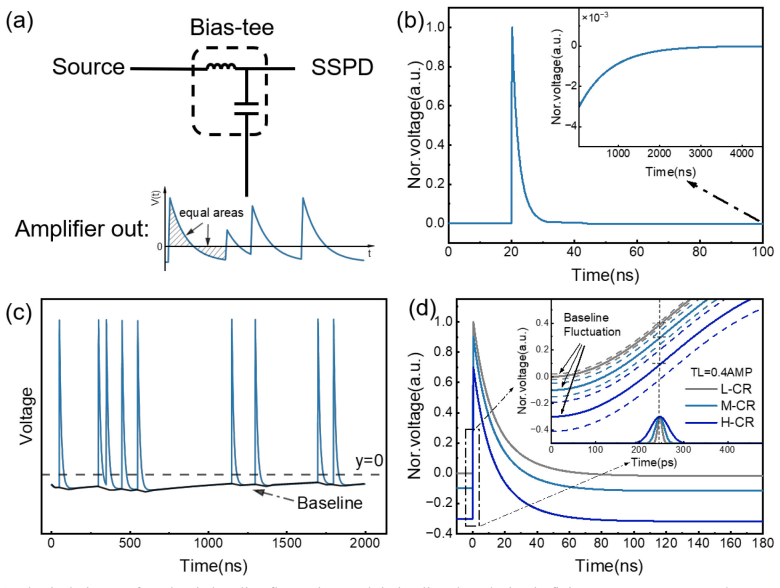
Stochastic baseline fluctuations arising from finite-memory readout dynamics constitute an intrinsic source of the count-rate-dependent timing jitter in SNSPD systems. Overlapping recovery responses from stochastically arriving photons accumulate and generate fluctuating baselines that introduce timing uncertainty at the threshold extractor. The developed stochastic-process framework quantitatively links photon statistics, readout time constants, and resulting jitter, predicting features such as nonmonotonic fluctuation amplitude versus repetition rate.
What carries the argument
Stochastic-process framework connecting photon arrival statistics to accumulated baseline variance via finite-memory recovery responses.
If this is right
- Baseline fluctuations exhibit nonmonotonic scaling with pulsed repetition frequency, peaking near half the rate.
- Timing jitter increases with longer circuit time constants due to greater overlap.
- Detector recovery speed directly modulates the strength of the stochastic effect.
- High-rate operation requires accounting for this statistical mechanism beyond deterministic distortions.
Where Pith is reading between the lines
- Designers of photon-counting systems could incorporate baseline variance calculations to predict and reduce jitter in applications like lidar or quantum key distribution.
- The framework might extend to other detectors with memory effects, such as those using similar threshold timing.
- Post-processing corrections based on estimated baseline statistics could partially mitigate the jitter without hardware changes.
- Further tests at varying temperatures or bias currents could reveal interactions with other noise sources.
Load-bearing premise
The detector recovery response is a fixed deterministic shape with strictly finite memory and no additional nonlinear or history-dependent effects.
What would settle it
Directly observing whether the measured baseline voltage variance scales with count rate exactly as predicted by the overlap statistics of the recovery pulses; mismatch would disprove the mechanism as the source of the jitter.
Figures


read the original abstract
Superconducting nanowire single-photon detectors (SNSPDs) have demonstrated timing jitter in the few-picosecond regime, yet their timing resolution deteriorates substantially under high-count-rate operation. Existing interpretations mainly attribute this degradation to deterministic waveform distortions, such as multiphoton responses and pulse pile-up, yet the experimentally observed jitter broadening at high count rates cannot be fully accounted for within this picture. Here, we show that stochastic baseline fluctuations arising from finite-memory readout dynamics constitute an intrinsic source of the count-rate-dependent timing jitter in SNSPD systems. For stochastically arriving photons, overlapping recovery responses accumulate in the readout chain and generate statistically fluctuating baselines, which are converted into timing uncertainty through threshold-based timing extraction. We develop a stochastic-process framework that quantitatively connects photon statistics, readout dynamics, and timing jitter. The framework predicts characteristic scaling behaviors, including a nonmonotonic dependence of baseline fluctuations under pulsed excitation with a maximum near half of the repetition frequency. These predictions are quantitatively verified through systematic variations of count rate, circuit time constant, and detector dynamical properties. Our results identify stochastic baseline dynamics as a fundamental mechanism limiting timing resolution in high-count-rate SNSPD operation and provide a general framework for optimizing finite-memory high-speed photon-counting systems.
Editorial analysis
A structured set of objections, weighed in public.
Referee Report
Summary. The paper claims that stochastic baseline fluctuations from overlapping recovery responses in finite-memory SNSPD readout circuits constitute an intrinsic source of count-rate-dependent timing jitter, beyond deterministic effects like pulse pile-up. It develops a stochastic-process model based on Poisson photon statistics and linear superposition of deterministic recovery waveforms, which predicts a nonmonotonic jitter dependence on repetition rate (peaking near half the frequency) and is quantitatively verified by experiments varying count rate, circuit time constant, and detector parameters.
Significance. If the central claim holds, the work identifies a fundamental, previously underappreciated mechanism limiting timing resolution in high-speed SNSPD operation. The framework offers predictive scaling laws and a generalizable approach for optimizing finite-memory photon-counting systems, with experimental support across multiple parameters strengthening its applicability to quantum optics and high-rate detection.
major comments (2)
- [Model framework (stochastic-process derivation)] The model derivation assumes strictly linear and deterministic recovery responses with strictly finite memory. Any unmodeled history-dependent nonlinearity (e.g., count-rate-dependent changes in kinetic inductance or thermal feedback) would invalidate the direct mapping from photon arrival statistics to baseline variance. The manuscript should explicitly bound the validity regime of this assumption or provide supporting evidence from the detector characterization data.
- [Experimental verification section] The experimental verification relies on independently measured recovery time constants, but full propagation of uncertainties in these parameters into the predicted jitter curves is not detailed. This affects the quantitative strength of the match to the observed nonmonotonic scaling.
minor comments (2)
- [Theory and predictions] Clarify the exact definition of the repetition frequency at which the baseline fluctuation maximum occurs in the pulsed-excitation case, and ensure all symbols in the scaling predictions are defined consistently with the equations.
- [Conclusions] Consider adding a brief discussion of how the framework extends to other finite-memory detectors beyond SNSPDs, to strengthen the generalizability claim.
Simulated Author's Rebuttal
We thank the referee for the positive assessment and constructive comments on our manuscript. We address each major comment point by point below.
read point-by-point responses
-
Referee: [Model framework (stochastic-process derivation)] The model derivation assumes strictly linear and deterministic recovery responses with strictly finite memory. Any unmodeled history-dependent nonlinearity (e.g., count-rate-dependent changes in kinetic inductance or thermal feedback) would invalidate the direct mapping from photon arrival statistics to baseline variance. The manuscript should explicitly bound the validity regime of this assumption or provide supporting evidence from the detector characterization data.
Authors: We agree that the linearity and finite-memory assumptions are central to the stochastic-process framework. In the revised manuscript, we will add an explicit section bounding the validity regime. This will reference our detector characterization measurements, which demonstrate that recovery waveforms remain linear and independent of count rate (with no observable history-dependent effects such as kinetic inductance changes or thermal feedback) across the full experimental range up to 10 MHz. The quantitative match between model and data without additional parameters further supports the applicability of the direct mapping in this regime. revision: yes
-
Referee: [Experimental verification section] The experimental verification relies on independently measured recovery time constants, but full propagation of uncertainties in these parameters into the predicted jitter curves is not detailed. This affects the quantitative strength of the match to the observed nonmonotonic scaling.
Authors: We acknowledge that a complete uncertainty propagation was omitted from the original submission. In the revised manuscript, we will include a detailed propagation of the uncertainties (standard deviations) from the independently measured recovery time constants into the predicted jitter curves. This will be presented as error bands on the theoretical predictions, allowing a more rigorous quantitative comparison to the observed nonmonotonic scaling with repetition rate. revision: yes
Circularity Check
No significant circularity; predictions generated from independent inputs before experimental verification
full rationale
The stochastic-process framework maps photon arrival statistics through a linear finite-memory filter of measured recovery waveforms to produce baseline variance and timing jitter predictions, including the nonmonotonic scaling with repetition rate. These predictions are stated to be generated from the equations prior to comparison with data. Recovery time constants and photon statistics are described as independently measured, and the verification uses systematic experimental variations of count rate, circuit parameters, and detector properties. No self-definitional steps, fitted inputs renamed as predictions, or load-bearing self-citations appear in the derivation chain. The central claim therefore remains independent of its own outputs.
Axiom & Free-Parameter Ledger
free parameters (1)
- recovery time constant
axioms (2)
- standard math Photon arrivals follow a Poisson process
- domain assumption Recovery response is linear and time-invariant
Lean theorems connected to this paper
-
IndisputableMonolith/Cost/FunctionalEquation.leanwashburn_uniqueness_aczel unclear?
unclearRelation between the paper passage and the cited Recognition theorem.
baseline variance follows directly from Campbell’s theorem: Var[B(t)] = λ ∫ h²(t) dt = λ Q²/(2 τ_e)
-
IndisputableMonolith/Foundation/RealityFromDistinction.leanreality_from_one_distinction unclear?
unclearRelation between the paper passage and the cited Recognition theorem.
finite-memory linear system driven by stochastic photon arrivals... Poisson point process
What do these tags mean?
- matches
- The paper's claim is directly supported by a theorem in the formal canon.
- supports
- The theorem supports part of the paper's argument, but the paper may add assumptions or extra steps.
- extends
- The paper goes beyond the formal theorem; the theorem is a base layer rather than the whole result.
- uses
- The paper appears to rely on the theorem as machinery.
- contradicts
- The paper's claim conflicts with a theorem or certificate in the canon.
- unclear
- Pith found a possible connection, but the passage is too broad, indirect, or ambiguous to say the theorem truly supports the claim.
Reference graph
Works this paper leans on
-
[1]
Picosecond superconducting single-photon optical detector
G. N. Gol’tsman, et al., "Picosecond superconducting single-photon optical detector", Appl. Phys. Lett. 79 (6), 705-707 (2001)
work page 2001
-
[2]
B. Korzh, et al., "Demonstration of sub- 3 ps temporal resolution with a superconducting nanowire single-photon detector", Nat. Photonics 14 (4), 250 - 255 (2020)
work page 2020
-
[3]
Efficient Single -Photon Detection with 7.7 ps Time Resolution for Photon- Correlation Measurements
I. Esmaeil Zadeh, et al., "Efficient Single -Photon Detection with 7.7 ps Time Resolution for Photon- Correlation Measurements", ACS Photonics 7 (7), 1780-1787 (2020)
work page 2020
-
[4]
X. -Y. Zhang, et al., "NbN Superconducting Nanowire Single -Photon Detector With 90.5% Saturated System Detection Efficiency and 14.7 ps System Jitter at 1550 nm Wavelength", IEEE J. Sel. Top. Quantum Electron. 28 (5), 1-8 (2022)
work page 2022
-
[5]
A. McCarthy, et al., "High -resolution long - distance depth imaging LiDAR with ultra -low timing jitter superconducting nanowire single -photon detectors", Optica 12 (2), 168-177 (2025)
work page 2025
-
[6]
I. Esmaeil Zadeh, J. W. N. Los, R. B. M. Gourgues, V. Steinmetz, G. Bulgarini, S. M. Dobrovolskiy, V. Zwiller and S. N. Dorenbos, "Single -photon detectors combining high efficiency, high detection rates, and ultra-high timing resolution", APL Photonics 2 (11), 111301 (2017)
work page 2017
-
[7]
Improving the timing jitter of a superconducting nanowire single - photon detection system
J.-J. Wu, L.-X. You, S.-J. Chen, H. Li, Y.- H. He, C.-L. Lv, Z. Wang and X. -M. Xie, "Improving the timing jitter of a superconducting nanowire single - photon detection system", Appl. Opt. 56 (8), 2195- 2200 (2017)
work page 2017
-
[8]
High -rate quantum key distribution exceeding 110 Mb s –1
W. Li, et al., "High -rate quantum key distribution exceeding 110 Mb s –1", Nat. Photonics 17 (5), 416 - 421 (2023)
work page 2023
-
[9]
5-GHz Chip-Based Quantum Key Distribution With 1 Mbps Secure Key Rate Over 150 km
G.-W. Zhang, et al., "5-GHz Chip-Based Quantum Key Distribution With 1 Mbps Secure Key Rate Over 150 km", Laser Photonics Rev. (2026)
work page 2026
-
[10]
F. Grünenfelder, et al., "Fast single -photon detectors and real -time key distillation enable high secret-key-rate quantum key distribution systems", Nat. Photonics 17 (5), 422-426 (2023)
work page 2023
-
[11]
Quantum computational advantage using photons
H.- S. Zhong, et al., "Quantum computational advantage using photons", Science 370 (6523), 1460- 1463 (2020)
work page 2020
-
[12]
Phase- Programmable Gaussian Boson Sampling Using Stimulated Squeezed Light
H. -S. Zhong, et al., "Phase- Programmable Gaussian Boson Sampling Using Stimulated Squeezed Light", Phys. Rev. Lett. 127 (18), 180502 (2021)
work page 2021
-
[13]
Y. -H. Deng, et al., "Gaussian Boson Sampling with Pseudo- Photon-Number-Resolving Detectors and Quantum Computational Advantage", Phys. Rev. Lett. 131 (15), 150601 (2023)
work page 2023
-
[14]
Z.- Y. Shu, et al., "On -chip superconducting nanowire single -photon detectors integrated with 13 pump rejection for entanglement characterization", Photonics Res. 13 (4), 1067-1073 (2025)
work page 2025
-
[15]
C. -M. Ding, et al., "Photon -Number-Resolving Single-Photon Detector with a System Detection Efficiency of 98% and Photon -Number Resolution of 32", ACS Photonics 12 (9), 4924-4931 (2025)
work page 2025
-
[16]
Superconducting Single -Photon Spectrometer with 3D -Printed Photonic -Crystal Filters
Y. Xiao, et al., "Superconducting Single -Photon Spectrometer with 3D -Printed Photonic -Crystal Filters", ACS Photonics 9 (10), 3450-3456 (2022)
work page 2022
-
[17]
J. -N. Zhang, et al., "Realization of a source- device-independent quantum random number generator secured by nonlocal dispersion cancellation", Adv. Photonics 5 (3), 036003 (2023)
work page 2023
-
[18]
Lunar Laser Communication Demonstration operations architecture
F. I. Khatri, B. S. Robinson, M. D. Semprucci and D. M. Boroson, "Lunar Laser Communication Demonstration operations architecture", Acta Astronaut. 111, 77-83 (2015)
work page 2015
-
[19]
Review of Deep Space Optical Communications
H. Ivanov, S. Mejri, A. Di Mira, K. J. Schulz and C. Heese, "Review of Deep Space Optical Communications", INTERNATIONAL JOURNAL OF SATELLITE COMMUNICATIONS AND NETWORKING 43 (3), 193-209 (2025)
work page 2025
-
[20]
H. Hao, et al., "A compact multi -pixel superconducting nanowire single -photon detector array supporting gigabit space -to-ground communications", Light Sci. Appl. 13 (1), 25 (2024)
work page 2024
-
[21]
Noise -tolerant LiDAR approaching the standard quantum-limited precision
H. -C. Li, et al., "Noise -tolerant LiDAR approaching the standard quantum-limited precision", Light Sci. Appl. 14 (1), 138 (2025)
work page 2025
-
[22]
H. Zhou, et al., "Photon- counting chirped amplitude modulation lidar system using superconducting nanowire single -photon detector at 1550-nm wavelength*", Chin. Phys. B 27 (1), 018501 (2018)
work page 2018
-
[23]
High -speed detection of 1550nm single photons with superconducting nanowire detectors
I. Craiciu, et al., "High -speed detection of 1550nm single photons with superconducting nanowire detectors", Optica 10 (2), 183-190 (2023)
work page 2023
-
[24]
Research progress of high speed superconducting nanowire single -photon detector
J.-X. Chen and H. Li, "Research progress of high speed superconducting nanowire single -photon detector", Journal of Functional Materials and Devices 31 (1), 1-10 (2025)
work page 2025
-
[25]
Enhanced Detection Rate and High Photon- Number Efficiencies with a Scalable Parallel SNSPD
L. Stasi, T. Taher, G. V. Resta, H. Zbinden, R. Thew and F. Bussières, "Enhanced Detection Rate and High Photon- Number Efficiencies with a Scalable Parallel SNSPD", ACS Photonics 12 (1), 320 -329 (2025)
work page 2025
-
[26]
D.-P. Wang, Y. Xiao, Z. Wan, C.-M. Ding, H.-X. Xu, J. Huang, J.- M. Xiong, L. -X. You and H. Li, "Origins and correction of secondary peaks in timing jitter of high-speed superconducting nanowire single - photon detectors", Appl. Phys. Lett. 128 (16), 162601 (2026)
work page 2026
-
[27]
Time -walk and jitter correction in SNSPDs at high count rates
A. Mueller, E. E. E. Wollman, B. Korzh, A. D. D. Beyer, L. Narvaez, R. Rogalin, M. Spiropulu and M. D. D. Shaw, "Time -walk and jitter correction in SNSPDs at high count rates", Appl. Phys. Lett. 122 (4) (2023)
work page 2023
-
[28]
Electrical trace analysis of superconducting nanowire photon-number-resolving detectors
T. Schapeler, N. Lamberty, T. Hummel, F. Schlue, M. Stefszky, B. Brecht, C. Silberhorn and T. J. Bartley, "Electrical trace analysis of superconducting nanowire photon-number-resolving detectors", Phys. Rev. Appl. 22 (1), 014024 (2024)
work page 2024
-
[29]
G. F. Knoll, Radiation detection and measurement. (John Wiley & Sons, 2010)
work page 2010
-
[30]
Integrated photonics for continuous -variable quantum optics
R. N. Clark, B. Puzio, O. M. Green, S. T. Pradyumna, O. Trojak, A. Politi and J. C. F. Matthews, "Integrated photonics for continuous -variable quantum optics", Nat. Photonics (2026)
work page 2026
-
[31]
A. M. Fox, Quantum optics: an introduction. (Oxford university press, 2006)
work page 2006
-
[32]
Campbell., The study of discontinuous phenomena
N. Campbell., The study of discontinuous phenomena. (1909)
work page 1909
-
[33]
Detecting single infrared photons toward optimal system detection efficiency
P. Hu, et al., "Detecting single infrared photons toward optimal system detection efficiency", Opt. Express 28 (24), 36884-36891 (2020)
work page 2020
-
[34]
J.-M. Xiong, et al., "Reducing current crowding in meander superconducting strip single -photon detectors by thickening bends", SUPERCOND SCI TECH 35 (5) (2022)
work page 2022
-
[35]
H. -X. Xu, et al., "Impact of distributed Bragg reflectors on the intrinsic detection efficiency of superconducting nanowire single -photon detectors", Superconductivity 13, 100152 (2025)
work page 2025
discussion (0)
Sign in with ORCID, Apple, or X to comment. Anyone can read and Pith papers without signing in.