Recognition: 2 theorem links
· Lean TheoremAdaptive Metrics for Norm-Minimization-Based Outer Approximation in Convex Vector Optimization
Pith reviewed 2026-05-15 02:42 UTC · model grok-4.3
The pith
Adaptive metrics extend improved convergence rates to all inner-product norms in convex vector optimization outer approximation.
A machine-rendered reading of the paper's core claim, the machinery that carries it, and where it could break.
Core claim
We prove that the improved Euclidean convergence rate O(k^{2/(1-q)}) extends to all fixed inner-product norms and establish a dispersion theorem showing that the cut normals generated by the algorithm naturally spread across all directions when the upper image has a strictly convex boundary with bounded curvature. This geometric condition guarantees that the adaptive metric remains well-conditioned throughout execution.
What carries the argument
The adaptive scalarization metric that varies across iterations while measuring approximation error in a fixed Euclidean norm.
If this is right
- The O(k^{2/(1-q)}) convergence rate holds for every fixed inner-product norm.
- Cut normals disperse across all directions if the upper image boundary is strictly convex with bounded curvature.
- Hausdorff error bounds can be derived explicitly in terms of metric conditioning.
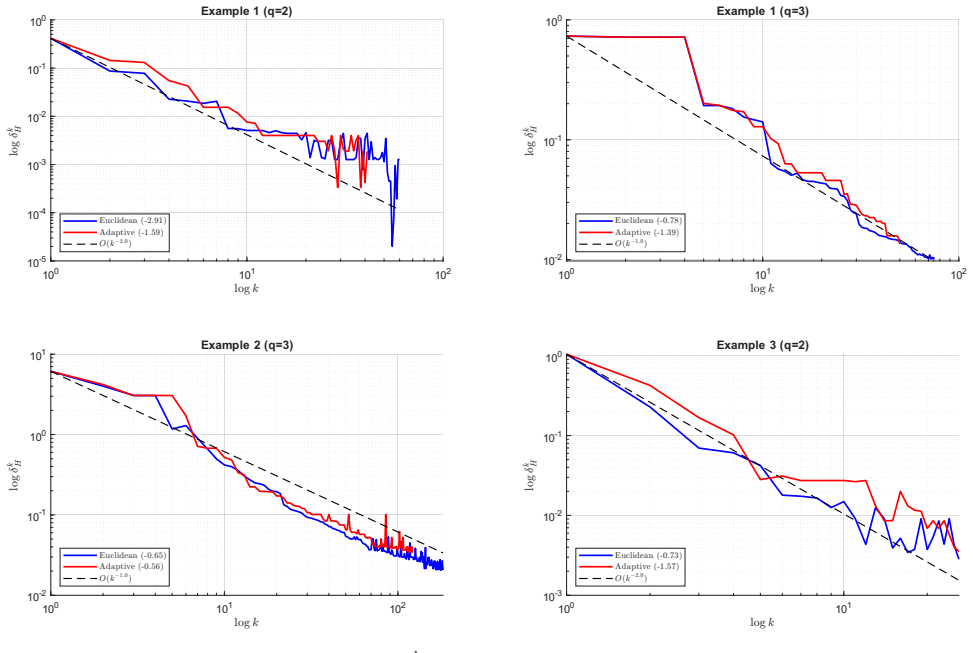
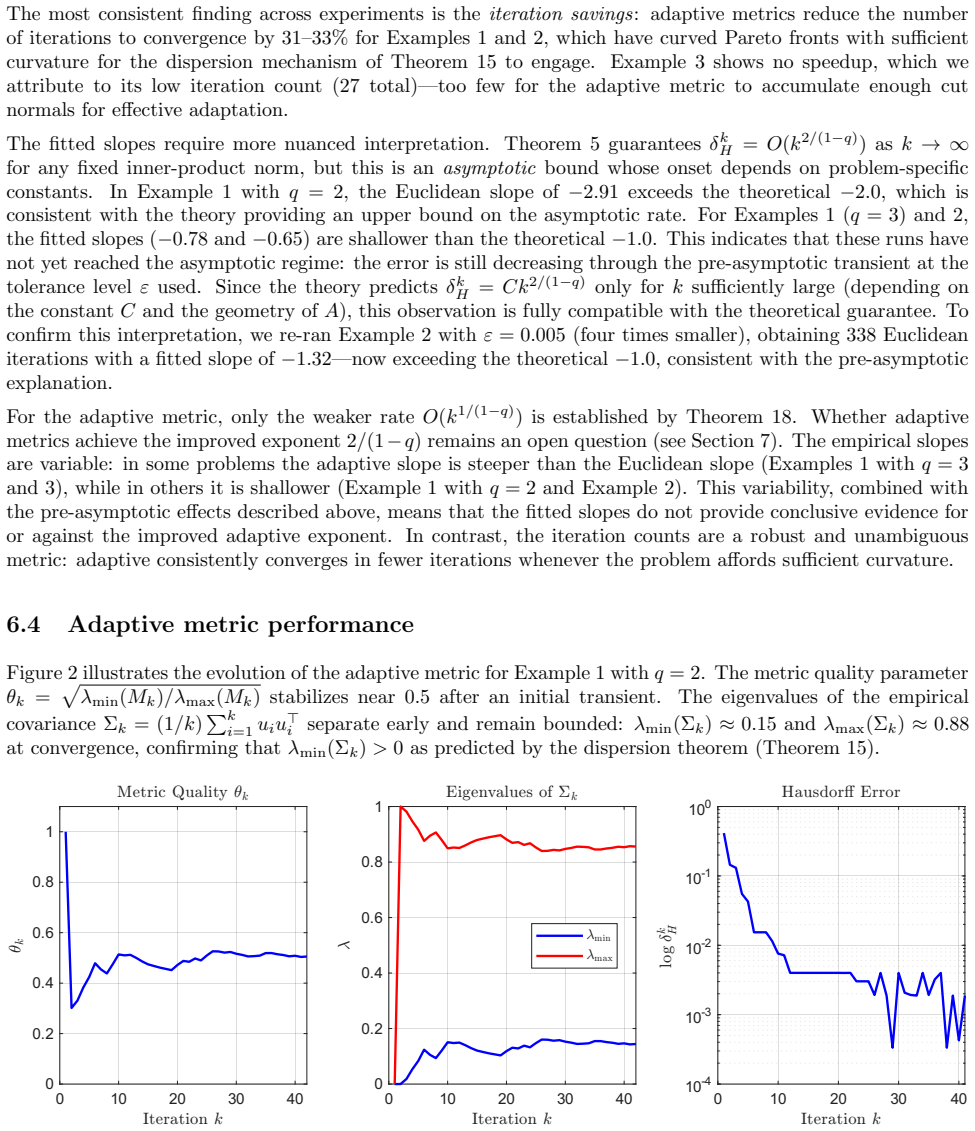
- Adaptive metrics require 31-33% fewer iterations than fixed-norm methods on curved Pareto fronts.
Where Pith is reading between the lines
- This framework may extend to other types of approximation algorithms in multi-objective optimization.
- Practitioners could develop heuristics to choose metrics based on estimated curvature of the Pareto front.
- The results suggest testing on higher-dimensional problems to check if the iteration savings scale.
Load-bearing premise
The upper image must have a strictly convex boundary with bounded curvature so that the adaptive metric remains well-conditioned.
What would settle it
Observing that cut normals cluster in a few directions or that the convergence rate fails to hold when applying the algorithm to a non-Euclidean inner-product norm on a strictly convex bounded-curvature instance.
Figures

read the original abstract
We develop an adaptive-metric framework for norm-minimization-based outer approximation algorithms in bounded convex vector optimization. The key idea is to let the scalarization metric vary across iterations while measuring approximation error in a fixed Euclidean norm. This enables the algorithm to exploit problem geometry dynamically. Our approach rests on two theoretical foundations. First, we prove that the improved Euclidean convergence rate $O(k^{2/(1-q)})$ -- previously known only for the standard $\ell_2$ norm -- extends to all fixed inner-product norms. Second, we establish a dispersion theorem showing that the cut normals generated by the algorithm naturally spread across all directions when the upper image has a strictly convex boundary with bounded curvature. This geometric condition guarantees that the adaptive metric remains well-conditioned throughout execution. Building on these results, we derive explicit convergence bounds that quantify how metric conditioning influences the Hausdorff error estimates. Numerical experiments validate the theoretical rates and demonstrate that adaptive metrics achieve 31--33\% fewer iterations than the fixed Euclidean norm on problems with curved Pareto fronts. Our results provide a rigorous foundation for adaptive metric selection in convex vector optimization.
Editorial analysis
A structured set of objections, weighed in public.
Referee Report
Summary. The paper develops an adaptive-metric framework for norm-minimization-based outer approximation algorithms in bounded convex vector optimization. The scalarization metric is allowed to vary across iterations while approximation error is measured in a fixed Euclidean norm. It proves that the improved convergence rate O(k^{2/(1-q)}) extends from the Euclidean case to all fixed inner-product norms, and establishes a dispersion theorem showing that cut normals spread across directions when the upper image boundary is strictly convex with bounded curvature. This condition ensures the adaptive metric stays well-conditioned. Explicit bounds are derived relating metric conditioning to Hausdorff error, and numerical experiments report 31-33% fewer iterations than fixed Euclidean norm on problems with curved Pareto fronts.
Significance. If the two central proofs hold, the work supplies a rigorous justification for adaptive metric selection in convex vector optimization, extending known rates and providing a geometric dispersion result that directly supports conditioning control. The explicit dependence of Hausdorff error on metric conditioning and the numerical validation on curved fronts would be useful for algorithm design in multi-objective optimization.
major comments (2)
- [§3.2, Theorem 3.1] §3.2, Theorem 3.1: The rate extension to arbitrary fixed inner-product norms is claimed, but the proof sketch does not explicitly track how the implicit constant in the O(k^{2/(1-q)}) bound depends on the condition number of the chosen inner product relative to the fixed Euclidean norm; this dependence is load-bearing for the subsequent Hausdorff-error bounds in §4.
- [§4.3, Dispersion Theorem 4.2] §4.3, Dispersion Theorem 4.2: The statement requires the upper-image boundary to have strictly convex curvature bounded by some M, yet the proof does not derive an explicit lower bound on the minimal angular separation of cut normals in terms of M and the current metric; without this, the claim that the adaptive metric remains uniformly well-conditioned cannot be verified from the given argument.
minor comments (3)
- [Abstract and §5] Abstract and §5: The reported 31--33% iteration reduction is presented without specifying the test problems' dimensions, curvature parameters, or number of runs; add these details to allow reproducibility assessment.
- [§2] Notation: The symbol q is used for the rate exponent without an early definition or reference to its origin in prior work; insert a brief reminder in §2.
- [Figure 3] Figure 3: The Hausdorff-error plots use log-log scale but omit the reference slope 2/(1-q) line; adding it would make visual comparison to the claimed rate immediate.
Simulated Author's Rebuttal
We thank the referee for the careful reading and valuable comments on our manuscript. The two points raised highlight opportunities to strengthen the explicitness of our proofs, and we will incorporate revisions to address them directly.
read point-by-point responses
-
Referee: [§3.2, Theorem 3.1] §3.2, Theorem 3.1: The rate extension to arbitrary fixed inner-product norms is claimed, but the proof sketch does not explicitly track how the implicit constant in the O(k^{2/(1-q)}) bound depends on the condition number of the chosen inner product relative to the fixed Euclidean norm; this dependence is load-bearing for the subsequent Hausdorff-error bounds in §4.
Authors: We agree that the dependence of the implicit constant on the condition number κ of the inner product (relative to the Euclidean norm) should be tracked explicitly for transparency and to support the Hausdorff bounds in §4. The current proof sketch uses norm equivalence but leaves the scaling with κ implicit. In the revision we will insert the explicit factor (arising from the equivalence constants between the inner-product norm and the Euclidean norm) into the O(k^{2/(1-q)}) statement and carry this factor forward into the error estimates of §4. revision: yes
-
Referee: [§4.3, Dispersion Theorem 4.2] §4.3, Dispersion Theorem 4.2: The statement requires the upper-image boundary to have strictly convex curvature bounded by some M, yet the proof does not derive an explicit lower bound on the minimal angular separation of cut normals in terms of M and the current metric; without this, the claim that the adaptive metric remains uniformly well-conditioned cannot be verified from the given argument.
Authors: We concur that an explicit quantitative lower bound on the minimal angular separation would make the well-conditioning claim fully verifiable. The dispersion theorem establishes spreading under the bounded-curvature assumption, but the proof sketch does not extract the dependence on M and the current metric. We will add a supporting lemma that derives a positive lower bound on the angular separation (of the form c/M scaled by the current metric conditioning) and use it to confirm that the adaptive metric remains uniformly well-conditioned throughout the algorithm. revision: yes
Circularity Check
No significant circularity; derivations are self-contained extensions
full rationale
The paper's load-bearing steps are explicit proofs: extension of the O(k^{2/(1-q)}) rate to all fixed inner-product norms (previously known only for ℓ₂) and a dispersion theorem for cut normals under the stated hypothesis of strictly convex boundary with bounded curvature. These are presented as independent mathematical arguments resting on problem geometry and algorithm mechanics, with the curvature assumption directly ensuring metric well-conditioning rather than being derived from the results themselves. No fitted parameters are renamed as predictions, no self-definitional loops appear in the stated claims, and numerical iteration reductions are labeled as validation only. The derivation chain does not reduce any central result to its own inputs by construction.
Axiom & Free-Parameter Ledger
axioms (1)
- domain assumption The upper image has a strictly convex boundary with bounded curvature
Lean theorems connected to this paper
-
IndisputableMonolith/Foundation/AlexanderDuality.leanalexander_duality_circle_linking unclear?
unclearRelation between the paper passage and the cited Recognition theorem.
dispersion theorem showing that the cut normals generated by the algorithm naturally spread across all directions when the upper image has a strictly convex boundary with bounded curvature
-
IndisputableMonolith/Cost/FunctionalEquation.leanwashburn_uniqueness_aczel unclear?
unclearRelation between the paper passage and the cited Recognition theorem.
improved Euclidean convergence rate O(k^{2/(1-q)}) extends to all fixed inner-product norms
What do these tags mean?
- matches
- The paper's claim is directly supported by a theorem in the formal canon.
- supports
- The theorem supports part of the paper's argument, but the paper may add assumptions or extra steps.
- extends
- The paper goes beyond the formal theorem; the theorem is a base layer rather than the whole result.
- uses
- The paper appears to rely on the theorem as machinery.
- contradicts
- The paper's claim conflicts with a theorem or certificate in the canon.
- unclear
- Pith found a possible connection, but the passage is too broad, indirect, or ambiguous to say the theorem truly supports the claim.
Reference graph
Works this paper leans on
-
[1]
Q. H. Ansari, E. K¨ obis, and J.-C. Yao,Vector Variational Inequalities and Vector Optimization(Vector Optimization), en. Cham: Springer International Publishing, 2018.doi:10.1007/978-3-319-63049-6
-
[2]
A Norm Minimization-Based Convex Vector Optimization Algorithm,
C ¸ . Ararat, F. Ulus, and M. Umer, “A Norm Minimization-Based Convex Vector Optimization Algorithm,” en,Journal of Optimization Theory and Applications, vol. 194, no. 2, pp. 681–712, Aug. 2022.doi:10. 1007/s10957-022-02045-8
work page 2022
-
[3]
Outer Approximation Algorithms for Convex Vector Optimization Problems,
˙I. N. Keskin and F. Ulus, “Outer Approximation Algorithms for Convex Vector Optimization Problems,” Optimization Methods and Software, vol. 38, no. 4, pp. 723–755, Jul. 2023.doi:10 . 1080 / 10556788 . 2023.2167994
-
[4]
Convergence Analysis of a Norm Minimization-Based Convex Vector Optimization Algorithm,
C ¸ . Ararat, F. Ulus, and M. Umer, “Convergence Analysis of a Norm Minimization-Based Convex Vector Optimization Algorithm,”SIAM Journal on Optimization, vol. 34, no. 3, pp. 2700–2728, Sep. 2024.doi: 10.1137/23M1574580
-
[5]
A Class of Adaptive Algorithms for Approximating Convex Bodies by Polyhedra,
G. K. Kamenev, “A Class of Adaptive Algorithms for Approximating Convex Bodies by Polyhedra,” Computational Mathematics and Mathematical Physics, vol. 32, no. 1, pp. 114–127, 1992
work page 1992
-
[6]
A. V. Lotov, V. A. Bushenkov, and G. K. Kamenev,Interactive Decision Maps: Approximation and Visualization of Pareto Frontier(Applied optimization). Boston, MA: Springer, 2004, vol. 89.doi:10. 1007/978-1-4419-8851-5
work page 2004
-
[7]
H. P. Benson, “An Outer Approximation Algorithm for Generating All Efficient Extreme Points in the Outcome Set of a Multiple Objective Linear Programming Problem,”Journal of Global Optimization, vol. 13, no. 1, pp. 1–24, Jan. 1998.doi:10.1023/A:1008215702611
-
[8]
An Approximation Algorithm for Convex Multi-Objective Pro- gramming Problems,
M. Ehrgott, L. Shao, and A. Sch¨ obel, “An Approximation Algorithm for Convex Multi-Objective Pro- gramming Problems,” en,Journal of Global Optimization, vol. 50, no. 3, pp. 397–416, Jul. 2011.doi: 10.1007/s10898-010-9588-7
-
[9]
Primal and Dual Approximation Algorithms for Convex Vector Optimization Problems,
A. L¨ ohne, B. Rudloff, and F. Ulus, “Primal and Dual Approximation Algorithms for Convex Vector Optimization Problems,” en,Journal of Global Optimization, vol. 60, no. 4, pp. 713–736, Dec. 2014.doi: 10.1007/s10898-013-0136-0
-
[10]
L¨ ohne,Vector Optimization with Infimum and Supremum(Vector Optimization), en
A. L¨ ohne,Vector Optimization with Infimum and Supremum(Vector Optimization), en. Berlin, Heidel- berg: Springer Berlin Heidelberg, 2011.doi:10.1007/978-3-642-18351-5
-
[11]
Algorithms to Solve Unbounded Convex Vector Optimization Problems,
A. Wagner, F. Ulus, B. Rudloff, G. Kov´ aˇ cov´ a, and N. Hey, “Algorithms to Solve Unbounded Convex Vector Optimization Problems,”SIAM Journal on Optimization, vol. 33, no. 4, pp. 2598–2624, 2023.doi: 10.1137/22M1507693 26
-
[12]
Jahn,Vector Optimization: Theory, Applications, and Extensions, en
J. Jahn,Vector Optimization: Theory, Applications, and Extensions, en. Berlin, Heidelberg: Springer, 2011.doi:10.1007/978-3-642-17005-8
-
[13]
A Branch-and-Bound-Based Algorithm for Nonconvex Multiobjective Op- timization,
J. Niebling and G. Eichfelder, “A Branch-and-Bound-Based Algorithm for Nonconvex Multiobjective Op- timization,”SIAM Journal on Optimization, vol. 29, no. 1, pp. 794–821, 2019.doi:10.1137/18M1169680
-
[14]
A Benson Type Algorithm for Nonconvex Multiobjective Programming Problems,
S. Nobakhtian and N. Shafiei, “A Benson Type Algorithm for Nonconvex Multiobjective Programming Problems,”TOP, vol. 25, no. 2, pp. 271–287, 2017.doi:10.1007/s11750-016-0430-3
-
[15]
Unbiased Approximation in Multicriteria Optimization,
K. Klamroth, J. Tind, and M. M. Wiecek, “Unbiased Approximation in Multicriteria Optimization,”Math- ematical Methods of Operations Research, vol. 56, no. 3, pp. 413–437, 2003.doi:10.1007/s001860200217
-
[16]
Constrained Optimization Using Multiple Objective Programming,
K. Klamroth and J. Tind, “Constrained Optimization Using Multiple Objective Programming,”Journal of Global Optimization, vol. 37, no. 3, pp. 325–355, 2007.doi:10.1007/s10898-006-9052-x
-
[17]
Conjugate Adaptive Algorithms for Polyhedral Approximation of Convex Bodies,
G. K. Kamenev, “Conjugate Adaptive Algorithms for Polyhedral Approximation of Convex Bodies,” Computational Mathematics and Mathematical Physics, vol. 42, no. 9, pp. 1301–1316, 2002
work page 2002
-
[18]
Approximation of Convex Bodies by Polytopes,
P. M. Gruber and P. Kenderov, “Approximation of Convex Bodies by Polytopes,” en,Rendiconti del Circolo Matematico di Palermo, vol. 31, no. 2, pp. 195–225, Jun. 1982.doi:10.1007/BF02844354
-
[19]
An Approximation Algorithm for Multi-Objective Optimization Problems Using a Box-Coverage,
G. Eichfelder and L. Warnow, “An Approximation Algorithm for Multi-Objective Optimization Problems Using a Box-Coverage,” en,Journal of Global Optimization, vol. 83, no. 2, pp. 329–357, Jun. 2022.doi: 10.1007/s10898-021-01109-9
-
[20]
Local Upper Bounds Based on Polyhedral Ordering Cones,
G. Eichfelder and F. Ulus, “Local Upper Bounds Based on Polyhedral Ordering Cones,”EURO Journal on Computational Optimization, vol. 14, p. 100 124, Jan. 2026.doi:10.1016/j.ejco.2025.100124
-
[21]
Solving Multiobjective Mixed Integer Convex Optimization Problems,
M. De Santis, G. Eichfelder, J. Niebling, and S. Rockt¨ aschel, “Solving Multiobjective Mixed Integer Convex Optimization Problems,”SIAM Journal on Optimization, vol. 30, no. 4, pp. 3122–3145, 2020. doi:10.1137/19M1264709
-
[22]
R. Schneider,Convex Bodies: The Brunn–Minkowski Theory(Encyclopedia of mathematics and its ap- plications), 2nd ed. Cambridge: Cambridge University Press, 2013
work page 2013
-
[23]
M. Grant and S. Boyd,CVX: MATLAB Software for Disciplined Convex Programming, Version 2.2, Mar. 2020
work page 2020
-
[24]
Graph Implementations for Nonsmooth Convex Programs,
M. Grant and S. Boyd, “Graph Implementations for Nonsmooth Convex Programs,” inRecent advances in learning and control, ser. Lecture notes in control and information sciences, V. Blondel, S. Boyd, and H. Kimura, Eds., Springer-Verlag Limited, 2008, pp. 95–110
work page 2008
-
[25]
A. L¨ ohne and B. Weißing, “The Vector Linear Program Solver Bensolve – Notes on Theoretical Back- ground,”European Journal of Operational Research, vol. 260, no. 3, pp. 807–813, 2017.doi:10.1016/j. ejor.2016.02.039 27
work page doi:10.1016/j 2017
discussion (0)
Sign in with ORCID, Apple, or X to comment. Anyone can read and Pith papers without signing in.