Recognition: 2 theorem links
· Lean TheoremA Formative Study of Brief Affective Text as a Complement to Wearable Sensing for Longitudinal Student Health Monitoring
Pith reviewed 2026-05-15 02:25 UTC · model grok-4.3
The pith
Ultra-brief text about daily concerns associates with measurable drops in physical activity and sleep quality on wearable sensors.
A machine-rendered reading of the paper's core claim, the machinery that carries it, and where it could break.
Core claim
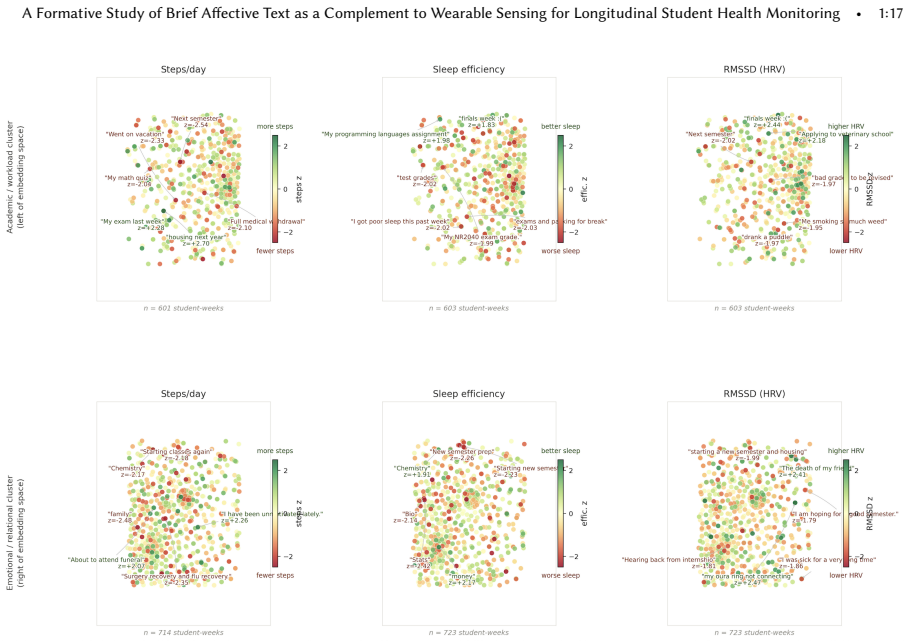
Weeks dominated by academic concern framing in ultra-brief open-ended text were associated with lower physical activity; weeks characterized by emotional exhaustion language were associated with poorer sleep quality and lower heart rate variability. General pretrained embeddings outperformed domain-adapted models for most outcomes, while affective dimensions across methods consistently associated with sensor outcomes and zero-shot topic classification did not.
What carries the argument
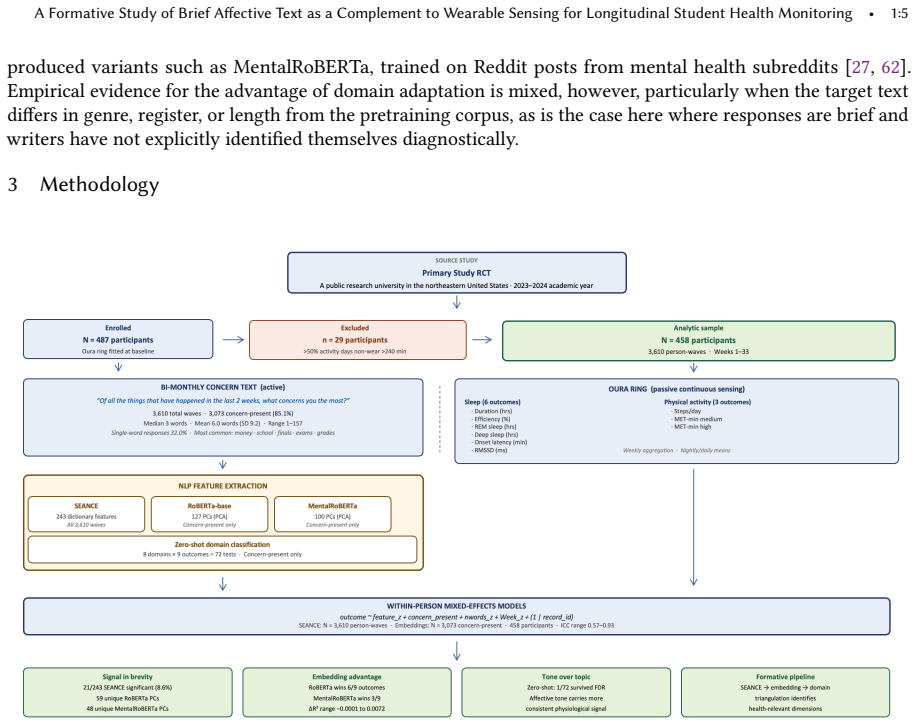
Within-person mixed-effects models that relate NLP-derived features from ultra-brief concern text (dictionary, general embeddings, domain-adapted) to nine longitudinal sleep and activity metrics from wearable sensors.
If this is right
- Academic concern language in brief text predicts reduced physical activity.
- Emotional exhaustion language predicts poorer sleep quality and lower heart rate variability.
- General pretrained embeddings deliver stronger associations than domain-adapted models for most outcomes.
- Affective dimensions carry more signal than specific topical content identified by zero-shot classification.
- Ultra-brief affective prompts can enrich the psychological interpretability of passive sensor data at low collection cost.
Where Pith is reading between the lines
- The same brief-text approach could be tested in non-student working populations to check whether the academic and exhaustion patterns generalize.
- Real-time monitoring systems might flag rising exhaustion language to prompt just-in-time support before wearable metrics deteriorate.
- Because general embeddings worked best, the method may transfer across languages or cultures with little retraining.
- Combining the text signal with other low-burden inputs such as location or calendar data could further strengthen the predictive models.
Load-bearing premise
The ultra-brief open-ended text responses validly capture the psychological states that actually drive the measured changes in sleep and activity without large self-report bias or unmeasured confounding.
What would settle it
A replication in which text responses are collected on a schedule independent of actual life events and no associations with the same wearable outcomes appear would falsify the central claim.
Figures



read the original abstract
Wearable devices capture physiological and behavioral data with increasing fidelity, but the psychological context shaping these outcomes is difficult to recover from sensor data alone, limiting passive sensing utility for digital health. We examined whether ultra-brief naturalistic concern text could serve as a scalable complement to passive sensing. In a year-long study of 458 university students (3,610 person-waves) tracked with Oura rings, participants responded bimonthly to an open-ended prompt about what concerned them most; responses had a median length of three words. We compared dictionary-based, general pretrained, and domain-adapted NLP approaches using within-person mixed-effects models across nine sleep and physical activity outcomes. Weeks dominated by academic concern framing were associated with lower physical activity; weeks characterized by emotional exhaustion language were associated with poorer sleep quality and lower heart rate variability. General pretrained embeddings outperformed domain-adapted models for most outcomes, with domain adaptation showing relative advantage for autonomic outcomes. Zero-shot classification of concern topics produced no significant associations, while affective dimensions across all three methods were consistently associated with outcomes, indicating emotional register rather than topical content carries the signal. These findings offer design guidance: ultra-brief affective prompts enrich the psychological interpretability of passive physiological data at minimal burden.
Editorial analysis
A structured set of objections, weighed in public.
Referee Report
Summary. The paper reports findings from a year-long observational study of 458 university students (3,610 person-waves) wearing Oura rings, who provided bimonthly ultra-brief open-ended text responses (median length three words) about their primary concerns. Within-person mixed-effects models across nine sleep and physical activity outcomes show that academic-concern framing is associated with lower physical activity, emotional-exhaustion language with poorer sleep quality and lower heart-rate variability, and that general pretrained embeddings outperform domain-adapted models while affective dimensions (rather than zero-shot topic classifications) carry the signal.
Significance. If the associations prove robust, the work offers a low-burden, scalable complement to passive sensing that could improve psychological interpretability of wearable data in student-health applications. The comparative NLP results and emphasis on affective register over topical content supply concrete design implications for future digital-health systems.
major comments (3)
- Methods: exact per-wave sample sizes, exclusion criteria, and missing-data handling for the 3,610 person-waves are not reported, which is load-bearing for assessing power and bias in the within-person mixed-effects models run on nine outcomes.
- Results: effect sizes (e.g., standardized coefficients or marginal R²) for the reported associations are omitted, and no multiple-testing correction across the nine outcomes is described, undermining claims of consistent affective-dimension effects.
- Methods/Results: the central assumption that median-three-word responses validly index the psychological states causally shaping wearable outcomes lacks any concurrent validation against gold-standard scales; without this, the associations remain vulnerable to self-report bias or time-varying confounders such as exam periods.
minor comments (2)
- Abstract: the phrase 'bimonthly' should be clarified as every two months to avoid ambiguity with twice-monthly.
- The manuscript would benefit from a table summarizing model specifications (random effects, covariates, outcome definitions) for the nine outcomes.
Simulated Author's Rebuttal
We thank the referee for their constructive feedback. We address each major comment below and have revised the manuscript to improve methodological transparency and acknowledge study limitations.
read point-by-point responses
-
Referee: Methods: exact per-wave sample sizes, exclusion criteria, and missing-data handling for the 3,610 person-waves are not reported, which is load-bearing for assessing power and bias in the within-person mixed-effects models run on nine outcomes.
Authors: We agree these details are essential. The revised manuscript now includes a dedicated Methods subsection with exact per-wave sample sizes, explicit exclusion criteria (e.g., minimum response length and valid Oura data requirements), and missing-data handling via complete-case analysis with sensitivity checks. This information is summarized in an updated Table 1. revision: yes
-
Referee: Results: effect sizes (e.g., standardized coefficients or marginal R²) for the reported associations are omitted, and no multiple-testing correction across the nine outcomes is described, undermining claims of consistent affective-dimension effects.
Authors: We have added standardized coefficients and marginal R² values for all associations in the revised Results. We also applied Bonferroni correction across the nine outcomes and report both unadjusted and adjusted p-values to quantify effect sizes and address multiple comparisons. revision: yes
-
Referee: Methods/Results: the central assumption that median-three-word responses validly index the psychological states causally shaping wearable outcomes lacks any concurrent validation against gold-standard scales; without this, the associations remain vulnerable to self-report bias or time-varying confounders such as exam periods.
Authors: We acknowledge this limitation of the formative, low-burden design. The revised Discussion now explicitly discusses potential self-report bias and time-varying confounders such as exam periods, while clarifying that associations are correlational. No concurrent gold-standard scales were collected. revision: partial
- The absence of concurrent validation against gold-standard psychological scales, which was not part of the original study protocol and cannot be added retroactively.
Circularity Check
No significant circularity in empirical observational study
full rationale
This is a purely empirical observational study that collects ultra-brief text responses and wearable data from 458 students, then fits standard within-person mixed-effects models to test associations between NLP-derived affective dimensions and nine sleep/activity outcomes. No derivations, equations, or predictions are presented; the central claims are direct statistical associations from the collected data. No self-citations are load-bearing for any derivation, no parameters are fitted and then renamed as predictions, and no ansatzes or uniqueness theorems are invoked. The work is self-contained against external benchmarks of empirical research.
Axiom & Free-Parameter Ledger
axioms (1)
- domain assumption Linear mixed-effects model assumptions (normality of residuals, independence within clusters) hold for within-person associations between text features and wearable outcomes
Lean theorems connected to this paper
-
IndisputableMonolith/Cost/FunctionalEquation.leanwashburn_uniqueness_aczel unclear?
unclearRelation between the paper passage and the cited Recognition theorem.
We compared dictionary-based, general pretrained, and domain-adapted NLP approaches using within-person mixed-effects models across nine sleep and physical activity outcomes.
-
IndisputableMonolith/Foundation/AbsoluteFloorClosure.leanabsolute_floor_iff_bare_distinguishability unclear?
unclearRelation between the paper passage and the cited Recognition theorem.
Zero-shot classification of concern topics produced no significant associations, while affective dimensions across all three methods were consistently associated with outcomes
What do these tags mean?
- matches
- The paper's claim is directly supported by a theorem in the formal canon.
- supports
- The theorem supports part of the paper's argument, but the paper may add assumptions or extra steps.
- extends
- The paper goes beyond the formal theorem; the theorem is a base layer rather than the whole result.
- uses
- The paper appears to rely on the theorem as machinery.
- contradicts
- The paper's claim conflicts with a theorem or certificate in the canon.
- unclear
- Pith found a possible connection, but the passage is too broad, indirect, or ambiguous to say the theorem truly supports the claim.
Reference graph
Works this paper leans on
-
[1]
Marco Altini and Hannu Kinnunen. 2021. The Promise of Sleep: A Multi-Sensor Approach for Accurate Sleep Stage Detection Using the Oura Ring.Sensors21, 13 (2021), 4302. doi:10.3390/s21134302
-
[2]
Razia Azen and David V. Budescu. 2003. The Dominance Analysis Approach for Comparing Predictors in Multiple Regression. Psychological Methods8, 2 (2003), 129–148. doi:10.1037/1082-989X.8.2.129
-
[3]
Scherer, Rui Wang, Haiyi Xie, and Andrew T
Dror Ben-Zeev, Emily A. Scherer, Rui Wang, Haiyi Xie, and Andrew T. Campbell. 2015. Next-Generation Psychiatric Assessment: Using Smartphone Sensors to Monitor Behavior and Mental Health.Psychiatric Rehabilitation Journal38, 3 (2015), 218–226. doi:10.1037/ prj0000130
work page 2015
-
[4]
Margaret M. Bradley and Peter J. Lang. 1999.Affective Norms for English Words (ANEW): Instruction Manual and Affective Ratings. Technical Report C-1. Center for Research in Psychophysiology, University of Florida, Gainesville, FL
work page 1999
-
[5]
David V. Budescu. 1993. Dominance Analysis: A New Approach to the Problem of Relative Importance of Predictors in Multiple Regression.Psychological Bulletin114, 3 (1993), 542–551. doi:10.1037/0033-2909.114.3.542
-
[6]
Ranganathan Chandrasekaran, Vipanchi Katthula, and Evangelos Moustakas. 2020. Patterns of use and key predictors for the use of wearable health care devices by US adults: insights from a national survey.Journal of medical Internet research22, 10 (2020), e22443
work page 2020
-
[7]
Prerna Chikersal, Afsaneh Doryab, Michael Tumminia, Daniella K. Villalba, Janine M. Dutcher, Xinwen Liu, Sheldon Cohen, Kasey G. Creswell, Jennifer Mankoff, J. David Creswell, Mayank Goel, and Anind K. Dey. 2021. Detecting Depression and Predicting Its Onset Using Longitudinal Symptoms Captured by Passive Sensing: A Machine Learning Approach with Robust F...
-
[8]
William E. Copeland, Ellen McGinnis, Yang Bai, Zoe Adams, Hilary Nardone, Vinay Devadanam, Jeffrey Rettew, and Jim J. Hudziak
-
[9]
doi:10.1016/j.jaac.2020.08.466
Impact of COVID-19 Pandemic on College Student Mental Health and Wellness.Journal of the American Academy of Child & Adolescent Psychiatry60, 1 (2021), 134–141.e2. doi:10.1016/j.jaac.2020.08.466
-
[10]
Glen Coppersmith, Mark Dredze, and Craig Harman. 2014. Quantifying Mental Health Signals in Twitter. InProceedings of the Workshop on Computational Linguistics and Clinical Psychology: From Linguistic Signal to Clinical Reality. Association for Computational Linguistics, Baltimore, Maryland, USA, 51–60. doi:10.3115/v1/W14-3207
-
[11]
Victor P. Cornet and Richard J. Holden. 2018. Systematic Review of Smartphone-Based Passive Sensing for Health and Wellbeing. Journal of Biomedical Informatics77 (2018), 120–132. doi:10.1016/j.jbi.2017.12.008
-
[12]
Crossley, Kristopher Kyle, and Danielle S
Scott A. Crossley, Kristopher Kyle, and Danielle S. McNamara. 2017. Sentiment Analysis and Social Cognition Engine (SEANCE): An Automatic Tool for Sentiment, Social Cognition, and Social-Order Analysis.Behavior Research Methods49, 3 (2017), 803–821. doi:10.3758/s13428-016-0743-z
-
[13]
Munmun De Choudhury, Michael Gamon, Scott Counts, and Eric Horvitz. 2013. Predicting Depression via Social Media. InProceedings of the International AAAI Conference on Web and Social Media (ICWSM), Vol. 7. 128–137. doi:10.1609/icwsm.v7i1.14432
-
[14]
Behavioral Sleep Medicine 17(2), 124–136 (2019)
Massimiliano de Zambotti, Leonardo Rosas, Ian M. Colrain, and Fiona C. Baker. 2019. The Sleep of the Ring: Comparison of the ¯OURA Sleep Tracker Against Polysomnography.Behavioral Sleep Medicine17, 2 (2019), 124–136. doi:10.1080/15402002.2017.1300587
-
[15]
Jacob Devlin, Ming-Wei Chang, Kenton Lee, and Kristina Toutanova. 2019. BERT: Pre-training of Deep Bidirectional Transformers for Language Understanding. InProceedings of the 2019 Conference of the North American Chapter of the Association for Computational Linguistics: Human Language Technologies (NAACL-HLT). Association for Computational Linguistics, Mi...
-
[16]
Facebook language predicts depression in medical records
Johannes C. Eichstaedt, Robert J. Smith, Raina M. Merchant, Lyle H. Ungar, Patrick Crutchley, Daniel Preoţiuc-Pietro, David A. Asch, and H. Andrew Schwartz. 2018. Facebook Language Predicts Depression in Medical Records.Proceedings of the National Academy of Sciences115, 44 (2018), 11203–11208. doi:10.1073/pnas.1802331115
-
[17]
Nancy L. Galambos, Andrea L. Dalton, and Jennifer L. Maggs. 2009. Losing Sleep Over It: Daily Variation in Sleep Quantity and Quality in Canadian Students’ First Semester of University.Journal of Research on Adolescence19, 4 (2009), 741–761. doi:10.1111/j.1532- 7795.2009.00618.x
-
[18]
Nuno Gomes, Matilde Pato, André Ribeiro Lourenço, and Nuno Datia. 2023. A Survey on Wearable Sensors for Mental Health Monitoring. Sensors23, 3 (2023), 1330. doi:10.3390/s23031330
-
[19]
James J. Gross. 2002. Emotion Regulation: Affective, Cognitive, and Social Consequences.Psychophysiology39, 3 (2002), 281–291. doi:10.1017/S0048577201393198
-
[20]
Sharath Chandra Guntuku, David B. Yaden, Margaret L. Kern, Lyle H. Ungar, and Johannes C. Eichstaedt. 2017. Detecting Depression and Mental Illness on Social Media: An Integrative Review.Current Opinion in Behavioral Sciences18 (2017), 43–49. doi:10.1016/j.cobeha. 2017.07.005
-
[21]
Suchin Gururangan, Ana Marasović, Swabha Swayamdipta, Kyle Lo, Iz Beltagy, Doug Downey, and Noah A. Smith. 2020. Don’t Stop Pretraining: Adapt Language Models to Domains and Tasks. InProceedings of the 58th Annual Meeting of the Association for Computational Linguistics. Association for Computational Linguistics, Online, 8342–8360. doi:10.18653/v1/2020.ac...
-
[22]
Gabriella M. Harari, Sandrine R. Müller, Min S. H. Aung, and Peter J. Rentfrow. 2017. Smartphone Sensing Methods for Studying Behavior in Everyday Life.Current Opinion in Behavioral Sciences18 (2017), 83–90. doi:10.1016/j.cobeha.2017.07.018
-
[23]
Allison G. Harvey. 2002. A Cognitive Model of Insomnia.Behaviour Research and Therapy40, 8 (2002), 869–893. doi:10.1016/S0005- 7967(01)00061-4
-
[24]
Kristin E. Heron, Robin S. Everhart, Susan M. McHale, and Joshua M. Smyth. 2017. Using Mobile-Technology-Based Ecological Momentary Assessment (EMA) Methods with Youth: A Systematic Review and Recommendations.Journal of Pediatric Psychology42, 10 (2017), 1087–1107. doi:10.1093/jpepsy/jsx078
-
[25]
Minqing Hu and Bing Liu. 2004. Mining and Summarizing Customer Reviews. InProceedings of the Tenth ACM SIGKDD International Conference on Knowledge Discovery and Data Mining. Seattle, WA, USA, 168–177. doi:10.1145/1014052.1014073
-
[26]
Kit Huckvale, Svetha Venkatesh, and Helen Christensen. 2019. Toward Clinical Digital Phenotyping: A Timely Opportunity to Consider Purpose, Quality, and Safety.npj Digital Medicine2 (2019), 88. doi:10.1038/s41746-019-0166-1
-
[27]
Jacobson, Berta Summers, and Sabine Wilhelm
Nicholas C. Jacobson, Berta Summers, and Sabine Wilhelm. 2020. Digital Biomarkers of Social Anxiety Severity: Digital Phenotyping Using Passive Smartphone Sensors.Journal of Medical Internet Research22, 5 (2020), e16875. doi:10.2196/16875
-
[28]
Shaoxiong Ji, Tianlin Zhang, Luna Ansari, Jie Fu, Prayag Tiwari, and Erik Cambria. 2022. MentalBERT: Publicly Available Pretrained Language Models for Mental Healthcare. InProceedings of the Thirteenth Language Resources and Evaluation Conference (LREC). European Language Resources Association, Marseille, France, 7184–7190
work page 2022
-
[29]
Kiecolt-Glaser, Lynanne McGuire, Theodore F
Janice K. Kiecolt-Glaser, Lynanne McGuire, Theodore F. Robles, and Ronald Glaser. 2002. Emotions, Morbidity, and Mortality: New Perspectives from Psychoneuroimmunology.Annual Review of Psychology53 (2002), 83–107. doi:10.1146/annurev.psych.53.100901.135217
-
[30]
Elisabet Kristiansson, Jan Fridolfsson, Daniel Arvidsson, Agneta Holmång, Mats Börjesson, and Ulrika Andersson-Hall. 2023. Validation of Oura Ring Energy Expenditure and Steps in Laboratory and Free-Living.BMC Medical Research Methodology23 (2023), 50. doi:10. Proc. ACM Interact. Mob. Wearable Ubiquitous Technol., Vol. 1, No. 1, Article 1. Publication dat...
work page 2023
-
[31]
Holly Krohn, Jerry Guintivano, Rachel Frische, Jamie Steed, Hannah Rackers, and Samantha Meltzer-Brody. 2022. App-Based Ecological Momentary Assessment to Enhance Clinical Care for Postpartum Depression: Pilot Acceptability Study.JMIR Formative Research6, 3 (2022), e28081. doi:10.2196/28081
-
[32]
How Does Fitbit Measure Brainwaves
Zilu Liang and Bernd Ploderer. 2020. “How Does Fitbit Measure Brainwaves”: A Qualitative Study into the Credibility of Sleep-Tracking Technologies.Proceedings of the ACM on Interactive, Mobile, Wearable and Ubiquitous Technologies4, 1 (2020), 1–29. doi:10.1145/3380994
-
[33]
Sarah Ketchen Lipson, Emily G. Lattie, and Daniel Eisenberg. 2019. Increased Rates of Mental Health Service Utilization by U.S. College Students: 10-Year Population-Level Trends (2007–2017).Psychiatric Services70, 1 (2019), 60–63. doi:10.1176/appi.ps.201800332
-
[34]
Tony Liu, Jonah Meyerhoff, Johannes C. Eichstaedt, Chris J. Karr, Susan M. Kaiser, Konrad P. Kording, David C. Mohr, and Lyle H. Ungar
-
[35]
The Relationship between Text Message Sentiment and Self-Reported Depression.Journal of Affective Disorders302 (2022), 7–14. doi:10.1016/j.jad.2021.12.048
-
[36]
Yinhan Liu, Myle Ott, Naman Goyal, Jingfei Du, Mandar Joshi, Danqi Chen, Omer Levy, Mike Lewis, Luke Zettlemoyer, and Veselin Stoyanov. 2019. RoBERTa: A Robustly Optimized BERT Pretraining Approach.arXiv preprint arXiv:1907.11692(2019)
work page internal anchor Pith review Pith/arXiv arXiv 2019
-
[37]
Hannah G. Lund, Brian D. Reider, Annie B. Whiting, and J. Roxanne Prichard. 2010. Sleep Patterns and Predictors of Disturbed Sleep in a Large Population of College Students.Journal of Adolescent Health46, 2 (2010), 124–132. doi:10.1016/j.jadohealth.2009.06.016
-
[38]
Lakmal Meegahapola, William Droz, Peter Kun, Amalia de Götzen, Chaitanya Nutakki, Shyam Diwakar, Salvador Ruiz Correa, Donglei Song, Hao Xu, Miriam Bidoglia, George Gaskell, Altangerel Chagnaa, Amarsanaa Ganbold, Tsolmon Zundui, Carlo Caprini, Daniele Miorandi, Alethia Hume, Jose Luis Zarza, Luca Cernuzzi, Ivano Bison, Marcelo Rodas Britez, Matteo Busso, ...
-
[39]
Tomas Mikolov, Kai Chen, Greg Corrado, and Jeffrey Dean. 2013. Efficient Estimation of Word Representations in Vector Space.arXiv preprint arXiv:1301.3781(2013)
work page internal anchor Pith review Pith/arXiv arXiv 2013
-
[40]
Saif M. Mohammad and Peter D. Turney. 2013. Crowdsourcing a Word-Emotion Association Lexicon.Computational Intelligence29, 3 (2013), 436–465. doi:10.1111/j.1467-8640.2012.00460.x
-
[41]
David C. Mohr, Mi Zhang, and Stephen M. Schueller. 2017. Personal Sensing: Understanding Mental Health Using Ubiquitous Sensors and Machine Learning.Annual Review of Clinical Psychology13 (2017), 23–47. doi:10.1146/annurev-clinpsy-032816-044949
-
[42]
Debbie S Moskowitz and Simon N Young. 2006. Ecological momentary assessment: what it is and why it is a method of the future in clinical psychopharmacology.Journal of Psychiatry and Neuroscience31, 1 (2006), 13–20
work page 2006
-
[43]
Inbal Nahum-Shani, Shawna N. Smith, Bonnie J. Spring, Linda M. Collins, Katie Witkiewitz, Ambuj Tewari, and Susan A. Murphy. 2018. Just-in-Time Adaptive Interventions (JITAIs) in Mobile Health: Key Components and Design Principles for Ongoing Health Behavior Support.Annals of Behavioral Medicine52, 6 (2018), 446–462. doi:10.1007/s12160-016-9830-8
-
[44]
Shinichi Nakagawa and Holger Schielzeth. 2013. A General and Simple Method for Obtaining 𝑅2 from Generalized Linear Mixed-Effects Models.Methods in Ecology and Evolution4, 2 (2013), 133–142. doi:10.1111/j.2041-210x.2012.00261.x
-
[45]
Huckins, Courtney Rogers, Meghan L
Subigya Nepal, Wenjun Liu, Arvind Pillai, Weichen Wang, Vlado Vojdanovski, Jeremy F. Huckins, Courtney Rogers, Meghan L. Meyer, and Andrew T. Campbell. 2024. Capturing the College Experience: A Four-Year Mobile Sensing Study of Mental Health, Resilience and Behavior of College Students during the Pandemic.Proceedings of the ACM on Interactive, Mobile, Wea...
-
[46]
Alicia L. Nobles, Jeffrey J. Glenn, Kamran Kowsari, Bethany A. Teachman, and Laura E. Barnes. 2018. Identification of Imminent Suicide Risk Among Young Adults Using Text Messages. InProceedings of the 2018 CHI Conference on Human Factors in Computing Systems (CHI ’18). ACM, Article 413, 11 pages. doi:10.1145/3173574.3173987
-
[47]
Susan Nolen-Hoeksema, Blair E. Wisco, and Sonja Lyubomirsky. 2008. Rethinking Rumination.Perspectives on Psychological Science3, 5 (2008), 400–424. doi:10.1111/j.1745-6924.2008.00088.x
-
[48]
James W. Pennebaker, Matthias R. Mehl, and Kate G. Niederhoffer. 2003. Psychological Aspects of Natural Language Use: Our Words, Our Selves.Annual Review of Psychology54 (2003), 547–577. doi:10.1146/annurev.psych.54.101601.145041
-
[49]
Ellis, Sally Andrews, and Adam Joinson
Lukasz Piwek, David A. Ellis, Sally Andrews, and Adam Joinson. 2016. The Rise of Consumer Health Wearables: Promises and Barriers. PLoS Medicine13, 2 (2016), e1001953. doi:10.1371/journal.pmed.1001953
-
[50]
Matthew Price, Johanna E Hidalgo, Yoshi M Bird, Laura SP Bloomfield, Casey Buck, Janine Cerutti, Peter Sheridan Dodds, Mikaela Irene Fudolig, Rachel Gehman, Marc Hickok, et al. 2023. A Large Clinical Trial to Improve Well-Being During the Transition to College Using Wearables: The Lived Experiences Measured Using Rings Study.Contemporary Clinical Trials13...
-
[51]
Andrew G Reece and Christopher M Danforth. 2017. Instagram photos reveal predictive markers of depression.EPJ Data Science6, 1 (2017), 15
work page 2017
-
[52]
Andrew G Reece, Andrew J Reagan, Katharina LM Lix, Peter Sheridan Dodds, Christopher M Danforth, and Ellen J Langer. 2017. Forecasting the onset and course of mental illness with Twitter data.Scientific reports7, 1 (2017), 13006. Proc. ACM Interact. Mob. Wearable Ubiquitous Technol., Vol. 1, No. 1, Article 1. Publication date: January 2026. A Formative St...
work page 2017
-
[53]
Philip Resnik, William Armstrong, Leonardo Claudino, Thang Nguyen, Viet-An Nguyen, and Jordan Boyd-Graber. 2015. Beyond LDA: Exploring Supervised Topic Modeling for Depression-Related Language in Twitter. InProceedings of the 2nd Workshop on Computational Linguistics and Clinical Psychology: From Linguistic Signal to Clinical Reality (CLPsych). Associatio...
-
[54]
John Rooksby, Mattias Rost, Alistair Morrison, and Matthew Chalmers. 2014. Personal Tracking as Lived Informatics. InProceedings of the SIGCHI Conference on Human Factors in Computing Systems. ACM, 1163–1172. doi:10.1145/2556288.2557039
-
[55]
Jessica L. Schleider, Mallory L. Dobias, Jenna Y. Sung, Emma Mumper, and Michael C. Mullarkey. 2020. Acceptability and Utility of an Open-Access, Online Single-Session Intervention Platform for Adolescent Mental Health.JMIR Mental Health7, 6 (2020), e20513. doi:10.2196/20513
-
[56]
Jessica L. Schleider and John R. Weisz. 2017. Little Treatments, Promising Effects? Meta-Analysis of Single-Session Interventions for Youth Psychiatric Problems.Journal of the American Academy of Child & Adolescent Psychiatry56, 2 (2017), 107–115. doi:10.1016/j.jaac. 2016.11.007
-
[57]
Yasaman S. Sefidgar, Woosuk Seo, Kevin S. Kuehn, Tim Althoff, Anne Browning, Eve Riskin, Paula S. Nurius, Anind K. Dey, and Jennifer Mankoff. 2019. Passively-Sensed Behavioral Correlates of Discrimination Events in College Students.Proceedings of the ACM on Human-Computer Interaction3, CSCW (2019), 1–29. doi:10.1145/3359216
-
[58]
Md Mobashir Hasan Shandhi, Karnika Singh, Natasha Janson, Perisa Ashar, Geetika Singh, Baiying Lu, D Sunshine Hillygus, Jennifer M Maddocks, and Jessilyn P Dunn. 2024. Assessment of ownership of smart devices and the acceptability of digital health data sharing. NPJ digital medicine7, 1 (2024), 44
work page 2024
-
[59]
Saul Shiffman, Arthur A. Stone, and Michael R. Hufford. 2008. Ecological Momentary Assessment.Annual Review of Clinical Psychology 4 (2008), 1–32. doi:10.1146/annurev.clinpsy.3.022806.091415
-
[60]
Matthew Smuck, Charles A. Odonkor, Jonathan K. Wilt, Nicolas Schmidt, and Michael A. Swiernik. 2021. The Emerging Clinical Role of Wearables: Factors for Successful Implementation in Healthcare.npj Digital Medicine4, 1 (2021), 45. doi:10.1038/s41746-021-00418-3
-
[61]
Rachel Stanton, Peter Reaburn, Brenda Happell, Joanne Dodd, Justin Scanlan, Catherine McMahon, Emma White, and Kwong Fong. 2023. Wearable technologies for health research: Opportunities, limitations, and practical and conceptual considerations.Brain, Behavior, and Immunity – Health30 (2023), 100630. doi:10.1016/j.bbih.2023.100630
-
[62]
Arthur A. Stone and Saul Shiffman. 1994. Ecological Momentary Assessment (EMA) in Behavioral Medicine.Annals of Behavioral Medicine16, 3 (1994), 199–202. doi:10.1093/abm/16.3.199
-
[63]
Philip J. Stone, Dexter C. Dunphy, Marshall S. Smith, and Daniel M. Ogilvie. 1966.The General Inquirer: A Computer Approach to Content Analysis. MIT Press, Cambridge, MA
work page 1966
-
[64]
Anne Marie Stupinski, Thayer Alshaabi, Michael V Arnold, Jane Lydia Adams, Joshua R Minot, Matthew Price, Peter Sheridan Dodds, and Christopher M Danforth. 2022. Quantifying changes in the Language used around Mental Health on Twitter over 10 years: Observational Study.JMIR mental health9, 3 (2022), e33685
work page 2022
-
[65]
Yosephine Susanto, Erik Cambria, Bali Chandra Ng, and Amir Hussain. 2022. Ten Years of Sentic Computing.Cognitive Computation14 (2022), 5–23. doi:10.1007/s12559-021-09824-x
-
[66]
Yla R. Tausczik and James W. Pennebaker. 2010. The Psychological Meaning of Words: LIWC and Computerized Text Analysis Methods. Journal of Language and Social Psychology29, 1 (2010), 24–54. doi:10.1177/0261927X09351676
-
[67]
Thayer, Fredrik Ahs, Mats Fredrikson, John J
Julian F. Thayer, Fredrik Ahs, Mats Fredrikson, John J. Sollers, and Tor D. Wager. 2012. A Meta-Analysis of Heart Rate Variability and Neuroimaging Studies: Implications for Heart Rate Variability as a Marker of Stress and Health.Neuroscience and Biobehavioral Reviews 36, 2 (2012), 747–756. doi:10.1016/j.neubiorev.2011.11.009
-
[68]
Trieu H. Trinh and Quoc V. Le. 2018. A Simple Method for Commonsense Reasoning.arXiv preprint arXiv:1806.02847(2018)
-
[69]
Trull and Ulrich Ebner-Priemer
Timothy J. Trull and Ulrich Ebner-Priemer. 2013. Ambulatory Assessment.Annual Review of Clinical Psychology9 (2013), 151–176. doi:10.1146/annurev-clinpsy-050212-185510
-
[70]
Timothy J. Trull and Ulrich W. Ebner-Priemer. 2020. Ambulatory Assessment in Psychopathology Research: A Review of Recommended Reporting Guidelines and Current Practices.Journal of Abnormal Psychology129, 1 (2020), 56–63. doi:10.1037/abn0000473
-
[71]
Rui Wang, Fanglin Chen, Zhenyu Chen, Tianxing Li, Gabriella Harari, Stefanie Tignor, Xia Zhou, Dror Ben-Zeev, and Andrew T. Campbell. 2014. StudentLife: Assessing Mental Health, Academic Performance and Behavioral Trends of College Students Using Smartphones. InProceedings of the 2014 ACM International Joint Conference on Pervasive and Ubiquitous Computin...
-
[72]
Fred Wen, Stefan Schneider, Arthur A
Cheng K. Fred Wen, Stefan Schneider, Arthur A. Stone, and Donna Spruijt-Metz. 2017. Compliance with Mobile Ecological Momentary Assessment Protocols in Children and Adolescents: A Systematic Review and Meta-Analysis.Journal of Medical Internet Research19, 4 (2017), e132. doi:10.2196/jmir.6641
-
[73]
Xuhai Xu, Prerna Chikersal, Afsaneh Doryab, Daniella K. Villalba, Janine M. Dutcher, Michael J. Tumminia, Tim Althoff, Sheldon Cohen, Kasey G. Creswell, J. David Creswell, Jennifer Mankoff, and Anind K. Dey. 2019. Leveraging Routine Behavior and Contextually-Filtered Features for Depression Detection among College Students.Proceedings of the ACM on Intera...
-
[74]
Wenpeng Yin, Jamaal Hay, and Dan Roth. 2019. Benchmarking Zero-shot Text Classification: Datasets, Evaluation and Entailment Approach. InProceedings of the 2019 Conference on Empirical Methods in Natural Language Processing and the 9th International Joint Conference on Natural Language Processing (EMNLP-IJCNLP). Association for Computational Linguistics, ...
-
[75]
Douglas F. Zatzick, Sun-Mee Kang, W. Ladson Hinton, Rosemary H. Kelly, Donald M. Hilty, Carol E. Franz, Leanne Le, and Richard L. Kravitz. 2001. Posttraumatic Concerns: A Patient-Centered Approach to Outcome Assessment After Traumatic Physical Injury.Medical Care39, 4 (2001), 327–339. doi:10.1097/00005650-200104000-00004
-
[76]
Yujie Zhu, Yonghao Long, Hailiang Wang, Kun Pyo Lee, Lie Zhang, and Stephen Jia Wang. 2024. Digital Behavior Change Intervention Designs for Habit Formation: Systematic Review.Journal of Medical Internet Research26 (2024), e54375. doi:10.2196/54375 Proc. ACM Interact. Mob. Wearable Ubiquitous Technol., Vol. 1, No. 1, Article 1. Publication date: January 2...
discussion (0)
Sign in with ORCID, Apple, or X to comment. Anyone can read and Pith papers without signing in.