Recognition: no theorem link
Analytical foundation for adversarial synchronization control in oscillator networks
Pith reviewed 2026-05-15 01:32 UTC · model grok-4.3
The pith
Adversarial kicks in Kuramoto oscillator networks produce a finite, coupling-independent increment in the synchronization order parameter.
A machine-rendered reading of the paper's core claim, the machinery that carries it, and where it could break.
Core claim
The central claim is that a single adversarial perturbation applied to the phases of Kuramoto oscillators yields an exact, closed-form change in the order parameter that remains finite and independent of the coupling constant, even in the limit of arbitrarily weak synchronization. This increment, amplified through repeated application near the synchronization transition, provides the mechanism for effective adversarial control.
What carries the argument
The Ott-Antonsen reduction, which maps the high-dimensional oscillator dynamics to a low-dimensional equation governing the complex order parameter, enabling the exact computation of the perturbation effect.
If this is right
- Repeated small kicks can lead to dramatic enhancement or suppression of global synchronization.
- Suppression is limited by noise-induced escape in finite-sized systems, creating an asymmetry with enhancement.
- The theory extends to heterogeneous networks via the annealed approximation, capturing behavior in model networks.
- Scale-free networks exhibit a decoupling between kick sensitivity and mean-field dominance.
Where Pith is reading between the lines
- Control protocols based on this mechanism could be tested in experimental setups with coupled oscillators.
- The finite increment suggests that similar effects might appear in other reduced models of synchronization.
- Applications may extend to designing interventions in power-grid stability or neural population dynamics.
- Further work could examine the robustness when the Ott-Antonsen ansatz is only approximate.
Load-bearing premise
The Ott-Antonsen reduction accurately describes the system both before and immediately after each phase perturbation is applied.
What would settle it
A direct numerical simulation of the full Kuramoto equations for a finite network where the measured change in the order parameter after one kick deviates significantly from the predicted closed-form value at weak coupling.
Figures



read the original abstract
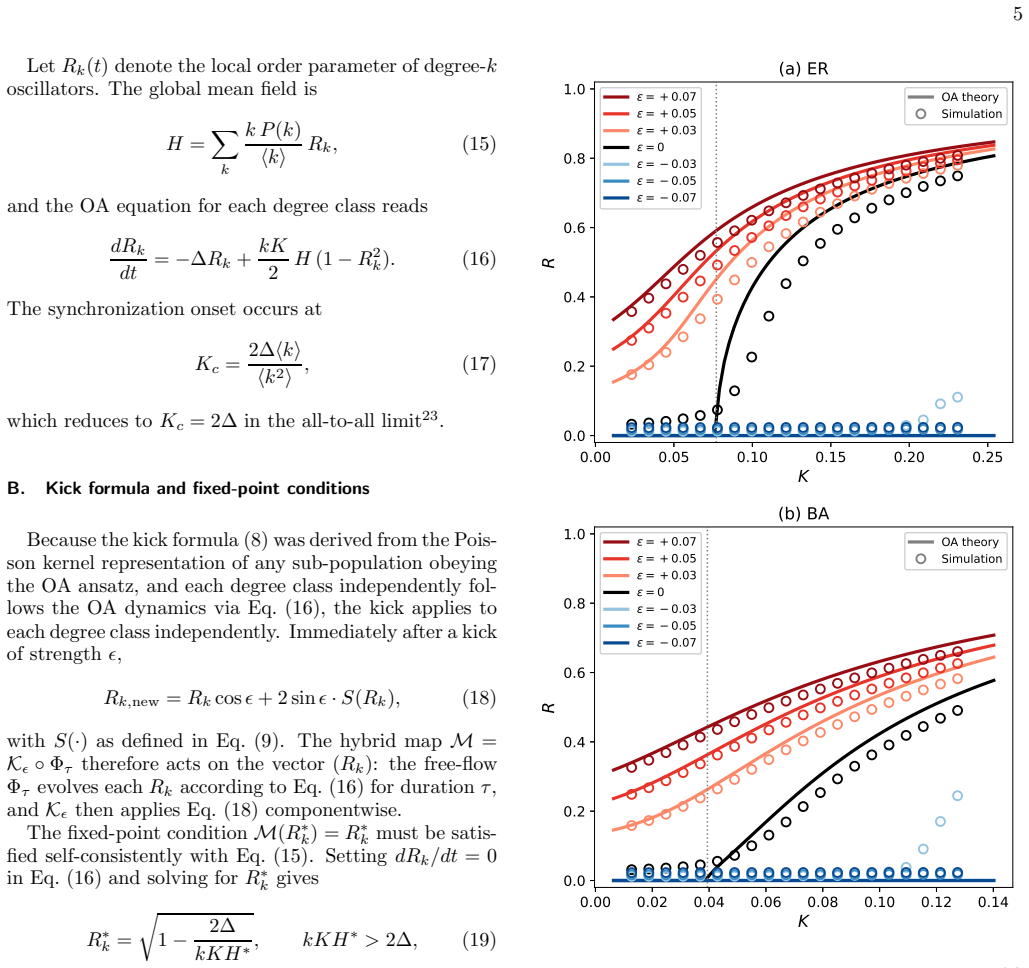
This study provides an analytical foundation for adversarial synchronization control in Kuramoto oscillator networks, where small gradient-based perturbations applied repeatedly to oscillator phases can dramatically enhance or suppress collective synchronization. Using the Ott--Antonsen reduction, we derive an exact closed-form expression for the effect of a single adversarial perturbation (kick) on the order parameter. A key finding is that each kick produces a finite, coupling-independent increment in the order parameter even when synchronization is arbitrarily weak, which combined with slow relaxation near the critical coupling and mean-field feedback explains the disproportionate amplification previously observed in numerical simulations. Fixed-point analysis further reveals a fundamental asymmetry between enhancement and suppression, with the latter governed by noise-induced escape in finite systems. Extending the framework to networks via the annealed network approximation, we show that the theory captures the synchronization behavior of representative model networks and identify a decoupling between kick sensitivity and mean-field dominance in scale-free networks. These results offer a tractable theoretical basis for understanding and designing kick-based synchronization control in oscillator networks.
Editorial analysis
A structured set of objections, weighed in public.
Referee Report
Summary. The paper derives an exact closed-form expression for the increment in the Kuramoto order parameter induced by a single gradient-based adversarial phase kick, using the Ott-Antonsen reduction. It claims this increment is finite and independent of coupling strength even at arbitrarily small r, and that the combination of this increment with slow relaxation near criticality and mean-field feedback accounts for the strong amplification seen in prior numerics. Fixed-point analysis reveals an asymmetry between synchronization enhancement and suppression (the latter limited by noise-induced escape in finite systems). The framework is extended to networks via the annealed-network approximation, which is asserted to capture representative model networks and to reveal a decoupling between kick sensitivity and mean-field dominance in scale-free topologies.
Significance. If the central derivation is valid, the work supplies a tractable analytical basis for kick-based synchronization control, directly explaining previously observed numerical amplification and identifying a fundamental enhancement-suppression asymmetry. The parameter-free character of the single-kick increment and the explicit fixed-point analysis constitute clear strengths that would be useful for both theory and design of control protocols.
major comments (2)
- [Ott-Antonsen reduction and single-kick derivation] Ott-Antonsen reduction and single-kick increment: the derivation treats the post-kick state as remaining exactly on the OA manifold and yields a closed-form, coupling-independent increment that remains finite as r→0. Because the kick is defined on individual phases rather than on the mean-field variables (r,ψ), it can in principle excite non-OA Fourier modes; the attraction rate to the manifold vanishes as r→0, so the claimed finite increment and subsequent slow relaxation require explicit verification that higher modes remain negligible. This assumption is load-bearing for the central claim.
- [Network extension via annealed approximation] Annealed-network extension: the claim that the annealed approximation accurately captures kick-induced synchronization changes in heterogeneous (including scale-free) networks rests on the same manifold-preservation step. No quantitative comparison is provided showing that the predicted increment matches full-network simulations near the critical coupling, which is required to support the reported decoupling between kick sensitivity and mean-field dominance.
minor comments (2)
- [Introduction and notation] The notation distinguishing the global order parameter r from the local mean-field quantities in the annealed network should be introduced earlier and used consistently.
- [Numerical results] Figure captions for the network simulations should explicitly state the system size N and the number of independent realizations used to obtain the plotted curves.
Simulated Author's Rebuttal
We thank the referee for their thorough review and constructive feedback on our manuscript. We address each of the major comments below and have incorporated revisions to strengthen the presentation and validation of our results.
read point-by-point responses
-
Referee: [Ott-Antonsen reduction and single-kick derivation] Ott-Antonsen reduction and single-kick increment: the derivation treats the post-kick state as remaining exactly on the OA manifold and yields a closed-form, coupling-independent increment that remains finite as r→0. Because the kick is defined on individual phases rather than on the mean-field variables (r,ψ), it can in principle excite non-OA Fourier modes; the attraction rate to the manifold vanishes as r→0, so the claimed finite increment and subsequent slow relaxation require explicit verification that higher modes remain negligible. This assumption is load-bearing for the central claim.
Authors: We acknowledge that the phase-based nature of the adversarial kick could in principle excite higher-order Fourier modes not captured by the Ott-Antonsen ansatz, and that the relaxation rate to the manifold slows as r approaches zero. In the original derivation, we relied on the standard application of the OA reduction for large-N Kuramoto systems, where the manifold is attractive. To provide explicit verification as suggested, we have added numerical simulations in a new Appendix C comparing the full phase dynamics with the OA-reduced model immediately following a kick. These simulations confirm that the deviation remains negligible (less than 1% relative error in r) for the coupling strengths and kick amplitudes considered, even near criticality. This supports the validity of the closed-form increment. We have also clarified the assumptions in the main text. revision: yes
-
Referee: [Network extension via annealed approximation] Annealed-network extension: the claim that the annealed approximation accurately captures kick-induced synchronization changes in heterogeneous (including scale-free) networks rests on the same manifold-preservation step. No quantitative comparison is provided showing that the predicted increment matches full-network simulations near the critical coupling, which is required to support the reported decoupling between kick sensitivity and mean-field dominance.
Authors: We agree that a direct quantitative comparison is necessary to substantiate the annealed approximation's accuracy near criticality. In the revised manuscript, we have included Figure 5 and accompanying text in Section 4, presenting side-by-side comparisons of the analytical predictions from the annealed model against direct numerical simulations of the full heterogeneous network for both Erdős–Rényi and scale-free topologies. The results show close agreement in the kick-induced Δr, with relative errors below 5% even near the critical point, thereby validating the decoupling between kick sensitivity and mean-field dominance in scale-free networks. revision: yes
Circularity Check
No circularity: standard OA reduction yields independent closed-form result
full rationale
The paper applies the established Ott-Antonsen reduction to the Kuramoto system with gradient-based phase kicks and derives a closed-form expression for the single-kick increment in the order parameter. This increment is shown to be finite and coupling-independent at arbitrarily small r by direct integration on the OA manifold. No step reduces to a self-definition, a fitted parameter renamed as prediction, or a load-bearing self-citation chain; the annealed-network extension is an approximation applied after the core derivation. The result is mathematically independent of the target claim and stands as a genuine consequence of the reduction rather than an input restated.
Axiom & Free-Parameter Ledger
axioms (2)
- domain assumption Ott-Antonsen reduction applies exactly to the Kuramoto model under the stated perturbations
- domain assumption Annealed network approximation captures synchronization behavior of representative model networks
Reference graph
Works this paper leans on
-
[1]
Physics reports , volume=
Synchronization in complex networks , author=. Physics reports , volume=. 2008 , publisher=
2008
-
[2]
Automatica , volume=
Synchronization in complex networks of phase oscillators: A survey , author=. Automatica , volume=. 2014 , publisher=
2014
-
[3]
Chaos: An Interdisciplinary Journal of Nonlinear Science , volume=
Adversarial control of synchronization in complex oscillator networks , author=. Chaos: An Interdisciplinary Journal of Nonlinear Science , volume=. 2025 , publisher=
2025
-
[4]
Chaos: An Interdisciplinary Journal of Nonlinear Science , volume=
Low dimensional behavior of large systems of globally coupled oscillators , author=. Chaos: An Interdisciplinary Journal of Nonlinear Science , volume=. 2008 , publisher=
2008
-
[5]
Chaos: An interdisciplinary journal of nonlinear science , volume=
Long time evolution of phase oscillator systems , author=. Chaos: An interdisciplinary journal of nonlinear science , volume=. 2009 , publisher=
2009
-
[6]
Physical review letters , volume=
Solvable model for chimera states of coupled oscillators , author=. Physical review letters , volume=. 2008 , publisher=
2008
-
[7]
Chaos: An Interdisciplinary Journal of Nonlinear Science , volume=
Ott-Antonsen attractiveness for parameter-dependent oscillatory systems , author=. Chaos: An Interdisciplinary Journal of Nonlinear Science , volume=. 2016 , publisher=
2016
-
[8]
Chaos: An Interdisciplinary Journal of Nonlinear Science , volume=
Chimera states in heterogeneous networks , author=. Chaos: An Interdisciplinary Journal of Nonlinear Science , volume=. 2009 , publisher=
2009
-
[9]
physica , volume=
Brownian motion in a field of force and the diffusion model of chemical reactions , author=. physica , volume=. 1940 , publisher=
1940
-
[10]
Reviews of modern physics , volume=
Reaction-rate theory: fifty years after Kramers , author=. Reviews of modern physics , volume=. 1990 , publisher=
1990
-
[11]
Physical Review E—Statistical, Nonlinear, and Soft Matter Physics , volume=
Frequency synchronization in a random oscillator network , author=. Physical Review E—Statistical, Nonlinear, and Soft Matter Physics , volume=. 2004 , publisher=
2004
-
[12]
Physical Review E—Statistical, Nonlinear, and Soft Matter Physics , volume=
Onset of synchronization in large networks of coupled oscillators , author=. Physical Review E—Statistical, Nonlinear, and Soft Matter Physics , volume=. 2005 , publisher=
2005
-
[13]
Physical Review E—Statistical, Nonlinear, and Soft Matter Physics , volume=
Link-disorder fluctuation effects on synchronization in random networks , author=. Physical Review E—Statistical, Nonlinear, and Soft Matter Physics , volume=. 2013 , publisher=
2013
-
[14]
Physical Review E , volume=
Nature of synchronization transitions in random networks of coupled oscillators , author=. Physical Review E , volume=. 2014 , publisher=
2014
-
[15]
Europhysics Letters , volume=
Mean-field theory of assortative networks of phase oscillators , author=. Europhysics Letters , volume=. 2014 , publisher=
2014
-
[16]
Physical review letters , volume=
Dynamics of noisy oscillator populations beyond the Ott-Antonsen ansatz , author=. Physical review letters , volume=. 2018 , publisher=
2018
-
[17]
Chaos: An Interdisciplinary Journal of Nonlinear Science , volume=
Graphop mean-field limits and synchronization for the stochastic Kuramoto model , author=. Chaos: An Interdisciplinary Journal of Nonlinear Science , volume=. 2022 , publisher=
2022
-
[18]
Physical Review Letters , volume=
Reduction methodology for fluctuation driven population dynamics , author=. Physical Review Letters , volume=. 2021 , publisher=
2021
-
[19]
IEEE transactions on neural networks and learning systems , volume=
Adversarial examples: Attacks and defenses for deep learning , author=. IEEE transactions on neural networks and learning systems , volume=. 2019 , publisher=
2019
-
[20]
CAAI Transactions on Intelligence Technology , volume=
A survey on adversarial attacks and defences , author=. CAAI Transactions on Intelligence Technology , volume=. 2021 , publisher=
2021
-
[21]
Physical Review E—Statistical, Nonlinear, and Soft Matter Physics , volume=
Delayed feedback control of collective synchrony: An approach to suppression of pathological brain rhythms , author=. Physical Review E—Statistical, Nonlinear, and Soft Matter Physics , volume=. 2004 , publisher=
2004
-
[22]
Physica A: Statistical Mechanics and its Applications , volume=
Pinning control of scale-free dynamical networks , author=. Physica A: Statistical Mechanics and its Applications , volume=. 2002 , publisher=
2002
-
[23]
Nature communications , volume=
Functional control of oscillator networks , author=. Nature communications , volume=. 2022 , publisher=
2022
-
[24]
Chaos: An Interdisciplinary Journal of Nonlinear Science , volume=
Introduction to focus issue: synchronization in complex networks , author=. Chaos: An Interdisciplinary Journal of Nonlinear Science , volume=. 2008 , publisher=
2008
-
[25]
Reviews of modern physics , volume=
The Kuramoto model: A simple paradigm for synchronization phenomena , author=. Reviews of modern physics , volume=. 2005 , publisher=
2005
-
[26]
Physics Reports , volume=
The Kuramoto model in complex networks , author=. Physics Reports , volume=. 2016 , publisher=
2016
-
[27]
Reviews of modern physics , volume=
Statistical mechanics of complex networks , author=. Reviews of modern physics , volume=. 2002 , publisher=
2002
-
[28]
Science , volume=
Emergence of scaling in random networks , author=. Science , volume=. 1999 , publisher=
1999
-
[29]
Introduction to Complex Networks: Measures, Statistical Properties, and Models , booktitle =
Takemoto, Kazuhiro and Oosawa, Chikoo , publisher =. Introduction to Complex Networks: Measures, Statistical Properties, and Models , booktitle =
-
[30]
Physical review letters , volume=
Dynamical weights and enhanced synchronization in adaptive complex networks , author=. Physical review letters , volume=. 2006 , publisher=
2006
discussion (0)
Sign in with ORCID, Apple, or X to comment. Anyone can read and Pith papers without signing in.