Recognition: no theorem link
Contestable Multi-Agent Debate with Arena-based Argumentative Computation for Multimedia Verification
Pith reviewed 2026-05-15 01:21 UTC · model grok-4.3
The pith
A multi-agent system turns retrieved evidence into scored support and attack arguments that resolve in local graphs to produce transparent editable verification reports for multimedia claims.
A machine-rendered reading of the paper's core claim, the machinery that carries it, and where it could break.
Core claim
The paper establishes that a contestable multi-agent architecture combining multimodal large language models, external verification tools, and arena-based quantitative bipolar argumentation can decompose verification tasks into sections, generate quantitative support and attack arguments from evidence, resolve those arguments through localized graphs with clash and uncertainty handling, and output transparent section-wise reports that remain computationally feasible for practical multimedia verification.
What carries the argument
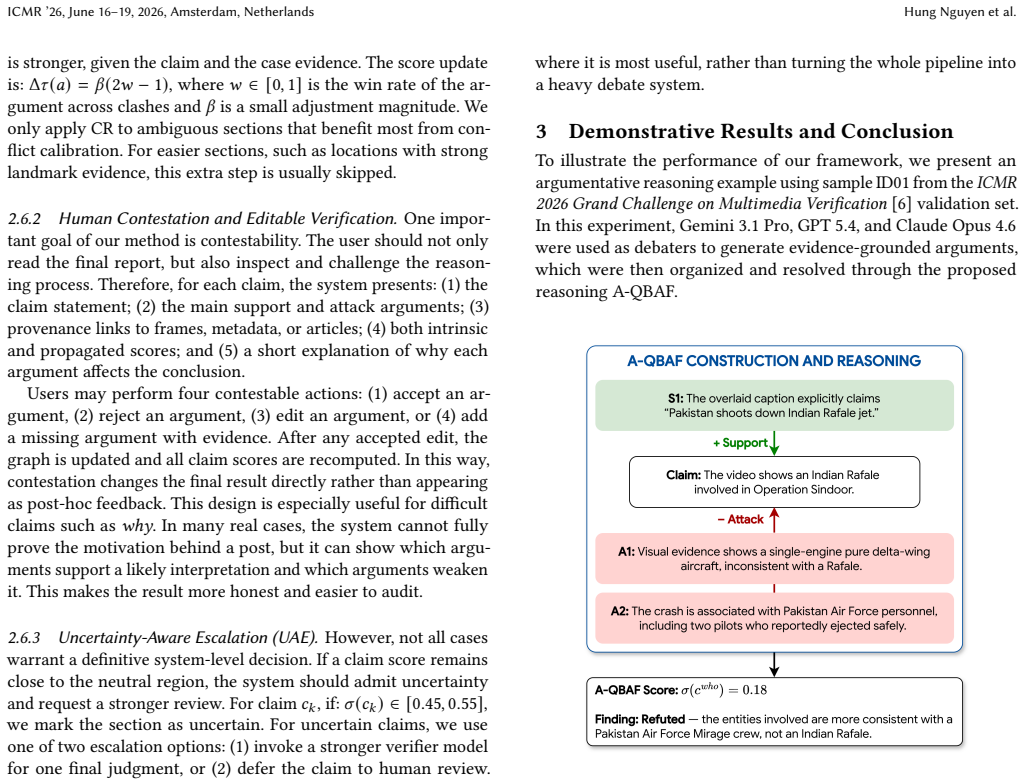
Arena-based quantitative bipolar argumentation (A-QBAF), a framework that represents arguments as bipolar relations with numerical strength scores and resolves them through arena-style debate in small local graphs.
If this is right
- Verification outputs become transparent at the section level so users can inspect and contest individual reasoning steps.
- Reports remain editable, allowing human operators to adjust arguments or scores without restarting the entire process.
- The localized graph resolution keeps computational cost low enough for routine real-world multimedia checks.
- Integration of external tools alongside language models supplies provenance that strengthens the traceability of each conclusion.
Where Pith is reading between the lines
- The same decomposition-plus-graph structure could be tested on non-multimedia fact-checking tasks such as textual claims or image-only verification to check transferability.
- Quantitative strength scores may allow calibration against human disagreement rates on the same cases, providing a measurable handle on uncertainty that pure language-model outputs lack.
- If the local graphs preserve information about provenance, downstream applications could trace a disputed conclusion back to specific retrieved items or model generations.
Load-bearing premise
Multimodal large language models paired with arena-based quantitative bipolar argumentation can convert retrieved evidence into accurate support and attack arguments whose resolution yields correct verification outcomes without systematic bias or error.
What would settle it
Apply the system to a held-out benchmark of multimedia cases whose ground-truth verification outcomes are already established by independent human experts, then measure the rate at which the generated reports match or diverge from those outcomes, especially on cases involving conflicting evidence.
Figures

read the original abstract
Multimedia verification requires not only accurate conclusions but also transparent and contestable reasoning. We propose a contestable multi-agent framework that integrates multimodal large language models, external verification tools, and arena-based quantitative bipolar argumentation (A-QBAF) as a submission to the ICMR 2026 Grand Challenge on Multimedia Verification. Our method decomposes each case into claim-centered sections, retrieves targeted evidence, and converts evidence into structured support and attack arguments with provenance and strength scores. These arguments are resolved through small local argument graphs with selective clash resolution and uncertainty-aware escalation. The resulting system generates section-wise verification reports that are transparent, editable, and computationally practical for real-world multimedia verification. Our implementation is public at: https://github.com/Analytics-Everywhere-Lab/MV2026_the_liems.
Editorial analysis
A structured set of objections, weighed in public.
Referee Report
Summary. The manuscript proposes a contestable multi-agent framework for multimedia verification that integrates multimodal large language models, external verification tools, and arena-based quantitative bipolar argumentation (A-QBAF). The method decomposes each case into claim-centered sections, retrieves targeted evidence, converts it into structured support and attack arguments with provenance and strength scores, resolves arguments via small local argument graphs with selective clash resolution and uncertainty-aware escalation, and generates transparent, editable section-wise verification reports. A public GitHub implementation is provided as a submission to the ICMR 2026 Grand Challenge on Multimedia Verification.
Significance. If empirically validated, the framework could advance multimedia verification by combining LLMs with quantitative argumentation to produce contestable, provenance-aware outputs that are more transparent and editable than standard black-box approaches. This addresses a practical need in real-world fact-checking and content moderation where explainability and contestability matter. The public code release supports reproducibility and is a clear strength.
major comments (2)
- [Abstract] Abstract and overall method description: The central claim that the pipeline produces accurate verification outcomes through evidence-to-argument conversion and A-QBAF resolution is unsupported by any experimental results, accuracy metrics, ablation studies, or benchmark evaluations in the manuscript. Without such evidence, it is impossible to assess whether the system avoids systematic bias or error as asserted.
- [Evaluation (missing)] No evaluation section exists: The absence of quantitative validation or case studies on multimedia verification tasks is load-bearing for the claim of computational practicality and correctness, leaving the framework as an untested architectural proposal.
minor comments (1)
- [Implementation] The GitHub repository link is given but the manuscript provides no details on reproduction steps, input formats, or example runs, which would aid readers in assessing the implementation.
Simulated Author's Rebuttal
We thank the referee for the constructive feedback. We agree that the manuscript, as a framework proposal for the ICMR 2026 Grand Challenge, lacks quantitative evaluation and will revise it to incorporate case studies, metrics, and tempered claims.
read point-by-point responses
-
Referee: [Abstract] Abstract and overall method description: The central claim that the pipeline produces accurate verification outcomes through evidence-to-argument conversion and A-QBAF resolution is unsupported by any experimental results, accuracy metrics, ablation studies, or benchmark evaluations in the manuscript. Without such evidence, it is impossible to assess whether the system avoids systematic bias or error as asserted.
Authors: We accept this observation. The abstract currently emphasizes potential benefits of the A-QBAF resolution without supporting data. In revision, we will rewrite the abstract to describe the framework as a proposed architecture with public implementation, and add a new Evaluation section containing case studies on multimedia verification tasks along with basic accuracy and efficiency metrics derived from the released code. revision: yes
-
Referee: [Evaluation (missing)] No evaluation section exists: The absence of quantitative validation or case studies on multimedia verification tasks is load-bearing for the claim of computational practicality and correctness, leaving the framework as an untested architectural proposal.
Authors: We agree that the lack of an evaluation section is a substantive gap. The submission focuses on the system architecture and reproducibility via GitHub, but we will add an Evaluation section with concrete case studies, runtime measurements, and qualitative analysis of argument graphs to demonstrate practicality and support the correctness claims. revision: yes
Circularity Check
No significant circularity detected in architectural proposal
full rationale
The paper describes an integration of external multimodal LLMs, verification tools, and A-QBAF for claim decomposition, evidence-to-argument conversion, and local graph resolution. No equations, fitted parameters, or self-citations are invoked in a way that reduces any prediction or result to the paper's own inputs by construction. The framework is presented as a practical system design relying on independent external components, with no self-definitional loops, fitted-input predictions, or load-bearing uniqueness claims from prior author work.
Axiom & Free-Parameter Ledger
axioms (2)
- domain assumption Multimodal large language models can reliably retrieve targeted evidence and convert it into structured support and attack arguments with provenance and strength scores
- domain assumption Arena-based quantitative bipolar argumentation can resolve conflicts through small local graphs with selective clash resolution and uncertainty-aware escalation
Reference graph
Works this paper leans on
-
[1]
Kars Alfrink et al. 2023. Contestable AI by design: Towards a framework.Minds and Machines33, 4 (2023), 613–639
work page 2023
- [2]
- [3]
-
[4]
Duc-Tien Dang-Nguyen, Sohail Ahmed Khan, Michael Riegler, Pål Halvorsen, Anh-Duy Tran, Minh-Son Dao, and Minh-Triet Tran. 2024. Overview of the grand challenge on detecting cheapfakes at acm icmr 2024. InProceedings of the 2024 International Conference on Multimedia Retrieval. 1275–1281
work page 2024
-
[5]
Duc-Tien Dang-Nguyen, Morten Langfeldt Dahlback, Henrik Vold, Silje Førsund, Minh-Son Dao, Kha-Luan Pham, Sohail Ahmed Khan, Marc Gallofré Ocaña, Minh-Triet Tran, and Anh-Duy Tran. 2025. The 2025 Grand Challenge on Multi- media Verification: Foundations and Overview. InProceedings of the 33rd ACM International Conference on Multimedia
work page 2025
-
[6]
Vold, Minh-Triet Tran, and Anh-Duy Tran
Duc-Tien Dang-Nguyen, Kha-Luan Pham, Minh-Anh Pham, Silje Førsund, Hen- rik B. Vold, Minh-Triet Tran, and Anh-Duy Tran. 2026. The 2026 Grand Challenge on Multimedia Verification: Overview and Key Directions. InProceedings of the 2026 International Conference on Multimedia Retrieval(Amsterdam, Netherlands) (ICMR ’26). Association for Computing Machinery, N...
work page 2026
-
[7]
Minh-Son Dao and Koji Zettsu. 2023. Leveraging knowledge graphs for cheap- fakes detection: Beyond dataset evaluation. In2023 IEEE International Conference on Multimedia and Expo Workshops (ICMEW). IEEE, 99–104
work page 2023
-
[8]
Gabriel Freedman, Adam Dejl, Deniz Gorur, Xiang Yin, Antonio Rago, and Francesca Toni. 2025. Argumentative Large Language Models for Explainable and Contestable Claim Verification. InProceedings of the 39th AAAI Conference on Artificial Intelligence, AAAI 2025, Vol. 39. Philadelphia, PA, USA, 14930–14939
work page 2025
-
[9]
Dhanvi Ganti. 2022. A novel method for detecting misinformation in videos, utilizing reverse image search, semantic analysis, and sentiment comparison of metadata.Utilizing Reverse Image Search, Semantic Analysis, and Sentiment Comparison of Metadata (June 5, 2022)(2022)
work page 2022
-
[10]
2025.NIST Open Media Forensics Challenge (OpenMFC Briefing for IIRD)
Haiying Guan. 2025.NIST Open Media Forensics Challenge (OpenMFC Briefing for IIRD)
work page 2025
-
[11]
Tuan-Vinh La, Quang-Tien Tran, Thanh-Phuc Tran, Anh-Duy Tran, Duc-Tien Dang-Nguyen, and Minh-Son Dao. 2022. Multimodal cheapfakes detection by utilizing image captioning for global context. InProceedings of the 3rd ACM Workshop on Intelligent Cross-Data Analysis and Retrieval. 9–16
work page 2022
-
[12]
Huy Hoan Le, Van Sy Thinh Nguyen, Thi Le Chi Dang, Vo Thanh Khang Nguyen, Truong Thanh Hung Nguyen, and Hung Cao. 2025. Multimedia Verification Through Multi-Agent Deep Research Multimodal Large Language Models. In Proceedings of the 33rd ACM International Conference on Multimedia. 14034–14040
work page 2025
-
[13]
2024.The OSINT Handbook: A practical guide to gathering and analyzing online information
Dale Meredith. 2024.The OSINT Handbook: A practical guide to gathering and analyzing online information. Packt Publishing Ltd
work page 2024
-
[14]
Eivind Moholdt, Sohail Ahmed Khan, and Duc-Tien Dang-Nguyen. 2023. De- tecting out-of-context image-caption pair in news: A counter-intuitive method. InProceedings of the 20th International Conference on Content-Based Multimedia Indexing. 203–209
work page 2023
-
[15]
Bao-Tin Nguyen, Van-Loc Nguyen, Thanh-Son Nguyen, Duc-Tien Dang-Nguyen, Trong-Le Do, and Minh-Triet Tran. 2024. A Hybrid Approach for Cheapfake Detection Using Reputation Checking and End-To-End Network. InProceedings of the 1st Workshop on Security-Centric Strategies for Combating Information Disorder. 1–12
work page 2024
-
[16]
Hung Nguyen, Alireza Rahimi, Veronica Whitford, Hélène Fournier, Irina Kon- dratova, René Richard, and Hung Cao. 2026. Heart2Mind: Human-Centered Contestable Psychiatric Disorder Prediction System Using Wearable ECG Moni- tors.ACM Transactions on Computing for Healthcare(2026)
work page 2026
-
[17]
Loc Phuc Truong Nguyen, Hung Thanh Do, Hung Truong Thanh Nguyen, and Hung Cao. 2025. Motion2Meaning: A Clinician-Centered Framework for Con- testable LLM in Parkinson’s Disease Gait Interpretation. InProceedings of 9th International Symposium on Chatbots and Human-centred AI (CONVERSATIONS) 2025
work page 2025
-
[18]
Minh-Nhat Nguyen, Trong-Nghia Tran, Minh-Triet Tran, Duc-Tien Dang- Nguyen, and Trong-Le Do. 2025. Robust Multimedia Verification of Cheapfakes and Deepfakes via External Context Leveraging. In2025 International Conference on Content-Based Multimedia Indexing (CBMI). IEEE, 1–8
work page 2025
-
[19]
Minh-Tam Nguyen, Quynh T Nguyen, Minh Son Dao, and Binh T Nguyen. 2025. Multimodal scene-graph matching for cheapfakes detection.International Journal of Multimedia Information Retrieval14, 2 (2025), 17
work page 2025
-
[20]
Thanh-Son Nguyen, Vinh Dang, Minh-Triet Tran, and Duc-Tien Dang-Nguyen
-
[21]
InProceedings of the 4th ACM Workshop on Intelligent Cross-Data Analysis and Retrieval
Leveraging cross-modals for cheapfakes detection. InProceedings of the 4th ACM Workshop on Intelligent Cross-Data Analysis and Retrieval. 51–59
-
[22]
Thanh-Son Nguyen and Minh-Triet Tran. 2023. Multi-Models from Computer Vision to Natural Language Processing for Cheapfakes Detection. In2023 IEEE International Conference on Multimedia and Expo Workshops (ICMEW). IEEE, 93–98
work page 2023
-
[23]
Kha-Luan Pham, Manh-Thien Nguyen, Anh-Duy Tran, Minh-Son Dao, and Duc- Tien Dang-Nguyen. 2023. Detecting cheapfakes using self-query adaptive-context learning. InProceedings of the 4th ACM Workshop on Intelligent Cross-Data Anal- ysis and Retrieval. 60–63
work page 2023
-
[24]
Thomas Ploug and Søren Holm. 2020. The four dimensions of contestable AI diagnostics-A patient-centric approach to explainable AI.Artificial intelligence in medicine107 (2020), 101901
work page 2020
-
[25]
Andreas Rossler, Davide Cozzolino, Luisa Verdoliva, Christian Riess, Justus Thies, and Matthias Nießner. 2019. Faceforensics++: Learning to detect manipulated facial images. InProceedings of the IEEE/CVF international conference on computer vision. 1–11
work page 2019
-
[26]
Jangwon Seo, Hyo-Seok Hwang, Jiyoung Lee, Minhyeok Lee, Wonsuk Kim, and Junhee Seok. 2024. A Multi-Stage Deep Learning Approach Incorporating Text- Image and Image-Image Comparisons for Cheapfake Detection. InProceedings of the 2024 International Conference on Multimedia Retrieval. 1312–1316
work page 2024
-
[27]
Ruben Tolosana, Ruben Vera-Rodriguez, Julian Fierrez, Aythami Morales, and Javier Ortega-Garcia. 2020. Deepfakes and beyond: A survey of face manipulation and fake detection.Information fusion64 (2020), 131–148
work page 2020
-
[28]
Quang-Tien Tran, Thanh-Phuc Tran, Minh-Son Dao, Tuan-Vinh La, Anh-Duy Tran, and Duc Tien Dang Nguyen. 2022. A textual-visual-entailment-based unsupervised algorithm for cheapfake detection. InProceedings of the 30th ACM International Conference on Multimedia. 7145–7149
work page 2022
-
[29]
Simon S Woo. 2022. Advanced Machine Learning Techniques to Detect Various Types of Deepfakes. InProceedings of the 1st Workshop on Security Implications of Deepfakes and Cheapfakes. 25–25
work page 2022
-
[30]
Yuqicheng Zhu, Nico Potyka, Daniel Hernández, Yuan He, Zifeng Ding, Bo Xiong, Dongzhuoran Zhou, Evgeny Kharlamov, and Steffen Staab. 2025. Ar- gRAG: Explainable Retrieval Augmented Generation using Quantitative Bipolar Argumentation. In19th International Conference on Neurosymbolic Learning and Reasoning
work page 2025
discussion (0)
Sign in with ORCID, Apple, or X to comment. Anyone can read and Pith papers without signing in.