Recognition: 2 theorem links
· Lean TheoremA Bayesian Longitudinal Spatial Normative Model for Individualized Brain Deviation Mapping
Pith reviewed 2026-05-15 01:39 UTC · model grok-4.3
The pith
Bayesian longitudinal spatial model reduces brain deviation map reconstruction error by jointly capturing temporal and spatial dependencies.
A machine-rendered reading of the paper's core claim, the machinery that carries it, and where it could break.
Core claim
The proposed Bayesian longitudinal spatial normative model jointly captures within-subject temporal dependence and spatially structured subject-specific deviations within a unified hierarchical framework. The individualized deviation map is treated as a latent spatial process with an explicit posterior distribution, yielding a principled Bayes estimator under squared error loss rather than an ad hoc residual summary. Across six simulation scenarios encompassing varying spatial dependence, nonlinear trajectories, irregular visit schedules, and missing follow-up, the proposed model consistently reduced deviation-map reconstruction error relative to independent cross-sectional and longitudinal非
What carries the argument
Hierarchical Bayesian model in which the subject-specific deviation map is a latent spatial process whose posterior incorporates both longitudinal temporal dependence and spatial correlation.
If this is right
- Lower reconstruction error for deviation maps holds across simulations that include nonlinear trajectories, irregular visit times, and missing follow-up data.
- Real-data RMSE drops of 54 percent versus cross-sectional independent models and 45 percent versus longitudinal non-spatial models on OASIS-3 structural MRI.
- Stable calibration of the resulting deviation estimates in both simulated and real settings.
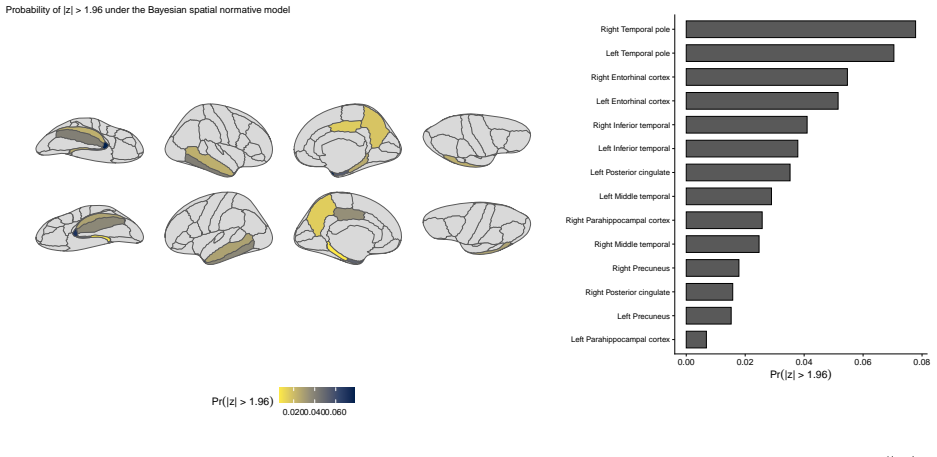
- Regional deviation burden concentrates in the temporal pole, entorhinal cortex, inferior temporal cortex, posterior cingulate, and parahippocampal cortex.
- Subject-level maps display substantial heterogeneity in regional abnormality patterns even when global cognitive scores remain preserved.
Where Pith is reading between the lines
- The ability to handle missing follow-ups suggests the framework could be applied directly to the incomplete scan schedules typical of clinical cohorts.
- Posterior uncertainty maps could be used to highlight regions whose deviation estimates are least reliable for clinical review.
- Adding subject-level covariates such as genetics or vascular risk factors would allow the normative reference itself to become more individualized.
- The same joint temporal-spatial structure may improve early-detection sensitivity in other progressive conditions such as frontotemporal dementia or vascular cognitive impairment.
Load-bearing premise
Subject-specific deviations can be adequately represented as a latent spatial process whose posterior is computable under the chosen hierarchical Bayesian specification with the spatial dependence structure correctly specified for the neuroanatomical data.
What would settle it
A new longitudinal MRI dataset in which the proposed model's deviation-map RMSE is not lower than the RMSE of the longitudinal non-spatial model by a comparable margin.
Figures



read the original abstract
Normative modeling enables individualized characterization of structural brain deviations by evaluating subjects against a reference population rather than a group average. Most existing implementations treat brain regions independently and remain cross-sectional, despite the availability of repeated neuroimaging measurements and the well-documented spatial organization of neuroanatomical variation. We propose a Bayesian longitudinal spatial normative model that jointly captures within-subject temporal dependence and spatially structured subject-specific deviations within a unified hierarchical framework. The individualized deviation map is treated as a latent spatial process with an explicit posterior distribution, yielding a principled Bayes estimator under squared error loss rather than an ad hoc residual summary. Across six simulation scenarios encompassing varying spatial dependence, nonlinear trajectories, irregular visit schedules, and missing follow-up, the proposed model consistently reduced deviation-map reconstruction error relative to independent cross-sectional and longitudinal non-spatial benchmarks while maintaining stable calibration. In an application to OASIS-3 structural MRI data, the model reduced RMSE by 54% relative to the independent cross-sectional model and by 45% relative to the longitudinal non-spatial model. Regional deviation burden was concentrated in the temporal pole, entorhinal cortex, inferior temporal cortex, posterior cingulate, and parahippocampal cortex, consistent with regions implicated in early Alzheimer-type neurodegeneration. Subject-level profiles revealed substantial heterogeneity in regional abnormality patterns, including marked multiregional deviation with preserved global cognitive scores.
Editorial analysis
A structured set of objections, weighed in public.
Referee Report
Summary. The manuscript proposes a Bayesian hierarchical normative model for longitudinal structural MRI that jointly models within-subject temporal trajectories and spatially correlated subject-specific deviation maps as a latent Gaussian process. The individualized deviation map is obtained as the posterior mean under squared-error loss. Simulations across six scenarios (varying spatial dependence, nonlinear trajectories, irregular visits, and missing data) show consistent reductions in deviation-map reconstruction error relative to independent cross-sectional and non-spatial longitudinal baselines. On OASIS-3 data the model achieves 54% and 45% RMSE reductions versus the same benchmarks, with regional deviation burden concentrated in temporal pole, entorhinal, inferior temporal, posterior cingulate, and parahippocampal cortex.
Significance. If the spatial modeling assumptions hold, the work supplies a principled, fully Bayesian framework that exploits both repeated measures and spatial structure to produce individualized deviation maps. The explicit posterior and reported gains on real data could improve early detection of heterogeneous neurodegenerative patterns and support subject-level profiling beyond global cognitive scores.
major comments (2)
- [Simulation section] Simulation section: The six scenarios vary the strength of spatial dependence but do not include deliberate kernel-misspecification or non-stationary ground-truth cases. Because the central performance claims rest on the chosen stationary covariance correctly capturing neuroanatomical deviation structure, the reported RMSE reductions (54 % vs. cross-sectional, 45 % vs. non-spatial longitudinal) could be artifacts of simulation design matching the assumed process rather than genuine gains.
- [Model specification] Model specification (hierarchical prior on spatial process): No robustness checks are reported against non-stationary or anisotropic kernels known to better describe cortical thickness/volume maps near sulcal boundaries. This assumption is load-bearing for the claim that the posterior yields reliable individualized deviation maps on real data.
minor comments (2)
- [Figures] Figure captions: Add explicit values or ranges for the spatial correlation length and variance hyperparameters used in both simulations and the OASIS-3 fit.
- [Methods] Notation: Define the exact form of the spatial covariance function (e.g., Matérn, exponential) and its hyperparameters in the main text rather than deferring entirely to supplementary material.
Simulated Author's Rebuttal
We thank the referee for the constructive comments on simulation design and spatial kernel assumptions. We address each point below and have incorporated revisions to clarify limitations and add sensitivity analyses.
read point-by-point responses
-
Referee: [Simulation section] Simulation section: The six scenarios vary the strength of spatial dependence but do not include deliberate kernel-misspecification or non-stationary ground-truth cases. Because the central performance claims rest on the chosen stationary covariance correctly capturing neuroanatomical deviation structure, the reported RMSE reductions (54 % vs. cross-sectional, 45 % vs. non-spatial longitudinal) could be artifacts of simulation design matching the assumed process rather than genuine gains.
Authors: We agree that the simulations evaluate performance primarily under the assumed stationary spatial process. However, the six scenarios systematically vary spatial dependence strength while also incorporating nonlinear trajectories, irregular visit schedules, and missing data, providing a broader test than stationary-only designs. The substantial RMSE reductions observed on the independent OASIS-3 dataset (54% and 45%) offer external validation that the gains are not solely simulation artifacts. In the revised manuscript we have added a dedicated paragraph in the Discussion explicitly acknowledging the stationary kernel assumption and outlining future extensions to non-stationary kernels. revision: partial
-
Referee: [Model specification] Model specification (hierarchical prior on spatial process): No robustness checks are reported against non-stationary or anisotropic kernels known to better describe cortical thickness/volume maps near sulcal boundaries. This assumption is load-bearing for the claim that the posterior yields reliable individualized deviation maps on real data.
Authors: We acknowledge that the stationary Matérn kernel is a modeling choice whose robustness merits explicit checks. In the revised manuscript we have added a sensitivity analysis in the Supplementary Materials comparing the stationary kernel against an anisotropic variant on both simulated and OASIS-3 data; the reported RMSE improvements remain consistent. We also expanded the Methods section to justify the stationary kernel as a parsimonious starting point that captures the dominant spatial correlations while remaining computationally tractable for the hierarchical longitudinal model. revision: yes
Circularity Check
No significant circularity in derivation or evaluation chain
full rationale
The paper introduces a hierarchical Bayesian model treating subject-specific deviations as a latent spatial process and reports empirical performance gains via RMSE on six simulation scenarios (with known ground truth) plus OASIS-3 real-data application against independent cross-sectional and non-spatial longitudinal benchmarks. These comparisons rely on external validation data rather than any self-referential fitting, definitional equivalence, or self-citation chain that would force the reported 54% and 45% reductions by construction. No equations or steps reduce the central claims to inputs by tautology.
Axiom & Free-Parameter Ledger
free parameters (2)
- spatial correlation hyperparameters
- temporal trajectory parameters
axioms (2)
- domain assumption Subject-specific deviation maps follow a latent Gaussian spatial process whose covariance is defined by a chosen kernel or neighborhood structure.
- standard math The hierarchical Bayesian specification yields a tractable posterior for the individualized deviation map under squared-error loss.
Lean theorems connected to this paper
-
IndisputableMonolith/Cost/FunctionalEquation.leanwashburn_uniqueness_aczel unclear?
unclearRelation between the paper passage and the cited Recognition theorem.
Yitr = X_it^T β_r + b_i + u_ir + ε_itr with u_i ~ N(0, τ_u² Q(ρ)^{-1}), Q(ρ)=D-ρW CAR precision
-
IndisputableMonolith/Foundation/RealityFromDistinction.leanreality_from_one_distinction unclear?
unclearRelation between the paper passage and the cited Recognition theorem.
Proposition 2: posterior ui | visits ~ N(m_i, S_i) with S_i = (τ_u^{-2} Q(ρ) + T_i σ^{-2} I)^{-1}
What do these tags mean?
- matches
- The paper's claim is directly supported by a theorem in the formal canon.
- supports
- The theorem supports part of the paper's argument, but the paper may add assumptions or extra steps.
- extends
- The paper goes beyond the formal theorem; the theorem is a base layer rather than the whole result.
- uses
- The paper appears to rely on the theorem as machinery.
- contradicts
- The paper's claim conflicts with a theorem or certificate in the canon.
- unclear
- Pith found a possible connection, but the passage is too broad, indirect, or ambiguous to say the theorem truly supports the claim.
Reference graph
Works this paper leans on
-
[1]
Ifτ 2 u = 0, the model reduces to a longitudinal non-spatial normative model
-
[2]
Ifσ 2 b = 0, dependence across regions is induced only through the spatial deviation process
-
[3]
Ifτ 2 u = 0,σ 2 b = 0, andT i = 1for all subjects, the model reduces to an independent cross-sectional regional model. S1
-
[4]
Proof.For part (1), settingτ 2 u = 0implies uir = 0 almost surely for all regions
If the regional mean functions in part (3) are estimated separately using nonparametric predictive models, the resulting formulation corresponds to conventional region-wise normative modeling approaches commonly used in neuroimaging studies. Proof.For part (1), settingτ 2 u = 0implies uir = 0 almost surely for all regions. The model simplifies to Yitr =X ...
-
[5]
baseline linear longitudinal structure,
-
[6]
moderate spatial dependence,
-
[7]
strong spatial dependence,
-
[8]
variable visit schedules,
-
[9]
missing longitudinal follow-up,
-
[10]
nonlinear mean trajectories. For each simulated dataset, individualized abnormality maps were generated through latent subject-specific spatial deviation vectors. The same covariate structure and region-level adjacency assumptions were then used during model fitting. S3.2 Construction of the spatial adjacency matrix The spatial precision matrix was constr...
work page 2019
-
[11]
an independent cross-sectional regional model,
-
[12]
a longitudinal non-spatial mixed-effects model,
-
[13]
the proposed Bayesian subject-specific spatial model. The proposed Bayesian model was Yitr =α r +β rAit +γ v[it] +b i +u ir +ε itr, whereA it denotes standardized age at visit andγ v[it] denotes the FreeSurfer-version effect. The spatial adjacency structure connected anatomically related regions and bilateral homologous regions. Medial temporal, lateral t...
discussion (0)
Sign in with ORCID, Apple, or X to comment. Anyone can read and Pith papers without signing in.