Recognition: no theorem link
Verification of reciprocity in anisotropic poroelastic wave simulation using symmetric Strang splitting
Pith reviewed 2026-05-15 01:31 UTC · model grok-4.3
The pith
Symmetric Strang splitting preserves reciprocity to near machine precision in anisotropic poroelastic wave simulations.
A machine-rendered reading of the paper's core claim, the machinery that carries it, and where it could break.
Core claim
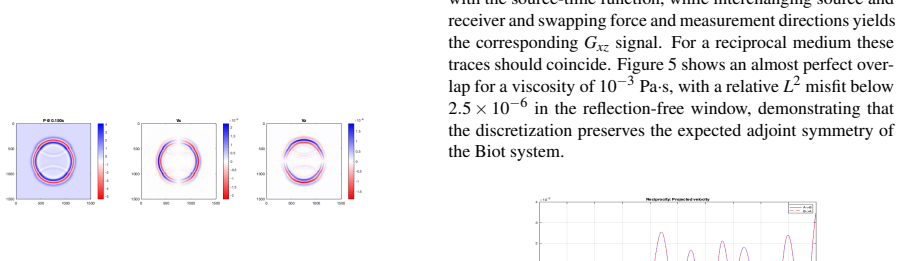
By expressing the Biot equations through a continuous evolution operator split into reversible skew-adjoint wave dynamics and irreversible self-adjoint non-positive Darcy dynamics including the Johnson-Koplik-Dashen correction, the authors construct a symmetric Strang-splitting time integrator that, when paired with staggered pseudo-spectral spatial discretization, yields discrete reciprocity with relative L2 misfit near machine precision for cross-component responses in anisotropic poroelastic media.
What carries the argument
Symmetric second-order Strang splitting of the split Biot evolution operator with half-step source injection and staggered pseudo-spectral discretization.
Load-bearing premise
The discrete operators exactly inherit the skew-adjoint property of the reversible wave subsystem and the self-adjoint non-positive property of the Darcy subsystem from the continuous evolution operator.
What would settle it
Observing a relative L2 misfit for cross-component reciprocity that remains orders of magnitude above machine precision in a 2D VTI poroelastic simulation using the described symmetric Strang-splitting scheme would falsify the inheritance of reciprocity.
Figures


read the original abstract
Poroelastic wave simulations are important for many applications relating fluid flow and wave characteristics in porous rock formations. Reciprocity is a key physical property of wave propagation in porous media that is important for such applications, even when viscous dissipation is present. However, numerical poroelastic simulations often fail to reproduce reciprocal responses because the discretization does not preserve the balance between reversible wave dynamics and irreversible fluid-solid drag. To address this, we formulate the Biot equations in terms of a continuous evolution operator split into a reversible (skew-adjoint) wave part and an irreversible (self-adjoint, non-positive) Darcy part, including the leading-order Johnson-Koplik-Dashen correction. This structure clarifies why reciprocity holds in the continuous equations and how it is easily broken in discrete form. Guided by this interpretation, we construct a symmetric second-order Strang-splitting scheme with half-step source injection. The method conserves energy in the reversible subsystem, treats Darcy dissipation unconditionally stably, and retains Courant limits similar to elastic solvers. Using a staggered pseudo-spectral discretization, we model multimode propagation in 2D VTI media and obtain cross-component reciprocity with a relative L2 misfit approaching machine precision, demonstrating that the discrete scheme inherits the symmetry properties of the continuous evolution operator.
Editorial analysis
A structured set of objections, weighed in public.
Referee Report
Summary. The paper formulates the Biot equations for anisotropic poroelastic media as a continuous evolution operator split into a reversible skew-adjoint wave subsystem and an irreversible self-adjoint non-positive Darcy subsystem (with leading-order Johnson-Koplik-Dashen correction). It constructs a symmetric second-order Strang-splitting time integrator with half-step source injection, paired with staggered pseudo-spectral spatial discretization. Numerical experiments on 2D VTI models demonstrate that cross-component reciprocity is recovered to relative L2 misfit levels approaching machine precision.
Significance. If the result holds, the work supplies a practical discretization strategy that inherits the continuous symmetry properties responsible for reciprocity, even in the presence of viscous dissipation. This is directly relevant to geophysical and engineering applications that rely on reciprocal wave responses in fluid-saturated porous media. The near-machine-precision verification on independent 2D VTI test cases provides concrete evidence that the discrete operators preserve the required skew-adjoint and self-adjoint properties.
minor comments (1)
- The abstract states that the scheme 'retains Courant limits similar to elastic solvers'; a brief quantitative comparison (e.g., maximum stable CFL value) in §4 or §5 would strengthen this claim without lengthening the text.
Simulated Author's Rebuttal
We thank the referee for their positive assessment of the manuscript, including the clear summary of the continuous operator splitting and the verification results, and for recommending acceptance. No revisions are required.
Circularity Check
No significant circularity; verification is independent
full rationale
The paper formulates the Biot equations via an evolution operator split into skew-adjoint wave and self-adjoint Darcy parts, constructs a symmetric Strang-splitting scheme with staggered pseudo-spectral discretization, and verifies reciprocity by direct numerical experiments in 2D VTI media that achieve relative L2 misfit near machine precision. This verification step is external to the scheme definition and does not reduce to fitted parameters, self-referential definitions, or load-bearing self-citations. The inheritance of adjoint properties is tested rather than presupposed, making the central claim self-contained against the reported benchmarks.
Axiom & Free-Parameter Ledger
axioms (1)
- domain assumption The Biot equations admit a continuous evolution operator that splits into a reversible skew-adjoint wave part and an irreversible self-adjoint non-positive Darcy part.
Reference graph
Works this paper leans on
-
[1]
Carcione, J. M., and Quiroga-Goode, G., 1995, Some aspects of the physics and numerical modeling of Biot compressional waves, J. Comput. Acous., 3, 261-280
work page 1995
-
[2]
Carcione, J. M., 1996, Wave propagation in anisotropic, satu- rated porous media: Plane-wave theory and numerical simula- tion:J. Acoust. Soc. Am., 99, 2655–2666
work page 1996
-
[3]
Carcione, J. M., C. Morency, and J. E. Santos, 2010, Computa- tional poroelasticity: A review:Geophysics, 75, 5, 75A229–75A243
work page 2010
-
[4]
M., 2022,Wave Fields in Real Media, 4th ed.: Elsevier
Carcione, J. M., 2022,Wave Fields in Real Media, 4th ed.: Elsevier. de Hoop, A. T., 1995, Handbook of Radiation and Scattering of Waves: Acoustic waves in fluids, elastic waves in solids, electromagnetic waves: Academic Press
work page 2022
-
[5]
Jakobsen, M., J. S. Stokke, K. Kumar, and A. F. Radu, 2025, Frequency-domain Biot–Allard equations for isotropic and anisotropic poroelastic media: Two-field formulations and iterative split- ting:Research Square, preprint, https://doi.org/10.21203/rs.3.rs- 8293824/v1
-
[6]
Johnson, D. L., J. Koplik, and L. Dashen, 1987, Theory of dynamic permeability and tortuosity in fluid-saturated porous media:Journal of Fluid Mechanics, 176, 379–402
work page 1987
-
[7]
Karpfinger, F., T. M. M¨uller, and B. Gurevich, 2009, Green’s functions and radiation patterns in poroelastic solids revisited: Geophysical Journal International, 178, 327–337
work page 2009
-
[8]
Kato, T., 1995,Perturbation theory for linear operators, Springer- Verlag
work page 1995
-
[9]
Lie, S., 1970, The Lie product formula for semigroups gener- ated by unbounded operators:Mathematische Annalen, 188, 235–242
work page 1970
-
[10]
Masson, Y . J., S. R. Pride, and K. T. Nihei, 2006, Finite differ- ence modeling of Biot’s poroelastic equations at seismic fre- quencies:Journal of Geophysical Research, 111, B10305
work page 2006
-
[11]
Pazy, A., 1983,Semigroups of linear operators and applica- tions to partial differential equations, Springer-Verlag
work page 1983
-
[12]
Sidler, R., J. M. Carcione, and K. Holliger, 2013, A pseudo- spectral method for the simulation of poro-elastic seismic wave propagation in 2D polar coordinates using domain decomposi- tion:Journal of Computational Physics, 235, 846–864
work page 2013
-
[13]
Strang, G., 1968, On the construction and comparison of dif- ference schemes:SIAM Journal on Numerical Analysis, 5, 506–517
work page 1968
-
[14]
Stokke, J. S., M. Jakobsen, K. Kumar, and F. A. Radu, 2025, A history-dependent dynamic Biot model: In Sequeira et al. (Eds.), ENUMATH 2023, Lecture Notes in Computational Sci- ence and Engineering, 154, 360–368, Springer
work page 2025
-
[15]
Tohti, M., Y . Wang, W. Xiao, Q. Di, K. Zhou, J. Wang, S. An, and S. Liao, 2021, Numerical simulation of seismic waves in 3-D orthorhombic poroelastic medium with microseismic source implementation:Geophysical Journal International, 227, 1012–1027
work page 2021
-
[16]
Trotter, H. F., 1959, On the product of semi-groups of opera- tors:Proceedings of the American Mathematical Society, 10, 545–551
work page 1959
-
[17]
Wapenaar, K., and J. Fokkema, 2004, Reciprocity theorems for diffusion, flow, and waves: Journal of Applied Mechanics, 71(1), 145–150
work page 2004
-
[18]
Zheng, J., T. Li, J. Xie, and Y . Sun, 2024, Improved numerical solution of anisotropic poroelastic wave equation in microseis- micity: Graphic process unit acceleration and moment tensor implementation:Geophysical Prospecting, 72(6)
work page 2024
discussion (0)
Sign in with ORCID, Apple, or X to comment. Anyone can read and Pith papers without signing in.