Recognition: 2 theorem links
· Lean TheoremAngel or Demon: Investigating the Plasticity Interventions' Impact on Backdoor Threats in Deep Reinforcement Learning
Pith reviewed 2026-05-15 01:33 UTC · model grok-4.3
The pith
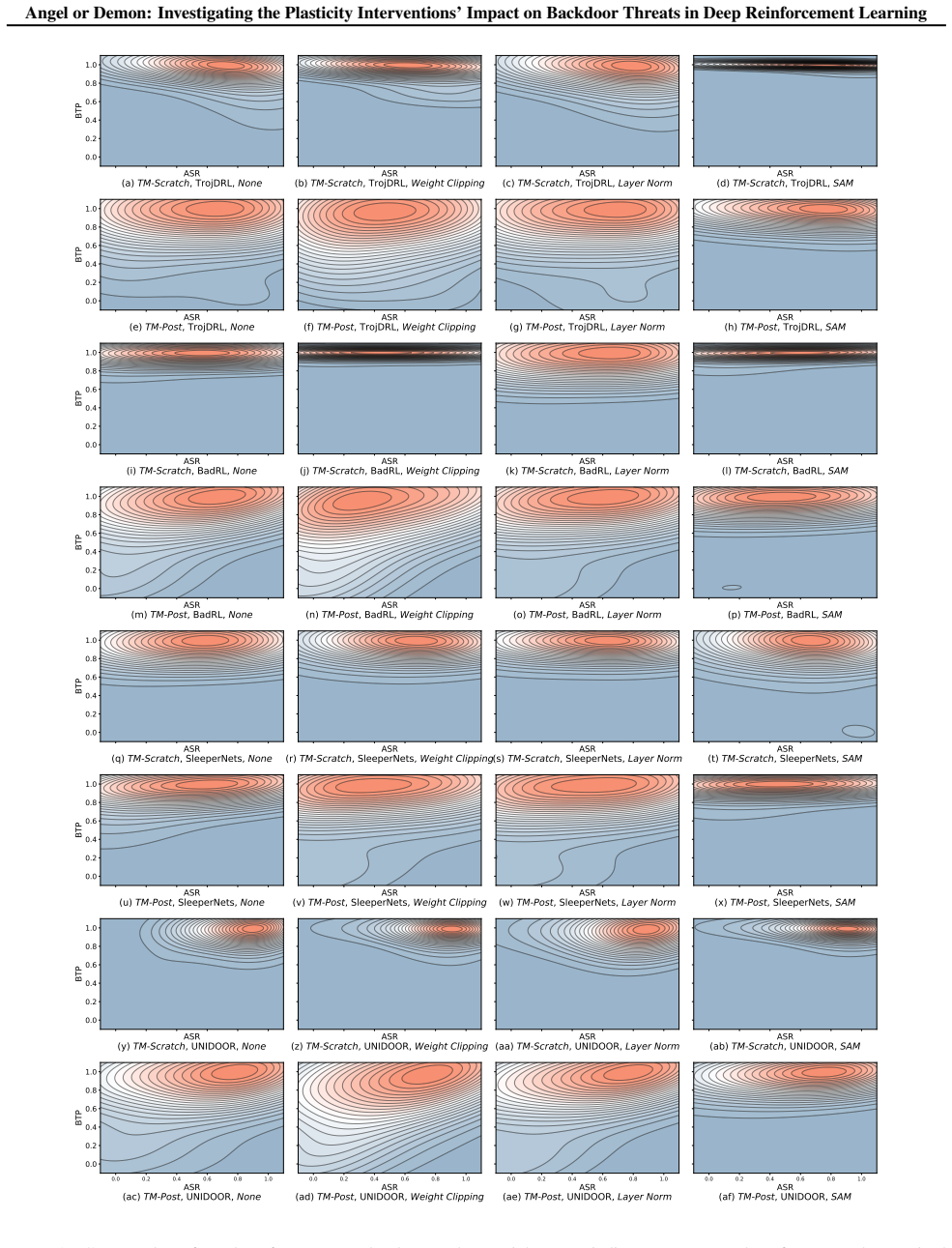
Most plasticity interventions reduce backdoor threats in deep reinforcement learning, but SAM makes them worse by amplifying gradients.
A machine-rendered reading of the paper's core claim, the machinery that carries it, and where it could break.
Core claim
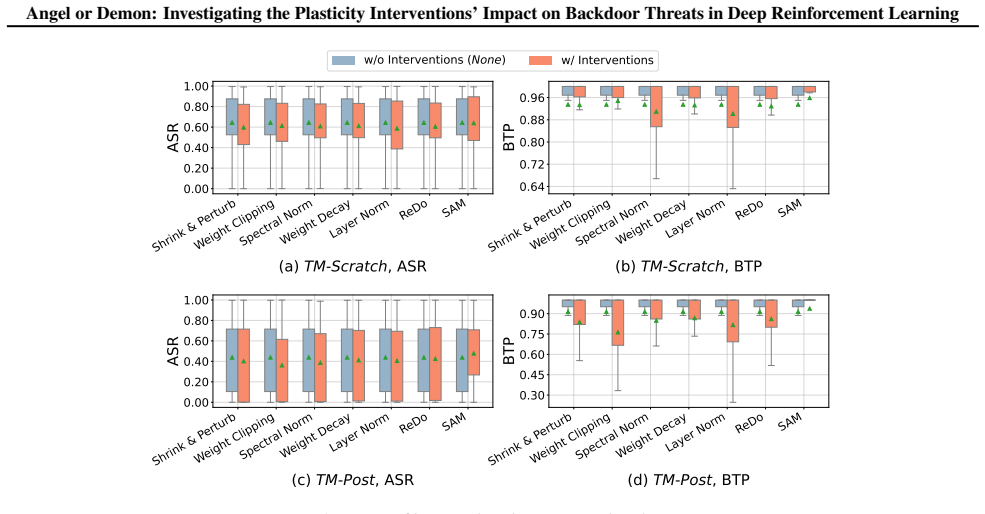
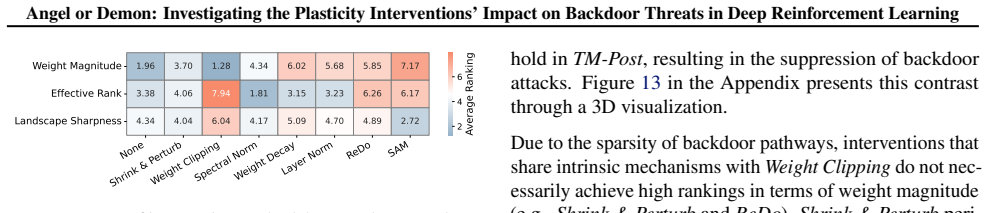
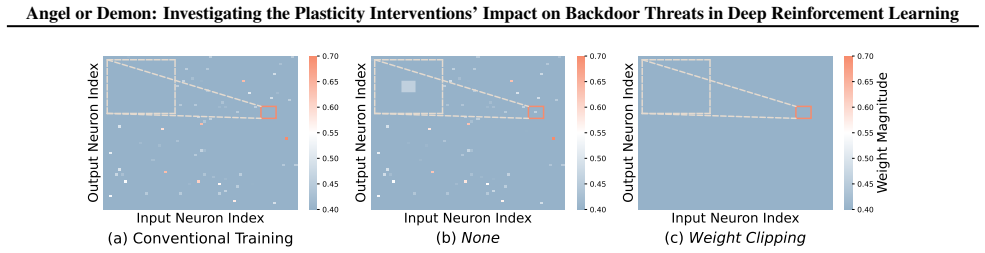
Only the SAM intervention exacerbates backdoor threats in DRL while the others mitigate them; the worsening occurs through backdoor gradient amplification, and the protection arises from activation pathway disruption together with representation space compression.
What carries the argument
The SCC conceptual framework that deconstructs the mechanistic interplay between plasticity interventions and backdoor attacks in DRL.
If this is right
- SAM should be used with extra caution in any DRL system that might face backdoor risks.
- Other plasticity methods can be chosen specifically to lower backdoor vulnerability without sacrificing their plasticity benefits.
- Loss-landscape sharpness measurements can be added to routine monitoring as an early warning for possible backdoor presence.
- The SCC framework supplies a structured way to test new combinations of interventions for backdoor resistance.
Where Pith is reading between the lines
- Security evaluations of DRL agents should now include the specific plasticity method as a variable rather than treating all agents as vanilla.
- Designers could deliberately stack multiple mitigating interventions to create layered defenses that are harder for attackers to overcome.
- The gradient-amplification effect of SAM might be turned into a diagnostic tool for identifying which parts of a network are most attack-prone.
Load-bearing premise
The 14,664 tested cases capture enough of the variety in real DRL environments and attack methods for the observed patterns to hold more generally.
What would settle it
A new DRL environment and model combination in which SAM no longer increases attack success rate or in which the other interventions fail to reduce it.
Figures







read the original abstract
Extensive research has highlighted the severe threats posed by backdoor attacks to deep reinforcement learning (DRL). However, prior studies primarily focus on vanilla scenarios, while plasticity interventions have emerged as indispensable built-in components of modern DRL agents. Despite their effectiveness in mitigating plasticity loss, the impact of these interventions on DRL backdoor vulnerabilities remains underexplored, and this lack of systematic investigation poses risks in practical DRL deployments. To bridge this gap, we empirically study 14,664 cases integrating representative interventions and attack scenarios. We find that only one intervention (i.e., SAM) exacerbates backdoor threats, while other interventions mitigate them. Pathological analysis identifies that the exacerbation is attributed to backdoor gradient amplification, while the mitigation stems from activation pathway disruption and representation space compression. From these findings, we derive two novel insights: (1) a conceptual framework SCC for robust backdoor injection that deconstructs the mechanistic interplay between interventions and backdoors in DRL, and (2) abnormal loss landscape sharpness as a key indicator for DRL backdoor detection.
Editorial analysis
A structured set of objections, weighed in public.
Referee Report
Summary. The manuscript presents an empirical study examining how plasticity interventions affect backdoor attacks in deep reinforcement learning (DRL). Through 14,664 tested cases across representative interventions and attack scenarios, it finds that only Sharpness-Aware Minimization (SAM) exacerbates backdoor threats by amplifying backdoor gradients, whereas other interventions mitigate threats by disrupting activation pathways and compressing representation spaces. The authors derive a conceptual framework called SCC for robust backdoor injection and identify abnormal loss landscape sharpness as a potential indicator for backdoor detection.
Significance. If the reported patterns are robust, this study is significant because it addresses a timely gap in DRL security by systematically evaluating built-in plasticity interventions that are now standard in modern agents. The large-scale empirical sweep provides concrete evidence of differential impacts, and the mechanistic pathological analysis offers insights beyond black-box observations. The proposed SCC framework and sharpness indicator represent constructive contributions that could guide both attack design and defense strategies in practical DRL deployments.
major comments (2)
- [Empirical Evaluation] The central claim that only SAM exacerbates backdoor threats (while others mitigate) rests on the 14,664-case survey, yet the manuscript provides no information on the number of random seeds per configuration, variance across runs, or statistical significance testing of the observed exacerbation/mitigation patterns. This is load-bearing for the generalization asserted in the abstract and results sections.
- [Pathological Analysis] In the pathological analysis, the attribution of SAM exacerbation to backdoor gradient amplification and mitigation to activation pathway disruption/representation compression is presented as observational. Without ablations or controls that isolate these mechanisms from confounding factors such as hyperparameter sensitivity or environment-specific dynamics, the causal explanations remain under-supported.
minor comments (2)
- [Abstract] The abstract refers to 'representative interventions and attack scenarios' without enumerating them; a short list or reference to the specific environments and models used would improve immediate readability.
- [Conceptual Framework] The SCC framework is introduced as a novel conceptual contribution, but its components and deconstruction of intervention-backdoor interplay would benefit from a dedicated formal subsection or diagram rather than being described only narratively.
Simulated Author's Rebuttal
We thank the referee for the thoughtful and constructive comments, which help strengthen the rigor of our empirical study. We address each major comment point-by-point below and will revise the manuscript to incorporate additional details and clarifications where feasible.
read point-by-point responses
-
Referee: [Empirical Evaluation] The central claim that only SAM exacerbates backdoor threats (while others mitigate) rests on the 14,664-case survey, yet the manuscript provides no information on the number of random seeds per configuration, variance across runs, or statistical significance testing of the observed exacerbation/mitigation patterns. This is load-bearing for the generalization asserted in the abstract and results sections.
Authors: We agree that explicit reporting of random seeds, variance, and statistical testing is essential to support the claimed patterns. Our experiments were run with 5 independent random seeds per configuration to mitigate stochasticity in DRL training, and we observed consistent directional effects (SAM exacerbation, others mitigation) across seeds. We will revise the manuscript to state the seed count explicitly in the experimental setup, include standard deviation bars or tables for key metrics, and add statistical significance tests (paired t-tests with p-values) comparing backdoor success rates with and without each intervention. These additions will appear in Section 4 and the appendix. revision: yes
-
Referee: [Pathological Analysis] In the pathological analysis, the attribution of SAM exacerbation to backdoor gradient amplification and mitigation to activation pathway disruption/representation compression is presented as observational. Without ablations or controls that isolate these mechanisms from confounding factors such as hyperparameter sensitivity or environment-specific dynamics, the causal explanations remain under-supported.
Authors: We acknowledge that the mechanistic attributions are derived from observational patterns (gradient norms, activation maps, and representation distances) measured across the 14,664 cases rather than from controlled ablations that hold all other factors fixed. The consistency of these patterns across multiple environments, attack types, and intervention strengths provides supporting evidence, but we agree it falls short of causal isolation. In revision we will (1) explicitly label the analysis as correlational/observational, (2) discuss potential confounders such as hyperparameter sensitivity, and (3) add a short paragraph on the limitations of the current evidence. Full isolating ablations would require a new experimental campaign that exceeds the scope of the present work; we therefore treat this as a partial revision. revision: partial
Circularity Check
No significant circularity in empirical claims
full rationale
The paper reports results from an empirical sweep of 14,664 intervention-attack combinations in DRL settings. All central findings (SAM exacerbates via gradient amplification; others mitigate via pathway disruption or representation compression) are presented as direct observations from experiments and post-hoc pathological analysis. No equations, fitted parameters renamed as predictions, self-citation load-bearing premises, or ansatz smuggling appear in the derivation chain. The SCC framework and loss-landscape indicator are introduced as conceptual summaries of the observed patterns rather than independent derivations that reduce to the inputs by construction. The study is therefore self-contained against external benchmarks with no circular reduction.
Axiom & Free-Parameter Ledger
axioms (1)
- domain assumption Plasticity interventions are now standard built-in components of modern DRL agents.
invented entities (2)
-
SCC conceptual framework
no independent evidence
-
Abnormal loss landscape sharpness
no independent evidence
Lean theorems connected to this paper
-
IndisputableMonolith/Cost/FunctionalEquation.leanwashburn_uniqueness_aczel unclear?
unclearRelation between the paper passage and the cited Recognition theorem.
Pathological analysis identifies that the exacerbation is attributed to backdoor gradient amplification, while the mitigation stems from activation pathway disruption and representation space compression.
-
IndisputableMonolith/Foundation/RealityFromDistinction.leanreality_from_one_distinction unclear?
unclearRelation between the paper passage and the cited Recognition theorem.
We derive two novel insights: (1) a conceptual framework SCC for robust backdoor injection...
What do these tags mean?
- matches
- The paper's claim is directly supported by a theorem in the formal canon.
- supports
- The theorem supports part of the paper's argument, but the paper may add assumptions or extra steps.
- extends
- The paper goes beyond the formal theorem; the theorem is a base layer rather than the whole result.
- uses
- The paper appears to rely on the theorem as machinery.
- contradicts
- The paper's claim conflicts with a theorem or certificate in the canon.
- unclear
- Pith found a possible connection, but the passage is too broad, indirect, or ambiguous to say the theorem truly supports the claim.
Reference graph
Works this paper leans on
- [1]
-
[2]
Multi-agent actor-critic for mixed cooperative-competitive environments , author=. NeurIPS , year=
-
[3]
CLIBE: detecting dynamic backdoors in transformer-based NLP models , author=. NDSS , year=
-
[4]
IEEE transactions on neural networks and learning systems , year=
Backdoor learning: A survey , author=. IEEE transactions on neural networks and learning systems , year=
-
[5]
Understanding black-box predictions via influence functions , author=. ICML , year=
-
[6]
Doan, Thang and Bennani, Mehdi Abbana and Mazoure, Bogdan and Rabusseau, Guillaume and Alquier, Pierre , booktitle=
-
[7]
Bennani, Mehdi Abbana and Doan, Thang and Sugiyama, Masashi , journal=
-
[8]
Zhang, Kaiyuan and Cheng, Siyuan and Shen, Guangyu and Tao, Guanhong and An, Shengwei and Makur, Anuran and Ma, Shiqing and Zhang, Xiangyu , booktitle=
- [9]
-
[10]
Yang, Yu and Liu, Tian Yu and Mirzasoleiman, Baharan , booktitle=
-
[11]
Pu, Yuwen and Chen, Jiahao and Zhou, Chunyi and Feng, Zhou and Li, Qingming and Hu, Chunqiang and Ji, Shouling , journal=
-
[12]
Cao, Yulong and Xiao, Chaowei and Cyr, Benjamin and Zhou, Yimeng and Park, Won and Rampazzi, Sara and Chen, Qi Alfred and Fu, Kevin and Mao, Z Morley , booktitle=
-
[13]
Xu, Yuan and Han, Xingshuo and Deng, Gelei and Li, Jiwei and Liu, Yang and Zhang, Tianwei , booktitle=
-
[14]
Kaufmann, Elia and Bauersfeld, Leonard and Loquercio, Antonio and Müller, Matthias and Koltun, Vladlen and Scaramuzza, Davide , journal=
-
[15]
Pan, Xinlei and Wang, Weiyao and Zhang, Xiaoshuai and Li, Bo and Yi, Jinfeng and Song, Dawn , booktitle=
-
[16]
Du, Linkang and Zhang, Zhikun and Chen, Min and Sun, Mingyang and Ji, Shouling and Cheng, Peng and Chen, Jiming and Backes, Michael and Zhang, Yang , journal=
-
[17]
Schulman, John and Wolski, Filip and Dhariwal, Prafulla and Radford, Alec and Klimov, Oleg , journal=
-
[18]
Ye, Dayong and Zhu, Tianqing and Zhu, Congcong and Wang, Derui and Gao, Kun and Shi, Zewei and Shen, Sheng and Zhou, Wanlei and Xue, Minhui , booktitle=
-
[19]
Gong, Chen and Li, Kecen and Yao, Jin and Wang, Tianhao , booktitle=
-
[20]
Du, Linkang and Chen, Min and Sun, Mingyang and Ji, Shouling and Cheng, Peng and Chen, Jiming and Zhang, Zhikun , booktitle=
-
[21]
Chen, Kangjie and Guo, Shangwei and Zhang, Tianwei and Xie, Xiaofei and Liu, Yang , booktitle=
-
[22]
Chen, Kangjie and Guo, Shangwei and Zhang, Tianwei and Li, Shuxin and Liu, Yang , booktitle=
-
[23]
Emergent Misalignment: Narrow finetuning can produce broadly misaligned LLMs , author=. ICML , year=
-
[24]
Pathmanathan, Pankayaraj and Chakraborty, Souradip and Liu, Xiangyu and Liang, Yongyuan and Huang, Furong , booktitle=
-
[25]
Li, Jianhui and Zhang, Bokang and Wu, Junfeng , journal=
- [26]
-
[27]
Ma, Oubo and Pu, Yuwen and Du, Linkang and Dai, Yang and Wang, Ruo and Liu, Xiaolei and Wu, Yingcai and Ji, Shouling , booktitle=
-
[28]
Wang, Tony Tong and Gleave, Adam and Tseng, Tom and Pelrine, Kellin and Belrose, Nora and Miller, Joseph and Dennis, Michael D and Duan, Yawen and Pogrebniak, Viktor and Levine, Sergey and others , booktitle=
-
[29]
Guo, Wenbo and Wu, Xian and Huang, Sui and Xing, Xinyu , booktitle=
-
[30]
Gleave, Adam and Dennis, Michael and Wild, Cody and Kant, Neel and Levine, Sergey and Russell, Stuart , booktitle=
-
[31]
Carlini, Nicholas and Wagner, David , booktitle=
-
[32]
Tu, James and Wang, Tsunhsuan and Wang, Jingkang and Manivasagam, Sivabalan and Ren, Mengye and Urtasun, Raquel , booktitle=
-
[33]
Sun, Jianwen and Zhang, Tianwei and Xie, Xiaofei and Ma, Lei and Zheng, Yan and Chen, Kangjie and Liu, Yang , booktitle=
-
[34]
Huang, Sandy and Papernot, Nicolas and Goodfellow, Ian and Duan, Yan and Abbeel, Pieter , journal=
-
[35]
Behzadan, Vahid and Munir, Arslan , booktitle=
-
[36]
Xia, Yingjie and Liu, Xuejiao and Ou, Jing and Ma, Oubo , journal=
-
[37]
Qiao, Wei and Feng, Yebo and Li, Teng and Ma, Zhuo and Shen, Yulong and Ma, JianFeng and Liu, Yang , booktitle=
-
[38]
Wilson, Garrett and Goh, Geoffrey and Jiang, Yan and Gupta, Ajay and Wang, Jiaxuan and Freeman, David and Dinuzzo, Francesco , booktitle=
-
[39]
Wang, Zixiang and Yan, Hao and Wang, Zhuoyue and Xu, Zhengjia and Wu, Zhizhong and Wang, Yining , booktitle=
-
[40]
Tang, Chen and Abbatematteo, Ben and Hu, Jiaheng and Chandra, Rohan and Mart. AAAI , year=
-
[41]
Chaudhari, Shreyas and Aggarwal, Pranjal and Murahari, Vishvak and Rajpurohit, Tanmay and Kalyan, Ashwin and Narasimhan, Karthik and Deshpande, Ameet and Castro da Silva, Bruno , journal=. 2024 , publisher=
work page 2024
-
[42]
Oubo Ma and Ruixiao Lin and Jiahao Chen and Yuan Su and Yong Yang and Shouling Ji , journal=
-
[43]
Chen, Xuan and Feng, Shiwei and Xiong, Zikang and An, Shengwei and Mao, Yunshu and Tao, Guanhong and Guo, Wenbo and Zhang, Xiangyu , journal=
-
[44]
Rathbun, Ethan and Oprea, Alina and Amato, Christopher , booktitle=
-
[45]
Foret, Pierre and Kleiner, Ariel and Mobahi, Hossein and Neyshabur, Behnam , journal=
-
[46]
Ma, Guozheng and Li, Lu and Zhang, Sen and Liu, Zixuan and Wang, Zhen and Chen, Yixin and Shen, Li and Wang, Xueqian and Tao, Dacheng , booktitle=
-
[47]
Raffin, Antonin and Hill, Ashley and Gleave, Adam and Kanervisto, Anssi and Ernestus, Maximilian and Dormann, Noah , journal=
-
[48]
Coumans, Erwin and Bai, Yunfei , howpublished=
-
[49]
Brockman, Greg and Cheung, Vicki and Pettersson, Ludwig and Schneider, Jonas and Schulman, John and Tang, Jie and Zaremba, Wojciech , journal=
-
[50]
Li, Songze and Zhang, Mingxuan and Ma, Oubo and Wei, Kang and Ji, Shouling , journal=
-
[51]
Dai, Yang and Ma, Oubo and Zhang, Longfei and Liang, Xingxing and Cao, Xiaochun and Ji, Shouling and Zhang, Jiaheng and Huang, Jincai and Shen, Li , journal=
-
[52]
Ma, Oubo and Du, Linkang and Dai, Yang and Zhou, Chunyi and Li, Qingming and Pu, Yuwen and Ji, Shouling , journal=
-
[53]
Rathbun, Ethan and Amato, Christopher and Oprea, Alina , booktitle=
-
[54]
Cui, Jing and Han, Yufei and Ma, Yuzhe and Jiao, Jianbin and Zhang, Junge , booktitle=
-
[55]
Kiourti, Panagiota and Wardega, Kacper and Jha, Susmit and Li, Wenchao , booktitle=
-
[56]
Liu, Shijie and Cullen, Andrew C and Montague, Paul and Erfani, Sarah and Rubinstein, Benjamin IP , journal=
-
[57]
Gong, Chen and Yang, Zhou and Bai, Yunpeng and He, Junda and Shi, Jieke and Li, Kecen and Sinha, Arunesh and Xu, Bowen and Hou, Xinwen and Lo, David and others , booktitle=
-
[58]
Wang, Lun and Javed, Zaynah and Wu, Xian and Guo, Wenbo and Xing, Xinyu and Song, Dawn , booktitle=
-
[59]
Yang, Zhaoyuan and Iyer, Naresh and Reimann, Johan and Virani, Nurali , journal=
-
[60]
Klein, Timo and Miklautz, Lukas and Sidak, Kevin and Plant, Claudia and Tschiatschek, Sebastian , journal=
-
[61]
Hernandez-Garcia, J Fernando and Dohare, Shibhansh and Sutton, Richard S , booktitle=
-
[62]
Lyle, Clare and Zheng, Zeyu and Khetarpal, Khimya and van Hasselt, Hado and Pascanu, Razvan and Martens, James and Dabney, Will , booktitle=
-
[63]
Lee, Hojoon and Cho, Hyeonseo and Kim, Hyunseung and Kim, Donghu and Min, Dugki and Choo, Jaegul and Lyle, Clare , booktitle=
-
[64]
Lyle, Clare and Zheng, Zeyu and Khetarpal, Khimya and Martens, James and van Hasselt, Hado P and Pascanu, Razvan and Dabney, Will , booktitle=
-
[65]
Elsayed, Mohamed and Lan, Qingfeng and Lyle, Clare and Mahmood, A Rupam , booktitle=
-
[66]
Dohare, Shibhansh and Hernandez-Garcia, J Fernando and Lan, Qingfeng and Rahman, Parash and Mahmood, A Rupam and Sutton, Richard S , journal=
-
[67]
Lee, Hojoon and Cho, Hanseul and Kim, Hyunseung and Gwak, Daehoon and Kim, Joonkee and Choo, Jaegul and Yun, Se-Young and Yun, Chulhee , booktitle=
-
[68]
Nikishin, Evgenii and Oh, Junhyuk and Ostrovski, Georg and Lyle, Clare and Pascanu, Razvan and Dabney, Will and Barreto, Andr. NeurIPS , year=
-
[69]
Abbas, Zaheer and Zhao, Rosie and Modayil, Joseph and White, Adam and Machado, Marlos C , booktitle=
-
[70]
Lyle, Clare and Zheng, Zeyu and Nikishin, Evgenii and Pires, Bernardo Avila and Pascanu, Razvan and Dabney, Will , booktitle=
-
[71]
Sokar, Ghada and Agarwal, Rishabh and Castro, Pablo Samuel and Evci, Utku , booktitle=
-
[72]
Lyle, Clare and Rowland, Mark and Dabney, Will , booktitle=
-
[73]
Nikishin, Evgenii and Schwarzer, Max and D’Oro, Pierluca and Bacon, Pierre-Luc and Courville, Aaron , booktitle=
-
[74]
Gogianu, Florin and Berariu, Tudor and Rosca, Mihaela C and Clopath, Claudia and Busoniu, Lucian and Pascanu, Razvan , booktitle=
-
[75]
Ash, Jordan and Adams, Ryan P , booktitle=
discussion (0)
Sign in with ORCID, Apple, or X to comment. Anyone can read and Pith papers without signing in.