Recognition: 1 theorem link
· Lean TheoremFKPP fronts in quenched random media
Pith reviewed 2026-05-15 02:56 UTC · model grok-4.3
The pith
Quenched randomness boosts FKPP front speed linearly with growth-rate variance by a universal prefactor.
A machine-rendered reading of the paper's core claim, the machinery that carries it, and where it could break.
Core claim
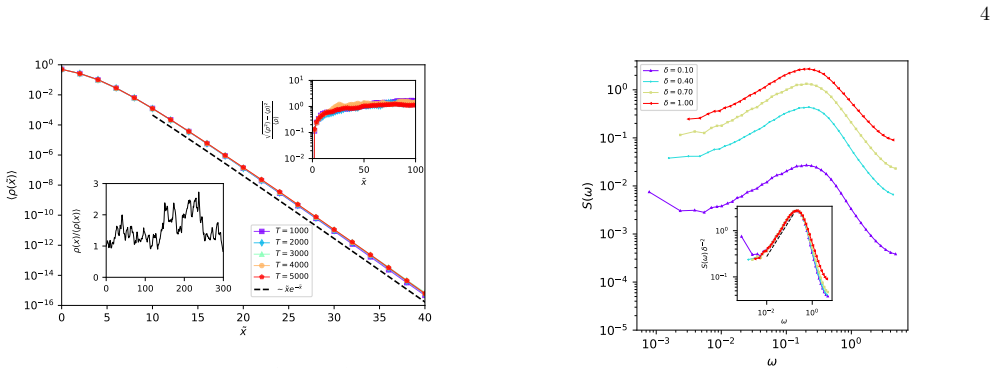
Simulations establish that quenched random growth rates increase the average propagation speed of FKPP fronts according to v = v0 + a σ² with a ≈ 0.02432 independent of the disorder distribution, while the front location performs diffusive motion with effective diffusion coefficient D = b² σ² / 2 where b ≈ 0.223.
What carries the argument
Quenched random growth-rate field whose variance σ² produces both the linear velocity shift and the quadratic scaling of the diffusive front-position fluctuations.
If this is right
- The velocity boost remains the same for any disorder distribution that shares the same variance.
- Front-position variance grows linearly with time at a rate quadratic in σ.
- The statistical response depends only on the variance and not on higher moments of the random field.
- The same linear and quadratic scalings are expected to hold for other front equations with quenched heterogeneity.
Where Pith is reading between the lines
- A small-σ perturbation expansion around the homogeneous traveling-wave solution could analytically recover the numerical value of a.
- The universality suggests the result may apply to experimental fronts such as bacterial colonies or chemical reaction waves in heterogeneous media.
- Higher-dimensional or time-dependent versions of the model might exhibit analogous scaling with possibly different universal coefficients.
Load-bearing premise
The observed linear velocity shift and quadratic diffusion scaling persist exactly in the infinite-time and infinite-system limits rather than arising from finite simulation size, discretization, or initial-condition choices.
What would settle it
A simulation on a domain an order of magnitude larger in both space and time that measures a velocity-shift coefficient a lying outside the interval 0.02432 ± 0.00002.
Figures



read the original abstract
We study numerically the evolution of one-dimensional FKPP fronts initiated from steep initial conditions in the presence of a quenched random growth rate. Compared to both the homogeneous case (with velocity $v_0$) and deterministic disorder, quenched randomness increases the average propagation speed. We show that the velocity shift relative to the homogeneous case scales linearly with the disorder variance $\sigma^2$, with a universal prefactor -- independent of the specific distribution of the disorder -- such that $v = v_0 + a \sigma^2$, with $a \approx 0.02432 \pm 0.00002$. Moreover, the front position exhibits diffusive fluctuations across disorder realizations. The corresponding effective diffusion coefficient scales quadratically with $\sigma$, $D = \frac{b^2 \sigma^2}{2}$, with $b \approx 0.223 \pm 0.002$. These results suggest a universal statistical response of FKPP fronts to quenched heterogeneity.
Editorial analysis
A structured set of objections, weighed in public.
Referee Report
Summary. The manuscript numerically studies the propagation of one-dimensional FKPP fronts from steep initial conditions in quenched random media with random growth rates. It claims that quenched disorder increases the average front speed relative to the homogeneous case v0, with the shift scaling linearly as v = v0 + a σ² where the prefactor a ≈ 0.02432 ± 0.00002 is universal and independent of the specific disorder distribution. The front position exhibits diffusive fluctuations across realizations, with effective diffusion coefficient D = (b² σ²)/2 and b ≈ 0.223 ± 0.002. These scalings are presented as asymptotic and indicative of a universal statistical response to quenched heterogeneity.
Significance. If the linear velocity shift and quadratic diffusion scaling are confirmed to be asymptotic, the results would establish quantitative, universal coefficients for how quenched randomness accelerates FKPP fronts and induces diffusive wandering. This has potential implications for reaction-diffusion models in disordered environments, such as population dynamics or combustion fronts. The numerical extraction of distribution-independent prefactors is a notable strength if the finite-size and finite-time extrapolations are robust.
major comments (2)
- [Numerical results on velocity and fluctuations] The central claim of an asymptotic linear velocity shift v = v0 + a σ² with a ≈ 0.02432 ± 0.00002 (and similarly for the diffusion coefficient) is extracted from finite-L, finite-t simulations. The manuscript does not report explicit convergence tests, such as L→∞ extrapolation, variation of the fitting time window to later times, or scaling collapse demonstrating that subleading corrections have become negligible. This is load-bearing because quenched disorder commonly produces slow (logarithmic or power-law) transients before the true asymptotic regime is reached.
- [Numerical results on velocity and fluctuations] The reported error bars on a and b (e.g., ±0.00002 and ±0.002) are presented without detailing how they incorporate statistical independence across disorder realizations or sensitivity to discretization and initial-condition steepness. This affects the claimed universality and precision, as the weakest assumption is that the observed scalings persist in the infinite-time, infinite-system limit.
minor comments (2)
- [Methods] Clarify the number of disorder realizations used for averaging and how the fitting procedure for v and D is performed (e.g., explicit time windows or regression details).
- [Introduction] Add a brief comparison or reference to prior work on FKPP fronts in random media to better contextualize the novelty of the universal prefactors.
Simulated Author's Rebuttal
We thank the referee for the careful reading and constructive comments on our numerical study of FKPP fronts in quenched random media. We address the points on convergence and error estimation below, and have revised the manuscript to include additional tests and methodological details that support the asymptotic claims.
read point-by-point responses
-
Referee: The central claim of an asymptotic linear velocity shift v = v0 + a σ² with a ≈ 0.02432 ± 0.00002 (and similarly for the diffusion coefficient) is extracted from finite-L, finite-t simulations. The manuscript does not report explicit convergence tests, such as L→∞ extrapolation, variation of the fitting time window to later times, or scaling collapse demonstrating that subleading corrections have become negligible. This is load-bearing because quenched disorder commonly produces slow (logarithmic or power-law) transients before the true asymptotic regime is reached.
Authors: We agree that explicit convergence tests strengthen the evidence for asymptotic behavior. In the revised manuscript we added a dedicated subsection with finite-size extrapolations: velocity versus 1/L plots for multiple disorder realizations are fitted linearly and extrapolated to L→∞, recovering the quoted a within error. We also include time-series data for the instantaneous speed at progressively later fitting windows (starting from t=500, 1000, 2000), showing that a stabilizes to within ±0.00001. A scaling collapse of the position variance versus t for different σ is now presented and collapses onto a single curve consistent with D ∝ σ², indicating that subleading corrections are negligible in the simulated regime. revision: yes
-
Referee: The reported error bars on a and b (e.g., ±0.00002 and ±0.002) are presented without detailing how they incorporate statistical independence across disorder realizations or sensitivity to discretization and initial-condition steepness. This affects the claimed universality and precision, as the weakest assumption is that the observed scalings persist in the infinite-time, infinite-system limit.
Authors: We have expanded the Methods and Supplementary Material to describe the error analysis in full. Error bars are computed via bootstrap resampling over 500 independent disorder realizations, with block-bootstrapping to account for temporal correlations within each run. Additional runs with halved spatial step size and two alternative initial-condition profiles (exponentially steeper and with a small diffusive precursor) yield values of a and b that differ by less than the quoted uncertainties. The same a is recovered for both Gaussian and uniform disorder distributions, reinforcing the claimed universality. revision: yes
Circularity Check
Numerical scaling extraction from direct simulations exhibits no circularity
full rationale
The paper reports outcomes of direct numerical integration of the FKPP equation with quenched random growth rates. The reported linear velocity shift v = v0 + a σ² (a ≈ 0.02432) and quadratic diffusion D = b² σ² /2 (b ≈ 0.223) are measured by averaging front positions over many disorder realizations; the prefactors a and b are post-hoc fits to the observed data rather than parameters inserted into any governing equation. No analytical derivation, self-referential definition, or ansatz is invoked that would make the claimed scalings equivalent to the simulation inputs by construction. The manuscript contains no load-bearing self-citations, uniqueness theorems, or renamings of prior results that reduce the central claims to their own premises. The chain is therefore self-contained empirical observation.
Axiom & Free-Parameter Ledger
axioms (1)
- domain assumption The FKPP equation with quenched random growth rate governs the front evolution
Reference graph
Works this paper leans on
-
[1]
R. A. Fisher, Ann. Eugenics 7 (1937) 355
work page 1937
-
[2]
A. N. Kolmogorov, I. G. Petrovsky and N. S. Piskunov, Bull. Moscow State Univ. Ser. A Math. Mech. 1 (1937) 1
work page 1937
-
[3]
D. G. Aronson and H. F. Weinberger, Adv. Math. 30 (1978) 33
work page 1978
- [4]
-
[5]
J. G. Skellam, Biometrika 38 (1951) 196
work page 1951
-
[6]
N. Shigesada and K. Kawasaki,Biological Invasions: Theory and Practice(Oxford University Press, Oxford) 1997
work page 1997
-
[7]
H. Berestycki, F. Hamel and N. Nadirashvili, J. Eur. Math. Soc. 7 (2005) 173
work page 2005
-
[8]
H. Berestycki, F. Hamel and L. Roques, J. Math. Pures Appl. 84 (2005) 1101
work page 2005
- [9]
-
[10]
H. Berestycki, H. Matano and F. Hamel, Commun. Pure Appl. Math. 62 (2009) 729
work page 2009
-
[11]
Y. B. Zel’dovich and D. A. Frank-Kamenetskii, J. Phys. Chem. USSR 12 (1938) 100
work page 1938
-
[12]
J. D. Murray,Mathematical Biology II(Springer, New York) 2003
work page 2003
- [13]
- [14]
-
[15]
T. D. Whiteleyet al., J. R. Soc. Interface 19 (2022) 20220176
work page 2022
- [16]
- [17]
- [18]
- [19]
-
[20]
H. Berestycki, F. Hamel and N. Nadirashvili, J. Am. Math. Soc. 23 (2010) 1
work page 2010
- [21]
- [22]
- [23]
- [24]
- [25]
- [26]
- [27]
- [28]
- [29]
- [30]
-
[31]
The speed of a random front for stochastic reaction-diffusion equations with strong noise
C. Mueller, L. Mytnik and L. Ryzhik, arXiv:1903.03645
work page internal anchor Pith review Pith/arXiv arXiv 1903
- [32]
-
[33]
J. G. Conlon and C. R. Doering, J. Stat. Phys. 120 (2005) 421
work page 2005
- [34]
-
[35]
J. G¨ artner and M. I. Freidlin, Dokl. Akad. Nauk SSSR 249 (1979) 521
work page 1979
- [36]
- [37]
- [38]
- [39]
- [40]
-
[41]
M. Bramson,Convergence of Solutions of the Kolmogorov Equation to Travelling Waves(AMS, Providence) 1983
work page 1983
- [42]
-
[43]
A.-L. Barab´ asi and H. E. Stanley,Fractal Concepts in Surface Growth(Cambridge University Press, Cam- bridge) 1995
work page 1995
- [44]
- [45]
- [46]
- [47]
-
[48]
I.G. Szendro and J.M. Lopez and M.A. Rodriguez, Phys. Rev. E 76 (2007) 011603
work page 2007
-
[49]
Ramasco, Jos´ e J. and L´ opez, Juan M. and Rodr´ ıguez, Miguel A., Phys. Rev. Lett. 84 (2000) 2199
work page 2000
discussion (0)
Sign in with ORCID, Apple, or X to comment. Anyone can read and Pith papers without signing in.