Recognition: 1 theorem link
· Lean TheoremMeschers: Geometry Processing of Impossible Objects
Pith reviewed 2026-05-15 03:05 UTC · model grok-4.3
The pith
Meschers represent impossible objects as meshes that support standard geometry processing and inverse rendering.
A machine-rendered reading of the paper's core claim, the machinery that carries it, and where it could break.
Core claim
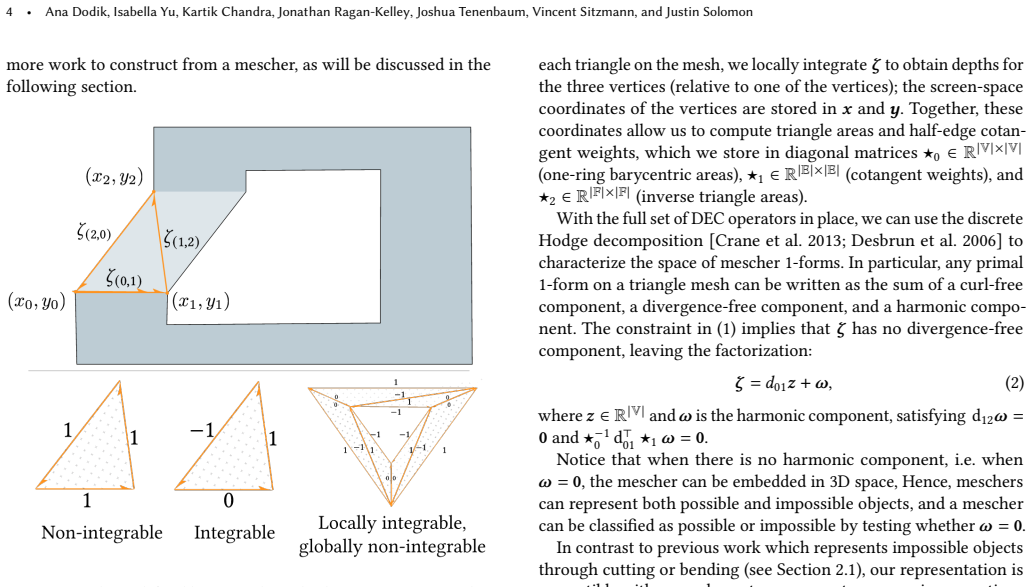
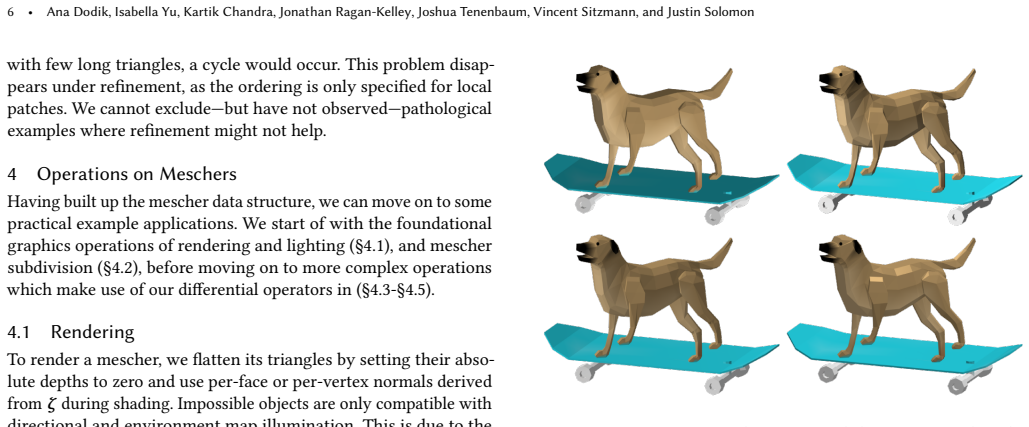
Meschers are meshes capable of representing impossible constructions akin to those found in M.C. Escher's woodcuts. Our representation has a theoretical foundation in discrete exterior calculus and supports the use-cases above, as we demonstrate in a number of example applications. Moreover, because we can do discrete geometry processing on our representation, we can inverse-render impossible objects. We also compare our representation to cut and bend representations of impossible objects.
What carries the argument
Meschers, meshes grounded in discrete exterior calculus that encode impossible objects while preserving validity of standard operations such as distance computation and smoothing.
If this is right
- Standard geometry processing operations such as smoothing and distance computation remain valid on the represented impossible objects.
- Inverse rendering of impossible objects becomes possible using the same mesh representation.
- Local geometry stays unchanged at any point, unlike cut-based embeddings that alter structure at seams.
- Relighting and other graphics pipelines can be applied directly without the depth-bending artifacts of prior methods.
Where Pith is reading between the lines
- The approach could support animation of impossible objects by applying time-varying geometry operators while maintaining perceptual consistency.
- It may allow computational experiments that test which impossible figures remain stable under repeated smoothing or subdivision.
- Integration with existing mesh libraries would let artists import Escher-style figures and run off-the-shelf tools without manual fixes.
Load-bearing premise
Discrete exterior calculus can be extended to meshes of impossible objects while keeping operations like smoothing and distance computation consistent without new artifacts.
What would settle it
Running a standard smoothing or distance algorithm on a Mescher and obtaining local geometric inconsistencies or lighting artifacts that do not match the intended impossible figure.
Figures





read the original abstract
Impossible objects, geometric constructions that humans can perceive but that cannot exist in real life, have been a topic of intrigue in visual arts, perception, and graphics, yet no satisfying computer representation of such objects exists. Previous work embeds impossible objects in 3D, cutting them or twisting/bending them in the depth axis. Cutting an impossible object changes its local geometry at the cut, which can hamper downstream graphics applications, such as smoothing, while bending makes it difficult to relight the object. Both of these can invalidate geometry operations, such as distance computation. As an alternative, we introduce Meschers, meshes capable of representing impossible constructions akin to those found in M.C. Escher's woodcuts. Our representation has a theoretical foundation in discrete exterior calculus and supports the use-cases above, as we demonstrate in a number of example applications. Moreover, because we can do discrete geometry processing on our representation, we can inverse-render impossible objects. We also compare our representation to cut and bend representations of impossible objects.
Editorial analysis
A structured set of objections, weighed in public.
Referee Report
Summary. The paper introduces Meschers, a mesh representation for impossible objects (e.g., Escher-like constructions) that cannot exist in Euclidean 3D space. It claims a foundation in discrete exterior calculus that preserves standard geometry-processing operations such as smoothing and distance computation, enables inverse rendering, and avoids the local-geometry changes or relighting difficulties of prior cut and bend embeddings. The work demonstrates several applications and includes comparisons to those earlier representations.
Significance. If the discrete-exterior-calculus extension is valid, the contribution would be significant for geometry processing and graphics: it would allow consistent operations on non-realizable geometries, support inverse problems, and provide a cleaner alternative to ad-hoc 3D embeddings. The absence of free parameters and the grounding in established DEC operators are strengths that could make the representation reusable across downstream tasks.
major comments (2)
- [§3] §3 (Theoretical Foundation): the claim that standard DEC operators remain valid on Meschers requires explicit construction of the modified exterior derivative and Hodge star; without the precise operator definitions and a proof that they commute with the impossibility constraints, the preservation of distance computation and smoothing cannot be verified.
- [§5] §5 (Results and Comparisons): the quantitative comparison to cut and bend methods reports only qualitative visual differences; adding error metrics (e.g., Hausdorff distance after smoothing or gradient consistency before/after inverse rendering) is needed to substantiate the claim that Meschers “invalidates geometry operations” less than the baselines.
minor comments (2)
- [Figure 4] Figure 4 caption: the legend for the inverse-rendered examples is missing; readers cannot distinguish the Mescher result from the cut/bend baselines without it.
- [Notation] Notation: the symbol for the Mescher-specific 2-form is introduced without a clear mapping to the standard DEC notation used in the rest of the paper; a short table of correspondences would improve readability.
Simulated Author's Rebuttal
We thank the referee for the positive assessment and recommendation for minor revision. The comments highlight useful ways to strengthen the presentation of the theoretical foundation and the empirical comparisons. We address each major comment below.
read point-by-point responses
-
Referee: [§3] §3 (Theoretical Foundation): the claim that standard DEC operators remain valid on Meschers requires explicit construction of the modified exterior derivative and Hodge star; without the precise operator definitions and a proof that they commute with the impossibility constraints, the preservation of distance computation and smoothing cannot be verified.
Authors: We agree that explicit operator definitions will improve clarity and verifiability. In the revised manuscript we will add the precise constructions of the modified exterior derivative and Hodge star for Meschers, together with a short proof that these operators commute with the impossibility constraints (i.e., that the discrete Stokes theorem and the usual DEC identities continue to hold on the augmented mesh). This addition will directly support the claims about distance computation and smoothing. revision: yes
-
Referee: [§5] §5 (Results and Comparisons): the quantitative comparison to cut and bend methods reports only qualitative visual differences; adding error metrics (e.g., Hausdorff distance after smoothing or gradient consistency before/after inverse rendering) is needed to substantiate the claim that Meschers “invalidates geometry operations” less than the baselines.
Authors: We accept that quantitative metrics would strengthen the comparison. In the revision we will report Hausdorff distances between the original and smoothed meshes for all three representations, as well as a gradient-consistency measure (L2 norm of the difference between rendered and target gradients) before and after inverse rendering. These numbers will be added to the existing visual comparisons in §5. revision: yes
Circularity Check
No significant circularity detected
full rationale
The paper presents Meschers as a representation grounded in established discrete exterior calculus, with the abstract asserting a theoretical foundation that supports standard geometry operations like distance computation and smoothing. No derivations, equations, or self-citations are visible in the provided text that reduce any central claim to a fitted parameter, self-definition, or load-bearing prior result by the same authors. The extension to impossible objects is framed as preserving validity of existing operators rather than redefining them circularly, and no uniqueness theorems or ansatzes are imported in a way that collapses the argument to its own inputs. This is a self-contained claim against external benchmarks with no enumerated circularity patterns exhibited.
Axiom & Free-Parameter Ledger
axioms (1)
- domain assumption Discrete exterior calculus can be adapted to represent impossible objects while preserving validity of geometry operations
invented entities (1)
-
Meschers
no independent evidence
Lean theorems connected to this paper
-
IndisputableMonolith/Foundation/AlexanderDuality.leanalexander_duality_circle_linking unclear?
unclearRelation between the paper passage and the cited Recognition theorem.
the local integrability condition can be expressed as a linear constraint: d12 ζ=0. ... ζ=d01 z + ω (harmonic component)
What do these tags mean?
- matches
- The paper's claim is directly supported by a theorem in the formal canon.
- supports
- The theorem supports part of the paper's argument, but the paper may add assumptions or extra steps.
- extends
- The paper goes beyond the formal theorem; the theorem is a base layer rather than the whole result.
- uses
- The paper appears to rely on the theorem as machinery.
- contradicts
- The paper's claim conflicts with a theorem or certificate in the canon.
- unclear
- Pith found a possible connection, but the passage is too broad, indirect, or ambiguous to say the theorem truly supports the claim.
Reference graph
Works this paper leans on
-
[1]
Photographing long scenes with multi-viewpoint panoramas. In ACM SIGGRAPH 2006 Papers. 853–861. Maneesh Agrawala, Denis Zorin, and Tamara Munzner
work page 2006
-
[2]
Artistic multiprojection rendering. InRendering Techniques 2000: Proceedings of the Eurographics Workshop in Brno, Czech Republic, June 26–28, 2000
work page 2000
-
[3]
The Visual Computer19, 2 (2003), 105–114
Differential coordinates for local mesh morphing and deformation. The Visual Computer19, 2 (2003), 105–114. Vlad Alexeev. 2001.Impossible world — im-possible.info. [Accessed 16-04-2025]. Irving Biederman
work page 2003
-
[4]
Computer vision, graphics, and image processing32, 1 (1985), 29–73
Human image understanding: Recent research and a theory. Computer vision, graphics, and image processing32, 1 (1985), 29–73. David Bommes, Henrik Zimmer, and Leif Kobbelt. 2023.Mixed-Integer Quadrangulation (1 ed.). Association for Computing Machinery, New York, NY, USA. https://doi. org/10.1145/3596711.3596740 Ryan Burgert, Xiang Li, Abe Leite, Kanchana ...
-
[5]
Ryan Capouellez, Jiacheng Dai, Aaron Hertzmann, and Denis Zorin
Diffusion illusions: Hiding images in plain sight.arXiv preprint arXiv:2312.03817 (2023). Ryan Capouellez, Jiacheng Dai, Aaron Hertzmann, and Denis Zorin
-
[6]
InACM SIGGRAPH 2023 Conference Proceedings(Los Angeles, CA, USA)(Siggraph ’23)
Algebraic Smooth Occluding Contours. InACM SIGGRAPH 2023 Conference Proceedings(Los Angeles, CA, USA)(Siggraph ’23). Association for Computing Machinery, New York, NY, USA, Article 39, 10 pages. https://doi.org/10.1145/3588432.3591547 Patrick Cavanagh
-
[7]
Kartik Chandra, Tzu-Mao Li, Joshua Tenenbaum, and Jonathan Ragan-Kelley
The artist as neuroscientist.Nature434, 7031 (2005), 301–307. Kartik Chandra, Tzu-Mao Li, Joshua Tenenbaum, and Jonathan Ragan-Kelley
work page 2005
-
[8]
InACM SIGGRAPH 2022 Conference Proceedings
Designing perceptual puzzles by differentiating probabilistic programs. InACM SIGGRAPH 2022 Conference Proceedings. 1–9. Ming-Te Chi, Tong-Yee Lee, Yingge Qu, and Tien-Tsin Wong
work page 2022
-
[9]
Self-Animating Images: Illusory Motion Using Repeated Asymmetric Patterns.ACM Trans. Graph. 27, 3 (aug 2008), 1–8. https://doi.org/10.1145/1360612.1360661 Hung-Kuo Chu, Wei-Hsin Hsu, Niloy J Mitra, Daniel Cohen-Or, Tien-Tsin Wong, and Tong-Yee Lee
-
[10]
Camouflage images.ACM Trans. Graph.29, 4 (2010), 51–1. https://dl.acm.org/doi/abs/10.1145/1833349.1778788 Omar Cornut
-
[11]
InACM SIGGRAPH 2013 Courses (Anaheim, California)(Siggraph ’13)
Digital geometry processing with discrete exterior calculus. InACM SIGGRAPH 2013 Courses (Anaheim, California)(Siggraph ’13). Association for Computing Machinery, New York, NY, USA, Article 7, 126 pages. https://doi.org/10.1145/2504435.2504442 Keenan Crane, Clarisse Weischedel, and Max Wardetzky
-
[12]
The Heat Method for Distance Computation.Commun. ACM60, 11 (Oct. 2017), 90–99. https://doi.org/ 10.1145/3131280 Fernando de Goes, Mathieu Desbrun, Mark Meyer, and Tony DeRose
-
[13]
Graph.35, 4, Article 133 (July 2016), 11 pages
Subdivision exterior calculus for geometry processing.ACM Trans. Graph.35, 4, Article 133 (July 2016), 11 pages. https://doi.org/10.1145/2897824.2925880 Mathieu Desbrun, Eva Kanso, and Yiying Tong
-
[14]
InACM SIGGRAPH 2006 Courses(Boston, Massachusetts) (Siggraph ’06)
Discrete differential forms for computational modeling. InACM SIGGRAPH 2006 Courses(Boston, Massachusetts) (Siggraph ’06). Association for Computing Machinery, New York, NY, USA, 39–54. https://doi.org/10.1145/1185657.1185665 Mathieu Desbrun, Melvin Leok, and Jerrold E. Marsden
-
[15]
Applied Numerical Mathematics53, 2-4 (May 2005), 231–248
Discrete Poincaré Lemma. Applied Numerical Mathematics53, 2-4 (May 2005), 231–248. https://doi.org/10. 1016/j.apnum.2004.09.035 Mathieu Desbrun, Mark Meyer, Peter Schroder, and Alan H. Barr. 2023.Implicit Fairing of Irregular Meshes using Diffusion and Curvature Flow(1 ed.). Association for Com- puting Machinery, New York, NY, USA. https://doi.org/10.1145...
-
[16]
https://doi.org/10.1068/p070283 arXiv:https://doi.org/10.1068/p070283 Pmid: 693228
The Penrose Triangle and a Family of Related Fig- ures.Perception7, 3 (1978), 283–296. https://doi.org/10.1068/p070283 arXiv:https://doi.org/10.1068/p070283 Pmid: 693228. Gershon Elber
-
[17]
Modeling (seemingly) impossible models.Computers & Graphics 35, 3 (2011), 632–638. Gershon Elber. 2012.Escher for Real — gershonelber.org. [Accessed 16-04-2025]. B. Ernst. 1986.Adventures with Impossible Figures. Tarquin. https://books.google.com/ books?id=HU_vAAAAMAAJ M.C. Escher. 1961.The Graphic Work of M.C. Escher. Oldbourne. https://books.google. com...
work page 2011
-
[18]
Erez Freud, Tzvi Ganel, and Galia Avidan
Motion without movement.ACM Siggraph Computer Graphics25, 4 (1991), 27–30. Erez Freud, Tzvi Ganel, and Galia Avidan
work page 1991
-
[19]
Representation of possible and impossi- ble objects in the human visual cortex: Evidence from fMRI adaptation.NeuroImage 64 (2013), 685–692. https://doi.org/10.1016/j.neuroimage.2012.08.070 Erez Freud, Bat-Sheva Hadad, Galia Avidan, and Tzvi Ganel
-
[20]
https://doi.org/10.3389/fpsyg.2015.00094 Matías Gárate
Evidence for similar early but not late representation of possible and impossible objects.Frontiers in Psychology6 (2015). https://doi.org/10.3389/fpsyg.2015.00094 Matías Gárate. 2020.Art Spotlight: Impossible Penrose Snake — sketchfab.com. [Accessed 16-04-2025]. Matías Gárate. 2023.The ins and outs of modelling impossible figures. — Blender Confer- ence ...
-
[21]
Daniel Geng, Inbum Park, and Andrew Owens
Visual Anagrams: Generating Multi-View Optical Illusions with Diffusion Models.arXiv preprint arXiv:2311.17919 (2023). Daniel Geng, Inbum Park, and Andrew Owens
-
[22]
Factorized Diffusion: Perceptual Illusions by Noise Decomposition.arXiv preprint arXiv:2404.11615(2024). R. L. (Richard Langton) Gregory. 1970.The intelligent eye, by R. L. Gregory.Weidenfeld & Nicolson, London. ACM Trans. Graph., Vol. 44, No. 4, Article . Publication date: August
-
[23]
https: //doi.org/10.1016/j.visres.2021.09.004 Aaron Hertzmann
A failure to learn object shape geometry: Implications for convolutional neural networks as plausible models of biological vision.Vision Research189 (2021), 81–92. https: //doi.org/10.1016/j.visres.2021.09.004 Aaron Hertzmann
-
[24]
https://doi.org/10.1167/jov.24
Toward a theory of perspective perception in pic- tures.Journal of Vision24, 4 (04 2024), 23–23. https://doi.org/10.1167/jov.24. 4.23 arXiv:https://arvojournals.org/arvo/content_public/journal/jov/938670/i1534- 7362-24-4-23_1713961163.65834.pdf Anil N. Hirani. 2003.Discrete Exterior Calculus. Ph. D. Dissertation. California Institute of Technology. http:/...
-
[25]
Constructing Drawings of Impossible Figures with Axonomet- ric Blocks and Pseudo-3D Manipulations. InProceedings of Bridges 2014: Mathe- matics, Music, Art, Architecture, Culture, Gary Greenfield, George Hart, and Reza Sarhangi (Eds.). Tessellations Publishing, Phoenix, Arizona, 159–166. http://archive. bridgesmathart.org/2014/bridges2014-159.html Olga A ...
work page 2014
-
[26]
Smoothsketch: 3d free-form shapes from complex sketches. InACM SIGGRAPH 2006 Papers. 589–598. Chih W Khoh and Peter Kovesi
work page 2006
- [27]
-
[28]
Series A: Mathematical, Physical and Engineering Sciences356, 1740 (1998), 1071–1086
Pictorial relief.Philosophical Transactions of the Royal Society of London. Series A: Mathematical, Physical and Engineering Sciences356, 1740 (1998), 1071–1086. Felix Kälberer, Matthias Nieser, and Konrad Polthier
work page 1998
-
[29]
QuadCover - Sur- face Parameterization using Branched Coverings.Computer Graphics Fo- rum26, 3 (2007), 375–384. https://doi.org/10.1111/j.1467-8659.2007.01060.x arXiv:https://onlinelibrary.wiley.com/doi/pdf/10.1111/j.1467-8659.2007.01060.x Chi-Fu William Lai, Sai-Kit Yeung, Xiaoqi Yan, Chi-Wing Fu, and Chi-Keung Tang
-
[30]
IEEE transactions on visualization and computer graphics22, 10 (2015), 2275–2288
3D navigation on impossible figures via dynamically reconfigurable maze. IEEE transactions on visualization and computer graphics22, 10 (2015), 2275–2288. Tzu-Mao Li, Miika Aittala, Frédo Durand, and Jaakko Lehtinen
work page 2015
-
[31]
Yuanbo Li, Tianyi Ma, Zaineb Aljumayaat, and Daniel Ritchie
Differentiable monte carlo ray tracing through edge sampling.ACM Transactions on Graphics (TOG)37, 6 (2018), 1–11. Yuanbo Li, Tianyi Ma, Zaineb Aljumayaat, and Daniel Ritchie
work page 2018
-
[32]
In Proceedings Shape Modeling Applications, 2004.Ieee, 181–190
Differential coordinates for interactive mesh editing. In Proceedings Shape Modeling Applications, 2004.Ieee, 181–190. Shichen Liu, Tianye Li, Weikai Chen, and Hao Li
work page 2004
-
[33]
Soft Rasterizer: A Differentiable Renderer for Image-based 3D Reasoning.The IEEE International Conference on Computer Vision (ICCV)(Oct 2019). Margaret S Livingstone. 2022.Vision and art (updated and expanded edition). Abrams. Charles T. Loop
work page 2019
-
[34]
https://cg.cs.tsinghua.edu.cn/papers/TVCG-2013-changeblindness.pdf David Marr
Change blind- ness images.IEEE transactions on visualization and computer graphics19, 11 (2013), 1808–1819. https://cg.cs.tsinghua.edu.cn/papers/TVCG-2013-changeblindness.pdf David Marr. 1982.Vision: A computational investigation into the human representation and processing of visual information. MIT press. Baptiste Nicolet, Alec Jacobson, and Wenzel Jakob
work page 2013
-
[35]
Yu Okano, Shogo Fukushima, Masahiro Furukawa, and Hiroyuki Kajimoto
Large steps in inverse rendering of geometry.ACM Transactions on Graphics (TOG)40, 6 (2021), 1–13. Yu Okano, Shogo Fukushima, Masahiro Furukawa, and Hiroyuki Kajimoto
work page 2021
-
[36]
InACM SIGGRAPH ASIA 2010 Posters(Seoul, Republic of Korea)(Sa ’10)
Embedded Motion: Generating the Perception of Motion in Peripheral Vision. InACM SIGGRAPH ASIA 2010 Posters(Seoul, Republic of Korea)(Sa ’10). As- sociation for Computing Machinery, New York, NY, USA, Article 41, 1 pages. https://doi.org/10.1145/1900354.1900400 Aude Oliva, Antonio Torralba, and Philippe G Schyns
-
[37]
Hybrid images.ACM Transactions on Graphics (TOG)25, 3 (2006), 527–532. https://stanford.edu/class/ ee367/reading/OlivaTorralb_Hybrid_Siggraph06.pdf Shigeru Owada and Jun Fujiki
work page 2006
-
[38]
Impossible objects: a special type of visual illusion.British Journal of Psychology(1958). Roger Penrose
work page 1958
-
[39]
On the Cohomology of Impossible Figures.Leonardo25 (1993), 245–247. https://api.semanticscholar.org/CorpusID:125905129 Nikhila Ravi, Jeremy Reizenstein, David Novotny, Taylor Gordon, Wan-Yen Lo, Justin Johnson, and Georgia Gkioxari
work page 1993
-
[40]
Accelerating 3d deep learning with pytorch3d.arXiv preprint arXiv:2007.08501, 2020
Accelerating 3D Deep Learning with Py- Torch3D.arXiv:2007.08501(2020). Oscar Reutersvärd
-
[41]
Guillermo Savransky, Dan Dimerman, and Craig Gotsman
How to make impossible objects possible: Anamorphic deformation of textured NURBS.Computer Aided Geometric Design78 (2020), 101826. Guillermo Savransky, Dan Dimerman, and Craig Gotsman
work page 2020
- [42]
-
[43]
An Information-processing Explanation Of Some Perceptual Phenomena.British Journal of Psychology58, 1- 2 (1967), 1–12. https://doi.org/10.1111/j.2044-8295.1967.tb01051.x arXiv:https://bpspsychub.onlinelibrary.wiley.com/doi/pdf/10.1111/j.2044- 8295.1967.tb01051.x Olga Sorkine
-
[44]
Three-dimensional realization of anomalous pictures—An application of picture interpretation theory to toy design.Pattern Recognition30, 7 (1997), 1061–1067. Benjamin Adam Taylor. 2020.Modeling and Rendering Three-Dimensional Impossible Objects. Bangor University (United Kingdom). E. Térouanne
work page 1997
-
[45]
North-Holland, 105–120. https://doi.org/10.1016/S0166- 4115(08)62082-8 Xi Wang, Zoya Bylinskii, Aaron Hertzmann, and Robert Pepperell
-
[46]
Ethan Weber*, Riley Peterlinz*, Rohan Mathur, Frederik Warburg, Alexei A
Toward quantifying ambiguities in artistic images.ACM Transactions on Applied Perception (TAP)17, 4 (2020), 1–10. Ethan Weber*, Riley Peterlinz*, Rohan Mathur, Frederik Warburg, Alexei A. Efros, and Angjoo Kanazawa
work page 2020
- [47]
discussion (0)
Sign in with ORCID, Apple, or X to comment. Anyone can read and Pith papers without signing in.