Recognition: 2 theorem links
· Lean TheoremAnalyzing the two-dimensional doped Hubbard model with the Worldvolume HMC method
Pith reviewed 2026-05-15 03:00 UTC · model grok-4.3
The pith
The Worldvolume HMC method computes observables with controlled errors in the doped two-dimensional Hubbard model on an 8 by 8 lattice where standard determinant quantum Monte Carlo fails.
A machine-rendered reading of the paper's core claim, the machinery that carries it, and where it could break.
Core claim
The Worldvolume HMC method predicts physical observables with controlled statistical errors on an 8 × 8 lattice at temperature T/t = 1/6.4 ≈ 0.156 and interaction strength U/t = 8.0, for which the standard determinant quantum Monte Carlo fails.
What carries the argument
The Worldvolume Hybrid Monte Carlo (WV-HMC) method, which samples an extended worldvolume to manage the complex fermion determinant phase arising from doping.
If this is right
- Physical observables such as energy and correlation functions become accessible with controlled errors in the doped regime.
- The sign problem is handled sufficiently well that standard error analysis applies at the reported parameters.
- The method requires no further approximations beyond the original Worldvolume HMC formulation for this lattice size and coupling.
- Simulations at U/t = 8 and T/t ≈ 0.156 are now feasible where determinant quantum Monte Carlo is unusable.
Where Pith is reading between the lines
- The same technique could be tested on larger lattices to check whether the controlled-error property persists with volume.
- Application to other doping values or temperatures would map out where the method remains practical.
- The approach may transfer to related sign-problematic models such as the t-J model or doped spin systems.
Load-bearing premise
The Worldvolume HMC sampling remains ergodic and unbiased when applied to the doped Hubbard model without additional approximations beyond those in the referenced 2020 method.
What would settle it
A set of independent runs on the same 8 by 8 lattice that show statistical errors failing to shrink with increasing sample size or that produce results inconsistent with the weak-coupling limit of the Hubbard model.
Figures


read the original abstract
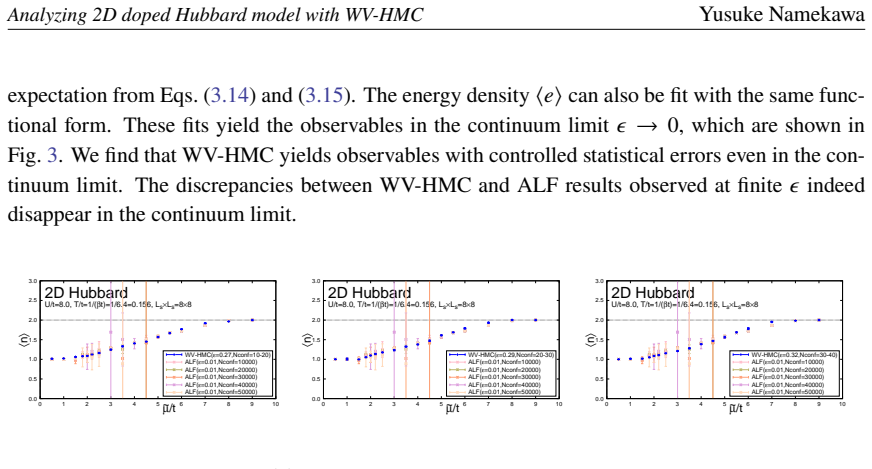
We apply the Worldvolume Hybrid Monte Carlo (WV-HMC) method [arXiv:2012.08468] to the two-dimensional Hubbard model, which is known to suffer from a severe sign problem when the system is doped (away from half filling). We show that the method predicts physical observables with controlled statistical errors on an $8 \times 8$ lattice at temperature $T/t = 1/6.4 \approx 0.156$ and interaction strength $U/t = 8.0$ ($t$ is the hopping amplitude), for which the standard determinant quantum Monte Carlo fails.
Editorial analysis
A structured set of objections, weighed in public.
Referee Report
Summary. The manuscript applies the Worldvolume Hybrid Monte Carlo (WV-HMC) method from arXiv:2012.08468 to the doped two-dimensional Hubbard model. It claims that the approach yields physical observables with controlled statistical errors on an 8×8 lattice at T/t ≈ 0.156 and U/t = 8, a parameter regime where standard determinant quantum Monte Carlo fails due to the sign problem.
Significance. If the sampling is confirmed to be ergodic and unbiased, the result would be significant for lattice QCD and condensed-matter simulations, as it provides a route to doped Hubbard-model observables at intermediate temperatures without additional approximations. This could enable new studies of the model's phase diagram relevant to high-Tc superconductivity.
major comments (2)
- [Abstract] Abstract: the claim of 'controlled statistical errors' on the 8×8 lattice at the stated parameters is not supported by any reported diagnostics such as integrated autocorrelation times, error-bar comparisons with known benchmarks, or evidence from multiple independent chains that the worldvolume measure is sampled from the correct stationary distribution.
- [Method] Method section (application of WV-HMC): the transfer of ergodicity from the simpler sign-problem instances validated in arXiv:2012.08468 to the doped Hubbard model at U/t=8 is assumed without explicit verification; no mixing-time estimates or stationarity tests are provided, making the central claim load-bearing on an untested assumption.
minor comments (1)
- [References] Ensure all citations, including arXiv:2012.08468, are listed with full bibliographic details in the references section.
Simulated Author's Rebuttal
We thank the referee for the careful reading and constructive comments on our manuscript. We address each major comment below and will revise the manuscript to incorporate additional supporting diagnostics as requested.
read point-by-point responses
-
Referee: [Abstract] Abstract: the claim of 'controlled statistical errors' on the 8×8 lattice at the stated parameters is not supported by any reported diagnostics such as integrated autocorrelation times, error-bar comparisons with known benchmarks, or evidence from multiple independent chains that the worldvolume measure is sampled from the correct stationary distribution.
Authors: We agree that the abstract and main text would be strengthened by explicit diagnostics. The manuscript reports statistical error bars on observables obtained from the WV-HMC runs, but does not include integrated autocorrelation times or multi-chain stationarity tests. In the revision we will add these: integrated autocorrelation times for the primary observables, comparisons against available benchmarks at nearby parameters, and results from several independent Markov chains demonstrating convergence to the same distribution. revision: yes
-
Referee: [Method] Method section (application of WV-HMC): the transfer of ergodicity from the simpler sign-problem instances validated in arXiv:2012.08468 to the doped Hubbard model at U/t=8 is assumed without explicit verification; no mixing-time estimates or stationarity tests are provided, making the central claim load-bearing on an untested assumption.
Authors: The referee correctly notes the absence of explicit mixing-time or stationarity diagnostics for this specific parameter point. The underlying WV-HMC algorithm was shown to be ergodic on simpler sign-problem models in the cited reference, and we employed the same algorithmic settings. To address the concern we will expand the method section with autocorrelation-based mixing-time estimates and stationarity tests (e.g., Gelman-Rubin statistics across independent chains) for the doped Hubbard runs at U/t=8. revision: yes
Circularity Check
No circularity: direct application of externally referenced method
full rationale
The paper applies the WV-HMC method from the cited prior reference to the doped 2D Hubbard model and reports simulation results for observables on the 8x8 lattice at the stated parameters. No equation, observable, or central claim reduces by construction to a fitted input, self-definition, or internal self-citation chain. The load-bearing step is the invocation of the referenced algorithm, which is treated as given external input rather than derived or verified inside this manuscript. The derivation chain consists of standard application and error reporting and remains self-contained against the benchmark of the prior work.
Axiom & Free-Parameter Ledger
axioms (1)
- domain assumption The Hubbard model is correctly formulated on a finite square lattice with periodic boundary conditions.
Lean theorems connected to this paper
-
IndisputableMonolith/Cost/FunctionalEquation.leanwashburn_uniqueness_aczel unclear?
unclearRelation between the paper passage and the cited Recognition theorem.
We apply the Worldvolume Hybrid Monte Carlo (WV-HMC) method [arXiv:2012.08468] to the two-dimensional Hubbard model... on an 8×8 lattice at T/t=1/6.4 and U/t=8.0
-
IndisputableMonolith/Foundation/AlexanderDuality.leanalexander_duality_circle_linking unclear?
unclearRelation between the paper passage and the cited Recognition theorem.
the Worldvolume Hybrid Monte Carlo (WV-HMC) method... continuous version of the TLT method
What do these tags mean?
- matches
- The paper's claim is directly supported by a theorem in the formal canon.
- supports
- The theorem supports part of the paper's argument, but the paper may add assumptions or extra steps.
- extends
- The paper goes beyond the formal theorem; the theorem is a base layer rather than the whole result.
- uses
- The paper appears to rely on the theorem as machinery.
- contradicts
- The paper's claim conflicts with a theorem or certificate in the canon.
- unclear
- Pith found a possible connection, but the passage is too broad, indirect, or ambiguous to say the theorem truly supports the claim.
Reference graph
Works this paper leans on
-
[1]
H. Y okoyama and H. Shiba,Variational monte-carlo studies of hubbard model. i , Journal of the Physical Society of Japan 56 (1987) 1490
work page 1987
-
[2]
K. Y amaji, T. Y anagisawa, T. Nakanishi and S. Koike,Variational monte carlo study on the superconductivity in the two-dimensional hubbard model , Physica C: Superconductivity 304 (1998) 225–238
work page 1998
-
[3]
S. Sorella, Wave function optimization in the variational monte carlo method , Physical Review B 71 (2005)
work page 2005
-
[4]
D. Tahara and M. Imada, Variational monte carlo method combined with quantum-number projection and multi-variable optimization, Journal of the Physical Society of Japan 77 (2008) 114701
work page 2008
-
[5]
A Constrained Path Quantum Monte Carlo Method for Fermion Ground States
S. Zhang, J. Carlson and J.E. Gubernatis, Constrained Path Quantum Monte Carlo Method for Fermion Ground States, Phys. Rev. Lett. 74 (1995) 3652 [cond-mat/9503055]
work page internal anchor Pith review Pith/arXiv arXiv 1995
-
[6]
A Constrained Path Monte Carlo Method for Fermion Ground States
S. Zhang, J. Carlson and J.E. Gubernatis, A Constrained path Monte Carlo method for fermion ground states, Phys. Rev. B 55 (1997) 7464 [cond-mat/9607062]
work page internal anchor Pith review Pith/arXiv arXiv 1997
-
[7]
A. Mukherjee and M. Cristoforetti, Lefschetz thimble Monte Carlo for many-body theories: A Hubbard model study , Phys. Rev. B 90 (2014) 035134 [1403.5680]
work page internal anchor Pith review Pith/arXiv arXiv 2014
-
[8]
Path integral representation for the Hubbard model with reduced number of Lefschetz thimbles
M.V . Ulybyshev and S.N. Valgushev, Path integral representation for the Hubbard model with reduced number of Lefschetz thimbles , 1712.02188
work page internal anchor Pith review Pith/arXiv arXiv
-
[9]
Taming the sign problem of the finite density Hubbard model via Lefschetz thimbles
M. Ulybyshev, C. Winterowd and S. Zafeiropoulos, Taming the sign problem of the finite density Hubbard model via Lefschetz thimbles , 1906.02726. 8 Analyzing 2D doped Hubbard model with WV-HMC Yusuke Namekawa
work page internal anchor Pith review Pith/arXiv arXiv 1906
-
[10]
M. Ulybyshev, C. Winterowd and S. Zafeiropoulos, Lefschetz thimbles decomposition for the Hubbard model on the hexagonal lattice , Phys. Rev. D 101 (2020) 014508 [1906.07678]
-
[11]
M. Ulybyshev, C. Winterowd, F. Assaad and S. Zafeiropoulos, Instanton gas approach to the Hubbard model, Phys. Rev. B 107 (2023) 045143 [2207.06297]
-
[12]
M. Ulybyshev and F.F. Assaad, Beyond the instanton gas approach: dominant thimbles approximation for the Hubbard model, 2407.09452
- [13]
-
[14]
S. Akiyama and Y . Kuramashi, Tensor renormalization group approach to (1+1)-dimensional Hubbard model, Phys. Rev. D 104 (2021) 014504 [2105.00372]
-
[15]
S. Akiyama, Y . Kuramashi and T. Y amashita,Metal–insulator transition in the (2+1)-dimensional Hubbard model with the tensor renormalization group , PTEP 2022 (2022) 023I01 [2109.14149]
-
[16]
M. Rodekamp, E. Berkowitz, C. Gäntgen, S. Krieg, T. Luu and J. Ostmeyer, Mitigating the Hubbard sign problem with complex-valued neural networks , Phys. Rev. B 106 (2022) 125139 [2203.00390]
-
[17]
C. Gäntgen, E. Berkowitz, T. Luu, J. Ostmeyer and M. Rodekamp, Fermionic sign problem minimization by constant path integral contour shifts , Phys. Rev. B 109 (2024) 195158 [2307.06785]
- [18]
-
[19]
M. Fukuma and N. Matsumoto, Worldvolume approach to the tempered Lefschetz thimble method, PTEP 2021 (2021) 023B08 [2012.08468]
- [20]
-
[21]
M. Fukuma, Simplified Algorithm for the Worldvolume HMC and the Generalized Thimble HMC, PTEP 2024 (2024) 053B02 [2311.10663]
-
[22]
Fukuma, Worldvolume Hybrid Monte Carlo algorithm for group manifolds, 2506.12002
M. Fukuma, Worldvolume Hybrid Monte Carlo algorithm for group manifolds, 2506.12002
-
[23]
M. Fukuma and Y . Namekawa, Applying the Worldvolume Hybrid Monte Carlo method to the two-dimensional Hubbard model, PoS LATTICE2024 (2025) 053
work page 2025
-
[24]
Applying the Worldvolume Hybrid Monte Carlo method to the Hubbard model away from half filling
M. Fukuma and Y . Namekawa, Applying the Worldvolume Hybrid Monte Carlo method to the Hubbard model away from half filling , 2507.23748
work page internal anchor Pith review Pith/arXiv arXiv
-
[25]
Enhancing the ergodicity of Worldvolume HMC via embedding generalized thimble HMC
M. Fukuma and Y . Namekawa, Enhancing the ergodicity of Worldvolume HMC via embedding Generalized-thimble HMC, 2508.02659. 9 Analyzing 2D doped Hubbard model with WV-HMC Yusuke Namekawa
work page internal anchor Pith review Pith/arXiv arXiv
-
[26]
Analytic Continuation Of Chern-Simons Theory
E. Witten, Analytic Continuation Of Chern-Simons Theory , AMS/IP Stud. Adv. Math. 50 (2011) 347 [ 1001.2933]
work page internal anchor Pith review Pith/arXiv arXiv 2011
-
[27]
AURORASCIENCE collaboration, New approach to the sign problem in quantum field theories: High density QCD on a Lefschetz thimble , Phys. Rev. D 86 (2012) 074506 [1205.3996]
work page internal anchor Pith review Pith/arXiv arXiv 2012
-
[28]
Monte Carlo simulations on the Lefschetz thimble: taming the sign problem
M. Cristoforetti, F. Di Renzo, A. Mukherjee and L. Scorzato, Monte Carlo simulations on the Lefschetz thimble: Taming the sign problem , Phys. Rev. D 88 (2013) 051501 [1303.7204]
work page internal anchor Pith review Pith/arXiv arXiv 2013
-
[29]
Hybrid Monte Carlo on Lefschetz Thimbles -- A study of the residual sign problem
H. Fujii, D. Honda, M. Kato, Y . Kikukawa, S. Komatsu and T. Sano, Hybrid Monte Carlo on Lefschetz thimbles - A study of the residual sign problem , JHEP 10 (2013) 147 [1309.4371]
work page internal anchor Pith review Pith/arXiv arXiv 2013
-
[30]
Lefschetz thimble structure in one-dimensional lattice Thirring model at finite density
H. Fujii, S. Kamata and Y . Kikukawa, Lefschetz thimble structure in one-dimensional lattice Thirring model at finite density , JHEP 11 (2015) 078 [1509.08176]
work page internal anchor Pith review Pith/arXiv arXiv 2015
-
[31]
Monte Carlo study of Lefschetz thimble structure in one-dimensional Thirring model at finite density
H. Fujii, S. Kamata and Y . Kikukawa, Monte Carlo study of Lefschetz thimble structure in one-dimensional Thirring model at finite density , JHEP 12 (2015) 125 [1509.09141]
work page internal anchor Pith review Pith/arXiv arXiv 2015
-
[32]
A Monte Carlo algorithm for simulating fermions on Lefschetz thimbles
A. Alexandru, G. Basar and P . Bedaque, Monte Carlo algorithm for simulating fermions on Lefschetz thimbles, Phys. Rev. D 93 (2016) 014504 [1510.03258]
work page internal anchor Pith review Pith/arXiv arXiv 2016
-
[33]
Sign problem and Monte Carlo calculations beyond Lefschetz thimbles
A. Alexandru, G. Basar, P .F. Bedaque, G.W. Ridgway and N.C. Warrington, Sign problem and Monte Carlo calculations beyond Lefschetz thimbles, JHEP 05 (2016) 053 [1512.08764]
work page internal anchor Pith review Pith/arXiv arXiv 2016
-
[34]
M. Fukuma and N. Umeda, Parallel tempering algorithm for integration over Lefschetz thimbles, PTEP 2017 (2017) 073B01 [1703.00861]
-
[35]
H.C. Andersen, RATTLE: A ”velocity” version of the SHAKE algorithm for molecular dynamics calculations, Journal of Computational Physics 52 (1983) 24
work page 1983
-
[36]
A. Alexandru, Improved algorithms for generalized thimble method, talk at the 37th international conference on lattice field theory, Wuhan (2019)
work page 2019
- [37]
-
[38]
S. Beyl, F. Goth and F.F. Assaad, Revisiting the Hybrid Quantum Monte Carlo Method for Hubbard and Electron-Phonon Models, Phys. Rev. B 97 (2018) 085144 [1708.03661]
work page internal anchor Pith review Pith/arXiv arXiv 2018
-
[39]
M. Bercx, F. Goth, J.S. Hofmann and F.F. Assaad, The ALF (Algorithms for Lattice Fermions) project release 1.0. Documentation for the auxiliary field quantum Monte Carlo code, SciPost Phys. 3 (2017) 013 [1704.00131]
work page internal anchor Pith review Pith/arXiv arXiv 2017
-
[40]
Documentation for the auxiliary-field quantum Monte Carlo code , SciPost Phys
ALF collaboration, The ALF (Algorithms for Lattice Fermions) project release 2.4. Documentation for the auxiliary-field quantum Monte Carlo code , SciPost Phys. Codeb. 2022 (2022) 1 [2012.11914]. 10
discussion (0)
Sign in with ORCID, Apple, or X to comment. Anyone can read and Pith papers without signing in.