Enhancing the ergodicity of Worldvolume HMC via embedding generalized thimble HMC
Pith reviewed 2026-05-19 00:33 UTC · model grok-4.3
The pith
Embedding generalized thimble HMC into worldvolume HMC consistently improves phase space exploration when the integration surface thins.
A machine-rendered reading of the paper's core claim, the machinery that carries it, and where it could break.
Core claim
Generalized thimble HMC can be embedded inside worldvolume HMC so that molecular-dynamics updates at a single fixed flow time are performed consistently with the worldvolume measure. When the worldvolume reduces to a thin layer the standalone worldvolume algorithm explores phase space inefficiently; the embedded fixed-surface updates allow larger step sizes and better exploration precisely in those regions. Numerical runs on the doped Hubbard model on an 8×8 lattice show that the combined and standalone algorithms produce statistically compatible results for number and energy densities. The combined method therefore permits simulations on larger spacetime volumes and controlled extrapolates.
What carries the argument
The consistent embedding of generalized thimble HMC updates, performed at fixed flow time on a single deformed surface, inside the worldvolume HMC dynamics.
If this is right
- Simulations become feasible on larger spacetime lattices than with standalone worldvolume HMC.
- Number and energy densities can be extrapolated to the zero Trotter-step limit at fixed temperature and interaction with controlled statistical errors.
- The sign-problem mitigation of worldvolume deformation is retained while phase-space exploration improves in the thin-layer regime.
- Molecular-dynamics step sizes can be increased in regions where ergodicity is only mildly problematic.
Where Pith is reading between the lines
- The embedding recipe may be portable to other lattice models that suffer from a severe sign problem once a suitable redundant parameter is identified.
- Further tuning of the redundant parameter could open access to lower temperatures or stronger couplings while still using modest flow times.
- Hybridizing additional thimble-based samplers inside the same worldvolume framework could yield still larger effective step sizes on bigger volumes.
Load-bearing premise
An optimal redundant nonphysical parameter exists that reduces the sign problem enough on the original surface to keep the maximum flow time small without reintroducing severe ergodicity problems.
What would settle it
A direct comparison on the same 8×8 doped Hubbard ensemble in which the combined algorithm produces number or energy densities lying outside the statistical error bars of the pure worldvolume or pure generalized-thimble runs.
Figures


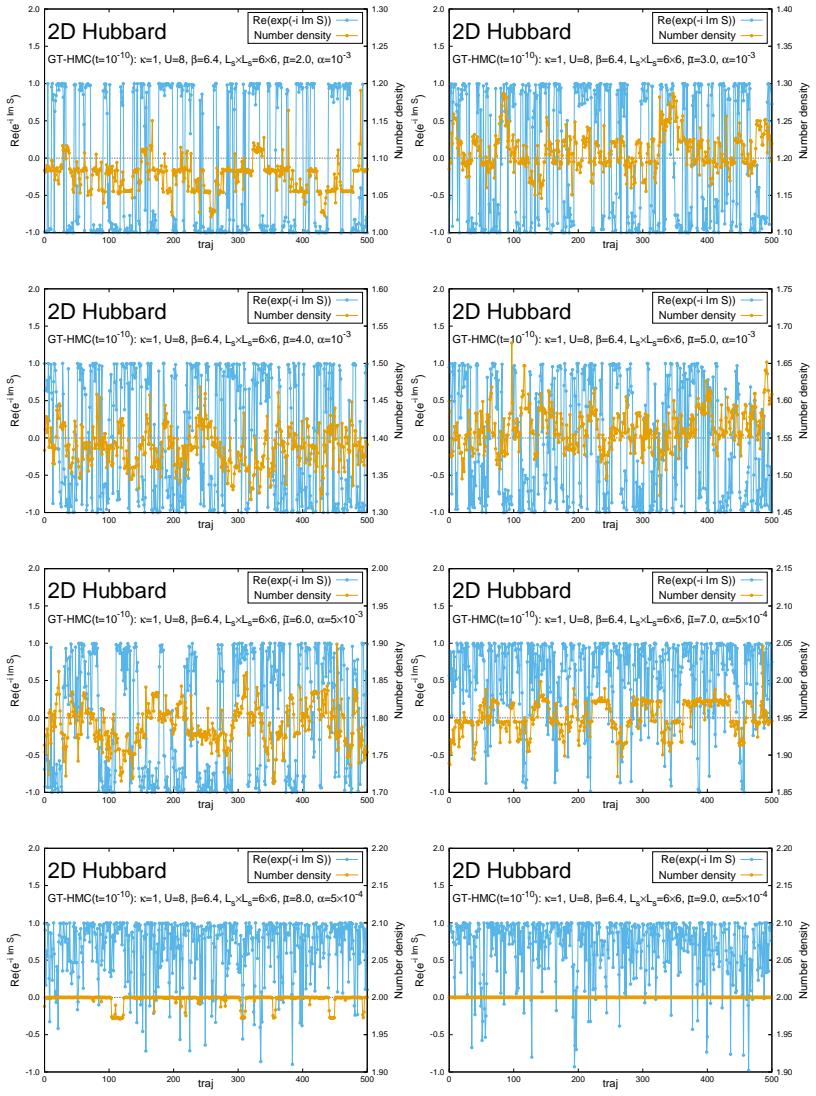


read the original abstract
The Worldvolume Hybrid Monte Carlo (WV-HMC) method [arXiv:2012.08468] is an efficient and versatile algorithm that mitigates the sign problem while resolving the ergodicity issues inherent in Lefschetz-thimble approaches. We focus on cases where the maximum flow time can be kept small, such as when applying WV-HMC to the doped Hubbard model utilizing a redundant, nonphysical parameter. An optimal choice of this parameter significantly reduces the sign problem on the original integration surface. This allows for small flow times, thereby enabling the simulation of larger system sizes at a modest computational cost. However, when the worldvolume reduces to a thin layer, phase-space exploration becomes inefficient, and ergodicity problems may reemerge. To address this limitation in WV-HMC, we propose embedding generalized thimble HMC (GT-HMC) into the WV-HMC framework. GT-HMC performs updates on a single deformed surface at a fixed flow time. Despite its inherent ergodicity issues at the zeros of the Boltzmann weight, GT-HMC efficiently explores the allowed region and typically permits larger molecular dynamics step sizes than WV-HMC. Consequently, it is highly effective in regions where ergodicity issues are less severe. We prove that GT-HMC can be consistently embedded within WV-HMC and confirm that the standalone and combined algorithms agree within statistical errors for the two-dimensional doped Hubbard model on an $8 \times 8$ lattice. This combined algorithm enables simulations on larger spacetime lattices. We demonstrate the feasibility of this approach by extrapolating the number and energy densities to the zero Trotter step limit at fixed temperature $T/t = 1/6.4\simeq 0.156$ and repulsive interaction $U/t = 8.0$. Even with modest sample sizes, we achieve controlled statistical errors across the entire range of the chemical potential.
Editorial analysis
A structured set of objections, weighed in public.
Referee Report
Summary. The paper proposes embedding generalized thimble Hybrid Monte Carlo (GT-HMC) into the Worldvolume Hybrid Monte Carlo (WV-HMC) framework to mitigate reemergent ergodicity issues when the worldvolume thins in applications to the doped Hubbard model with a redundant nonphysical parameter. It claims to prove the consistency of this embedding, reports numerical agreement within statistical errors between standalone WV-HMC and the combined algorithm on an 8×8 lattice, and demonstrates controlled Trotter extrapolation of number and energy densities to the zero-step limit at fixed T/t=1/6.4 and U/t=8.
Significance. If the embedding consistency holds and the GT-HMC component continues to control ergodicity on larger volumes, the combined method would offer a practical route to larger-lattice simulations of sign-problematic fermionic models. The explicit numerical agreement on the 8×8 case and the Trotter extrapolation with modest samples are concrete strengths; however, the scaling claim to larger spacetime lattices rests on an untested assumption about sustained ergodicity control.
major comments (3)
- [§3] §3 (consistency proof): the manuscript asserts a proof that GT-HMC can be consistently embedded within WV-HMC, but does not detail the steps showing preservation of the worldvolume integration measure or the absence of bias in the combined molecular-dynamics updates. This is load-bearing for the central consistency claim.
- [§4] §4 (numerical comparison on 8×8 lattice): agreement within errors is reported, yet the text does not specify the number of independent samples, measured autocorrelation times, or quantitative criteria used to confirm that the post-hoc choice of the redundant nonphysical parameter does not differentially affect the standalone versus combined runs.
- [§5] §5 (scaling claim): the assertion that the combined algorithm enables simulations on larger spacetime lattices relies on the assumption that thin-worldvolume ergodicity problems remain controlled when spatial volume (and thus degrees of freedom) increases. No additional volume tests or scaling arguments are provided beyond the single 8×8 lattice plus Trotter extrapolation at fixed T/t.
minor comments (2)
- [Abstract] Abstract: the phrase 'modest sample sizes' and 'controlled statistical errors' should be replaced by explicit numbers or ranges to allow readers to assess the strength of the numerical evidence.
- [§2] Notation: the definition and optimization procedure for the redundant nonphysical parameter should be stated once in a dedicated subsection rather than referenced only in passing.
Simulated Author's Rebuttal
We thank the referee for the careful reading and constructive comments on our manuscript. We address each major point below and indicate where revisions will be made to improve clarity and rigor.
read point-by-point responses
-
Referee: §3 (consistency proof): the manuscript asserts a proof that GT-HMC can be consistently embedded within WV-HMC, but does not detail the steps showing preservation of the worldvolume integration measure or the absence of bias in the combined molecular-dynamics updates. This is load-bearing for the central consistency claim.
Authors: We agree that the consistency argument in §3 would benefit from greater explicitness. The original presentation summarized the key invariance properties without walking through the Jacobian and measure-preservation steps. In the revised manuscript we will expand this section to include a step-by-step derivation: (i) the worldvolume measure is preserved because the GT-HMC flow at fixed flow time is a canonical transformation within each slice, (ii) the combined molecular-dynamics integrator remains volume-preserving and reversible, and (iii) the acceptance probability is constructed from the same effective action used in standalone WV-HMC, introducing no additional bias. These details will be added as a short appendix or inline subsection. revision: yes
-
Referee: §4 (numerical comparison on 8×8 lattice): agreement within errors is reported, yet the text does not specify the number of independent samples, measured autocorrelation times, or quantitative criteria used to confirm that the post-hoc choice of the redundant nonphysical parameter does not differentially affect the standalone versus combined runs.
Authors: We acknowledge the omission of these quantitative diagnostics. In the revised version we will report: the total number of independent configurations after binning (approximately 2000 per algorithm after autocorrelation analysis), the integrated autocorrelation times for the number and energy densities (typically 5–15 MD trajectories), and a direct comparison of the redundant-parameter dependence via overlap histograms and a χ² consistency test between the two data sets. These additions will make the statistical equivalence explicit and address any concern about differential bias from the parameter choice. revision: yes
-
Referee: §5 (scaling claim): the assertion that the combined algorithm enables simulations on larger spacetime lattices relies on the assumption that thin-worldvolume ergodicity problems remain controlled when spatial volume (and thus degrees of freedom) increases. No additional volume tests or scaling arguments are provided beyond the single 8×8 lattice plus Trotter extrapolation at fixed T/t.
Authors: The referee correctly notes that we have not yet performed explicit tests on volumes larger than 8×8. The claim that the combined algorithm enables larger lattices rests on the observation that GT-HMC supplies efficient local exploration precisely where the worldvolume thins, allowing larger MD step sizes than pure WV-HMC. We will add a short scaling discussion in §5 that (i) recalls why the ergodicity issue is local in the redundant-parameter direction rather than in spatial volume, and (ii) outlines the expected computational scaling (O(V) per trajectory with the GT-HMC component). While direct larger-volume benchmarks lie beyond the scope of the present work, the 8×8 agreement plus the algorithmic construction provide the basis for the extrapolation statement. We are happy to tone down the wording if the referee prefers. revision: partial
Circularity Check
Minor self-citation to prior WV-HMC work; new GT-HMC embedding and numerical checks remain independent.
full rationale
The derivation introduces an independent embedding of GT-HMC into the WV-HMC framework, proves consistency of the embedding, and verifies agreement via direct numerical runs on the 8x8 doped Hubbard model. The sole self-citation is to the 2012.08468 WV-HMC definition, which supplies background context but does not carry the load of the consistency proof or the statistical agreement test. No fitted parameters are relabeled as predictions, no self-definitional loops appear in the embedding equations, and no uniqueness theorem is imported from the authors' own prior work to force the result. The extrapolation claim to larger volumes rests on an untested ergodicity assumption rather than a circular reduction.
Axiom & Free-Parameter Ledger
free parameters (1)
- redundant nonphysical parameter
axioms (1)
- domain assumption When the worldvolume reduces to a thin layer at small flow time, phase-space exploration in pure WV-HMC becomes inefficient and ergodicity problems reemerge.
Lean theorems connected to this paper
-
IndisputableMonolith/Foundation/RealityFromDistinction.leanreality_from_one_distinction unclear?
unclearRelation between the paper passage and the cited Recognition theorem.
We propose embedding Generalized-thimble HMC (GT-HMC) into the WV-HMC framework... tangent bundle over a deformed surface can be embedded into that over the worldvolume with the symplectic structure respected.
-
IndisputableMonolith/Cost/FunctionalEquation.leanwashburn_uniqueness_aczel unclear?
unclearRelation between the paper passage and the cited Recognition theorem.
The molecular dynamics is implemented by repeating the RATTLE update... H_GT(z,π) = ½⟨π,π⟩ + Re S(z)
What do these tags mean?
- matches
- The paper's claim is directly supported by a theorem in the formal canon.
- supports
- The theorem supports part of the paper's argument, but the paper may add assumptions or extra steps.
- extends
- The paper goes beyond the formal theorem; the theorem is a base layer rather than the whole result.
- uses
- The paper appears to rely on the theorem as machinery.
- contradicts
- The paper's claim conflicts with a theorem or certificate in the canon.
- unclear
- Pith found a possible connection, but the passage is too broad, indirect, or ambiguous to say the theorem truly supports the claim.
Forward citations
Cited by 3 Pith papers
-
Analyzing the two-dimensional doped Hubbard model with the Worldvolume HMC method
WV-HMC successfully simulates the doped 2D Hubbard model on 8x8 lattices at U/t=8 and T/t≈0.156 with controlled statistical errors.
-
Lattice field theories with a sign problem
A review of holomorphic extensions, dual variables, tensor renormalization group, and machine learning approaches for controlling the sign problem in lattice field theories.
-
Lattice field theories with a sign problem
Reviews approaches such as Lefschetz thimbles, complex Langevin dynamics, dual variables, tensor renormalization group, and machine learning to control the sign problem in lattice field theories.
Reference graph
Works this paper leans on
-
[1]
Analytic Continuation Of Chern-Simons Theory
E. Witten, “Analytic continuation of Chern-Simons theory,” AMS/ IP Stud. Adv. Math. 50, 347-446 (2011) [arXiv:1001.2933 [hep-th]]
work page internal anchor Pith review Pith/arXiv arXiv 2011
-
[2]
High density QCD on a Lefschetz thimble?
M. Cristoforetti, F. Di Renzo and L. Scorzato, “New approach to the sign problem in quantum field theories: High density QCD on a Lefschetz thimble,” Phy s. Rev. D 86, 074506 (2012) [arXiv:1205.3996 [hep-lat]]
work page internal anchor Pith review Pith/arXiv arXiv 2012
-
[3]
Monte Carlo simulations on the Lefschetz thimble: taming the sign problem
M. Cristoforetti, F. Di Renzo, A. Mukherjee and L. Scorzato, “Monte Carlo simulations on the Lefschetz thimble: Taming the sign problem,” Phys. Rev. D 88, no. 5, 051501(R) (2013) [arXiv:1303.7204 [hep-lat]]
work page internal anchor Pith review Pith/arXiv arXiv 2013
-
[4]
Hybrid Monte Carlo on Lefschetz Thimbles -- A study of the residual sign problem
H. Fujii, D. Honda, M. Kato, Y. Kikukawa, S. Komatsu and T. Sano , “Hybrid Monte Carlo on Lefschetz thimbles - A study of the residual sign problem,” J HEP 1310, 147 (2013) [arXiv:1309.4371 [hep-lat]]. 23
work page internal anchor Pith review Pith/arXiv arXiv 2013
-
[5]
Lefschetz thimble structure in one-dimensional lattice Thirring model at finite density
H. Fujii, S. Kamata and Y. Kikukawa, “Lefschetz thimble structu re in one-dimensional lattice Thirring model at finite density,” JHEP 11, 078 (2015) [erratum: JHEP 02, 036 (2016)] [arXiv:1509.08176 [hep-lat]]
work page internal anchor Pith review Pith/arXiv arXiv 2015
-
[6]
Monte Carlo study of Lefschetz thimble structure in one-dimensional Thirring model at finite density
H. Fujii, S. Kamata and Y. Kikukawa, “Monte Carlo study of Lefsc hetz thimble struc- ture in one-dimensional Thirring model at finite density,” JHEP 12, 125 (2015) [erra- tum: JHEP 09, 172 (2016)] [arXiv:1509.09141 [hep-lat]]
work page internal anchor Pith review Pith/arXiv arXiv 2015
-
[7]
A Monte Carlo algorithm for simulating fermions on Lefschetz thimbles
A. Alexandru, G. Ba¸ sar and P. Bedaque, “Monte Carlo algorithm for simulat- ing fermions on Lefschetz thimbles,” Phys. Rev. D 93, no. 1, 014504 (2016) [arXiv:1510.03258 [hep-lat]]
work page internal anchor Pith review Pith/arXiv arXiv 2016
-
[8]
Sign problem and Monte Carlo calculations beyond Lefschetz thimbles
A. Alexandru, G. Ba¸ sar, P. F. Bedaque, G. W. Ridgway and N. C. Warrington, “Sign problem and Monte Carlo calculations beyond Lefschetz thimbles,” JH EP 1605, 053 (2016) [arXiv:1512.08764 [hep-lat]]
work page internal anchor Pith review Pith/arXiv arXiv 2016
-
[9]
Parallel tempering algorithm for integ ration over Lefschetz thimbles,
M. Fukuma and N. Umeda, “Parallel tempering algorithm for integr ation over Lefschetz thimbles,” PTEP 2017, no. 7, 073B01 (2017) [arXiv:1703.00861 [hep-lat]]
-
[10]
Tempered transitions between thimbles
A. Alexandru, G. Ba¸ sar, P. F. Bedaque and N. C. Warrington, “Tempered transitions between thimbles,” Phys. Rev. D 96, no. 3, 034513 (2017) [arXiv:1703.02414 [hep-lat]]
work page internal anchor Pith review Pith/arXiv arXiv 2017
-
[11]
Applying the tempere d Lefschetz thimble method to the Hubbard model away from half-filling,
M. Fukuma, N. Matsumoto and N. Umeda, “Applying the tempere d Lefschetz thimble method to the Hubbard model away from half-filling,” Phys. Rev. D 100, no.11, 114510 (2019) [arXiv:1906.04243 [cond-mat.str-el]]
-
[12]
Worldvolume approach to the te mpered Lefschetz thimble method,
M. Fukuma and N. Matsumoto, “Worldvolume approach to the te mpered Lefschetz thimble method,” PTEP 2021, no.2, 023B08 (2021) [arXiv:2012.08468 [hep-lat]]
-
[13]
Statistical analy sis method for the worldvolume hybrid Monte Carlo algorithm,
M. Fukuma, N. Matsumoto and Y. Namekawa, “Statistical analy sis method for the worldvolume hybrid Monte Carlo algorithm,” PTEP 2021, no.12, 123B02 (2021) [arXiv:2107.06858 [hep-lat]]
-
[14]
Simplified Algorithm for the Worldvolume HMC and the G eneralized Thimble HMC,
M. Fukuma, “Simplified Algorithm for the Worldvolume HMC and the G eneralized Thimble HMC,” PTEP 2024, no.5, 053B02 (2024) [arXiv:2311.10663 [hep-lat]]
-
[15]
Worldvolume Hybrid Monte Carlo algorithm for group manifolds,
M. Fukuma, “Worldvolume Hybrid Monte Carlo algorithm for group manifolds,” [arXiv:2506.12002 [hep-lat]]
-
[16]
Applying the Worldvolume Hybrid Monte Carlo method to the Hubbard model away from half filling
M. Fukuma and Y. Namekawa, “Applying the Worldvolume Hybrid Mo nte Carlo method to the Hubbard model away from half filling,” [arXiv:2507.23748 [cond-mat.str- el]]
work page internal anchor Pith review Pith/arXiv arXiv
-
[17]
M. Fukuma and Y. Namekawa, “Applying the Worldvolume Hybrid Mo nte Carlo method to the finite-density complex φ 4 model and the Hubbard model,” PoS LAT- TICE2023, 178 (2024) 24
work page 2024
-
[18]
Applying the Worldvolume Hybrid Mo nte Carlo method to the two-dimensional Hubbard model,
M. Fukuma and Y. Namekawa, “Applying the Worldvolume Hybrid Mo nte Carlo method to the two-dimensional Hubbard model,” PoS LATTICE2024, 053 (2025)
work page 2025
-
[19]
M. Fukuma and Y. Namekawa, “Applying the Worldvolume Hybrid Mo nte Carlo method to the complex scalar field theory at finite density,” in prepar ation
-
[20]
Revisiting the Hybrid Quantum Monte Carlo Method for Hubbard and Electron-Phonon Models
S. Beyl, F. Goth and F. F. Assaad, “Revisiting the Hybrid Quantu m Monte Carlo Method for Hubbard and Electron-Phonon Models,” Phys. Rev. B 97, no.8, 085144 (2018) [arXiv:1708.03661 [cond-mat.str-el]]
work page internal anchor Pith review Pith/arXiv arXiv 2018
-
[21]
A. Mukherjee and M. Cristoforetti, “Lefschetz thimble Monte Carlo for many-body the- ories: A Hubbard model study,” Phys. Rev. B 90, no.3, 035134 (2014) [arXiv:1403.5680 [cond-mat.str-el]]
work page internal anchor Pith review Pith/arXiv arXiv 2014
-
[22]
Path integral represen tation for the Hubbard model with reduced number of Lefschetz thimbles,
M. V. Ulybyshev and S. N. Valgushev, “Path integral represen tation for the Hubbard model with reduced number of Lefschetz thimbles,” [arXiv:1712.0218 8 [cond-mat.str- el]]
-
[23]
Taming the s ign problem of the finite density Hubbard model via Lefschetz thimbles,
M. Ulybyshev, C. Winterowd and S. Zafeiropoulos, “Taming the s ign problem of the finite density Hubbard model via Lefschetz thimbles,” [arXiv:1906.027 26 [cond-mat.str- el]]
work page 1906
-
[24]
Lefschetz thimbles decomposition for the Hubbard model on the hexagonal lattice,
M. Ulybyshev, C. Winterowd and S. Zafeiropoulos, “Lefschetz thimbles decomposition for the Hubbard model on the hexagonal lattice,” Phys. Rev. D 101, no.1, 014508 (2020) [arXiv:1906.07678 [cond-mat.str-el]]
-
[25]
Instanton gas approach to the Hubbard model,
M. Ulybyshev, C. Winterowd, F. Assaad and S. Zafeiropoulos, “ Instanton gas approach to the Hubbard model,” Phys. Rev. B 107, no.4, 045143 (2023) [arXiv:2207.06297 [cond- mat.str-el]]
-
[26]
M. Ulybyshev and F. F. Assaad, “Beyond the instanton gas app roach: dominant thim- bles approximation for the Hubbard model,” [arXiv:2407.09452 [cond-m at.str-el]]
-
[27]
Improved algorithms for generalized thimble met hod,
A. Alexandru, “Improved algorithms for generalized thimble met hod,” talk at the 37th international conference on lattice field theory, Wuhan, 2019
work page 2019
-
[28]
Implementation of th e HMC algorithm on the tempered Lefschetz thimble method,
M. Fukuma, N. Matsumoto and N. Umeda, “Implementation of th e HMC algorithm on the tempered Lefschetz thimble method,” [arXiv:1912.13303 [hep-lat ]]
-
[29]
H. C. Andersen, “RATTLE: A “velocity” version of the SHAKE alg orithm for molecular dynamics calculations,” J. Comput. Phys. 52, 24 (1983)
work page 1983
-
[30]
Symplectic numerical integrat ors in constrained Hamiltonian systems,
B. J. Leimkuhler and R. D. Skeel, “Symplectic numerical integrat ors in constrained Hamiltonian systems,” J. Comput. Phys. 112, 117 (1994)
work page 1994
-
[31]
Schwinger-Keldysh on the lattice: a faster algorithm and its application to field theory
A. Alexandru, G. Basar, P. F. Bedaque and G. W. Ridgway, Phys . Rev. D 95, no.11, 114501 (2017) doi:10.1103/PhysRevD.95.114501 [arXiv:1704.06404 [h ep-lat]]. 25
work page internal anchor Pith review Pith/arXiv arXiv doi:10.1103/physrevd.95.114501 2017
-
[32]
M. Bercx, F. Goth, J. S. Hofmann and F. F. Assaad, “The ALF ( Algorithms for Lattice Fermions) project release 1.0. Documentation for the auxiliary field quantum Monte Carlo code,” SciPost Phys. 3, no.2, 013 (2017) [arXiv:1704.00131 [cond-mat.str-el]]
work page internal anchor Pith review Pith/arXiv arXiv 2017
-
[33]
F. F. Assaad et al. [ALF], “The ALF (Algorithms for Lattice Fermions) project release 2.4. Documentation for the auxiliary-field quantum Monte Carlo code ,” SciPost Phys. Codeb. 2022, 1 (2022) [arXiv:2012.11914 [cond-mat.str-el]]. 26 -1.0 -0.5 0.0 0.5 1.0 1.5 2.0 0 100 200 300 400 500 1.00 1.05 1.10 1.15 1.20 1.25 1.30 2D Hubbard GT-HMC(t=10-10): κ=1, U=8,...
discussion (0)
Sign in with ORCID, Apple, or X to comment. Anyone can read and Pith papers without signing in.