Recognition: 2 theorem links
· Lean TheoremSearch for new physics in triple boson production in proton-proton collisions at sqrt{s} = 13 TeV using the effective field theory approach
Pith reviewed 2026-05-15 02:39 UTC · model grok-4.3
The pith
No excess appears in triple boson production, setting new limits on effective field theory coefficients.
A machine-rendered reading of the paper's core claim, the machinery that carries it, and where it could break.
Core claim
The analysis finds that observed event rates in triple gauge boson final states match standard model expectations with no significant excess. This null result translates into constraints on Wilson coefficients, including the tightest bounds from the analysis of -0.13 < c_W/Λ² < 0.12 TeV^{-2} and -0.24 < c_Hq3/Λ² < 0.21 TeV^{-2} at 95 percent CL for two dimension-six operators in the Warsaw basis.
What carries the argument
The standard model effective field theory parameterization using Wilson coefficients for mass dimension-6 and -8 operators, applied to the triple vector boson production cross section in the boosted kinematic regime with vector boson tagging.
Load-bearing premise
Standard model background processes are assumed to contribute few events in the boosted regime and vector boson tagging is assumed to correctly identify hadronic decays without large mismodeling.
What would settle it
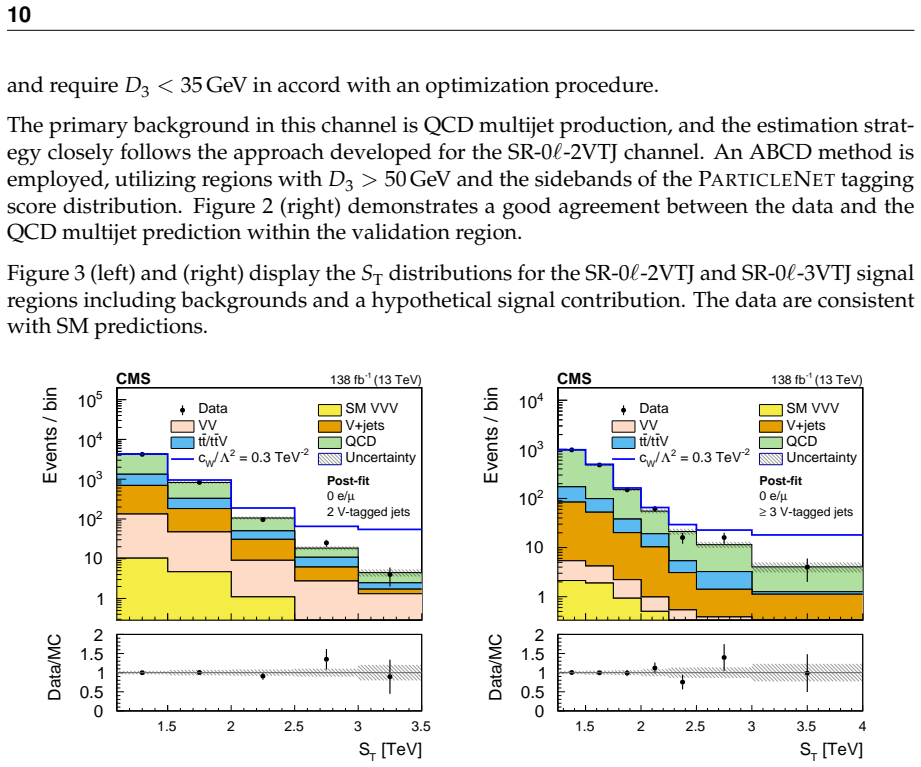
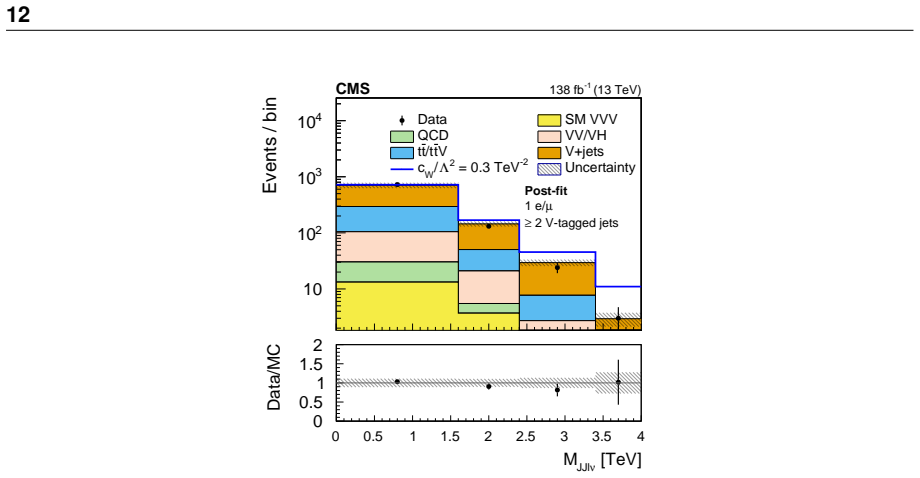
A statistically significant excess of events above standard model predictions in the high scalar transverse momentum sum bins of the triple boson selection would indicate new physics and contradict the reported null result.
Figures





read the original abstract
A search for new physics in the production of three massive gauge bosons (VVV, where V is a W or Z boson) is presented. The event selection is most effective in the Lorentz-boosted regime in which all three bosons have a transverse momentum ($p_\mathrm{T}$) above 200 GeV. Standard model (SM) processes contribute few events in this regime. When a boosted W or Z boson decays hadronically, the decay products tend to form a large-radius jet with substructure that reflects the presence of two quarks from the decay; such jets are called V-tagged jets. Special techniques to reconstruct and select V-tagged jets are applied. Events are categorized according to the number and kinematic features of charged leptons and V-tagged jets. Event yields are obtained in bins of a suitable kinematic variable such as the scalar $p_\mathrm{T}$ sum of the reconstructed objects in the event. No excess over SM expectations is observed. Bounds are placed on Wilson coefficients for a set of mass dimension-6 and -8 operators in the framework of SM effective field theory. The two most stringent bounds placed by this analysis are $-$0.13 $\lt$ $c_\mathrm{W}/\Lambda^2$ $\lt$ 0.12 TeV$^{-2}$ and $-$0.24 $\lt$ $c_\mathrm{Hq3}/\Lambda^2$ $\lt$ 0.21 TeV$^{-2}$ at 95% CL, where $c_\mathrm{W}$ and $c_\mathrm{Hq3}$ are dimension-6 Wilson coefficients in the Warsaw basis and $\Lambda$ is the mass scale of new physics.
Editorial analysis
A structured set of objections, weighed in public.
Referee Report
Summary. The manuscript reports a search for new physics in triple gauge boson (VVV) production in 13 TeV pp collisions within the SM effective field theory framework. It selects events in the boosted regime (all bosons with p_T > 200 GeV), applies V-tagging to hadronic W/Z decays, categorizes events by lepton multiplicity and V-tagged jet kinematics, bins yields in a scalar p_T sum variable, observes no excess over SM expectations, and extracts 95% CL bounds on dimension-6 and -8 Wilson coefficients, with the strongest limits being -0.13 < c_W/Λ² < 0.12 TeV^{-2} and -0.24 < c_Hq3/Λ² < 0.21 TeV^{-2}.
Significance. If the background modeling and V-tagging assumptions are validated, the result supplies useful constraints on EFT operators in a high-p_T regime where SM triple-boson rates are small, complementing existing diboson and single-boson searches. The boosted selection and kinematic binning are well-motivated for enhancing sensitivity to dimension-8 contributions.
major comments (2)
- [Abstract] Abstract: The central claim that 'Standard model (SM) processes contribute few events in this regime' and the subsequent bounds on c_W/Λ² and c_Hq3/Λ² rest on the assumption that irreducible backgrounds (V+jet, VV with mis-tags) are negligible above p_T > 200 GeV and that V-tagging efficiency/mistag rates are accurately known; the manuscript supplies no quantitative control-region yields, data-driven background estimates, or systematic uncertainty breakdown to support this assumption, which directly rescales the fitted yields and limits.
- [Results] Results and EFT fit description: The statistical procedure used to convert the binned event yields into the quoted 95% CL intervals on the Wilson coefficients is not specified (profile likelihood, asymptotic approximation, treatment of nuisance parameters), preventing verification that the reported intervals properly incorporate the dominant experimental uncertainties.
minor comments (1)
- [Abstract] Abstract: The phrase 'a suitable kinematic variable such as the scalar p_T sum' should be replaced by the explicit variable name and binning definition used in the fit.
Simulated Author's Rebuttal
We thank the referee for the careful and constructive review of our manuscript. The comments highlight important areas for clarification and additional detail, which we address point by point below. We will incorporate revisions to improve the transparency of the background validation and statistical procedure.
read point-by-point responses
-
Referee: [Abstract] Abstract: The central claim that 'Standard model (SM) processes contribute few events in this regime' and the subsequent bounds on c_W/Λ² and c_Hq3/Λ² rest on the assumption that irreducible backgrounds (V+jet, VV with mis-tags) are negligible above p_T > 200 GeV and that V-tagging efficiency/mistag rates are accurately known; the manuscript supplies no quantitative control-region yields, data-driven background estimates, or systematic uncertainty breakdown to support this assumption, which directly rescales the fitted yields and limits.
Authors: We agree that additional quantitative support for the background modeling assumptions would strengthen the manuscript. While the full text includes some validation of V-tagging performance and a description of the boosted selection, we acknowledge the absence of explicit control-region yields and a dedicated systematic breakdown in the current version. In the revised manuscript we will add a new subsection under Background Estimation that presents control-region data yields, data-driven background estimates for V+jet and mis-tagged VV processes, and a table summarizing the dominant systematic uncertainties and their impact on the signal yields. revision: yes
-
Referee: [Results] Results and EFT fit description: The statistical procedure used to convert the binned event yields into the quoted 95% CL intervals on the Wilson coefficients is not specified (profile likelihood, asymptotic approximation, treatment of nuisance parameters), preventing verification that the reported intervals properly incorporate the dominant experimental uncertainties.
Authors: We apologize for the insufficient detail on the statistical procedure. The analysis uses a binned profile-likelihood fit in which nuisance parameters float the dominant experimental and theoretical uncertainties (including V-tagging efficiencies, jet energy scale, and luminosity), with the 95% CL intervals obtained via the asymptotic approximation. In the revised manuscript we will expand the Results section to explicitly describe the likelihood function, the list of nuisance parameters and their constraints, the treatment of correlations, and confirmation that the asymptotic approximation was validated against toy Monte Carlo studies. revision: yes
Circularity Check
Direct experimental data-to-SM comparison yields EFT bounds with no circularity
full rationale
The paper reports a search for new physics via triple boson production, selecting events in the boosted regime and comparing observed yields in kinematic bins directly to Standard Model expectations. No excess is found, and Wilson coefficient bounds are extracted from a fit of EFT signal contributions to the data. This chain relies on external detector simulation, background modeling validated in control regions, and statistical fitting procedures that are independent of the final reported intervals. No equations reduce the bounds to quantities defined by the fit itself, no self-citations carry the central claim, and no ansatz or uniqueness theorem is invoked to force the result. The analysis is therefore self-contained against external benchmarks.
Axiom & Free-Parameter Ledger
free parameters (2)
- c_W / Λ²
- c_Hq3 / Λ²
axioms (2)
- domain assumption Standard model processes contribute few events in the boosted regime where all three bosons have p_T above 200 GeV
- domain assumption V-tagged jets can be reliably identified using substructure techniques to reconstruct boosted W or Z decays
Lean theorems connected to this paper
-
Cost/FunctionalEquationwashburn_uniqueness_aczel unclear?
unclearRelation between the paper passage and the cited Recognition theorem.
Bounds are placed on Wilson coefficients for a set of mass dimension-6 and -8 operators in the framework of SM effective field theory. The two most stringent bounds placed by this analysis are −0.13 < c_W/Λ² < 0.12 TeV^{-2} and −0.24 < c_Hq3/Λ² < 0.21 TeV^{-2} at 95% CL
-
Foundation/AlexanderDualityalexander_duality_circle_linking unclear?
unclearRelation between the paper passage and the cited Recognition theorem.
The observable of choice would be the VVV invariant mass, m_VVV … approximated using S_T, the scalar p_T sum
What do these tags mean?
- matches
- The paper's claim is directly supported by a theorem in the formal canon.
- supports
- The theorem supports part of the paper's argument, but the paper may add assumptions or extra steps.
- extends
- The paper goes beyond the formal theorem; the theorem is a base layer rather than the whole result.
- uses
- The paper appears to rely on the theorem as machinery.
- contradicts
- The paper's claim conflicts with a theorem or certificate in the canon.
- unclear
- Pith found a possible connection, but the passage is too broad, indirect, or ambiguous to say the theorem truly supports the claim.
Reference graph
Works this paper leans on
-
[1]
Dimension-Six Terms in the Standard Model Lagrangian
B. Grzadkowski, M. Iskrzynski, M. Misiak, and J. Rosiek, “Dimension-six terms in the standard model Lagrangian”,JHEP10(2010) 085,doi:10.1007/JHEP10(2010)085, arXiv:1008.4884
work page internal anchor Pith review Pith/arXiv arXiv doi:10.1007/jhep10(2010)085 2010
-
[2]
SMEFTsim 3.0 — a practical guide
I. Brivio, “SMEFTsim 3.0 — a practical guide”,JHEP04(2021) 073, doi:10.1007/JHEP04(2021)073,arXiv:2012.11343
-
[3]
Observation of the production of three massive gauge bosons at√s=13 TeV
CMS Collaboration, “Observation of the production of three massive gauge bosons at√s=13 TeV”,Phys. Rev. Lett.(2020) 151802, doi:10.1103/PhysRevLett.125.151802,arXiv:2006.11191
-
[4]
Measurement of WWZ and ZH production cross sections at√s=13 and 13.6 TeV
CMS Collaboration, “Measurement of WWZ and ZH production cross sections at√s=13 and 13.6 TeV”,Phys. Rev. Lett.135(2025) 091802,doi:10.1103/6z3d-zjw4, arXiv:2505.20483
-
[5]
Observation of WWW production in pp collisions at√s=13 TeV with the ATLAS detector
ATLAS Collaboration, “Observation of WWW production in pp collisions at√s=13 TeV with the ATLAS detector”,Phys. Rev. Lett.129(2022) 061803, doi:10.1103/PhysRevLett.129.061803,arXiv:2201.13045
-
[6]
Observation of VVZ production at √s=13 TeV with the ATLAS detector
ATLAS Collaboration, “Observation of VVZ production at √s=13 TeV with the ATLAS detector”,Phys. Lett. B866(2025) 139527,doi:10.1016/j.physletb.2025.139527, arXiv:2412.15123
-
[7]
The CMS statistical analysis and combination tool:COMBINE
CMS Collaboration, “The CMS statistical analysis and combination tool:COMBINE”, Comput. Softw. Big Sci.8(2024) 18,doi:10.1007/s41781-024-00121-4, arXiv:2404.06614
-
[8]
G. Boldrini, “SM and EFT interpretation of Vector Boson Scattering measurements at CMS and development of the DAQ system for the Barrel Timing Layer for HL-LHC”. PhD thesis, University of Milan, May, 2024. References 31
work page 2024
-
[9]
HEPData record for this analysis, 2026.doi:10.17182/hepdata.172651
-
[10]
Dimension-eight operator basis for universal standard model effective field theory
T. Corbett, J. Desai, O. J. P . Eboli, and M. C. Gonzalez-Garcia, “Dimension-eight operator basis for universal standard model effective field theory”,Phys. Rev. D110(2024) 033003,doi:10.1103/PhysRevD.110.033003,arXiv:2404.03720
-
[11]
CMS Collaboration, “The CMS trigger system”,JINST12(2017) P01020, doi:10.1088/1748-0221/12/01/P01020,arXiv:1609.02366
work page internal anchor Pith review Pith/arXiv arXiv doi:10.1088/1748-0221/12/01/p01020 2017
-
[12]
Performance of the CMS high-level trigger during LHC Run 2
CMS Collaboration, “Performance of the CMS high-level trigger during LHC Run 2”, JINST19(2024) P11021,doi:10.1088/1748-0221/19/11/P11021, arXiv:2410.17038
-
[13]
The CMS experiment at the CERN LHC
CMS Collaboration, “The CMS experiment at the CERN LHC”,JINST3(2008) S08004, doi:10.1088/1748-0221/3/08/S08004
-
[14]
Development of the CMS detector for the CERN LHC Run 3
CMS Collaboration, “Development of the CMS detector for the CERN LHC Run 3”, JINST19(2024) P05064,doi:10.1088/1748-0221/19/05/P05064, arXiv:2309.05466
-
[15]
GEANT4 Collaboration, “GEANT4 — a simulation toolkit”,Nucl. Instrum. Meth. A506 (2003) 250,doi:10.1016/S0168-9002(03)01368-8
-
[16]
J. Alwall et al., “The automated computation of tree-level and next-to-leading order differential cross sections, and their matching to parton shower simulations”,JHEP07 (2014) 079,doi:10.1007/JHEP07(2014)079,arXiv:1405.0301
work page internal anchor Pith review Pith/arXiv arXiv doi:10.1007/jhep07(2014)079 2014
-
[17]
J. Alwall et al., “Comparative study of various algorithms for the merging of parton showers and matrix elements in hadronic collisions”,Eur. Phys. J. C53(2008) 473, doi:10.1140/epjc/s10052-007-0490-5,arXiv:0706.2569
work page internal anchor Pith review Pith/arXiv arXiv doi:10.1140/epjc/s10052-007-0490-5 2008
-
[18]
A New Method for Combining NLO QCD with Shower Monte Carlo Algorithms
P . Nason, “A new method for combining NLO QCD with shower Monte Carlo algorithms”,JHEP11(2004) 040,doi:10.1088/1126-6708/2004/11/040, arXiv:hep-ph/0409146
work page internal anchor Pith review Pith/arXiv arXiv doi:10.1088/1126-6708/2004/11/040 2004
-
[19]
Matching NLO QCD computations with Parton Shower simulations: the POWHEG method
S. Frixione, P . Nason, and C. Oleari, “Matching NLO QCD computations with parton shower simulations: the POWHEG method”,JHEP11(2007) 070, doi:10.1088/1126-6708/2007/11/070,arXiv:0709.2092
work page internal anchor Pith review Pith/arXiv arXiv doi:10.1088/1126-6708/2007/11/070 2007
-
[20]
A general framework for implementing NLO calculations in shower Monte Carlo programs: the POWHEG BOX
S. Alioli, P . Nason, C. Oleari, and E. Re, “A general framework for implementing NLO calculations in shower Monte Carlo programs: the POWHEG BOX”,JHEP06(2010) 043, doi:10.1007/JHEP06(2010)043,arXiv:1002.2581
work page internal anchor Pith review Pith/arXiv arXiv doi:10.1007/jhep06(2010)043 2010
-
[21]
Parton distributions for the LHC Run II
NNPDF Collaboration, “Parton distributions for the LHC Run II”,JHEP04(2015) 040, doi:10.1007/JHEP04(2015)040,arXiv:1410.8849
work page internal anchor Pith review Pith/arXiv arXiv doi:10.1007/jhep04(2015)040 2015
-
[22]
T. Sj ¨ostrand et al., “An introduction to PYTHIA 8.2”,Comput. Phys. Commun.191(2015) 159,doi:10.1016/j.cpc.2015.01.024,arXiv:1410.3012
work page internal anchor Pith review Pith/arXiv arXiv doi:10.1016/j.cpc.2015.01.024 2015
-
[23]
Extraction and validation of a new set of CMS PYTHIA8 tunes from underlying-event measurements
CMS Collaboration, “Extraction and validation of a new set of CMS PYTHIA8 tunes from underlying-event measurements”,Eur. Phys. J. C80(2020) 4, doi:10.1140/epjc/s10052-019-7499-4,arXiv:1903.12179
-
[24]
Matching in pp→t t W/Z/h+jet SMEFT studies
R. Goldouzian et al., “Matching in pp→t t W/Z/h+jet SMEFT studies”,JHEP06 (2021) 151,doi:10.1007/JHEP06(2021)151,arXiv:2012.06872. 32
-
[25]
Particle-flow reconstruction and global event description with the CMS detector
CMS Collaboration, “Particle-flow reconstruction and global event description with the CMS detector”,JINST12(2017) P10003,doi:10.1088/1748-0221/12/10/P10003, arXiv:1706.04965
work page internal anchor Pith review Pith/arXiv arXiv doi:10.1088/1748-0221/12/10/p10003 2017
-
[26]
Electron and photon reconstruction and identification with the CMS experiment at the CERN LHC
CMS Collaboration, “Electron and photon reconstruction and identification with the CMS experiment at the CERN LHC”,JINST16(2021) P05014, doi:10.1088/1748-0221/16/05/P05014,arXiv:2012.06888
-
[27]
CMS Collaboration, “Performance of electron reconstruction and selection with the CMS detector in proton-proton collisions at √s=8 TeV”,JINST10(2015) P06005, doi:10.1088/1748-0221/10/06/P06005,arXiv:1502.02701
work page internal anchor Pith review Pith/arXiv arXiv doi:10.1088/1748-0221/10/06/p06005 2015
-
[28]
Performance of CMS muon reconstruction in pp collision events at sqrt(s) = 7 TeV
CMS Collaboration, “Performance of CMS muon reconstruction in pp collision events at√s=7 TeV”,JINST7(2012) P10002,doi:10.1088/1748-0221/7/10/P10002, arXiv:1206.4071
work page internal anchor Pith review Pith/arXiv arXiv doi:10.1088/1748-0221/7/10/p10002 2012
-
[29]
CMS Collaboration, “Performance of the CMS muon detector and muon reconstruction with proton-proton collisions at √s=13 TeV”,JINST13(2018) P06015, doi:10.1088/1748-0221/13/06/P06015,arXiv:1804.04528
work page internal anchor Pith review Pith/arXiv arXiv doi:10.1088/1748-0221/13/06/p06015 2018
-
[30]
CMS Collaboration, “Performance of reconstruction and identification ofτleptons decaying to hadrons andν τ in pp collisions at √s=13 TeV”,JINST13(2018) P10005, doi:10.1088/1748-0221/13/10/P10005,arXiv:1809.02816
work page internal anchor Pith review Pith/arXiv arXiv doi:10.1088/1748-0221/13/10/p10005 2018
-
[31]
Identification of hadronic tau lepton decays using a deep neural network
CMS Collaboration, “Identification of hadronic tau lepton decays using a deep neural network”,JINST17(2022) P07023,doi:10.1088/1748-0221/17/07/P07023, arXiv:2201.08458
-
[32]
Identification of tau leptons using a convolutional neural network with domain adaptation
CMS Collaboration, “Identification of tau leptons using a convolutional neural network with domain adaptation”,JINST20(2025) P12032, doi:10.1088/1748-0221/20/12/P12032,arXiv:2511.05468
-
[33]
M. Cacciari, G. P . Salam, and G. Soyez, “FastJet user manual”,Eur. Phys. J. C72(2012) 1896,doi:10.1140/epjc/s10052-012-1896-2,arXiv:1111.6097
work page internal anchor Pith review Pith/arXiv arXiv doi:10.1140/epjc/s10052-012-1896-2 2012
-
[34]
Dispelling the N^3 myth for the Kt jet-finder
M. Cacciari and G. P . Salam, “Dispelling theN 3 myth for thek T jet-finder”,Phys. Lett. B 641(2006) 57,doi:10.1016/j.physletb.2006.08.037,arXiv:hep-ph/0512210
work page internal anchor Pith review Pith/arXiv arXiv doi:10.1016/j.physletb.2006.08.037 2006
-
[35]
Jet flavour classification using DeepJet
E. Bols et al., “Jet flavour classification using DeepJet”,JINST15(2020) P12012, doi:10.1088/1748-0221/15/12/P12012,arXiv:2008.10519
-
[36]
Pileup Per Particle Identification
D. Bertolini, P . Harris, M. Low, and N. Tran, “Pileup per particle identification”,JHEP10 (2014) 059,doi:10.1007/JHEP10(2014)059,arXiv:1407.6013
work page internal anchor Pith review Pith/arXiv arXiv doi:10.1007/jhep10(2014)059 2014
-
[37]
Pileup mitigation at CMS in 13 TeV data
CMS Collaboration, “Pileup mitigation at CMS in 13 TeV data”,JINST15(2020) P09018, doi:10.1088/1748-0221/15/09/P09018,arXiv:2003.00503
-
[38]
A. J. Larkoski, S. Marzani, G. Soyez, and J. Thaler, “Soft drop”,JHEP05(2014) 146, doi:10.1007/JHEP05(2014)146,arXiv:1402.2657
work page internal anchor Pith review Pith/arXiv arXiv doi:10.1007/jhep05(2014)146 2014
-
[39]
CMS Collaboration, “Identification of heavy, energetic, hadronically decaying particles using machine-learning techniques”,JINST15(2020) P06005, doi:10.1088/1748-0221/15/06/P06005,arXiv:2004.08262. References 33
-
[40]
CMS Collaboration, “Performance of missing transverse momentum reconstruction in proton-proton collisions at √s=13 TeV using the CMS detector”,JINST14(2019) P07004,doi:10.1088/1748-0221/14/07/P07004,arXiv:1903.06078
work page internal anchor Pith review Pith/arXiv arXiv doi:10.1088/1748-0221/14/07/p07004 2019
-
[41]
A measurement ofσB(W→eν)andσB(Z→e +e−)in pp collisions at √s=1800 GeV
CDF Collaboration, “A measurement ofσB(W→eν)andσB(Z→e +e−)in pp collisions at √s=1800 GeV”,Phys. Rev. D44(1991) 29, doi:10.1103/PhysRevD.44.29
-
[42]
Particle Data Group, “Review of particle physics”,Phys. Rev. D110(2024) 030001, doi:10.1103/PhysRevD.110.030001
-
[43]
CMS Collaboration, “First measurement of the cross section for top-quark pair production in proton-proton collisions at √s=7 tev”,Phys. Lett. B695(2011) 424, doi:10.1016/j.physletb.2010.11.058,arXiv:1010.5994
work page internal anchor Pith review Pith/arXiv arXiv doi:10.1016/j.physletb.2010.11.058 2011
-
[44]
Measurement of the Inclusive W and Z Production Cross Sections in pp Collisions at sqrt(s) = 7 TeV
CMS Collaboration, “Measurement of the inclusive W and Z production cross sections in pp collisions at √s=7 TeV”,JHEP10(2011) 132,doi:10.1007/JHEP10(2011)132, arXiv:1107.4789
work page internal anchor Pith review Pith/arXiv arXiv doi:10.1007/jhep10(2011)132 2011
-
[45]
Performance of the CMS electromagnetic calorimeter in pp collisions at √s=13 TeV
CMS Collaboration, “Performance of the CMS electromagnetic calorimeter in pp collisions at √s=13 TeV”,JINST19(2024) P09004, doi:10.1088/1748-0221/19/09/P09004,arXiv:2403.15518
-
[46]
Performance of the CMS muon trigger system in proton-proton collisions at √s=13 TeV
CMS Collaboration, “Performance of the CMS muon trigger system in proton-proton collisions at √s=13 TeV”,JINST16(2021) P07001, doi:10.1088/1748-0221/16/07/P07001,arXiv:2102.04790
-
[47]
Jet energy scale and resolution in the CMS experiment in pp collisions at 8 TeV
CMS Collaboration, “Jet energy scale and resolution in the CMS experiment in pp collisions at 8 TeV”,JINST12(2017) P02014, doi:10.1088/1748-0221/12/02/P02014,arXiv:1607.03663
work page internal anchor Pith review Pith/arXiv arXiv doi:10.1088/1748-0221/12/02/p02014 2017
-
[48]
Determination of Jet Energy Calibration and Transverse Momentum Resolution in CMS
CMS Collaboration, “Determination of jet energy calibration and transverse momentum resolution in CMS”,JINST6(2011) P11002, doi:10.1088/1748-0221/6/11/P11002,arXiv:1107.4277
work page internal anchor Pith review Pith/arXiv arXiv doi:10.1088/1748-0221/6/11/p11002 2011
-
[49]
Measurement of the inelastic proton-proton cross section at $\sqrt{s}=$ 13 TeV
CMS Collaboration, “Measurement of the inelastic proton-proton cross section at√s=13 TeV”,JHEP07(2018) 161,doi:10.1007/JHEP07(2018)161, arXiv:1802.02613
work page internal anchor Pith review Pith/arXiv arXiv doi:10.1007/jhep07(2018)161 2018
-
[50]
Precision luminosity measurement in proton-proton collisions at√s=13 TeV in 2015 and 2016 at CMS
CMS Collaboration, “Precision luminosity measurement in proton-proton collisions at√s=13 TeV in 2015 and 2016 at CMS”,Eur. Phys. J. C81(2021) 800, doi:10.1140/epjc/s10052-021-09538-2,arXiv:2104.01927
-
[51]
CMS luminosity measurement for the 2017 data-taking period at√s=13 TeV
CMS Collaboration, “CMS luminosity measurement for the 2017 data-taking period at√s=13 TeV”, CMS Physics Analysis Summary CMS-PAS-LUM-17-004, 2017
work page 2017
-
[52]
CMS luminosity measurement for the 2018 data-taking period at√s=13 TeV
CMS Collaboration, “CMS luminosity measurement for the 2018 data-taking period at√s=13 TeV”, CMS Physics Analysis Summary CMS-PAS-LUM-18-002, 2018
work page 2018
-
[53]
CMS Collaboration, “Measurements of production cross sections of WZ and same-sign WW boson pairs in association with two jets in proton-proton collisions at √s=13 TeV”, Phys. Lett. B809(2020) 135710,doi:10.1016/j.physletb.2020.135710, arXiv:2005.01173. 34
-
[54]
EFT validity issues in vector boson scattering processes
M. Szleper et al., “EFT validity issues in vector boson scattering processes”,PoS LHCP2020(2020) 023,doi:10.22323/1.382.0023
-
[55]
Trial factors for the look elsewhere effect in high energy physics
E. Gross and O. Vitells, “Trial factors for the look elsewhere effect in high energy physics”,Eur. Phys. J. C70(2010) 525,doi:10.1140/epjc/s10052-010-1470-8, arXiv:1005.1891
work page internal anchor Pith review Pith/arXiv arXiv doi:10.1140/epjc/s10052-010-1470-8 2010
-
[56]
Asymptotic formulae for likelihood-based tests of new physics
G. Cowan, K. Cranmer, E. Gross, and O. Vitells, “Asymptotic formulae for likelihood-based tests of new physics”,Eur. Phys. J. C71(2011) 1554, doi:10.1140/epjc/s10052-011-1554-0,arXiv:1007.1727. [Erratum: Eur.Phys.J.C 73, 2501 (2013)]. 35 A The CMS Collaboration Yerevan Physics Institute, Yerevan, Armenia A. Hayrapetyan, V . Makarenko , A. Tumasyan1 Instit...
work page internal anchor Pith review Pith/arXiv arXiv doi:10.1140/epjc/s10052-011-1554-0 2011
discussion (0)
Sign in with ORCID, Apple, or X to comment. Anyone can read and Pith papers without signing in.