Recognition: no theorem link
Sophie Germain, math\'ematicienne extraordinaire: A story stranger than fiction
Pith reviewed 2026-05-15 02:14 UTC · model grok-4.3
The pith
Sophie Germain developed a grand plan to prove Fermat's Last Theorem in full using new number theory tools.
A machine-rendered reading of the paper's core claim, the machinery that carries it, and where it could break.
Core claim
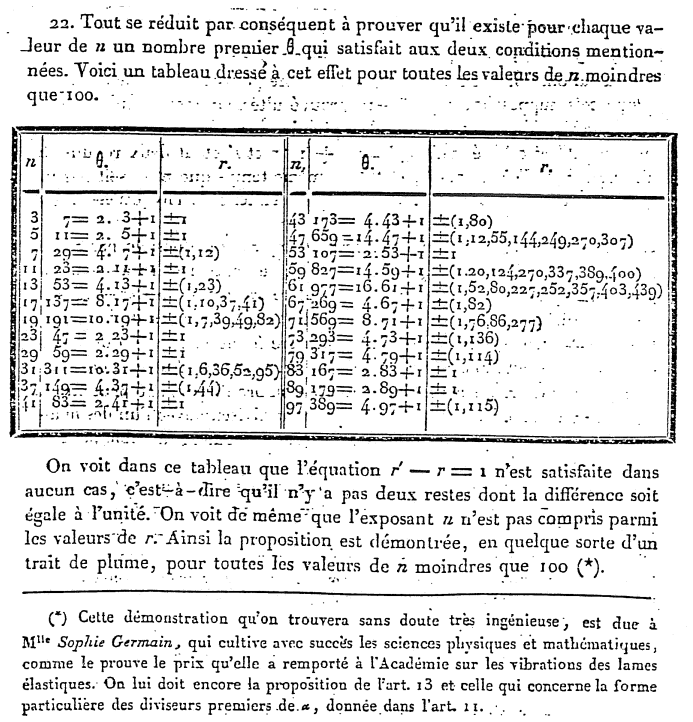
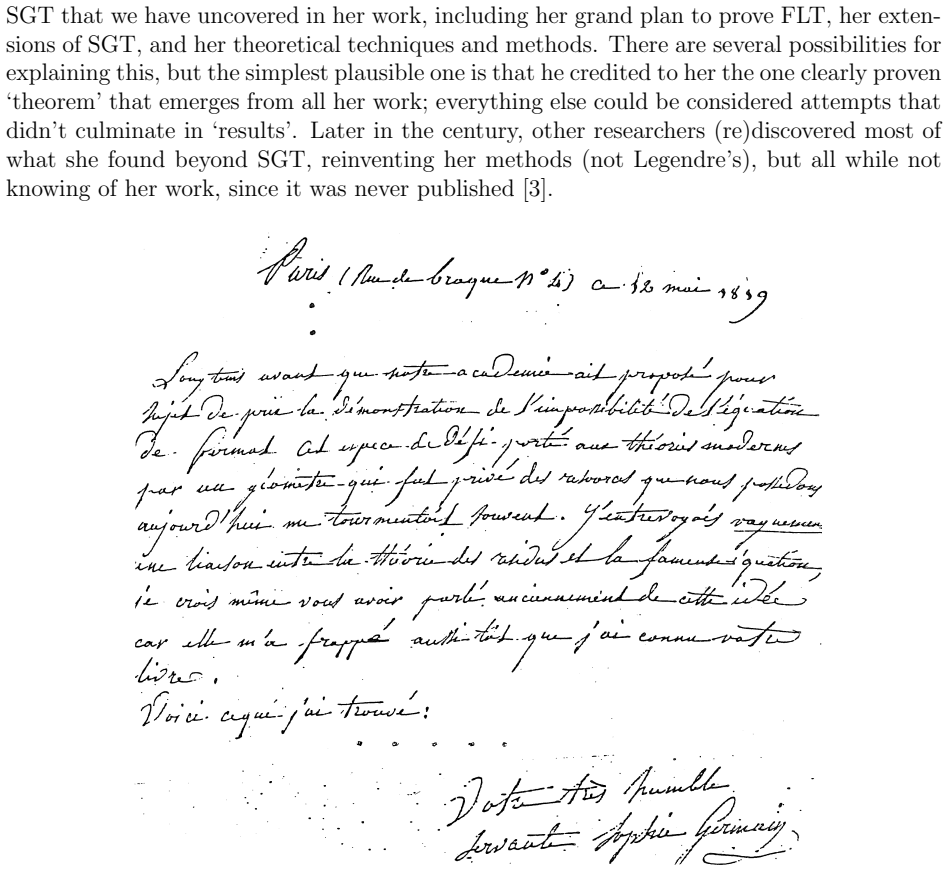
Germain had a grand plan for proving Fermat's Last Theorem in its entirety, and carried this plan a long way, using then new tools, e.g., congruence, modular primitive roots, and permutations. Recent study of her handwritten manuscripts and correspondence with Legendre and Gauss shows she accomplished far more than the single theorem long attributed to her.
What carries the argument
Germain's grand plan for a complete proof of Fermat's Last Theorem, implemented through modular arithmetic techniques including congruences, primitive roots, and permutations.
If this is right
- Her number theory work extended well beyond the single result published by Legendre.
- She applied novel modular tools to advance the proof in multiple cases.
- Her interactions with Lagrange, Legendre, and Gauss involved sharing these deeper ideas.
- The revised record places her earlier in the development of techniques later central to number theory.
Where Pith is reading between the lines
- Historians might now search other overlooked manuscripts from the same period for comparable unreported plans.
- Germain's modular approach could be compared directly with the methods that succeeded in the 20th century to see where it aligned or diverged.
- If her plan had been published in full, it might have directed more mathematicians toward similar modular strategies decades earlier.
Load-bearing premise
The handwritten manuscripts and correspondence accurately reflect Germain's own original ideas and plans without later misattribution or alteration.
What would settle it
Discovery of documents or analysis showing that the detailed plans and notations in the manuscripts were added or altered by later hands would disprove that they represent her personal grand plan.
Figures



read the original abstract
Sophie Germain (1776-1831) was the first woman we know who did important original research in mathematics, specifically in elasticity theory and number theory. Celebrating her semiquincentennial year, we outline Germain's recently unearthed number theory results on Fermat's Last Theorem, in the context of her life, work, and interactions with Lagrange, Legendre, and Gauss. For two centuries her accomplishment on Fermat's Last Theorem was thought to consist of a single theorem attributed to her in a publication by Legendre, the first general result towards proving Fermat's Last Theorem. But recent discoveries in her handwritten manuscripts and correspondence with Legendre and Gauss show that she accomplished much more, albeit forgotten. In particular, she had a grand plan for proving Fermat's Last Theorem in its entirety, and carried this plan a long way, using then new tools, e.g., congruence, modular primitive roots, and permutations.
Editorial analysis
A structured set of objections, weighed in public.
Referee Report
Summary. The paper claims that Sophie Germain had a grand plan for proving Fermat's Last Theorem in its entirety, carrying it out using new tools such as congruence, modular primitive roots, and permutations, as shown in her recently unearthed handwritten manuscripts and correspondence, beyond the single theorem previously known from Legendre.
Significance. This finding, if the manuscript interpretations hold, would significantly enhance our understanding of Germain's mathematical contributions and the early development of number theory techniques applied to FLT, crediting her with a more systematic approach than previously acknowledged.
major comments (2)
- [Section on number theory results] The central claim of a unified grand plan requires more direct evidence from the manuscripts; specific quotes or diagrams from the notes should be provided to show how individual results on congruences and permutations fit into an overarching strategy for all odd primes, rather than appearing as separate explorations.
- [Correspondence sections] The interpretation of letters to Legendre and Gauss needs to address the possibility of misattribution or later additions to ensure the ideas are attributed accurately to Germain's original work.
minor comments (1)
- Consider adding a table or timeline summarizing the key manuscript discoveries and their dates for clarity.
Simulated Author's Rebuttal
We thank the referee for the careful reading of our manuscript and the constructive suggestions, which we believe will improve the clarity and evidentiary support for our claims regarding Sophie Germain's work. We address each major comment below.
read point-by-point responses
-
Referee: [Section on number theory results] The central claim of a unified grand plan requires more direct evidence from the manuscripts; specific quotes or diagrams from the notes should be provided to show how individual results on congruences and permutations fit into an overarching strategy for all odd primes, rather than appearing as separate explorations.
Authors: We agree that additional direct evidence from the manuscripts would strengthen the presentation of the unified grand plan. In the revised manuscript, we will incorporate specific quotes from Germain's handwritten notes (with translations) and descriptions of relevant diagrams or tabular arrangements that demonstrate the connections between her congruence results, primitive root techniques, and permutation methods as part of a systematic strategy intended to apply to all odd primes. This will make explicit how these elements cohere rather than standing as isolated explorations. revision: yes
-
Referee: [Correspondence sections] The interpretation of letters to Legendre and Gauss needs to address the possibility of misattribution or later additions to ensure the ideas are attributed accurately to Germain's original work.
Authors: We appreciate the caution regarding potential misattribution or later additions in the correspondence. In the revised version, we will expand the relevant sections to explicitly discuss the provenance and dating of the letters, drawing on available archival evidence and cross-references to rule out or qualify possibilities of misattribution. Where uncertainties remain, we will note them transparently while affirming the attribution to Germain based on the primary sources. revision: yes
Circularity Check
No circularity: historical narrative grounded in primary sources
full rationale
The paper is a historical account of Sophie Germain's work, drawing on unearthed manuscripts and correspondence with Legendre and Gauss. No mathematical derivations, equations, fitted parameters, predictions, or uniqueness theorems appear. Claims rest on external primary documents rather than any self-referential chain, self-citation of prior results by the author, or renaming of known patterns. The central interpretation of a 'grand plan' is presented as an inference from the documents themselves, with no reduction to inputs by construction. This is a standard self-contained historical analysis with no load-bearing circular steps.
Axiom & Free-Parameter Ledger
axioms (1)
- domain assumption The authenticity and dating of the handwritten manuscripts and correspondence to Sophie Germain's lifetime.
Reference graph
Works this paper leans on
-
[1]
L. L. Bucciarelli and N. Dworsky, Sophie Germain: An Essay in the History of the Theory of Elasticity, D. Reidel, Dordrecht, Holland, 1980
work page 1980
-
[2]
A. Del Centina, Unpublished manuscripts of Sophie Germain and a revaluation of her work on Fermat's Last Theorem, Archive for History of Exact Sciences 62 (2008), 349--392
work page 2008
-
[3]
R. Laubenbacher, D. Pengelley, Voici ce que j'ai trouv\' e : \ \ Sophie Germain's grand plan to prove Fermat's Last Theorem, Historia Mathematica 37 (2010), 641--692; available at https://arxiv.org/abs/0801.1809v3
-
[4]
R. Laubenbacher, D. Pengelley, Mathematical Expeditions: Chronicles by the Explorers, Springer, New York, 1999
work page 1999
-
[5]
D. Musielak, Sophie's Diary: A Mathematical Novel, Mathematical Association of America, Washington, 2014
work page 2014
-
[6]
Musielak, Sophie Germain: Revolutionary Mathematician, Springer Nature, Cham, 2020
D. Musielak, Sophie Germain: Revolutionary Mathematician, Springer Nature, Cham, 2020
work page 2020
-
[7]
D. Pengelley, Teaching with Original Historical Sources in Mathematics, https://sites.google.com/view/davidpengelley/history
-
[8]
D. Pengelley, Number Theory Through the Eyes of Sophie Germain:\ An Inquiry Course, American Mathematical Society, Providence, 2023
work page 2023
-
[9]
TRansforming Instruction in Undergraduate Mathematics via Primary Historical Sources, https://triumphs.ursinus.edu/
-
[10]
The TRIUMPHS\ Society, https://triumphssociety.org/
discussion (0)
Sign in with ORCID, Apple, or X to comment. Anyone can read and Pith papers without signing in.