Analyzing Codes of Conduct for Online Safety in Video Games at Scale
Pith reviewed 2026-06-30 20:10 UTC · model grok-4.3
The pith
Codes of conduct appear in only a small share of Steam multiplayer games and address interpersonal harms less specifically than gameplay violations.
A machine-rendered reading of the paper's core claim, the machinery that carries it, and where it could break.
Core claim
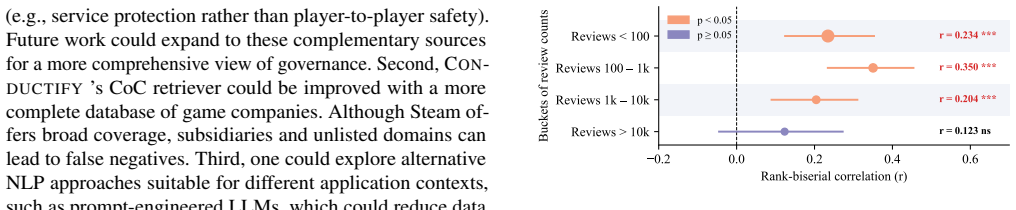
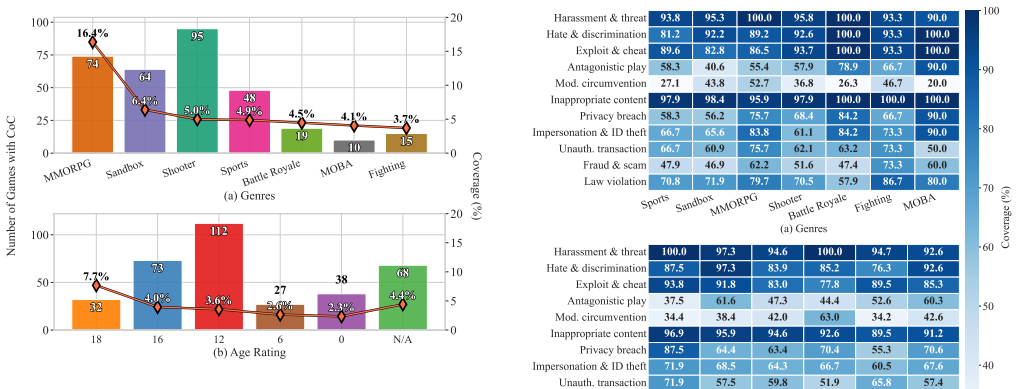
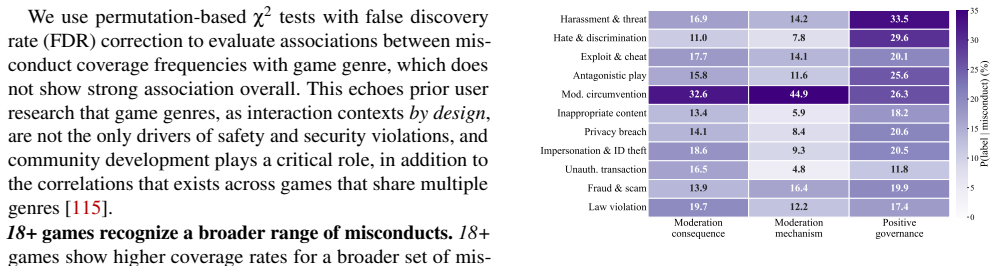
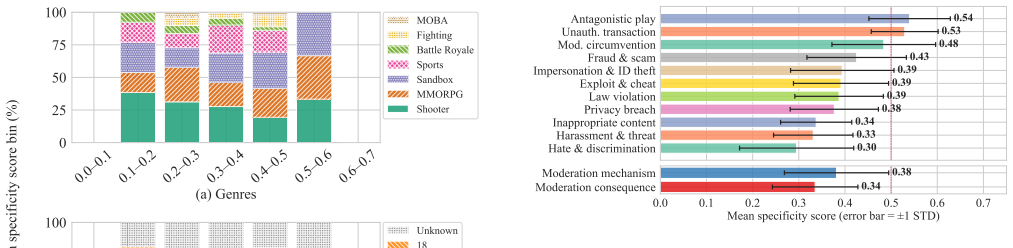
CONDUCTIFY located available codes of conduct for 350 of 9,586 multiplayer titles on Steam. CoCs are more available among popular, adult-oriented, and community-driven games, while most multiplayer games operate without them. Over 80 percent of the games with CoCs address traditional security and safety violations consistently, but their governance approaches vary substantially across violation types. Articulations of interpersonal harm and underage player safety are often less specific than those for harms related to gameplay mechanics.
What carries the argument
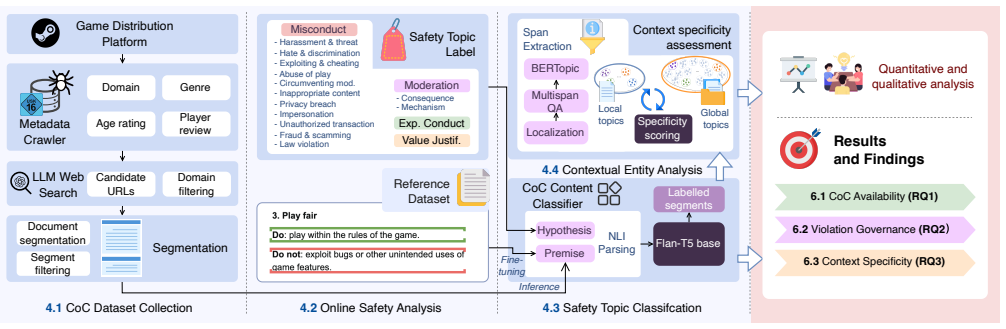
CONDUCTIFY, a pipeline that identifies and classifies codes of conduct from game store pages or linked resources, then measures their coverage and specificity across violation categories.
If this is right
- Most multiplayer games on the platform run without any posted safety rules despite regulatory and industry calls for them.
- When codes exist they treat security violations more uniformly than interpersonal or age-related ones.
- Lower specificity on harassment and underage safety leaves enforcement open to wider interpretation.
- Community-driven and adult-rated titles show higher adoption, suggesting market or social pressure influences availability.
Where Pith is reading between the lines
- Platforms could surface missing codes as a visibility signal to encourage wider adoption.
- Standardized templates with minimum detail levels for interpersonal harms might reduce the observed specificity gap.
- Extending the same scan to console storefronts would test whether the Steam pattern holds on other distribution channels.
Load-bearing premise
The pipeline finds and correctly classifies nearly all available codes of conduct without missing many or mislabeling their content.
What would settle it
A manual audit of a random sample of 200 multiplayer Steam pages that records how many actually link to or contain a code of conduct and whether the pipeline's classification of violation coverage matches the manual reading.
Figures


read the original abstract
Online video games have become major online social spaces where users interact, compete, and create together. These spaces, however, expose users to a wide spectrum of online harms, including harassment, discrimination, inappropriate content, privacy breach, cheating, and more. The shape and severity of such harms vary across game design, mechanics, and community context. To mitigate these harms, game companies issue Codes of Conduct (CoCs) that articulate online safety rules and direct players to safety resources. However, it remains unclear how prevalent CoCs are, what safety, security and privacy violations they govern, and whether they meet growing regulatory and industry expectations. We develop and leverage CONDUCTIFY, a pipeline for identifying and analyzing CoCs at scale. Applied to Steam, the largest PC game marketplace, it located the available CoCs for 350 of the 9,586 multiplayer titles on Steam. We found that CoCs are more available among popular, adult-oriented, and community-driven games, while most multiplayer games operate without CoCs despite regulatory and industry recommendations. Although over 80% of the games with CoCs available consistently address traditional security and safety violations, their governance approaches vary substantially across types of violations. A further asymmetry emerges in specificity. Compared with harms related to gameplay mechanics, the articulations of interpersonal harm and the underage player safety are often less specific, despite their relevance to many game communities. Together, these results inform the improvement of online safety governance and CoC enforcement practices, and building better safety infrastructure for the community of players and developers.
Editorial analysis
A structured set of objections, weighed in public.
Referee Report
Summary. The paper introduces CONDUCTIFY, a pipeline for large-scale identification and analysis of Codes of Conduct (CoCs) from Steam store pages and linked resources. Applied to 9,586 multiplayer titles, it reports CoCs available for only 350 games, with higher prevalence among popular, adult-oriented, and community-driven titles. Over 80% of available CoCs address traditional security/safety violations, but governance approaches vary; specificity is lower for interpersonal harms and underage player safety than for gameplay mechanics. The work claims these patterns inform improvements in online safety governance despite regulatory recommendations.
Significance. If the pipeline and classifications hold, the scale of the analysis (nearly 10k titles) provides a valuable empirical baseline on CoC prevalence and content variation in video games, a domain with growing regulatory attention. The observational correlations with game characteristics and the noted asymmetry in specificity could usefully guide developer and policy efforts. The study credits its automated pipeline for enabling the breadth of coverage.
major comments (3)
- [Methods (CONDUCTIFY pipeline)] Methods section describing CONDUCTIFY: No precision, recall, or manual validation (e.g., audit of random sample or inter-rater checks) is reported for the pipeline's ability to locate and classify CoCs from store pages/linked resources. This is load-bearing for the central prevalence claim (350/9586) and all downstream correlations with popularity/adult-orientation, as systematic false negatives would directly inflate the 'most games lack CoCs' result and bias availability patterns.
- [Results (specificity judgments)] Results on specificity analysis: No inter-rater reliability metric or validation procedure is described for the human or automated judgments distinguishing specificity levels across violation types (e.g., interpersonal harm vs. gameplay mechanics). This directly affects the asymmetry claim, which is presented as a key finding.
- [Data collection and preprocessing] Data handling section: Unclear treatment of CoCs that exist only in-game, on unlinked external sites, or in non-text forms, and no sensitivity analysis for missing data. This is critical because the abstract and results treat absence of detected CoCs as equivalent to 'operate without CoCs,' which could be confounded by detection limits rather than true absence.
minor comments (2)
- [Results] Table or figure presenting the 80% coverage statistic should include exact counts and breakdowns by violation category to allow readers to assess the 'consistently address' claim.
- [Methods] Clarify the exact definition and operationalization of 'community-driven' and 'adult-oriented' in the correlation analysis to improve reproducibility.
Simulated Author's Rebuttal
We thank the referee for their careful review and constructive major comments. We agree that the points raised identify important gaps in reporting and validation that affect the strength of the central claims. We address each comment below and will incorporate revisions to improve transparency and robustness.
read point-by-point responses
-
Referee: Methods section describing CONDUCTIFY: No precision, recall, or manual validation (e.g., audit of random sample or inter-rater checks) is reported for the pipeline's ability to locate and classify CoCs from store pages/linked resources. This is load-bearing for the central prevalence claim (350/9586) and all downstream correlations with popularity/adult-orientation, as systematic false negatives would directly inflate the 'most games lack CoCs' result and bias availability patterns.
Authors: We acknowledge that the original manuscript did not include quantitative validation metrics for the CONDUCTIFY pipeline. In the revised version we will add a dedicated validation subsection. This will report results from a manual audit of a stratified random sample of 500 titles (including precision, recall, and F1 for CoC detection) and inter-rater agreement statistics for the classification of violation types and specificity levels. These additions will directly support the prevalence estimate and downstream analyses. revision: yes
-
Referee: Results on specificity analysis: No inter-rater reliability metric or validation procedure is described for the human or automated judgments distinguishing specificity levels across violation types (e.g., interpersonal harm vs. gameplay mechanics). This directly affects the asymmetry claim, which is presented as a key finding.
Authors: The specificity judgments followed an explicit coding rubric developed by the team. We agree that reliability metrics should have been reported. The revision will add a methods paragraph describing the coding procedure and will include inter-rater reliability (Cohen's kappa) computed on a double-coded subset of 100 CoCs. If original coding was primarily single-coder, we will note this limitation and present the new reliability check as part of the revision. revision: yes
-
Referee: Data handling section: Unclear treatment of CoCs that exist only in-game, on unlinked external sites, or in non-text forms, and no sensitivity analysis for missing data. This is critical because the abstract and results treat absence of detected CoCs as equivalent to 'operate without CoCs,' which could be confounded by detection limits rather than true absence.
Authors: We will expand the data collection and limitations sections to explicitly define the search scope as Steam store pages and directly linked resources only. The revision will add a dedicated limitations paragraph acknowledging that CoCs existing solely in-game, on unlinked sites, or in non-text formats fall outside the analysis, and will qualify statements about games 'operating without CoCs' accordingly. A brief sensitivity discussion will be included to address potential impact of undetected CoCs on the reported patterns. revision: yes
Circularity Check
No circularity; empirical pipeline application on external data
full rationale
The paper is an observational study that develops CONDUCTIFY as a methodological tool and applies it to count and classify CoCs from Steam store pages for 9,586 titles. The reported prevalence (350/9,586), availability correlations, and content-analysis statistics are direct outputs of this data processing step. No equations, fitted parameters, self-definitional constructs, or load-bearing self-citations appear in the derivation. The pipeline itself is not claimed to be derived from the target results; any accuracy concerns are validity issues, not circularity.
Axiom & Free-Parameter Ledger
Reference graph
Works this paper leans on
-
[1]
https://github.com/huridocs/ pdf-document-layout-analysis
GitHub - huridocs/pdf-document-layout-analysis: A Docker-powered service for PDF document lay- out analysis. https://github.com/huridocs/ pdf-document-layout-analysis . [Accessed 27- 08-2025]
2025
-
[2]
https://steamcommunity.com/ groups/steamworks/announcements/detail/ 4183351393029705363
Steam :: Steamworks Development :: Content Ratings Requirement in Germany — steamcom- munity.com. https://steamcommunity.com/ groups/steamworks/announcements/detail/ 4183351393029705363. [Accessed 27-08-2025]
2025
-
[3]
The methods used to implement an ethical code of conduct and employee attitudes
Avshalom M Adam and Dalia Rachman-Moore. The methods used to implement an ethical code of conduct and employee attitudes. Journal of Business Ethics, 54(3):225–244, 2004
2004
-
[4]
GPT-4o Search Preview, August
Open AI. GPT-4o Search Preview, August
-
[5]
https://platform.openai.com/docs/ models/gpt-4o-search-preview
-
[6]
Pri- vacy policies over time: Curation and analysis of a million-document dataset
Ryan Amos, Gunes Acar, Eli Lucherini, Mihir Kshir- sagar, Arvind Narayanan, and Jonathan Mayer. Pri- vacy policies over time: Curation and analysis of a million-document dataset. In Proceedings of the Web Conference 2021, pages 2165–2176, 2021
2021
-
[7]
Actions speak louder than words:{Entity-Sensitive} privacy policy and data flow analysis with {PoliCheck}
Benjamin Andow, Samin Yaseer Mahmud, Justin Whitaker, William Enck, Bradley Reaves, Kapil Singh, and Serge Egelman. Actions speak louder than words:{Entity-Sensitive} privacy policy and data flow analysis with {PoliCheck}. In 29th USENIX Security Symposium (USENIX Security 20), pages 985–1002, 2020
2020
-
[8]
Inclusion 101, 2026
AnyKey. Inclusion 101, 2026
2026
-
[9]
Valve conquered PC gaming
Louis Ashworth. Valve conquered PC gaming. What comes next? — ft.com. https://www.ft.com/content/ f4a13716-838a-43da-853b-7c31ac17192c . [Accessed 27-08-2025]
2025
-
[10]
China’sOnline Game Age-Appropriateness Warning, December 2020
China Audio-Video and Digital Publishing Association. China’sOnline Game Age-Appropriateness Warning, December 2020. https://www.nppa.gov.cn/xxfb/ ywdt/202012/t20201218_664903.html
2020
-
[11]
Don’t you know that you’re toxic: Normalization of toxic- ity in online gaming
Nicole A Beres, Julian Frommel, Elizabeth Reid, Re- gan L Mandryk, and Madison Klarkowski. Don’t you know that you’re toxic: Normalization of toxic- ity in online gaming. In Proceedings of the 2021 CHI Conference on Human Factors in Computing Systems, pages 1–15, 2021
2021
-
[12]
Nltk: the natural language toolkit
Steven Bird. Nltk: the natural language toolkit. In Proceedings of the COLING/ACL 2006 interactive presentation sessions, pages 69–72, 2006
2006
-
[13]
Gaming the name: Player strategies for adapting to name constraints in on- line videogames
Katreen Boustani, Anne C Tally, Yu Ra Kim, and Christena Nippert-Eng. Gaming the name: Player strategies for adapting to name constraints in on- line videogames. In Proceedings of the Annual Symposium on Computer-Human Interaction in Play, pages 120–131, 2020
2020
-
[14]
Women gamers report 2023
Bryter. Women gamers report 2023. https://www.bryter-global.com/women-gamers-report-2023, 2023
2023
-
[15]
Automated extraction and presentation of data practices in privacy policies
Duc Bui, Kang G Shin, Jong-Min Choi, and Junbum Shin. Automated extraction and presentation of data practices in privacy policies. Proceedings on Privacy Enhancing Technologies, 2021
2021
-
[16]
Inside the Multimillion-Dollar Gray Market for Video Game Cheats, Au- gust 2025
Matt Burgess. Inside the Multimillion-Dollar Gray Market for Video Game Cheats, Au- gust 2025. https://www.wired.com/story/ inside-the-multimillion-dollar-grey-market-for-video-game-cheats/
2025
-
[17]
Toxic gamer culture, corporate regulation, and stan- dards of behavior among players of online games
Thorsten Busch, Kelly Boudreau, and Mia Consalvo. Toxic gamer culture, corporate regulation, and stan- dards of behavior among players of online games. In Video Game Policy, pages 176–190. Routledge, 2015
2015
-
[18]
Toxic gamer culture, corporate regulation, and stan- dards of behavior among players of online games
Thorsten Busch, Kelly Boudreau, and Mia Consalvo. Toxic gamer culture, corporate regulation, and stan- dards of behavior among players of online games. In Video game policy, pages 176–190. Routledge, 2015
2015
-
[19]
e-snli: Natural lan- guage inference with natural language explanations
Oana-Maria Camburu, Tim Rocktäschel, Thomas Lukasiewicz, and Phil Blunsom. e-snli: Natural lan- guage inference with natural language explanations. Advances in Neural Information Processing Systems, 31, 2018
2018
-
[20]
For honor, for toxicity: Detecting toxic behavior through gameplay
Alessandro Canossa, Dmitry Salimov, Ahmad Azad- var, Casper Harteveld, and Georgios Yannakakis. For honor, for toxicity: Detecting toxic behavior through gameplay. Proc. ACM Hum.-Comput. Interact., 5(CHI PLAY), October 2021
2021
-
[21]
The internet’s hid- den rules: An empirical study of reddit norm violations at micro, meso, and macro scales
Eshwar Chandrasekharan, Mattia Samory, Shagun Jhaver, Hunter Charvat, Amy Bruckman, Cliff Lampe, Jacob Eisenstein, and Eric Gilbert. The internet’s hid- den rules: An empirical study of reddit norm violations at micro, meso, and macro scales. Proceedings of the ACM on Human-Computer Interaction, 2(CSCW):1– 25, 2018
2018
-
[22]
Clear: Towards contextual 16 llm-empowered privacy policy analysis and risk gen- eration for large language model applications
Chaoran Chen, Daodao Zhou, Yanfang Ye, Toby Jia- jun Li, and Yaxing Yao. Clear: Towards contextual 16 llm-empowered privacy policy analysis and risk gen- eration for large language model applications. In Proceedings of the 30th International Conference on Intelligent User Interfaces, pages 277–297, 2025
2025
-
[23]
Chi, Jeff Dean, Jacob Devlin, Adam Roberts, Denny Zhou, Quoc V
Hyung Won Chung, Le Hou, Shayne Longpre, Barret Zoph, Yi Tay, William Fedus, Eric Li, Xuezhi Wang, Mostafa Dehghani, Siddhartha Brahma, Albert Web- son, Shixiang Shane Gu, Zhuyun Dai, Mirac Suzgun, Xinyun Chen, Aakanksha Chowdhery, Sharan Narang, Gaurav Mishra, Adams Yu, Vincent Zhao, Yanping Huang, Andrew Dai, Hongkun Yu, Slav Petrov, Ed H. Chi, Jeff Dea...
2022
-
[24]
{PoliGraph}: Automated privacy pol- icy analysis using knowledge graphs
Hao Cui, Rahmadi Trimananda, Athina Markopoulou, and Scott Jordan. {PoliGraph}: Automated privacy pol- icy analysis using knowledge graphs. In32nd USENIX Security Symposium (USENIX Security 23), pages 1037–1054, 2023
2023
-
[25]
A systematic mapping study on automated analysis of privacy policies
Jose M Del Alamo, Danny S Guaman, Boni García, and Ana Diez. A systematic mapping study on automated analysis of privacy policies. Computing, 104(9):2053– 2076, 2022
2053
-
[26]
Online Safety Act 2023, October 2023
Department for Science, Innovation & Technology. Online Safety Act 2023, October 2023. https://www. legislation.gov.uk/ukpga/2023/50
2023
-
[27]
Ai voice chat modera- tion systems in video gaming under eu data protection law
Jasmin Dolling and Tarmio Frei. Ai voice chat modera- tion systems in video gaming under eu data protection law. In Artificial Intelligence, pages 71–94. Nomos Verlagsgesellschaft mbH & Co. KG, 2025
2025
-
[28]
Dubuisson and A.K
M.-P. Dubuisson and A.K. Jain. A modified haus- dorff distance for object matching. Proceedings of 12th International Conference on Pattern Recognition, 1:566–568, 2026
2026
-
[29]
Entertainment Software Rating Board, August 2025.https://www.esrb.org/
ESRB. Entertainment Software Rating Board, August 2025.https://www.esrb.org/
2025
-
[30]
The Digital Services Act, Oc- tober 2022
European Union. The Digital Services Act, Oc- tober 2022. https://commission.europa.eu/ strategy-and-policy/priorities-2019-2024/ europe-fit-digital-age/ digital-services-act_en
2022
-
[31]
The Disruption and Harms in Online Gaming Framework, Decem- ber 2020
Fair Play Alliance. The Disruption and Harms in Online Gaming Framework, Decem- ber 2020. https://thrivingingames.org/ disruption-and-harms-in-gaming-framework/
2020
-
[32]
Child safety and protection in the online gaming ecosystem
Anum Faraz, Jinane Mounsef, Ali Raza, and Sandra Willis. Child safety and protection in the online gaming ecosystem. IEEE Access, 10:115895–115913, 2022
2022
-
[33]
Reddit rules! characterizing an ecosystem of governance
Casey Fiesler, Jialun Jiang, Joshua McCann, Kyle Frye, and Jed Brubaker. Reddit rules! characterizing an ecosystem of governance. In Proceedings of the International AAAI Conference on Web and Social Media, volume 12, 2018
2018
-
[34]
Seth Frey, Qiankun Zhong, Beril Bulat, William D Weisman, Caitlyn Liu, Stephen Fujimoto, Hannah Wang, and Charles M Schweik. Governing online goods: Maturity and formalization in minecraft, reddit, and world of warcraft communities.Proceedings of the ACM on Human-Computer Interaction, 6(CSCW2):1– 23, 2022
2022
-
[35]
Building cre- ative strategies and solutions to promote benefits while mitigating harms of video games: A workshop at chi play 2024
Julian Frommel, Guo Freeman, Kathrin Gerling, Daniel Johnson, and Regan L Mandryk. Building cre- ative strategies and solutions to promote benefits while mitigating harms of video games: A workshop at chi play 2024. In Companion Proceedings of the 2024 Annual Symposium on Computer-Human Interaction in Play, pages 462–465, 2024
2024
-
[36]
i cannot write this because it violates our content policy
Lan Gao, Oscar Chen, Rachel Lee, Nick Feamster, Chenhao Tan, and Marshini Chetty. " i cannot write this because it violates our content policy": Under- standing content moderation policies and user expe- riences in generative ai products. arXiv preprint arXiv:2506.14018, 2025
-
[37]
Un- ravelling the complexity of the video game industry: An integrative framework and future research direc- tions
Edward Goh, Omar Al-Tabbaa, and Zaheer Khan. Un- ravelling the complexity of the video game industry: An integrative framework and future research direc- tions. Telematics and informatics reports, 12:100100, 2023
2023
-
[38]
Android Apps on Google Play — play.google.com
Google. Android Apps on Google Play — play.google.com. https://play.google.com/ store/games?hl=en. [Accessed 27-08-2025]
2025
-
[39]
Software engineering code of ethics
Don Gotterbarn, Keith Miller, and Simon Rogerson. Software engineering code of ethics. Communications of the ACM, 40(11):110–118, 1997
1997
-
[40]
Policies of misconduct: A content analysis of codes of conduct for online multiplayer games.Proceedings of the ACM on Human-Computer Interaction, 6(CHI PLAY):1–23, 2022
Thomas D Grace, Ian Larson, and Katie Salen. Policies of misconduct: A content analysis of codes of conduct for online multiplayer games.Proceedings of the ACM on Human-Computer Interaction, 6(CHI PLAY):1–23, 2022
2022
-
[41]
The dark and bright side of video game consumption: Effects of violent and proso- cial video games
Tobias Greitemeyer. The dark and bright side of video game consumption: Effects of violent and proso- cial video games. Current opinion in psychology, 46:101326, 2022
2022
-
[42]
BERTopic: Neural topic modeling with a class-based TF-IDF procedure
Maarten Grootendorst. Bertopic: Neural topic model- ing with a class-based tf-idf procedure. arXiv preprint arXiv:2203.05794, 2022. 17
work page internal anchor Pith review Pith/arXiv arXiv 2022
-
[43]
Polisis: Automated analysis and presentation of privacy poli- cies using deep learning
Hamza Harkous, Kassem Fawaz, Rémi Lebret, Flo- rian Schaub, Kang G Shin, and Karl Aberer. Polisis: Automated analysis and presentation of privacy poli- cies using deep learning. In 27th USENIX Security Symposium (USENIX Security 18), pages 531–548, 2018
2018
-
[44]
Hark: A deep learning system for navigating privacy feedback at scale
Hamza Harkous, Sai Teja Peddinti, Rishabh Khandel- wal, Animesh Srivastava, and Nina Taft. Hark: A deep learning system for navigating privacy feedback at scale. In 2022 IEEE Symposium on Security and Privacy (SP), pages 2469–2486. IEEE, 2022
2022
-
[45]
Who gets targeted in online games? Study maps harassment risk by gender, age, and identity, Au- gust 2025
Miguel Hernandez. Who gets targeted in online games? Study maps harassment risk by gender, age, and identity, Au- gust 2025. https://phys.org/news/ 2025-06-online-games-gender-age-identity. html
2025
-
[46]
Zorah Hilvert-Bruce and James T. Neill. I’m just trolling: The role of normative beliefs in aggressive behaviour in online gaming. Computers in Human Behavior, 102:303–311, 2020
2020
-
[47]
Steam game statistics
Richard Jaimes. Steam game statistics. https://www.quantumrun.com/consulting/ steam-game-statistics/, 2025. [Accessed 15-01-2026]
2025
-
[48]
V olunteer work: Map- ping the future of moderation research
Charles Kiene, Kate Grandprey-Shores, Eshwar Chan- drasekharan, Shagun Jhaver, Jialun" Aaron" Jiang, Bri- anna Dym, Joseph Seering, Sarah Gilbert, Kat Lo, Donghee Yvette Wohn, et al. V olunteer work: Map- ping the future of moderation research. In Companion Publication of the 2019 Conference on Computer Supported Cooperative Work and Social Computing, pag...
2019
-
[49]
Addressing toxicity and extremism in games: Con- versations with the video game industry
Elizabeth D Kilmer, Zeynep Aslan, and Rachel Kowert. Addressing toxicity and extremism in games: Con- versations with the video game industry. Games and Culture, page 15554120241265139, 2024
2024
-
[50]
Kinsey Institute Study Shows Female Gamers Only Label Half of Sexual Harassment Incidents They Experience as Such, May 2024
Kinsey Institute. Kinsey Institute Study Shows Female Gamers Only Label Half of Sexual Harassment Incidents They Experience as Such, May 2024. https: //www.kinseyinstitute.org/news-events/ news/2024-05-07-female-gamers.php
2024
-
[51]
Designed for hostility? toxic be- havior and ambivalent game elements in online multi- player game genres
Bastian Kordyaka. Designed for hostility? toxic be- havior and ambivalent game elements in online multi- player game genres. In Proceedings of the 2026 CHI Conference on Human Factors in Computing Systems, CHI ’26, New York, NY , USA, 2026. Association for Computing Machinery
2026
-
[52]
Towards a unified theory of toxic behav- ior in video games
Bastian Kordyaka, Katharina Jahn, and Bjoern Niehaves. Towards a unified theory of toxic behav- ior in video games. Internet Res., 30(4):1081–1102, jun 2020
2020
-
[53]
The cycle of toxic- ity: Exploring relationships between personality and player roles in toxic behavior in multiplayer online bat- tle arena games
Bastian Kordyaka, Samuli Laato, Katharina Jahn, Juho Hamari, and Bjoern Niehaves. The cycle of toxic- ity: Exploring relationships between personality and player roles in toxic behavior in multiplayer online bat- tle arena games. Proc. ACM Hum.-Comput. Interact., 7(CHI PLAY), October 2023
2023
-
[54]
Toxic behaviors in team-based competitive gaming: The case of league of legends
Yubo Kou. Toxic behaviors in team-based competitive gaming: The case of league of legends. In Proceedings of the Annual Symposium on Computer-Human Interaction in Play, CHI PLAY ’20, page 81–92, New York, NY , USA, 2020. Association for Computing Ma- chinery
2020
-
[56]
Punishment and its discontents: An anal- ysis of permanent ban in an online game commu- nity
Yubo Kou. Punishment and its discontents: An anal- ysis of permanent ban in an online game commu- nity. Proceedings of the ACM on Human-Computer Interaction, 5(CSCW2):1–21, 2021
2021
-
[57]
Flag and flaggabil- ity in automated moderation: The case of reporting toxic behavior in an online game community
Yubo Kou and Xinning Gui. Flag and flaggabil- ity in automated moderation: The case of reporting toxic behavior in an online game community. In Proceedings of the 2021 CHI conference on human factors in computing systems, pages 1–12, 2021
2021
-
[58]
The unsung heroes of facebook groups modera- tion: A case study of moderation practices and tools
Tina Kuo, Alicia Hernani, and Jens Grossklags. The unsung heroes of facebook groups modera- tion: A case study of moderation practices and tools. Proceedings of the ACM on Human-Computer Interaction, 7(CSCW1):1–38, 2023
2023
-
[59]
Effective enforcement of the on- line safety act and digital services act: unpacking the compliance and enforcement regimes of the uk and eu’s online safety legislation
Stephanie Law. Effective enforcement of the on- line safety act and digital services act: unpacking the compliance and enforcement regimes of the uk and eu’s online safety legislation. Journal of Media Law, 16(2):263–300, 2024
2024
-
[60]
A survey on deep learning for named entity recognition
Jing Li, Aixin Sun, Jianglei Han, and Chenliang Li. A survey on deep learning for named entity recognition. IEEE transactions on knowledge and data engineering, 34(1):50–70, 2020
2020
-
[61]
it’s up to the consumer to be smart
Jingjie Li, Kaiwen Sun, Brittany Skye Huff, Anna Marie Bierley, Younghyun Kim, Florian Schaub, and Kassem Fawaz. “it’s up to the consumer to be smart”: Understanding the security and privacy attitudes of smart home users on reddit. In 2023 IEEE 18 Symposium on Security and Privacy (SP), pages 2850–2866. IEEE, 2023
2023
-
[62]
Like, comment, get scammed: Characterizing comment scams on media platforms
Xigao Li, Amir Rahmati, and Nick Nikiforakis. Like, comment, get scammed: Characterizing comment scams on media platforms. Network and Distributed System Security (NDSS) Symposium, 2024
2024
-
[63]
Yuxuan Li, Sauvik Das, and Hirokazu Shirado. What makes llm agent simulations useful for policy? insights from an iterative design engagement in emergency pre- paredness. arXiv preprint arXiv:2509.21868, 2025
-
[64]
Automated analysis of changes in privacy policies: A structured self-attentive sentence embedding approach
Fangyu Lin, Sagar Samtani, Hongyi Zhu, Brandimarte Laura, and Hsinchun Chen. Automated analysis of changes in privacy policies: A structured self-attentive sentence embedding approach. MIS Quarterly, 48(4), 2024
2024
-
[65]
The ‘white-eyed’ player culture: Grief play and construction of de- viance in MMORPGs
Holin Lin and Chuen-Tsai Sun. The ‘white-eyed’ player culture: Grief play and construction of de- viance in MMORPGs. In Proceedings of DiGRA 2005 Conference: Changing Views: Worlds in Play, January 2005
2005
-
[66]
Towards automatic clas- sification of privacy policy text
Frederick Liu, Shomir Wilson, Peter Story, Sebastian Zimmeck, and Norman Sadeh. Towards automatic clas- sification of privacy policy text. School of Computer Science Carnegie Mellon University, 2018
2018
-
[67]
Co-design privacy notice and controls with children
Lanjing Liu, Xiaozheng Wang, Shaddi Hasan, and Yax- ing Yao. Co-design privacy notice and controls with children. In Proceedings of the Extended Abstracts of the CHI Conference on Human Factors in Computing Systems, pages 1–7, 2025
2025
-
[68]
Have you been prop- erly notified? automatic compliance analysis of privacy policy text with gdpr article 13
Shuang Liu, Baiyang Zhao, Renjie Guo, Guozhu Meng, Fan Zhang, and Meishan Zhang. Have you been prop- erly notified? automatic compliance analysis of privacy policy text with gdpr article 13. In Proceedings of the Web Conference 2021, pages 2154–2164, 2021
2021
-
[69]
Transparency, fairness, and coping: How players experience moder- ation in multiplayer online games
Renkai Ma, Yao Li, and Yubo Kou. Transparency, fairness, and coping: How players experience moder- ation in multiplayer online games. In Proceedings of the 2023 CHI Conference on Human Factors in Computing Systems, pages 1–21, 2023
2023
-
[70]
Doxxing in the Gaming World: Protecting Your Identity, April 2025
KD Malen. Doxxing in the Gaming World: Protecting Your Identity, April 2025. https://gamespace.com/all-articles/news/ doxxing-in-the-gaming-world-protecting-your-identity/
2025
-
[71]
you are what you play
Dragana Martinovic, Victor Ralevich, Joshua Mc- Dougall, and Michael Perklin. “you are what you play”: Breaching privacy and identifying users in on- line gaming. In 2014 Twelfth Annual International Conference on Privacy, Security and Trust, pages 31–
2014
-
[72]
hdb- scan: Hierarchical density based clustering
Leland McInnes, John Healy, Steve Astels, et al. hdb- scan: Hierarchical density based clustering. J. Open Source Softw., 2(11):205, 2017
2017
-
[73]
Protection of children code of practice for user-to-user services
Ofcom. Protection of children code of practice for user-to-user services. https://www.ofcom. org.uk/siteassets/resources/documents/ consultations/category-1-10-weeks/ statement-protecting-children-from-harms-online/ main-document/protection-of-children-code-of-practice-for-user-to-user-services-. pdf?v=399756. [Accessed 07-05-2026]
2026
-
[74]
A window into young children’s online worlds, April 2024
Ofcom. A window into young children’s online worlds, April 2024. https://www. ofcom.org.uk/media-use-and-attitudes/ media-habits-children/ a-window-into-young-childrens-online-worlds
2024
-
[75]
Privonto: a se- mantic framework for the analysis of privacy policies
Alessandro Oltramari, Dhivya Piraviperumal, Flo- rian Schaub, Shomir Wilson, Sushain Cherivirala, Thomas B Norton, N Cameron Russell, Peter Story, Joel Reidenberg, and Norman Sadeh. Privonto: a se- mantic framework for the analysis of privacy policies. Semantic Web, 9(2):185–203, 2018
2018
-
[76]
Shidong Pan, Thong Hoang, Dawen Zhang, Zhenchang Xing, Xiwei Xu, Qinghua Lu, and Mark Staples. To- ward the cure of privacy policy reading phobia: Auto- mated generation of privacy nutrition labels from pri- vacy policies. arXiv preprint arXiv:2306.10923, 2023
-
[77]
A NEW HOPE: Contextual privacy policies for mobile appli- cations and an approach toward automated genera- tion
Shidong Pan, Zhen Tao, Thong Hoang, Dawen Zhang, Tianshi Li, Zhenchang Xing, Xiwei Xu, Mark Sta- ples, Thierry Rakotoarivelo, and David Lo. A NEW HOPE: Contextual privacy policies for mobile appli- cations and an approach toward automated genera- tion. In 33rd USENIX Security Symposium (USENIX Security 24), pages 5699–5716, Philadelphia, PA, Au- gust 2024...
2024
-
[78]
Is it a trap? a large-scale empirical study and compre- hensive assessment of online automated privacy policy generators for mobile apps
Shidong Pan, Dawen Zhang, Mark Staples, Zhenchang Xing, Jieshan Chen, Xiwei Xu, and Thong Hoang. Is it a trap? a large-scale empirical study and compre- hensive assessment of online automated privacy policy generators for mobile apps. In 33rd USENIX Security Symposium (USENIX Security 24), pages 5681–5698, Philadelphia, PA, August 2024. USENIX Association
2024
-
[79]
Pan-European Game Informatio, August 2025
PEGI. Pan-European Game Informatio, August 2025. https://pegi.info/
2025
-
[80]
Mandryk, Nicole A
Elizabeth Reid, Regan L. Mandryk, Nicole A. Beres, Madison Klarkowski, and Julian Frommel. Feeling good and in control: In-game tools to support targets of toxicity. Proc. ACM Hum.-Comput. Interact., 6(CHI PLAY), October 2022. 19
2022
-
[81]
Ethical behavior in higher educational insti- tutions: The role of the code of conduct
Zabihollah Rezaee, Robert C Elmore, and Joseph Z Szendi. Ethical behavior in higher educational insti- tutions: The role of the code of conduct. Journal of business ethics, 30(2):171–183, 2001
2001
discussion (0)
Sign in with ORCID, Apple, or X to comment. Anyone can read and Pith papers without signing in.