Introducing the Lumina project: large-volume radiation-hydrodynamic simulations of the epochs of hydrogen and helium reionization
Pith reviewed 2026-05-19 16:09 UTC · model grok-4.3
The pith
Lumina simulation shows hydrogen reionization mostly finished by galaxies at z~5.2 with helium reionization by AGN nearly complete at z=3.
A machine-rendered reading of the paper's core claim, the machinery that carries it, and where it could break.
Core claim
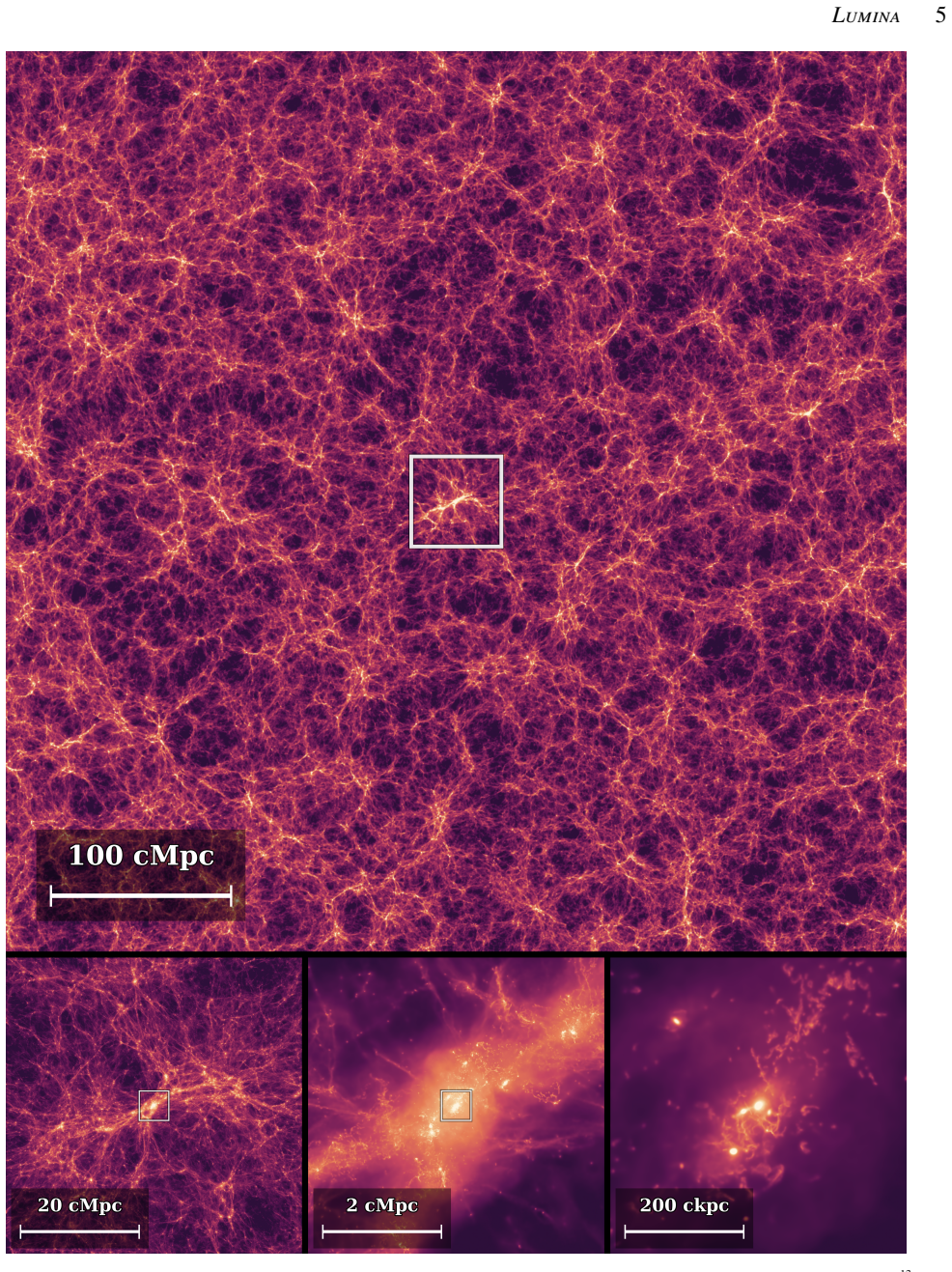
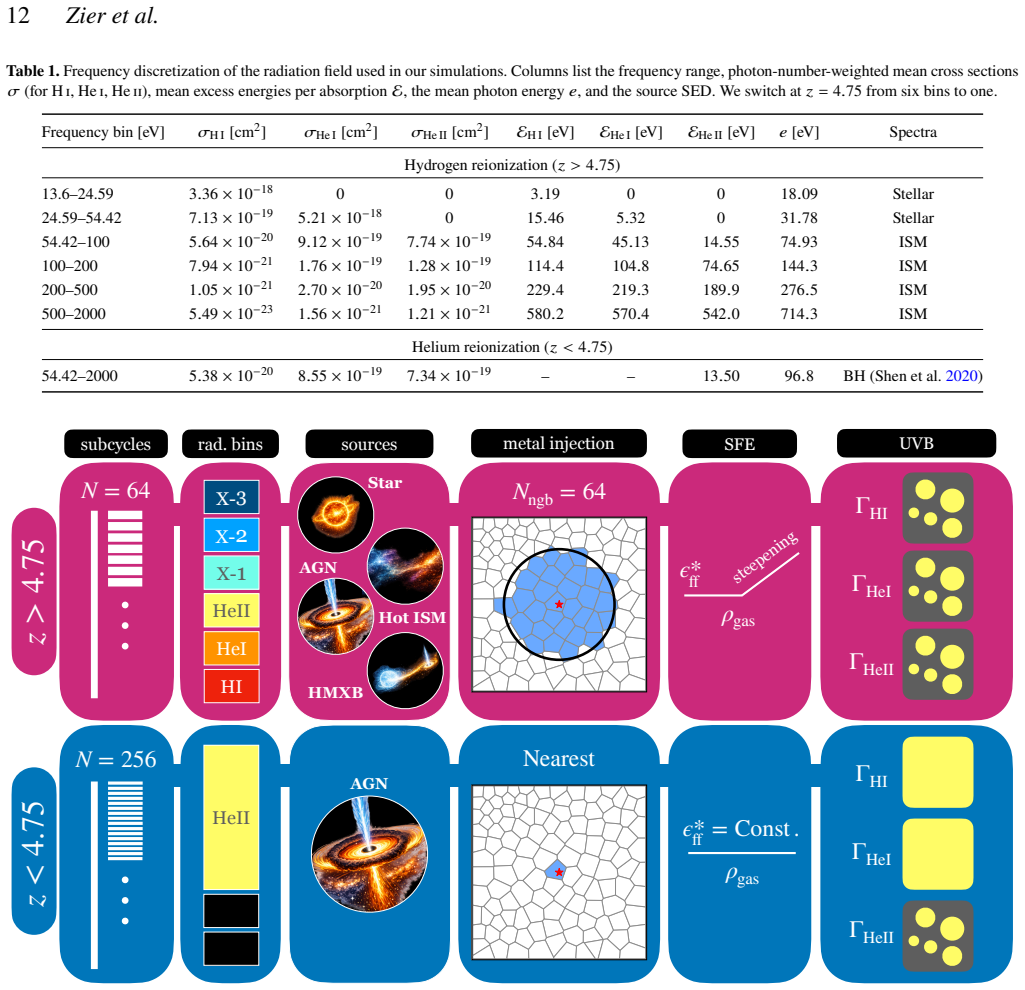
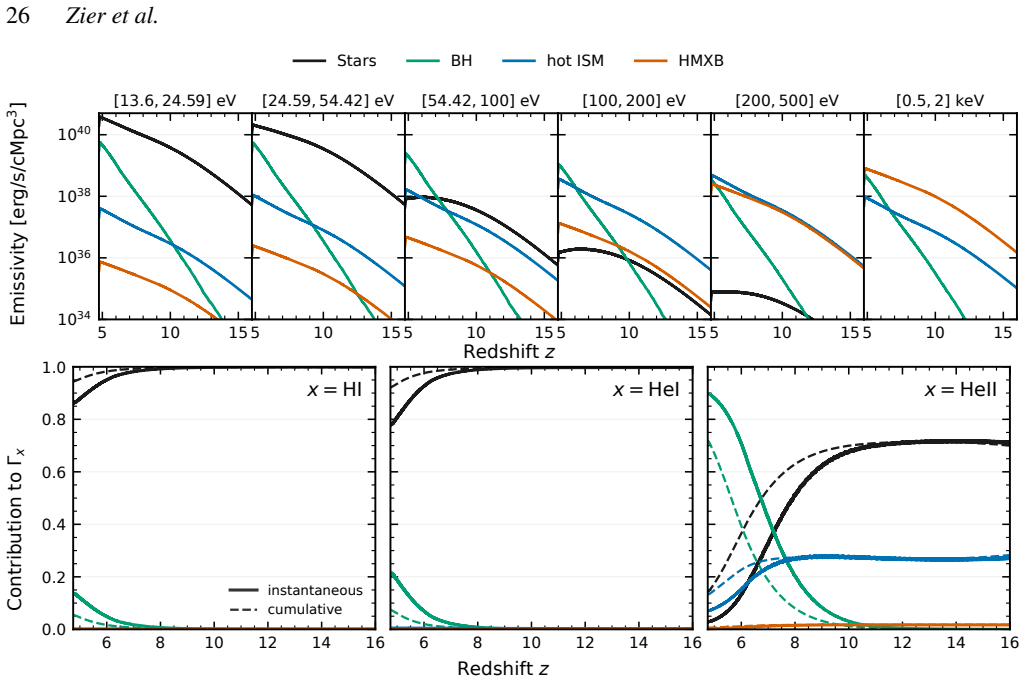
Lumina evolves a 500 cMpc comoving volume with 2 times 6000 cubed resolution elements using the AREPO moving-mesh code, the IllustrisTNG galaxy-formation model, and a GPU-accelerated six-bin M1 radiation-transport solver. It predicts a late, predominantly stellar-driven hydrogen reionization with the median sub-volume fully ionized by z approximately 5.2 and residual neutral HI patches persisting until z approximately 4.75. HeII reionization is driven self-consistently by AGN and is nearly complete by z=3, producing a Thomson-scattering optical depth in excellent agreement with Planck, an IGM thermal history and photoionization background broadly consistent with constraints, and a clear late
What carries the argument
The 500 cMpc moving-mesh AREPO simulation that couples the IllustrisTNG galaxy-formation model to a six-bin M1 radiation-transport solver to evolve HI, HeI, and HeII ionization states together with galaxies and AGN.
If this is right
- The simulation produces a Thomson-scattering optical depth that matches Planck observations.
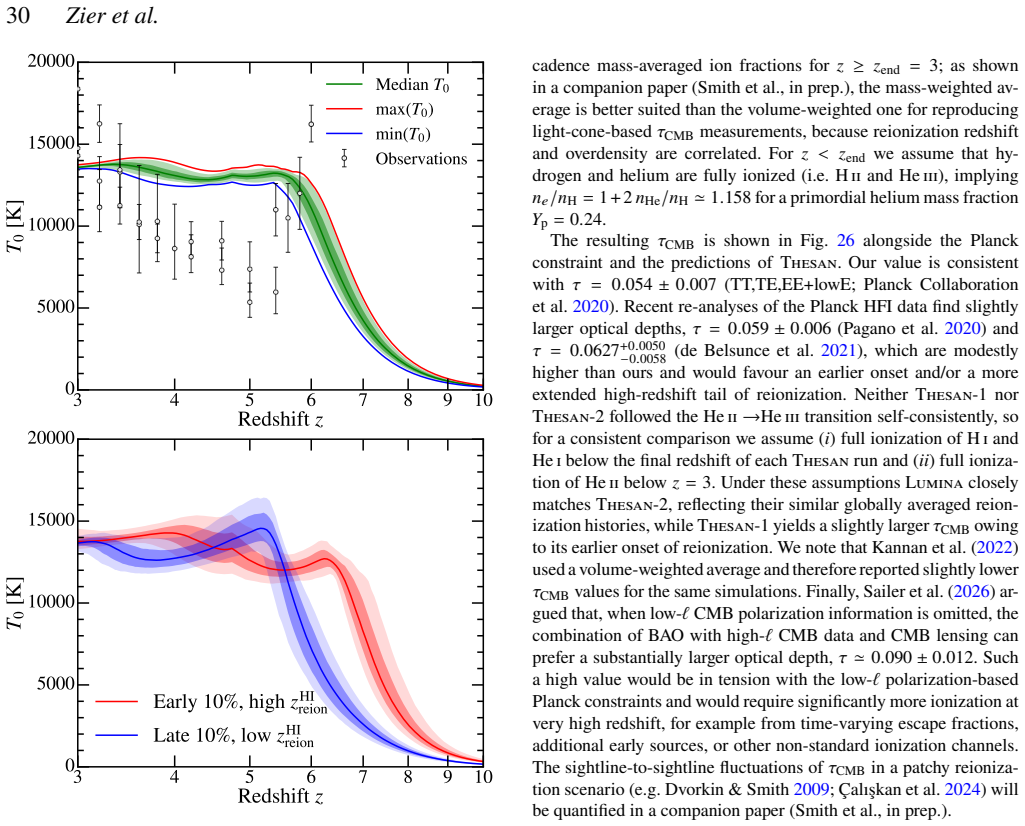
- A clear thermal boost appears in the IGM temperature during HeII reionization near z=3.
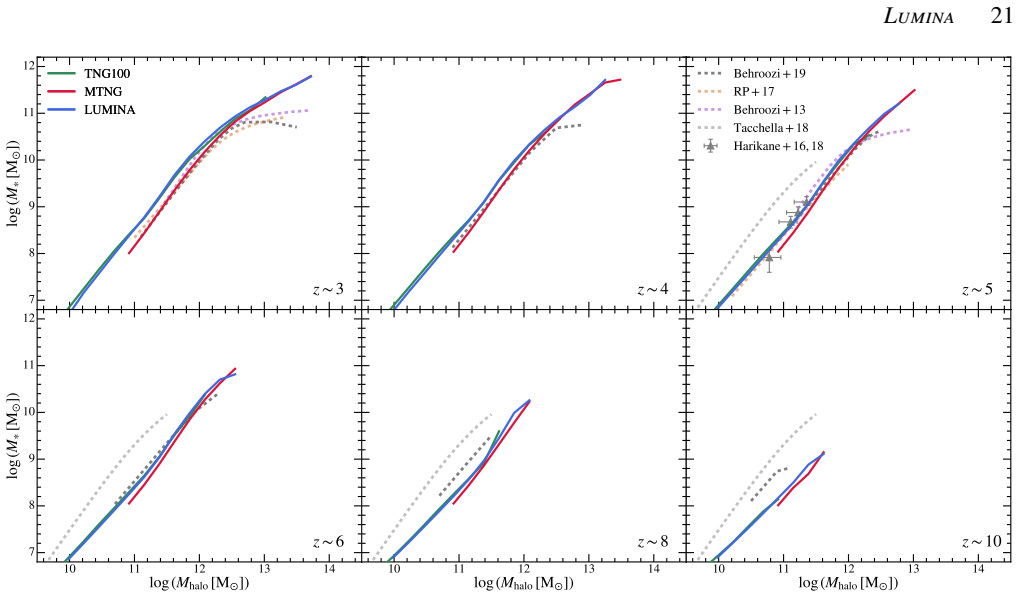
- The galaxy population remains consistent with the original IllustrisTNG project while providing better statistics for rare objects and cosmic variance.
- Forward modeling of observables that link HI and HeII ionization topologies to evolving galaxy and AGN populations becomes possible.
Where Pith is reading between the lines
- If the photon escape fractions are correctly predicted without extra tuning, then reionization observations could directly constrain the feedback prescriptions inside the IllustrisTNG model.
- The 500 cMpc volume makes it feasible to quantify how large-scale environment affects the timing of reionization patches, an effect that smaller boxes cannot capture reliably.
- Outputs from the run could be used to predict the 21-cm brightness temperature field or the Lyman-alpha transmission during the final stages of reionization for comparison with upcoming radio and optical surveys.
Load-bearing premise
The IllustrisTNG galaxy-formation model, when coupled to the six-bin M1 radiation transport solver, accurately captures the escape of ionizing photons from galaxies and AGN without requiring additional tuning beyond the original TNG calibration.
What would settle it
A measurement of the volume-averaged neutral hydrogen fraction at z=4.8 that shows either full ionization or significantly more neutral gas than the simulation's residual patches would contradict the predicted reionization timeline.
Figures










read the original abstract
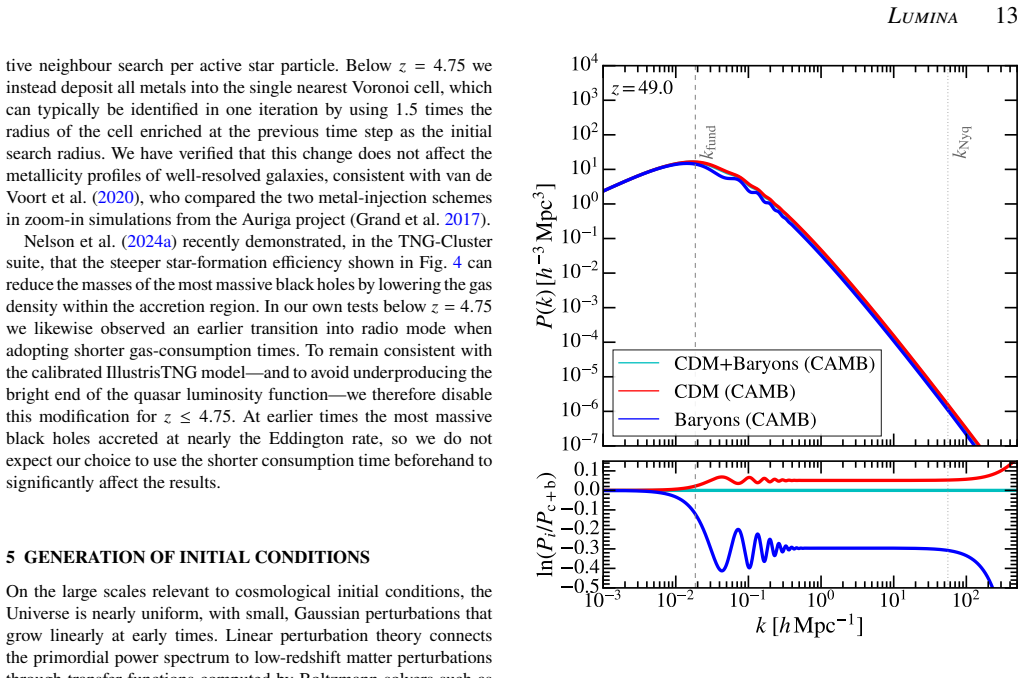
Understanding how galaxies and active galactic nuclei (AGN) jointly drive the reionization of the intergalactic medium (IGM) across cosmic time remains a major challenge in cosmology. We present Lumina, a large-volume radiation-hydrodynamic simulation that self-consistently follows the coupled evolution of the intergalactic medium, galaxies, and AGN through HI, HeI, and HeII reionization down to redshift $z=3$. Lumina evolves a cosmological volume of comoving side length $L_{\mathrm{box}}=500\,\mathrm{cMpc}$ with $2\times 6000^{3}$ resolution elements, corresponding to baryonic and dark-matter mass resolutions of $3.6\times 10^{6}\,\text{M}_{\odot}$ and $1.9\times 10^{7}\,\text{M}_{\odot}$, respectively. The simulation uses the moving-mesh code AREPO, combining the IllustrisTNG galaxy-formation model with a GPU-accelerated M1 radiation-transport solver in six frequency bins. The initial conditions employ separate transfer functions for baryons and dark matter and include their relative streaming velocity. Lumina predicts a late, predominantly stellar-driven hydrogen reionization, with the median sub-volume fully ionized by $z\approx 5.2$ and residual neutral HI patches persisting until $z\approx 4.75$. HeII reionization is driven self-consistently by AGN and is nearly complete by $z=3$. The simulation yields a Thomson-scattering optical depth in excellent agreement with Planck, an IGM thermal history and photoionization background broadly consistent with observational constraints, and a clear late-time thermal boost associated with HeII reionization. Its galaxy population remains consistent with the original IllustrisTNG project, while the larger volume improves statistics for rare objects, large-scale environments, and cosmic variance, enabling forward modelling of observables linking HI and HeII topologies to the evolving galaxy and AGN populations.
Editorial analysis
A structured set of objections, weighed in public.
Referee Report
Summary. The manuscript introduces the Lumina simulation: a 500 cMpc comoving volume radiation-hydrodynamic run with AREPO that couples the IllustrisTNG galaxy-formation model to a GPU-accelerated six-bin M1 radiation-transport solver. It evolves galaxies, AGN, and the IGM self-consistently through HI, HeI, and HeII reionization to z=3, reporting a late, predominantly stellar-driven hydrogen reionization (median sub-volume ionized by z≈5.2, residual neutral patches to z≈4.75) with AGN-driven HeII reionization nearly complete by z=3. The run yields Thomson optical depth in agreement with Planck, an IGM thermal history and photoionization background consistent with observations, and a late-time thermal boost from HeII reionization, while preserving consistency with the original IllustrisTNG galaxy population.
Significance. If the reionization timelines hold, the work supplies a valuable large-volume, self-consistent platform for forward-modeling observables that link HI/HeII topologies to evolving galaxy and AGN populations, with improved statistics for rare objects and cosmic variance relative to smaller-box simulations. The self-consistent AGN treatment for HeII reionization and the reported thermal boost constitute clear strengths; the Planck τ agreement provides a useful integrated check.
major comments (2)
- [Simulation setup and galaxy-formation model coupling] The central claim of a late, stellar-driven hydrogen reionization midpoint at z≈5.2 rests on the effective escape fraction of ionizing photons produced by the untuned IllustrisTNG ISM+feedback model at baryonic mass resolution 3.6×10^6 M⊙. Galaxies ≲10^8 M⊙, which dominate the high-z photon budget, are only marginally resolved; their ISM porosity and outflows (hence f_esc) are therefore set by numerical rather than physical scales. No convergence tests or resolution-variation runs are presented to quantify how a factor-of-two shift in emergent f_esc would move the reionization midpoint. This directly affects the headline timeline prediction.
- [Results on reionization timelines and observational comparisons] Consistency with Planck τ and broad IGM thermal-history constraints is reported, yet these are integrated quantities that can be satisfied by compensating errors between source strength and IGM clumping. The manuscript does not supply quantitative error bars on the neutral-fraction evolution, direct comparisons to Lyman-α forest transmission statistics, or sensitivity tests that would demonstrate the timeline is robust rather than tuned by the integrated observables.
minor comments (2)
- [Abstract] The abstract states 'excellent agreement with Planck' without quoting the simulated τ value or the precise observational constraint used; the main text should provide this numerical comparison.
- [Methods] Notation for the six frequency bins and the precise frequency boundaries of the M1 solver should be defined explicitly in the methods section for reproducibility.
Simulated Author's Rebuttal
We thank the referee for their thoughtful and constructive review of our manuscript on the Lumina simulation. We address each major comment point by point below, indicating where revisions will be made to strengthen the presentation.
read point-by-point responses
-
Referee: [Simulation setup and galaxy-formation model coupling] The central claim of a late, stellar-driven hydrogen reionization midpoint at z≈5.2 rests on the effective escape fraction of ionizing photons produced by the untuned IllustrisTNG ISM+feedback model at baryonic mass resolution 3.6×10^6 M⊙. Galaxies ≲10^8 M⊙, which dominate the high-z photon budget, are only marginally resolved; their ISM porosity and outflows (hence f_esc) are therefore set by numerical rather than physical scales. No convergence tests or resolution-variation runs are presented to quantify how a factor-of-two shift in emergent f_esc would move the reionization midpoint. This directly affects the headline timeline prediction.
Authors: We agree that galaxies below ~10^8 M⊙ are only marginally resolved at the adopted baryonic mass resolution and that the emergent f_esc is influenced by numerical scales in the ISM and feedback modeling. The IllustrisTNG galaxy-formation model was calibrated to reproduce a range of galaxy observables, but we acknowledge that dedicated resolution-variation runs for the full 500 cMpc volume are computationally prohibitive. In the revised manuscript we will add a dedicated subsection in the methods and discussion sections that (i) quantifies the mass resolution relative to the characteristic galaxy mass at z>6, (ii) cites existing convergence studies of f_esc within the TNG framework at higher resolution, and (iii) estimates the plausible range of reionization midpoint shifts under a factor-of-two variation in effective f_esc while preserving consistency with the stellar mass function. This will make the limitations and robustness of the timeline prediction more transparent. revision: yes
-
Referee: [Results on reionization timelines and observational comparisons] Consistency with Planck τ and broad IGM thermal-history constraints is reported, yet these are integrated quantities that can be satisfied by compensating errors between source strength and IGM clumping. The manuscript does not supply quantitative error bars on the neutral-fraction evolution, direct comparisons to Lyman-α forest transmission statistics, or sensitivity tests that would demonstrate the timeline is robust rather than tuned by the integrated observables.
Authors: We note that the galaxy and AGN source models are taken directly from the calibrated IllustrisTNG framework without additional tuning to reionization observables; the reionization history therefore emerges self-consistently. The manuscript already reports the neutral-fraction evolution using the median and range across sub-volumes, which captures cosmic variance. In the revision we will (i) add explicit 16–84 percentile error bands derived from the sub-volume analysis to the neutral-fraction figure, (ii) include a direct comparison of the simulated Lyman-α forest transmission statistics (effective optical depth and transmission spikes) against observational compilations at z≈5–6, and (iii) expand the discussion of robustness by showing that the same source model reproduces the original TNG galaxy population at lower redshifts. These additions will address the concern about compensating errors and provide a more quantitative validation of the timeline. revision: yes
Circularity Check
No significant circularity; reionization timelines are emergent simulation outputs
full rationale
The paper describes a forward radiation-hydrodynamic simulation (Lumina) that evolves a 500 cMpc volume from initial conditions using the pre-existing IllustrisTNG galaxy-formation model coupled to a six-bin M1 solver. The headline results—median sub-volume HI ionization by z≈5.2, residual neutral patches to z≈4.75, and AGN-driven HeII reionization by z=3—are direct numerical outcomes of integrating the coupled equations, not obtained by fitting any parameters to reionization observables inside this work. The TNG sub-grid model was calibrated in prior independent studies to z≈0 stellar mass function and SFR data; no reionization-specific retuning of escape fractions or efficiencies occurs here. Self-citations to TNG papers exist but are not load-bearing for the timing claims, as the simulation supplies new, externally falsifiable forward predictions at the stated resolution. No self-definitional, fitted-input-renamed-as-prediction, or ansatz-smuggled steps appear in the derivation chain.
Axiom & Free-Parameter Ledger
free parameters (2)
- six frequency bins for radiation
- baryonic mass resolution 3.6e6 Msun
axioms (2)
- standard math Standard Lambda-CDM initial conditions with separate baryon and dark-matter transfer functions plus relative streaming velocity
- domain assumption IllustrisTNG galaxy formation model accurately describes star formation and AGN feedback in the presence of radiation
Lean theorems connected to this paper
-
IndisputableMonolith/Foundation/RealityFromDistinction.leanreality_from_one_distinction unclear?
unclearRelation between the paper passage and the cited Recognition theorem.
Lumina evolves a cosmological volume... combining the IllustrisTNG galaxy-formation model with a GPU-accelerated M1 radiation-transport solver in six frequency bins.
What do these tags mean?
- matches
- The paper's claim is directly supported by a theorem in the formal canon.
- supports
- The theorem supports part of the paper's argument, but the paper may add assumptions or extra steps.
- extends
- The paper goes beyond the formal theorem; the theorem is a base layer rather than the whole result.
- uses
- The paper appears to rely on the theorem as machinery.
- contradicts
- The paper's claim conflicts with a theorem or certificate in the canon.
- unclear
- Pith found a possible connection, but the passage is too broad, indirect, or ambiguous to say the theorem truly supports the claim.
Reference graph
Works this paper leans on
-
[1]
The diverse star formation histories of early massive, quenched galaxies in modern galaxy formation simulations. , keywords =. doi:10.1093/mnras/stae2626 , archivePrefix =. 2409.16916 , primaryClass =
-
[2]
The Formation Histories of Massive and Quiescent Galaxies in the 3 < z < 4.5 Universe. , keywords =. doi:10.3847/1538-4357/ada6ac , archivePrefix =. 2410.02076 , primaryClass =
-
[3]
On the stunning abundance of super-early, luminous galaxies revealed by JWST. , keywords =. doi:10.1093/mnras/stad1095 , archivePrefix =. 2208.00720 , primaryClass =
-
[4]
MEOW: The increase in the obscured AGN fraction in mid-infrared from 0 < z < 6 with JWST MIRI. arXiv e-prints , keywords =. doi:10.48550/arXiv.2603.22393 , archivePrefix =. 2603.22393 , primaryClass =
-
[5]
Efficient formation of a massive quiescent galaxy at redshift 4.9. Nature Astronomy , keywords =. doi:10.1038/s41550-024-02424-3 , archivePrefix =. 2404.05683 , primaryClass =
-
[6]
A Census of Photometrically Selected Little Red Dots at 4 < z < 9 in JWST Blank Fields. , keywords =. doi:10.3847/1538-4357/ad4265 , archivePrefix =. 2401.09981 , primaryClass =
-
[7]
What You See Is What You Get: Empirically Measured Bolometric Luminosities of Little Red Dots. , keywords =. doi:10.3847/1538-4357/ae1836 , archivePrefix =. 2509.05434 , primaryClass =
-
[8]
Unveiling the Cosmic Chemistry: Revisiting the Mass─Metallicity Relation with JWST/NIRSpec at 4 < z < 10. , keywords =. doi:10.3847/1538-4357/ad8f32 , archivePrefix =. 2408.07974 , primaryClass =
-
[9]
JADES: Insights into the low-mass end of the mass-metallicity-SFR relation at 3 < z < 10 from deep JWST/NIRSpec spectroscopy. , keywords =. doi:10.1051/0004-6361/202346698 , archivePrefix =. 2304.08516 , primaryClass =
-
[10]
JWST Census for the Mass-Metallicity Star Formation Relations at z = 4-10 with Self-consistent Flux Calibration and Proper Metallicity Calibrators. , keywords =. doi:10.3847/1538-4365/acd556 , archivePrefix =. 2301.12825 , primaryClass =
-
[11]
The chemical make-up of the Sun: A 2020 vision
The chemical make-up of the Sun: A 2020 vision. , keywords =. doi:10.1051/0004-6361/202140445 , archivePrefix =. 2105.01661 , primaryClass =
work page internal anchor Pith review Pith/arXiv arXiv doi:10.1051/0004-6361/202140445 2020
-
[12]
The MOSDEF Survey: The Evolution of the Mass-Metallicity Relation from z = 0 to z 3.3. , keywords =. doi:10.3847/1538-4357/abf4c1 , archivePrefix =. 2009.07292 , primaryClass =
-
[13]
Evolution of Stellar-to-Halo Mass Ratio at z = 0 - 7 Identified by Clustering Analysis with the Hubble Legacy Imaging and Early Subaru/Hyper Suprime-Cam Survey Data. , keywords =. doi:10.3847/0004-637X/821/2/123 , archivePrefix =. 1511.07873 , primaryClass =
work page internal anchor Pith review Pith/arXiv arXiv doi:10.3847/0004-637x/821/2/123
-
[14]
COSMOS-Web: Stellar mass assembly in relation to dark matter halos across 0.2 < z < 12 of cosmic history. , keywords =. doi:10.1051/0004-6361/202452570 , archivePrefix =. 2410.08290 , primaryClass =
-
[15]
The evolving slope of the stellar mass function at 0.6 <= z < 4.5 from deep WFC3 data
The evolving slope of the stellar mass function at 0.6 z < 4.5 from deep WFC3 data. , keywords =. doi:10.1051/0004-6361/201117513 , archivePrefix =. 1111.5728 , primaryClass =
work page internal anchor Pith review Pith/arXiv arXiv doi:10.1051/0004-6361/201117513
-
[16]
JWST/MIRI reveals the true number density of massive galaxies in the early Universe. arXiv e-prints , keywords =. doi:10.48550/arXiv.2403.02399 , archivePrefix =. 2403.02399 , primaryClass =
-
[17]
Galaxy Stellar Mass Functions from z 10 to z 6 using the Deepest Spitzer/Infrared Array Camera Data: No Significant Evolution in the Stellar-to-halo Mass Ratio of Galaxies in the First Gigayear of Cosmic Time. , keywords =. doi:10.3847/1538-4357/ac1bb6 , archivePrefix =. 2103.16571 , primaryClass =
-
[18]
The COSMOS2015 galaxy stellar mass function . Thirteen billion years of stellar mass assembly in ten snapshots. , keywords =. doi:10.1051/0004-6361/201730419 , archivePrefix =. 1701.02734 , primaryClass =
work page internal anchor Pith review Pith/arXiv arXiv doi:10.1051/0004-6361/201730419
-
[19]
The Evolution of the Galaxy Stellar Mass Function at z = 4-8: A Steepening Low-mass-end Slope with Increasing Redshift. , keywords =. doi:10.3847/0004-637X/825/1/5 , archivePrefix =. 1507.05636 , primaryClass =
work page internal anchor Pith review Pith/arXiv arXiv doi:10.3847/0004-637x/825/1/5
-
[20]
Mass assembly in quiescent and star-forming galaxies since z=4 from UltraVISTA
Mass assembly in quiescent and star-forming galaxies since z ≃ 4 from UltraVISTA. , keywords =. doi:10.1051/0004-6361/201321100 , archivePrefix =. 1301.3157 , primaryClass =
work page internal anchor Pith review Pith/arXiv arXiv doi:10.1051/0004-6361/201321100
-
[21]
The main sequence of star-forming galaxies across cosmic times. , keywords =. doi:10.1093/mnras/stac3214 , archivePrefix =. 2203.10487 , primaryClass =
-
[22]
Bursting at the seams: the star-forming main sequence and its scatter at z = 3─9 using NIRCam photometry from JADES. , keywords =. doi:10.1093/mnras/staf1950 , archivePrefix =. 2508.04410 , primaryClass =
-
[23]
A Highly Consistent Framework for the Evolution of the Star-Forming "Main Sequence" from z~0-6
A Highly Consistent Framework for the Evolution of the Star-Forming ``Main Sequence'' from z -0.5ex 0-6. , keywords =. doi:10.1088/0067-0049/214/2/15 , archivePrefix =. 1405.2041 , primaryClass =
work page internal anchor Pith review Pith/arXiv arXiv doi:10.1088/0067-0049/214/2/15 2041
-
[24]
Probing the star formation main sequence down to 10 ^ 7 M _ at 1 < z < 9. , keywords =. doi:10.1051/0004-6361/202557448 , archivePrefix =. 2509.22871 , primaryClass =
-
[25]
The Star-forming Main Sequence and Bursty Star-formation Histories at z>1.4 in JADES and AURORA. arXiv e-prints , keywords =. doi:10.48550/arXiv.2510.06681 , archivePrefix =. 2510.06681 , primaryClass =
-
[26]
The X-Ray-to-Optical Properties of Optically Selected Active Galaxies over Wide Luminosity and Redshift Ranges. , keywords =. doi:10.1086/503627 , archivePrefix =. astro-ph/0602407 , primaryClass =
work page internal anchor Pith review Pith/arXiv arXiv doi:10.1086/503627
-
[27]
The X-ray to optical-UV luminosity ratio of X-ray selected Type 1 AGN in XMM-COSMOS
The X-ray to optical-UV luminosity ratio of X-ray selected type 1 AGN in XMM-COSMOS. , keywords =. doi:10.1051/0004-6361/200913298 , archivePrefix =. 0912.4166 , primaryClass =
work page internal anchor Pith review Pith/arXiv arXiv doi:10.1051/0004-6361/200913298
-
[28]
Mean Spectral Energy Distributions and Bolometric Corrections for Luminous Quasars
Mean Spectral Energy Distributions and Bolometric Corrections for Luminous Quasars. , keywords =. doi:10.1088/0067-0049/206/1/4 , archivePrefix =. 1304.5573 , primaryClass =
work page internal anchor Pith review Pith/arXiv arXiv doi:10.1088/0067-0049/206/1/4
-
[29]
On the evolution of the HI column density distribution in cosmological simulations
On the evolution of the H I column density distribution in cosmological simulations. , keywords =. doi:10.1093/mnras/stt066 , archivePrefix =. 1210.7808 , primaryClass =
work page internal anchor Pith review Pith/arXiv arXiv doi:10.1093/mnras/stt066
-
[30]
A New Calculation of the Ionizing Background Spectrum and the Effects of HeII Reionization
A New Calculation of the Ionizing Background Spectrum and the Effects of He II Reionization. , keywords =. doi:10.1088/0004-637X/703/2/1416 , archivePrefix =. 0901.4554 , primaryClass =
work page internal anchor Pith review Pith/arXiv arXiv doi:10.1088/0004-637x/703/2/1416
-
[31]
Simulating cosmic structure formation with the GADGET-4 code. , keywords =. doi:10.1093/mnras/stab1855 , archivePrefix =. 2010.03567 , primaryClass =
-
[32]
Formation and fate of low-metallicity stars in TNG50. , keywords =. doi:10.1093/mnras/stac717 , archivePrefix =. 2203.07383 , primaryClass =
-
[33]
Populating a cluster of galaxies - I. Results at z=0. , keywords =. doi:10.1046/j.1365-8711.2001.04912.x , archivePrefix =. astro-ph/0012055 , primaryClass =
-
[34]
Chemical enrichment in cosmological, smoothed particle hydrodynamics simulations. , keywords =. doi:10.1111/j.1365-2966.2009.15331.x , archivePrefix =. 0902.1535 , primaryClass =
-
[35]
The Luminosity Function and Stellar Evolution. , year = 1955, month = jan, volume =. doi:10.1086/145971 , adsurl =
-
[36]
The Initial Mass Function of Stars: Evidence for Uniformity in Variable Systems
The Initial Mass Function of Stars: Evidence for Uniformity in Variable Systems. Science , keywords =. doi:10.1126/science.1067524 , archivePrefix =. astro-ph/0201098 , primaryClass =
work page internal anchor Pith review Pith/arXiv arXiv doi:10.1126/science.1067524
-
[37]
Galactic Stellar and Substellar Initial Mass Function
Galactic Stellar and Substellar Initial Mass Function. , keywords =. doi:10.1086/376392 , archivePrefix =. astro-ph/0304382 , primaryClass =
work page internal anchor Pith review Pith/arXiv arXiv doi:10.1086/376392
-
[38]
Protostellar Collapse with Various Metallicities
Protostellar Collapse with Various Metallicities. , keywords =. doi:10.1086/308776 , archivePrefix =. astro-ph/0003212 , primaryClass =
work page internal anchor Pith review Pith/arXiv arXiv doi:10.1086/308776
-
[39]
The fragmentation of pre-enriched primordial objects. , keywords =. doi:10.1046/j.1365-8711.2001.04915.x , archivePrefix =. astro-ph/0104271 , primaryClass =
-
[40]
, archivePrefix = "arXiv", eprint =
The transition from population III to population II-I star formation. , keywords =. doi:10.1111/j.1365-2966.2010.17003.x , archivePrefix =. 1003.4992 , primaryClass =
-
[41]
A solar-metallicity and dusty DLA at z _ abs = 2.58
The interplay between chemical and mechanical feedback from the first generation of stars. , keywords =. doi:10.1111/j.1365-2966.2011.18455.x , archivePrefix =. 1011.3999 , primaryClass =
-
[42]
First stars, very massive black holes and metals
First Stars, Very Massive Black Holes, and Metals. , keywords =. doi:10.1086/339917 , archivePrefix =. astro-ph/0111341 , primaryClass =
work page internal anchor Pith review Pith/arXiv arXiv doi:10.1086/339917
-
[43]
Constraints on the initial mass function of the first stars. , keywords =. doi:10.1111/j.1365-2966.2006.10331.x , archivePrefix =. astro-ph/0510685 , primaryClass =
-
[44]
A solar-metallicity and dusty DLA at z _ abs = 2.58
The first low-mass stars: critical metallicity or dust-to-gas ratio?. , keywords =. doi:10.1111/j.1365-2966.2011.19818.x , archivePrefix =. 1109.2900 , primaryClass =
-
[45]
The formation of the extremely primitive star SDSS J102915+172927 relies on dust. , keywords =. doi:10.1111/j.1745-3933.2012.01257.x , archivePrefix =. 1203.4234 , primaryClass =
-
[46]
Thermal and Fragmentation Properties of Star-forming Clouds in Low-metallicity Environments
Thermal and Fragmentation Properties of Star-forming Clouds in Low-Metallicity Environments. , keywords =. doi:10.1086/429955 , archivePrefix =. astro-ph/0503010 , primaryClass =
work page internal anchor Pith review Pith/arXiv arXiv doi:10.1086/429955
-
[47]
Dust grain growth and the formation of the extremely primitive star SDSS J102915+172927
Dust grain growth and the formation of the extremely primitive star SDSS J102915+172927. , keywords =. doi:10.1093/mnras/stu178 , archivePrefix =. 1401.5057 , primaryClass =
work page internal anchor Pith review Pith/arXiv arXiv doi:10.1093/mnras/stu178
-
[48]
Transition of the initial mass function in the metal-poor environments. , keywords =. doi:10.1093/mnras/stab2497 , archivePrefix =. 2103.04997 , primaryClass =
-
[49]
Impact of the cosmic background radiation on the initial mass function of metal-poor stars. , keywords =. doi:10.1093/mnras/stac1549 , archivePrefix =. 2205.15328 , primaryClass =
-
[50]
Disc fragmentation and oligarchic growth of protostellar systems in low-metallicity gas clouds. , keywords =. doi:10.1093/mnras/stab2799 , archivePrefix =. 2008.06107 , primaryClass =
-
[51]
Stellar Yields of Rotating First Stars. II. Pair-instability Supernovae and Comparison with Observations. , keywords =. doi:10.3847/1538-4357/aab95f , archivePrefix =. 1803.06630 , primaryClass =
work page internal anchor Pith review Pith/arXiv arXiv doi:10.3847/1538-4357/aab95f
-
[52]
The First Stars: Formation, Properties, and Impact. , keywords =. doi:10.1146/annurev-astro-071221-053453 , archivePrefix =. 2303.12500 , primaryClass =
-
[53]
First results from the IllustrisTNG simulations: the stellar mass content of groups and clusters of galaxies. , keywords =. doi:10.1093/mnras/stx3112 , archivePrefix =. 1707.03406 , primaryClass =
work page internal anchor Pith review Pith/arXiv arXiv doi:10.1093/mnras/stx3112
-
[54]
Simulating Galaxy Formation with the IllustrisTNG Model
Simulating galaxy formation with the IllustrisTNG model. , keywords =. doi:10.1093/mnras/stx2656 , archivePrefix =. 1703.02970 , primaryClass =
work page internal anchor Pith review Pith/arXiv arXiv doi:10.1093/mnras/stx2656
-
[55]
First results from the TNG50 simulation: galactic outflows driven by supernovae and black hole feedback. , keywords =. doi:10.1093/mnras/stz2306 , archivePrefix =. 1902.05554 , primaryClass =
work page internal anchor Pith review Pith/arXiv arXiv doi:10.1093/mnras/stz2306 1902
-
[56]
Introducing the THESAN project: radiation-magnetohydrodynamic simulations of the epoch of reionization. , keywords =. doi:10.1093/mnras/stab3710 , archivePrefix =. 2110.00584 , primaryClass =
-
[57]
The THESAN project: properties of the intergalactic medium and its connection to reionization-era galaxies. , keywords =. doi:10.1093/mnras/stac257 , archivePrefix =. 2110.01628 , primaryClass =
-
[58]
The THESAN project: Lyman- emission and transmission during the Epoch of Reionization. , keywords =. doi:10.1093/mnras/stac713 , archivePrefix =. 2110.02966 , primaryClass =
-
[59]
Cooling Functions for Low-Density Astrophysical Plasmas. , keywords =. doi:10.1086/191823 , adsurl =
-
[60]
Public Release of A-SLOTH: Ancient Stars and Local Observables by Tracing Halos. , keywords =. doi:10.3847/1538-4357/ac7150 , archivePrefix =. 2206.00223 , primaryClass =
-
[61]
The numerical frontier of the high-redshift Universe
The numerical frontier of the high-redshift Universe. Computational Astrophysics and Cosmology , keywords =. doi:10.1186/s40668-014-0006-2 , archivePrefix =. 1410.3482 , primaryClass =
work page internal anchor Pith review Pith/arXiv arXiv doi:10.1186/s40668-014-0006-2
-
[62]
Formation of Population III stars in fossil HII regions: significance of HD. , keywords =. doi:10.1111/j.1365-2966.2005.09685.x , archivePrefix =. astro-ph/0505599 , primaryClass =
-
[63]
Simulations on a Moving Mesh: The Clustered Formation of Population III Protostars
Simulations on a Moving Mesh: The Clustered Formation of Population III Protostars. , keywords =. doi:10.1088/0004-637X/737/2/75 , archivePrefix =. 1101.5491 , primaryClass =
work page internal anchor Pith review Pith/arXiv arXiv doi:10.1088/0004-637x/737/2/75
-
[64]
The Formation and Fragmentation of Disks around Primordial Protostars
The Formation and Fragmentation of Disks Around Primordial Protostars. Science , keywords =. doi:10.1126/science.1198027 , archivePrefix =. 1101.5284 , primaryClass =
work page internal anchor Pith review Pith/arXiv arXiv doi:10.1126/science.1198027
-
[65]
, archivePrefix = "arXiv", eprint =
Formation and evolution of primordial protostellar systems. , keywords =. doi:10.1111/j.1365-2966.2012.21212.x , adsurl =
-
[66]
Fragmentation-induced starvation in Population III star formation: a resolution study. , keywords =. doi:10.1093/mnras/stab3697 , archivePrefix =. 2112.10800 , primaryClass =
-
[67]
Trapping of H II regions in Population III star formation. , keywords =. doi:10.1093/mnras/stac487 , archivePrefix =. 2202.09803 , primaryClass =
-
[68]
Merge or survive: Number of Population III stars per minihalo
Merge or Survive: Number of Population III Stars per Minihalo. , keywords =. doi:10.3847/1538-4357/ab1b6f , archivePrefix =. 1904.09731 , primaryClass =
work page internal anchor Pith review Pith/arXiv arXiv doi:10.3847/1538-4357/ab1b6f 1904
-
[69]
Constraining the Statistics of Population III Binaries
Constraining the statistics of Population III binaries. , keywords =. doi:10.1093/mnras/stt789 , archivePrefix =. 1211.1889 , primaryClass =
work page internal anchor Pith review Pith/arXiv arXiv doi:10.1093/mnras/stt789
-
[70]
The Formation of Population III Binaries from Cosmological Initial Conditions
The Formation of Population III Binaries from Cosmological Initial Conditions. Science , keywords =. doi:10.1126/science.1173540 , archivePrefix =. 0907.2919 , primaryClass =
work page internal anchor Pith review Pith/arXiv arXiv doi:10.1126/science.1173540
-
[71]
The first stars: formation of binaries and small multiple systems. , keywords =. doi:10.1111/j.1365-2966.2009.16113.x , archivePrefix =. 0908.0712 , primaryClass =
-
[72]
Physical Processes in the Interstellar Medium
Physical Processes in the Interstellar Medium. Saas-Fee Advanced Course , keywords =. doi:10.1007/978-3-662-47890-5_2 , archivePrefix =. 1412.5182 , primaryClass =
work page internal anchor Pith review Pith/arXiv arXiv doi:10.1007/978-3-662-47890-5_2
-
[73]
Cradles of the first stars: self-shielding, halo masses, and multiplicity. , keywords =. doi:10.1093/mnras/staa139 , archivePrefix =. 2001.04480 , primaryClass =
-
[74]
Following the Cosmic Evolution of Pristine Gas. II. The Search for Pop III-bright Galaxies. , keywords =. doi:10.3847/1538-4357/aa989a , archivePrefix =. 1710.09878 , primaryClass =
work page internal anchor Pith review Pith/arXiv arXiv doi:10.3847/1538-4357/aa989a
-
[75]
The Effects of Radiative Feedback and Supernova-induced Turbulence on Early Galaxies. , keywords =. doi:10.3847/1538-4357/ac815c , archivePrefix =. 2207.07161 , primaryClass =
-
[76]
Population III star-forming environments
A needle in a haystack? Catching Population III stars in the epoch of reionization: I. Population III star-forming environments. , keywords =. doi:10.1093/mnras/stad1201 , archivePrefix =. 2301.10259 , primaryClass =
-
[77]
Gravitational waves from Population III binary black holes formed by dynamical capture. , keywords =. doi:10.1093/mnras/staa1362 , archivePrefix =. 2003.00065 , primaryClass =
-
[78]
Legacy of star formation in the pre-reionization universe
Legacy of star formation in the pre-reionization universe. , keywords =. doi:10.1093/mnras/stz1529 , archivePrefix =. 1804.07372 , primaryClass =
work page internal anchor Pith review Pith/arXiv arXiv doi:10.1093/mnras/stz1529
-
[79]
THESAN-HR: how does reionization impact early galaxy evolution?. , keywords =. doi:10.1093/mnras/stad2523 , archivePrefix =. 2212.03255 , primaryClass =
-
[80]
THESAN-HR: galaxies in the Epoch of Reionization in warm dark matter, fuzzy dark matter, and interacting dark matter. , keywords =. doi:10.1093/mnras/stad3397 , archivePrefix =. 2304.06742 , primaryClass =
discussion (0)
Sign in with ORCID, Apple, or X to comment. Anyone can read and Pith papers without signing in.