Degradation-Aware Blur-Segmentation of Brain Tumor
Pith reviewed 2026-05-19 19:28 UTC · model grok-4.3
The pith
A joint deblurring and segmentation network maintains high tumor Dice scores in motion-blurred 3D MRI scans.
A machine-rendered reading of the paper's core claim, the machinery that carries it, and where it could break.
Core claim
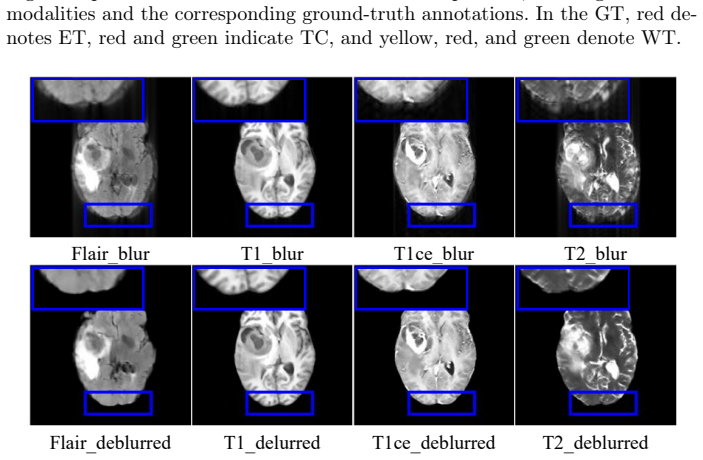
DABSeg unifies motion deblurring and tumor segmentation in multimodal 3D MRI by using a feature-domain motion-deblurring stem to compensate for blur, a blur-aware cross-modal cross-attention module for modality complementarity, and multi-scale residual aggregation; it is trained with a joint loss of weighted Dice plus clear-reference reconstruction that applies higher weight to small targets, and experiments on BraTS2020 under both clear and degenerative conditions show higher tumor Dice scores and boundary precision than prior methods.
What carries the argument
Feature-domain motion-deblurring stem paired with blur-aware cross-modal cross-attention module, which performs simultaneous blur compensation and tumor boundary refinement inside the same network.
If this is right
- Higher tumor Dice scores on both clear and motion-degraded BraTS2020 cases.
- Sharper boundary delineation for small lesions and tumor margins.
- Greater robustness for clinical workflows that rely on multi-modal 3D segmentation.
- Direct applicability to radiotherapy target delineation when scans contain typical motion artifacts.
Where Pith is reading between the lines
- The same joint-training pattern could be tested on other artifact-prone modalities such as CT or PET to see if cross-task learning transfers.
- Collecting paired clear and blurred scans from the same patients would remove reliance on synthetic degradation and give a stricter test of the reconstruction term.
- Adding explicit uncertainty maps from the deblurring branch might further guide the segmentation head on ambiguous border voxels.
Load-bearing premise
Joint optimization of deblurring and segmentation will improve feature quality for small lesions without introducing new artifacts or needing perfectly matched clear images for training.
What would settle it
Running DABSeg on a test collection of real patient-motion-blurred MRI volumes and finding its Dice score or boundary precision no higher than a standard segmentation network trained without the deblurring stem.
Figures




read the original abstract
Multimodal 3D MRI brain tumor segmentation is a pivotal step in radiotherapy target delineation, surgical planning and post-treatment assessment. Existing methods often assume artifact-free MRI images. However, inevitable patient motion during scanning introduces artifacts and blur that degrade boundary and texture features, leading to poor segmentation performance. To bridge this gap, we introduce Degradation-Aware Blur-Segmentation Net (DABSeg), a synchronous deblurring 3D multimodal MRI segmentation network that unifies blur removal and accurate segmentation. Specifically, we propose a feature-domain motion-deblurring stem to compensate for blur and rebalance intensity. Concurrently, the backbone network embeds a blur-aware cross-modal cross-attention module and multi-scale residual aggregation to yield effective modality complementarity. Notably, we optimize a joint loss that combines weighted Dice with a clear-reference reconstruction term, where imbalanced weights are applied to small targets to boost learning intensity and predictive stability for small lesions and border regions. Systematic comparisons and ablation experiments on the BraTS2020 dataset under both clear and degenerative conditions consistently demonstrate that DABSeg surpasses state-of-the-art methods in tumor Dice score and boundary precision. These results validate the effectiveness of degenerative-aware cross-task collaborative learning in improving the robustness and clinical utility of multi-modal 3D brain tumor segmentation under realistic degenerative conditions. The source code is available at https://github.com/YuchunWang24/DABSeg_ICPR
Editorial analysis
A structured set of objections, weighed in public.
Referee Report
Summary. The manuscript introduces the Degradation-Aware Blur-Segmentation Net (DABSeg), a synchronous 3D multimodal MRI network for brain tumor segmentation that jointly performs motion deblurring. Key components include a feature-domain motion-deblurring stem for blur compensation and intensity rebalancing, a blur-aware cross-modal cross-attention module, multi-scale residual aggregation in the backbone, and a joint loss combining weighted Dice loss with a clear-reference reconstruction term that applies imbalanced weights to small targets. Systematic comparisons and ablations on BraTS2020 under clear and artificially degraded conditions report consistent gains in tumor Dice score and boundary precision over state-of-the-art methods, with source code released.
Significance. If the reported gains hold, the work could improve robustness of clinical brain tumor segmentation pipelines where motion blur is common, supporting better radiotherapy planning and post-treatment assessment. The code release at https://github.com/YuchunWang24/DABSeg_ICPR is a clear strength that enables reproducibility and extension of the degradation-aware joint learning approach.
major comments (2)
- [§4 and §3.2] §4 (Experiments) and §3.2 (Degradation simulation): the central claim of improved Dice and boundary precision under degenerative conditions rests on synthetic blur applied to BraTS2020 volumes, yet the manuscript provides insufficient detail on kernel types, 3D motion modeling, or slice-specific artifacts to confirm these match real patient motion; without this, the generalization risk to clinical scans remains untested.
- [§3.3] §3.3 (Joint loss): the reconstruction term requires paired clear-reference images during training, but the paper does not address or test performance when such references are unavailable (as in real unpaired clinical data), which directly bears on whether the blur-aware modules improve rather than degrade small-lesion features.
minor comments (2)
- [Abstract and §3.3] The exact functional form and numerical values of the imbalanced weights for small targets are stated only qualitatively in the abstract and loss section; providing the formula or schedule would aid replication.
- [Figures 4-6] Figure captions and axis labels in the ablation and comparison plots could more explicitly indicate which degradation level (e.g., blur severity) each bar corresponds to.
Simulated Author's Rebuttal
Thank you for the detailed and constructive review of our manuscript. We have carefully addressed each major comment below with revisions to the paper where appropriate, aiming to strengthen the clarity and completeness of our work.
read point-by-point responses
-
Referee: [§4 and §3.2] §4 (Experiments) and §3.2 (Degradation simulation): the central claim of improved Dice and boundary precision under degenerative conditions rests on synthetic blur applied to BraTS2020 volumes, yet the manuscript provides insufficient detail on kernel types, 3D motion modeling, or slice-specific artifacts to confirm these match real patient motion; without this, the generalization risk to clinical scans remains untested.
Authors: We thank the referee for highlighting this issue. In the revised manuscript, we have substantially expanded Section 3.2 to provide explicit details on the degradation simulation: we now specify the use of 3D Gaussian kernels with standard deviations from 1 to 5 voxels for intensity blurring, motion blur kernels derived from random linear trajectories in 3D space to model patient head movement during acquisition, and per-slice application with randomized severity to simulate varying artifact levels across the volume. Regarding generalization, we acknowledge that synthetic degradations, while enabling quantitative and reproducible evaluation on BraTS2020, may not fully capture all characteristics of real clinical motion blur. We have added a dedicated limitations paragraph in the discussion section noting this and outlining plans for future validation on real motion-degraded clinical scans. revision: yes
-
Referee: [§3.3] §3.3 (Joint loss): the reconstruction term requires paired clear-reference images during training, but the paper does not address or test performance when such references are unavailable (as in real unpaired clinical data), which directly bears on whether the blur-aware modules improve rather than degrade small-lesion features.
Authors: We agree this is a key practical consideration. The reconstruction term leverages paired clear references when available to guide deblurring. To address the concern, we have added new ablation experiments in the revised Section 4, training the full DABSeg model using only the weighted Dice loss (omitting the reconstruction term entirely). These results demonstrate that the feature-domain deblurring stem and blur-aware cross-modal cross-attention modules continue to deliver measurable gains in Dice scores and boundary precision under degraded conditions compared to baselines, indicating they enhance rather than degrade small-lesion features independently. We have also expanded Section 3.3 with a discussion of potential adaptations for unpaired clinical data, such as incorporating adversarial or cycle-consistent losses for unsupervised deblurring. revision: yes
Circularity Check
No circularity: empirical method validated on held-out data
full rationale
The paper proposes an empirical neural network (DABSeg) with a feature-domain deblurring stem, blur-aware cross-attention modules, and a joint loss combining weighted Dice and clear-reference reconstruction. All performance claims (Dice scores, boundary precision) are obtained via systematic comparisons and ablations on the BraTS2020 dataset under clear and degenerative conditions, using held-out test data. No derivation, prediction, or first-principles result reduces to its inputs by construction; the reported metrics are measured independently rather than being tautological with loss weights or fitted parameters. The approach is self-contained against external benchmarks with no load-bearing self-citations, uniqueness theorems, or ansatz smuggling.
Axiom & Free-Parameter Ledger
free parameters (1)
- imbalanced weights for small targets
Lean theorems connected to this paper
-
IndisputableMonolith/Cost/FunctionalEquation.leanwashburn_uniqueness_aczel unclear?
unclearRelation between the paper passage and the cited Recognition theorem.
We propose Degradation-Aware Blur-Segmentation Net (DABSeg), a synchronous deblurring 3D multimodal MRI segmentation network that unifies blur removal and accurate segmentation. Specifically, we propose a feature-domain motion-deblurring stem...
-
IndisputableMonolith/Foundation/AbsoluteFloorClosure.leanreality_from_one_distinction unclear?
unclearRelation between the paper passage and the cited Recognition theorem.
we optimize a joint loss that combines weighted Dice with a clear-reference reconstruction term
What do these tags mean?
- matches
- The paper's claim is directly supported by a theorem in the formal canon.
- supports
- The theorem supports part of the paper's argument, but the paper may add assumptions or extra steps.
- extends
- The paper goes beyond the formal theorem; the theorem is a base layer rather than the whole result.
- uses
- The paper appears to rely on the theorem as machinery.
- contradicts
- The paper's claim conflicts with a theorem or certificate in the canon.
- unclear
- Pith found a possible connection, but the passage is too broad, indirect, or ambiguous to say the theorem truly supports the claim.
Reference graph
Works this paper leans on
-
[1]
In: Inter- national Conference on Medical Image Computing and Computer-Assisted Inter- vention
Al-Haj Hemidi, Z., Weihsbach, C., Heinrich, M.P.: Im-moco: self-supervised mri motion correction using motion-guided implicit neural representations. In: Inter- national Conference on Medical Image Computing and Computer-Assisted Inter- vention. pp. 382–392. Springer (2024)
work page 2024
-
[2]
In: European conference on computer vision
Chen, L., Chu, X., Zhang, X., Sun, J.: Simple baselines for image restoration. In: European conference on computer vision. pp. 17–33. Springer (2022)
work page 2022
-
[3]
Costanzo, A., Lim, A., Pereira, M., Modarai, Y., Lo, J., Momeni, N., Eisenstat, J., Wagner, M.W., Vidarsson, L., Miller, E., et al.: Fetal assessment suite (fetas): a web-based platform for automatic fetal mri analysis using ai. Scientific Reports (2025)
work page 2025
-
[4]
American Journal of Neuro- radiology (2025)
Fujita, S., Polak, D., Nickel, D., Splitthoff, D.N., Huang, Y., Gil, N., Buathong, S., Chiang, C.H., Lo, W.C., Clifford, B., et al.: Motion-informed 3d deep learning reconstruction in patients with cognitive impairment. American Journal of Neuro- radiology (2025)
work page 2025
-
[5]
Biomedical Signal Processing and Control104, 107505 (2025)
Gao, T., Hu, W., Chen, M., Chen, L., Jiang, H.: Msdmat-bts: Multi-scale diffusion model and attention mechanism for brain tumor segmentation. Biomedical Signal Processing and Control104, 107505 (2025)
work page 2025
-
[6]
IEEE Access 12, 62664–62676 (2024) Degradation-Aware Blur-Segmentation of Brain Tumor 15
Håversen, A.H., Bavirisetti, D.P., Kiss, G.H., Lindseth, F.: Qt-unet: A self- supervised self-querying all-transformer u-net for 3d segmentation. IEEE Access 12, 62664–62676 (2024) Degradation-Aware Blur-Segmentation of Brain Tumor 15
work page 2024
-
[7]
In: International MICCAI Brainlesion Workshop
Henry, T., Carré, A., Lerousseau, M., Estienne, T., Robert, C., Paragios, N., Deutsch, E.: Brain tumor segmentation with self-ensembled, deeply-supervised 3d u-net neural networks: a brats 2020 challenge solution. In: International MICCAI Brainlesion Workshop. pp. 327–339. Springer (2020)
work page 2020
-
[8]
In: International Conference on Medical Image Computing and Computer-Assisted Intervention
Li, H., Li, Z., Mao, Y., Ding, Z., Huang, Z.: Dc-seg: Disentangled contrastive learning for brain tumor segmentation with missing modalities. In: International Conference on Medical Image Computing and Computer-Assisted Intervention. pp. 138–148. Springer (2025)
work page 2025
-
[9]
Biomedical Signal Processing and Control99, 106911 (2025)
Li, Y., Kang, J.: Tdpc-net: Multi-scale lightweight and efficient 3d segmentation network with a 3d attention mechanism for brain tumor segmentation. Biomedical Signal Processing and Control99, 106911 (2025)
work page 2025
-
[10]
IEEE transac- tions on medical imaging42(8), 2451–2461 (2023)
Lin, J., Lin, J., Lu, C., Chen, H., Lin, H., Zhao, B., Shi, Z., Qiu, B., Pan, X., Xu, Z., et al.: Ckd-transbts: clinical knowledge-driven hybrid transformer with modality-correlated cross-attention for brain tumor segmentation. IEEE transac- tions on medical imaging42(8), 2451–2461 (2023)
work page 2023
-
[11]
Liu, T., Jiang, H., Huang, K.: Kmd: Koopman multi-modality decomposition for generalizedbraintumorsegmentationunderincompletemodalities.In:Proceedings of the Computer Vision and Pattern Recognition Conference. pp. 15663–15671 (2025)
work page 2025
-
[12]
Nie, Z., Yang, J., Li, C., Wang, Y., Tang, J.: Diffbts: A lightweight diffusion model for 3d multimodal brain tumor segmentation. Sensors25(10), 2985 (2025)
work page 2025
-
[13]
Health information science and systems14(9) (2026)
Herrera Montes de Oca, D., Ochoa Ruíz, G., Stephan Otto, C., González Mendoza, M., Munuera del Cerro, J., Mata Miquel, C.: Magnetic resonance image enhance- ment and segmentation using conventional and deep learning denoising techniques for dynamic cerebral angiography. Health information science and systems14(9) (2026)
work page 2026
-
[14]
Computers in Biology and Medicine186, 109694 (2025)
Qin, J., Xu, D., Zhang, H., Xiong, Z., Yuan, Y., He, K.: Btsegdiff: Brain tumor segmentation based on multimodal mri dynamically guided diffusion probability model. Computers in Biology and Medicine186, 109694 (2025)
work page 2025
-
[15]
IEEE Transactions on Medical Imaging (2025)
Shao, M., Wang, Z., Duan, H., Huang, Y., Zhai, B., Wang, S., Long, Y., Zheng, Y.: Rethinking brain tumor segmentation from the frequency domain perspective. IEEE Transactions on Medical Imaging (2025)
work page 2025
-
[16]
IEEE transactions on medical imaging39(9), 2881–2892 (2020)
Shaw, R., Sudre, C.H., Varsavsky, T., Ourselin, S., Cardoso, M.J.: A k-space model of movement artefacts: application to segmentation augmentation and artefact re- moval. IEEE transactions on medical imaging39(9), 2881–2892 (2020)
work page 2020
-
[17]
Nature Biomedical Engineering9(4), 521–538 (2025)
Sun, Y., Wang, L., Li, G., Lin, W., Wang, L.: A foundation model for enhanc- ing magnetic resonance images and downstream segmentation, registration and diagnostic tasks. Nature Biomedical Engineering9(4), 521–538 (2025)
work page 2025
-
[18]
Scientific Reports14(1), 6637 (2024)
Uus, A.U., Hall, M., Grigorescu, I.,Avena Zampieri,C., Egloff Collado, A., Payette, K., Matthew, J., Kyriakopoulou, V., Hajnal, J.V., Hutter, J., et al.: Automated body organ segmentation, volumetry and population-averaged atlas for 3d motion- corrected t2-weighted fetal body mri. Scientific Reports14(1), 6637 (2024)
work page 2024
-
[19]
In: International Conference on Medical Image Computing and Computer-Assisted Intervention
Wang, J., Yang, H., Yang, Y., Sun, J.: Mri motion artifact correction via frequency- assisted artifact disentanglement and confidence-guided knowledge distillation. In: International Conference on Medical Image Computing and Computer-Assisted Intervention. pp. 392–401. Springer (2025)
work page 2025
-
[20]
Xu, Y., Li, X., Jie, Y., Tan, H.: Simultaneous tri-modal medical image fusion and super-resolution using conditional diffusion model. In: Proceedings of the Interna- tional Conference on Medical Image Computing and Computer-Assisted Interven- tion (MICCAI). pp. 635–645. Springer (2024)
work page 2024
discussion (0)
Sign in with ORCID, Apple, or X to comment. Anyone can read and Pith papers without signing in.